

Bamberg's Altes Rathaus is the rare civic building that belongs to neither bank. It sits on an artificial island in the Regnitz, exactly where the river splits into two channels, with the Obere Brücke carrying pedestrians past its painted walls. That position is the whole point: the town hall stands between the ecclesiastical hill town and the merchants' island town, a compromise made architecture.
Most visitors never pay a cent here, and that is fine. The public bridge crossing, the two facades, the bridge sculpture and the view toward the river houses are all open to anyone walking through the old town. What costs money, when it is open, are separate museum interiors in and around the heritage ensemble — each with its own operator, its own ticket and its own hours.
Allow roughly 20 to 30 minutes for the free exterior circuit, treating that as a suggestion rather than an official figure, and budget more if you add a museum. The one current wrinkle is the Ludwig porcelain collection: its long-time home at Obere Brücke 1 is inside a building the city describes as undergoing extensive renovation, so a selection was shown elsewhere until June 2026.
Why the Altes Rathaus Stands on an Island
Medieval Bamberg was split between two powers. The bishop controlled the hill town around the cathedral, while merchants and guilds held the island town where trade happened. A town hall built on either bank would have sat inside someone else's jurisdiction, so the citizens placed it in the river itself.
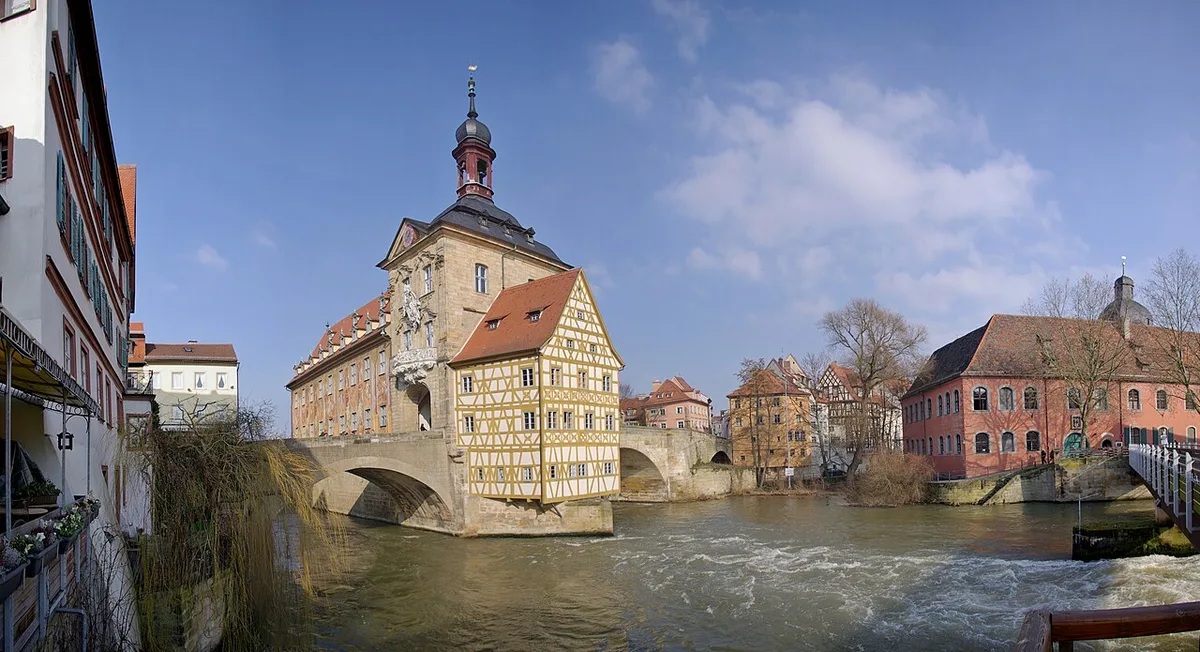
Tradition holds that the bishop refused to grant the townspeople any land at all, prompting them to drive piles into the riverbed and create their own island. Treat that as legend rather than documented fact — it explains the building's symbolism beautifully, but it is not a verified planning record. Construction of the town hall is generally dated to the late 14th century, with later rebuilding phases shaping what you see today.
The location also explains the building's odd shape. Because the site is narrow and the river does not pause, the complex grew upward and outward in stages, absorbing a bridge tower, a main block and a small half-timbered annex. The result reads less like one building than three structures jammed together over water.
What You Can See for Free: The Obere Brücke and the Bridge Itself
The Obere Brücke is a public crossing in the historic centre, and it doubles as the best free viewing platform in Bamberg. It is the city's oldest surviving bridge, linking the island town with the Domberg area, and it stands immediately beside the Old Town Hall. Walking it costs nothing and takes only a few minutes.
The bridge you cross is a three-arch stone structure built between 1451 and 1456 to plans by the city master-builder Hans Vorchheimer. Its central arch, destroyed in 1945, was rebuilt in concrete and clad in sandstone so the historic appearance survived. Knowing that helps when you look at the arch nearest the town hall and notice how clean the stone is.
Sculpture is part of the crossing, not decoration you have to hunt for. A Crucifixion group dated 1713 stands on the bridge, and opposite it is a figure of St John Nepomuk from the early 18th century, replaced in 1926 by a copy while the original went to the Historical Association of Bamberg's collections. Look up as you walk rather than photographing only the town hall.
Reading the Rococo Facade: Trompe-l'oeil and the Cherub's Leg
The painted face you see from the Obere Brücke is an 18th-century makeover. A major renovation between 1744 and 1756, commissioned by Prince-Bishop Adam Friedrich von Seinsheim, brought in the court painter Johann Anwander, whose frescoes were completed in 1755. What looks like architecture is largely paint applied to a building that is older and plainer underneath.
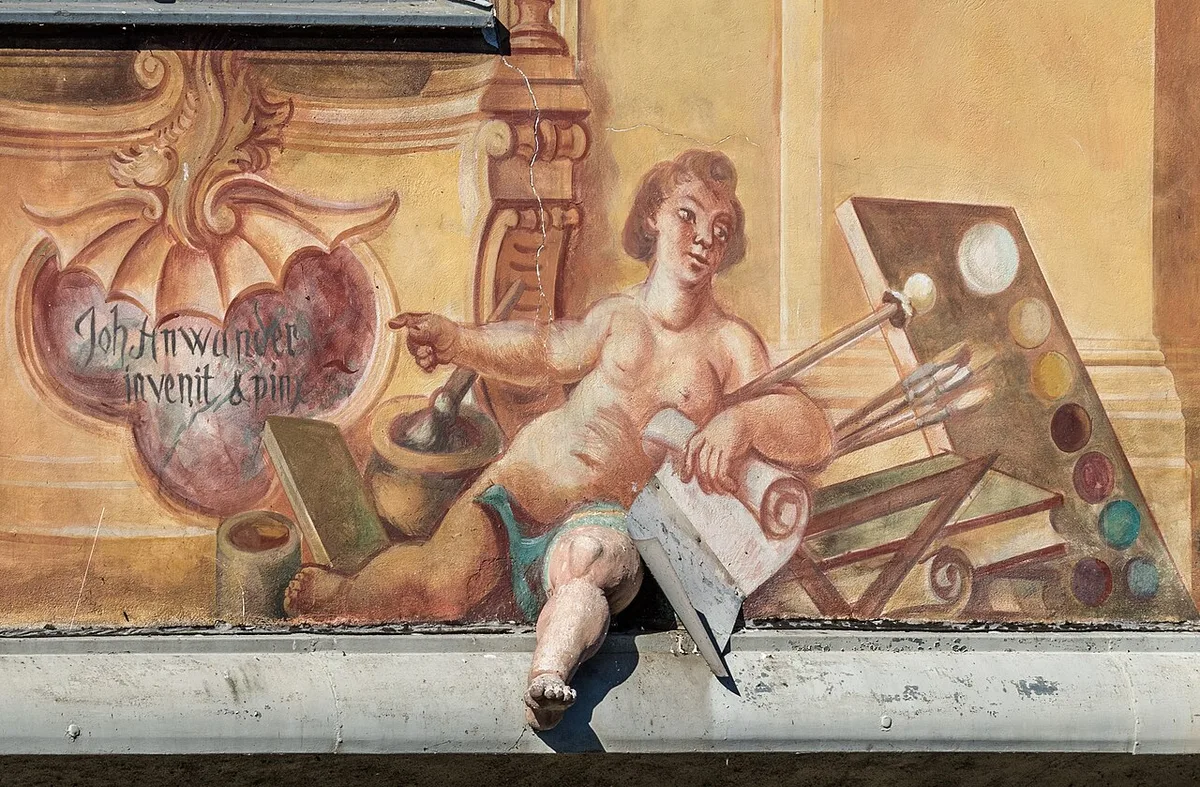
Anwander worked in trompe-l'oeil, the illusionistic technique that persuades the eye to read flat surfaces as three-dimensional structures. Columns, mouldings and figures that appear to project from the wall are frequently just pigment. Knowing this changes how you look: instead of photographing a decorated wall, you start testing which elements are real plaster and which are painted.
The detail everyone crouches to find is a painted cherub's leg that seems to break free of the fresco and extend over the building's actual stucco moulding, as if a figure were climbing out. It is a deliberate visual joke, and it is the single best reason to walk close to the facade rather than admiring it from across the bridge. Bring the camera down to eye level with the moulding to see the trick clearly.
The Rottmeisterhäuschen and the Two-Building Illusion
Clinging to one side of the main block is the Rottmeisterhäuschen, a small half-timbered structure added later to provide extra quarters. Its timber frame sits in deliberate contrast to the painted grandeur beside it, and it is the element that makes the complex look like a pair of buildings rather than one. Photographers tend to pick it out first for exactly that reason.
The annex matters historically as well as visually. Because it stands so close to the bridge, interventions on the crossing also affected it — the 1945 demolitions that destroyed the central arch had consequences for the Rottmeisterhäuschen too. The Old Town Hall itself, with its bridge tower and main building, is listed separately at Obere Brücke 1, with oldest parts dating to the early 14th century and today's appearance resulting from 18th-century Baroquisation.
Where to Stand: Two Bridges, Two Faces
The Altes Rathaus has two painted faces, and each is best seen from a different crossing. From the Obere Brücke you get the dense Rococo facade with the cherub's leg and the bridge sculpture in the foreground. From the lower crossing downstream you see the other elevation and, crucially, the full island silhouette with water on both sides.
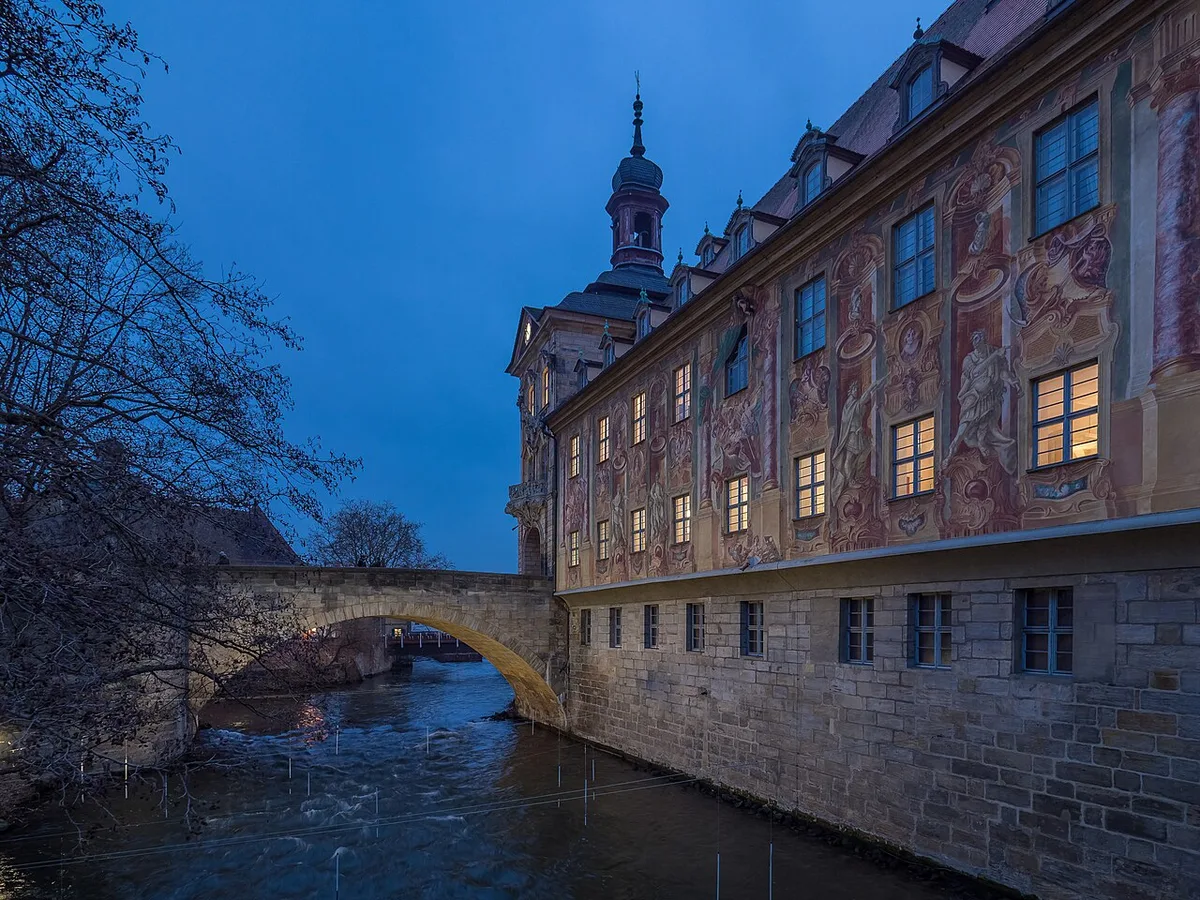
Treat the two viewpoints as a two-stop walk rather than one photo opportunity. Cross the Obere Brücke, look back from the far side, then follow the riverbank downstream for the second angle. From there it is a short continuation to the Klein Venedig Bamberg fishermen's quarter, where half-timbered houses line the Regnitz and the perspective opens up along the water. Related guide: Bamberg photography guide.
Timing matters more than gear. Tour groups cluster on the Obere Brücke through the middle of the day, so early morning or late afternoon gives you space on the bridge and softer light on the frescoes. The riverbank path is usually quieter and stays usable outside the busiest window.
The Museum Side: What Is Ticketed and What Is Not
Free applies to the bridge and the street-level exterior, not to interiors. The Old Town Hall's own interior access, hours and pricing are not publicly settled while the building is described as undergoing extensive renovation, so plan around the exterior and treat interiors as a bonus rather than a fixed stop. Check with Bamberg's tourist information before you travel if a specific interior is your priority.
Other museums in the heritage ensemble run entirely separate admission and schedules, and none of their tickets cover the town hall. The Historical Museum in the Alte Hofhaltung beside the cathedral, for example, keeps its own published opening days and prices, and Villa Dessauer operates on different days again. Do not assume one ticket opens several doors.
If you want a reliable indoor visit on the same day, the safest approach is to pick a museum whose operator publishes current hours and ticket details, then build the free town-hall exterior into the walk between them. The Domberg cluster, including the cathedral and the Alte Hofhaltung, sits a short uphill stroll from the bridge and offers plenty of interior options.
The Ludwig Porcelain Collection: Where It Went
The Ludwig Collection of porcelain and faience spent years housed at Obere Brücke 1, the town hall address. That is no longer a reliable assumption. The city's museums service states that the iconic building is currently undergoing extensive renovation, so the collection's usual home is not the place to plan around.
A small selection of these pieces was displayed at the New Residence under the title Courtly Encounters until 21 June 2026. That was a dated arrangement rather than a permanent relocation, and it was a selection rather than the full collection. If porcelain is the reason for your visit, confirm where pieces are shown now before you travel.
The New Residence is itself a separate ticketed site with its own published opening hours, season-dependent timings and admission structure, and its operators note that some rooms may be closed for renovation. Confirm current access and ticket details directly with the palace administration before building a day around it. Do not carry town-hall assumptions across to a different building's ticket desk.
Practical Planning: Time, Timing and Season
A straightforward visit is short. Budget around 20 to 30 minutes as a suggestion for the exterior, bridge and both viewpoints, and allow an hour or more if you add a museum interior. The town hall rewards looking rather than queuing, and the free portion is the part almost everyone remembers.
Season changes the experience more than the building does. Summer brings longer daylight, busier bridges and outdoor tables along the river; winter shortens the usable light sharply and empties the crossing. Whatever the season, the grounds and crossing are not gated, so you are not dependent on an opening time for the exterior.
Fold the visit into a wider old-town walk instead of treating it as a standalone attraction. Details on how to sequence the hill town, island town and gardeners' town belong in a full Bamberg: Itineraries and City Travel Guides, and the cathedral, the Alte Hofhaltung, the riverbank and the fishermen's quarter are all within a compact walkable area.
What to Pair With the Altes Rathaus
Head uphill to the Domberg for the cathedral, the Alte Hofhaltung and the museum cluster, then come back down to the river. Bamberg Cathedral is the obvious architectural counterpart to the town hall: one monumental and ecclesiastical, the other civic and wedged between banks. Doing both on foot keeps the day to a single walkable area.
Downstream, the Klein Venedig stretch along the Regnitz is the natural companion to the bridge views, and the riverside path links the two without a detour. Broader itineraries for the city, including how to sequence the hill town, island town and gardeners' town, are worth reading before you fix your route.
Keep one afternoon free rather than scheduling tightly. Bamberg's old town is compact but stepped and cobbled, and the best moments here tend to be unplanned ones on the bridge when a tour group clears and the river goes quiet.
Plan Your Visit
The Altes Rathaus works as a free visit and a paid one, and the two should not be confused. The bridge, the two facades, the sculpture and the riverbank views cost nothing and need no ticket or booking. The museum side is fragmented across separate buildings with separate operators, and the town hall's own interior is not something to plan around while renovation is under way.
If porcelain is your reason for coming, the old display window has closed: the displaced selection at the New Residence ran only until 21 June 2026. Check Bamberg's tourist information and the city museums service for where pieces are shown now. For everything else, simply walk the Obere Brücke, look for the cherub's leg, cross to the lower bank and let the island do the rest.
Frequently Asked Questions
Is the Old Town Hall in Bamberg free to visit?
Yes, for the parts that matter most to most visitors. The Obere Brücke is a public crossing, and the town hall's two painted facades, the bridge sculpture and the surrounding river views can all be seen at street level without a ticket. Interiors are a different matter: they belong to a building the city describes as undergoing extensive renovation, so do not treat the exterior experience and a museum visit as one product.
Can you go inside the Altes Rathaus?
Do not plan on it. The city's museums service states that the Old Town Hall, which long housed the Ludwig Collection, is currently undergoing extensive renovation, and it does not present the building as a normally open interior attraction. Interior access, hours and pricing should be confirmed with Bamberg's tourist information before you travel rather than assumed from older guides.
What is the cherub's leg on the Bamberg town hall facade?
It is a painted detail on the Rococo frescoes completed in 1755 by the court painter Johann Anwander. The frescoes use trompe-l'oeil, a technique that makes flat paint read as three-dimensional architecture, and one painted cherub's leg appears to step out over the building's real stucco moulding. Walk close to the facade and look at the level of the moulding; the trick is easiest to spot from a few metres away.
Why was Bamberg's town hall built on an island?
Because neither bank was politically neutral ground. The bishop controlled the hill town around the cathedral and the merchants dominated the island town, so a civic building placed in the Regnitz belonged to neither jurisdiction. Local tradition adds that the bishop refused to grant the townspeople any land at all, prompting them to build an island; that story is best treated as legend rather than documented history. Construction of the town hall is generally dated to the late 14th century.
Where is the best place to photograph the Altes Rathaus?
Use both bridges deliberately. From the Obere Brücke you get the Rococo facade, the sculpture and the closest view of the fresco details. From the lower crossing downstream you see the opposite elevation and the full island silhouette with the Regnitz on both sides. Early morning or late afternoon reduces tour-group traffic on the bridge and gives softer light on the painted walls.
Where is the Ludwig porcelain collection now?
Its usual home at Obere Brücke 1 is inside the town hall, which the city states is undergoing extensive renovation. A small selection was displayed at the New Residence under the title Courtly Encounters only until 21 June 2026, so that arrangement has ended. Check with the city museums service for current display information if porcelain is central to your visit.
How long do you need at the Altes Rathaus?
Around 20 to 30 minutes is a reasonable suggestion for the free exterior circuit: the Obere Brücke crossing, both facades, the bridge sculpture and the riverbank viewpoint. Add an hour or more if you include a museum interior elsewhere in the old town, since those are separate ticketed sites with their own opening hours. The building rewards slow looking more than a long stay.


