

Bamberg Cathedral, properly St. Peter's and St. George's Imperial Cathedral, stands on the Domberg above the old town and anchors one of Germany's most complete historic skylines. Emperor Heinrich II had it constructed from 1002 and it was completed in 1012 after a ten-year building period, though fires destroyed two earlier versions before the present building survived. That layered history is exactly why the interior rewards a focused visit rather than a quick lap.
The headline works of art are clustered in the main nave and choir, and the Bamberg tourism authority lists the highlights as the tomb of the holy imperial couple Kunigunde and Heinrich II created by Tilmann Riemenschneider, the mysterious Bamberg Horseman, the altar by Veit Stoss, and the papal tomb of Clement II. Bamberg Tourismus gives the opening hours; on a suggested basis, allow roughly 45 to 60 minutes to walk the nave, circle the choir, and read the labels without rushing.
What Makes Bamberg Cathedral Different
Many German cathedrals are defined by a single Gothic spire or a single royal tomb. Bamberg's imperial cathedral carries a double burden of history: it is the burial church of a canonised imperial couple and the resting place of a pope, Clement II, who died in 1047. Bamberg Tourismus documents the imperial burials and the papal tomb together among the building's main highlights, a combination of imperial and papal memory in one church that is unusual even by cathedral standards.
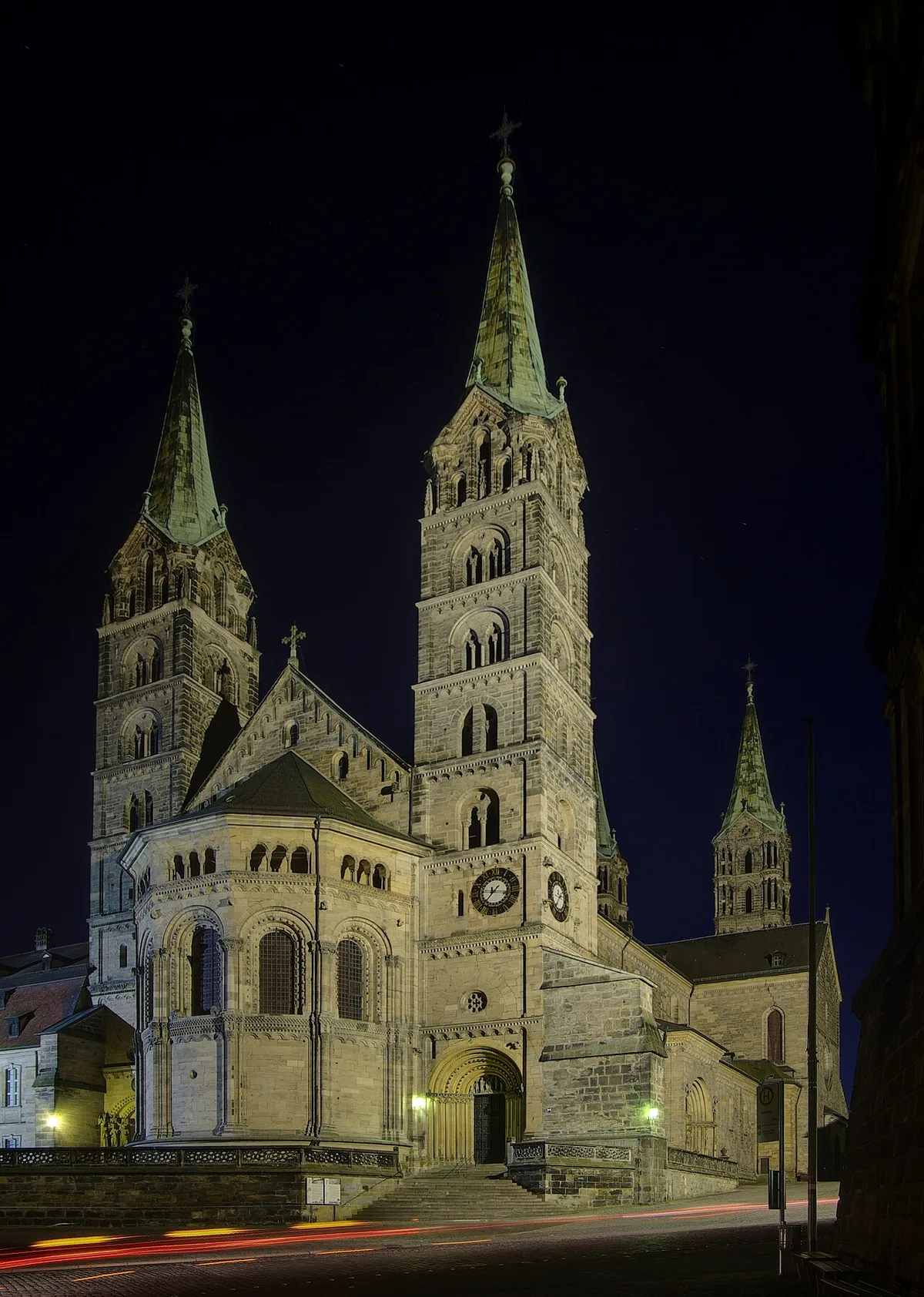
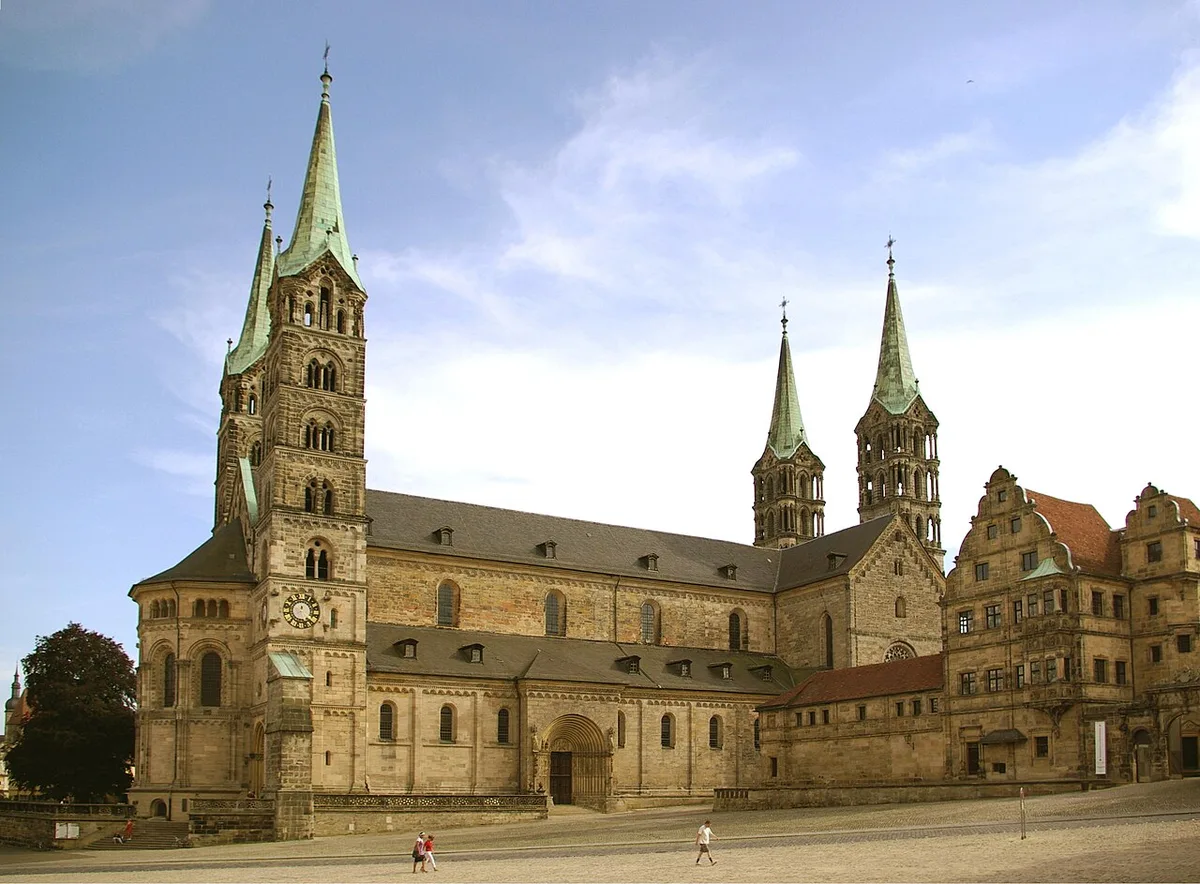
The building itself shows its scars. The Bamberg tourism listing records that the first cathedral of 1012 fell victim to fire, as did its successor, and that the third construction contains stylistic elements of the late Romanesque and early Gothic periods. Look for the four towers from outside before you enter, since they frame the Domplatz approach and make the building easy to spot from the river side of town.
Getting There and Orienting Yourself on the Domberg
The cathedral address given by Bamberg Tourismus is Domplatz 5 in Bamberg, and the square sits at the top of the hill known as the Domberg. Walking up from the old town is the normal approach, and the climb is part of the experience because the cathedral, the Neue Residenz, and the Alte Hofhaltung all share the same plateau. The Alte Hofhaltung Bamberg faces the cathedral across the square, and its Renaissance courtyard is a natural first stop before or after your visit.
Allow extra time for the hill if you are coming from the railway station or the river district, because Bamberg is built on seven hills and most routes to the Domberg involve some climbing. Once you reach the plateau, the four towers give you a clear orientation point, and the square opens in front of the main west portal. Bus routes change with city works, so confirm the current approach on the Bamberg tourist information pages rather than relying on an old map.
The Must-See Interiors: Horseman, Papal Tomb, and Imperial Tombs
The Bamberg Horseman is the image most visitors come for, a stone rider whose identity Bamberg Tourismus describes as shrouded in mystery. The tourism listing presents it as one of the cathedral's main highlights rather than dating it precisely, so treat any firm attribution with caution. Because it stands at a height inside the cathedral, walk past it first, then return for a second look from a different angle; the lighting changes across the day. The monument is part of the main interior, so no ticket is required to see it.
The papal tomb of Clement II sits in the cathedral's liturgical heart. Bamberg Tourismus lists the papal tomb of Clemens II as one of the highlights, and the city travel guide source records that Clement II died in 1047, making his burial here a reminder that Bamberg held a pope in the eleventh century. The same tourism listing places the tomb alongside the imperial burials rather than treating it as a side chapel curiosity.
The tomb of Heinrich II and Kunigunde is the work of Tilmann Riemenschneider, and Bamberg Tourismus names it first among the cathedral's highlights, describing the couple as holy. The altar by Veit Stoss completes the shortlist. If you have a fixed window, prioritise the Horseman, the Riemenschneider tomb, and the Clement II tomb on the first pass, then use any remaining time for the altar and the smaller chapels. A focused walk of this type fits comfortably inside the suggested hour.
Free Entry Versus Ticketed Interiors
The main cathedral interior is where the Horseman, the imperial tombs, and the Clement II tomb are found, and Bamberg Tourismus directs visitors to the diocesan museum website for current information about the cathedral and its museum. The Diocesan Museum Bamberg and its treasury holdings are a separate space with its own opening pattern and its own admission. Do not assume one ticket covers everything on the Domberg, because the sources do not support a single combined ticket.
Admission prices and any combined offers are not published in the extracted sources as a single stable figure, so check the diocesan museum's own pages or the Bamberg tourist information office for the day you plan to visit. If the treasury is your main reason for coming, build the visit around its published hours rather than the cathedral's, since the two schedules do not always align. The diocesan museum page sets out what a ticket actually includes.
Opening Hours and Closures to Plan Around
Bamberg Cathedral follows a seasonal schedule rather than one fixed set of hours. According to Bamberg Tourismus, from 1 April to 31 October it opens Monday and Tuesday from 9:00 to 18:00, Thursday and Friday from 9:30 to 18:00, Saturday from 9:00 to 16:30, and Sunday and public holidays from 13:00 to 18:00. From 1 November to 31 March the pattern shifts earlier, running Monday to Wednesday 9:00 to 17:00, Thursday and Friday 9:30 to 17:00, Saturday 9:00 to 16:30, and Sunday and public holidays 13:00 to 17:00.
Sightseeing stops during mass and other church celebrations, and Bamberg Tourismus states that the cathedral is always closed for sightseeing on those occasions, which means a building that looks open can still be closed to visitors for a stretch of the day. The most predictable trap is the Saturday organ concert: from May to October the cathedral closes to sightseeing every Saturday from 11:30 to 13:00 and admits concert visitors only. If Saturday is your only day, either plan around that window or buy a concert ticket.
Bamberg Tourismus recommends checking the official cathedral website and suggests visitors look to www.bamberger-dom.de and www.dioezesanmuseum-bamberg.de if in doubt about current conditions, since individual dates can be added for diocesan events. Use those pages rather than a schedule copied from an older guide, and treat the recurring weekly pattern as the reliable planning tool.
Quiet Days: When Tours and Explanations Stop
On designated Quiet Days Bamberg Tourismus states that tours and explanations are not allowed, and silence is requested from all visitors. The recurring list given by the tourism authority covers Christmas Eve, Ash Wednesday, Maundy Thursday, Good Friday, Easter Saturday, Perpetual Adoration on 29 and 30 June, All Hallows on 1 November, and All Saints on 2 November. On those days you can still enter as an individual visitor during open hours, but a guided group format will not be permitted.
If your trip overlaps with any of those dates, adjust your plan instead of trying to negotiate at the door. Move the cathedral to another morning and use the Quiet Day for the Neue Residenz or the old town, both of which run on their own schedules. Confirm the current Quiet Day list before you finalise a group booking, since religious calendars can add local observances.
Group Visits and Registration Through DoMus
Individual visitors can simply walk in during open hours, and Bamberg Tourismus notes that public tours for individual guests take place on a daily basis. Every group, however, requires advance registration and may only be led by authorised or registered cathedral guides. The tourism authority states that this applies to private individuals, groups and travel companies as much as to church groups and school classes, and that group size is limited to a maximum of 20 people per guide. The DoMus visitor service handles group bookings alongside the daily public tours.
Public tours are the simpler option if you are travelling alone or as a couple, since they need no group registration. The city travel guide source records that private guided tours of the cathedral can be booked but are not possible during mass times, which is another reason to check the liturgical schedule before you request a slot. Book through the DoMus visitor service rather than approaching a guide directly on the square, because only authorised or registered guides are permitted to lead groups.
How Long to Spend and What to See Nearby
A suggested 45 to 60 minutes covers the main interior works at a comfortable pace, and that is a planning suggestion rather than an official figure. Add time if you want to read the tomb inscriptions carefully, attend one of the daily public tours, or sit through an organ concert. Photographers should budget longer for the Horseman, since good angles require waiting for other visitors to move.
The Domberg plateau makes a natural half-day. The Neue Residenz Bamberg tickets cover the state rooms and gallery, and the city travel guide source describes more than 40 staterooms along with the State Gallery of old German and Baroque paintings, noting that the apartments are only accessible on a guided tour. The same source records that the Rose Garden behind the residence is free to enter, and that the Bamberg State Library next door holds medieval manuscripts, three of which are on the UNESCO Memory of the World Register, with free admission. Pair these with the cathedral for a morning, then walk down to the Old Town Hall Bamberg island bridge to finish the loop through the old town. For wider planning, see Neue Residenz Bamberg Tickets.
If you prefer to build a full day rather than a morning, the Bamberg: Itineraries and City Travel Guides collection adds routes that connect the cathedral with the river districts and the brewery cellars. Use the Bamberg: Landmark Visitor Guides page for the wider landmark set and for background on the sites you are combining. Grouping the Domberg sights first keeps the uphill walking in one block and leaves the flatter riverside for the afternoon.
Plan Your Visit
Bamberg Cathedral works best as a focused hour inside a wider Domberg morning. Decide in advance whether the free main interior is enough or whether the Diocesan Museum treasury justifies a separate ticket, then check both schedules so the ticketed part does not fall on a closed stretch.
Build the day around the fixed points: the Saturday concert closure from May to October, the afternoon Sunday opening, and any Quiet Day that overlaps your dates. With those variables settled, the Horseman, the Riemenschneider tomb, and the papal tomb of Clement II are all reachable on foot in a single unhurried loop of the hill.
Frequently Asked Questions
What is the Bamberg Horseman and why is it important?
Bamberg Tourismus lists the Bamberg Horseman among the cathedral's main highlights and describes the figure as shrouded in mystery, which is why its identity remains a subject of debate rather than a settled fact. It can be seen during normal opening hours as part of the main interior, alongside the Riemenschneider tomb and the papal tomb of Clement II. Because it is mounted at height, plan to look at it twice from different positions in the nave rather than walking past once.
Is entry to Bamberg Cathedral free?
The extracted sources describe the Diocesan Museum and cathedral treasury as a separate space with its own opening pattern, while Bamberg Tourismus points visitors to the diocesan museum website for current information about the cathedral and its museum. The sources do not publish a single stable admission figure for either the cathedral or the treasury, so confirm current conditions and what a ticket includes with the diocesan museum or the Bamberg tourist information office before you go.
When is Bamberg Cathedral closed for sightseeing?
According to Bamberg Tourismus, the cathedral is always closed for sightseeing during mass and other church celebrations, and from May to October it closes every Saturday from 11:30 to 13:00 for the organ concert, admitting concert visitors only. On Quiet Days the tourism authority states that tours and explanations are not allowed; the recurring list covers Christmas Eve, Ash Wednesday, Maundy Thursday, Good Friday, Easter Saturday, Perpetual Adoration on 29 and 30 June, All Hallows on 1 November, and All Saints on 2 November. Check the official cathedral and tourism websites before travelling.
Do I need to book a tour for Bamberg Cathedral?
Bamberg Tourismus states that public tours for individual guests take place on a daily basis, so solo travellers and couples can join one without group registration. All groups, by contrast, require registration in advance and may only be led by authorised or registered cathedral guides, with group size limited to a maximum of 20 people per guide; bookings go through the DoMus visitor service. The city travel guide source adds that private tours are not possible during mass times.
How long does a visit to Bamberg Cathedral take?
A suggested duration of 45 to 60 minutes is enough to see the Horseman, the Riemenschneider tomb of Heinrich II and Kunigunde, and the papal tomb of Clement II at a comfortable pace. This is a planning suggestion rather than an official recommendation, and no official visit duration is published in the extracted sources. Add time if you join one of the daily public tours, attend an organ concert, or include the separate Diocesan Museum treasury, which follows its own hours.


