

Würzburg Cathedral, dedicated to St. Kilian, is the monumental Romanesque church on Domplatz and the obvious anchor for a day in the old town. It is an active diocesan cathedral rather than a museum, which shapes everything about how you plan a visit. You cannot treat it like a fixed opening-hours attraction, because services, rehearsals and special closures move the goalposts from week to week. For wider planning, see Würzburg landmark visitor guides. For wider planning, see Würzburg city travel guides.
The clearest structural cue comes from the operator: from the Tuesday after Easter until the end of October, the cathedral organ sounds from Monday to Saturday at 12:05, followed directly by a one-hour public tour. Plan around that window and you get both the building and the music in a single stop.
Free Entry and the Operator's Opening Rhythm
The operator publishes the basics plainly: the Dom is open every day from 08:00 to 18:00, with Sundays running to 19:30 after the evening Mass, and sightseeing is possible outside worship services. No admission is mentioned for the church interior, so visitors generally treat entry as free. Anything run separately, such as the treasury, is a different question and needs its own check.
Because the Dom is a working church, opening hours are only part of the picture. The operator reserves the right to close the building at short notice for concert rehearsals or preparation for services, and those notices appear on the official site rather than in third-party listings. Checking the visitor notices page in the days before you travel is the simplest way to catch a planned closure, especially around major feast days and the autumn concert season.
The autumn 2026 anniversary concert illustrates how far an event can override the normal routine. For the rehearsals on Friday 16 and Saturday 17 October, the operator stated that both the 12:05 organ impulse and the 12:30 tour would be cancelled on both days, and that viewing the Dom would only be possible to a limited extent. Treat any published schedule as a starting point and re-check the day before.
How Long to Spend: Suggested Options, Not Official Figures
These are suggestions rather than official durations. A quick look at the nave, the Schönborn Chapel and the west facade takes roughly 30 minutes, which is realistic if the Dom is one stop on a longer walk. A normal visit of 60 to 75 minutes covers the main space, the chapel and a short pause in the crypt without feeling rushed.
Budget around two hours if you stay for the organ impulse and the one-hour public tour that follows it. A third-party travel guide suggests about 1.5 to 2 hours for a thorough interior visit, and 2.5 to 3 hours if you add a concert or a themed tour. Those figures are a useful sanity check, but the operator does not publish an official visit duration.
The main variable is whether you catch the building during a quiet window. Ten minutes at the west facade in good morning light can be worth more than a hurried circuit inside, so it pays to look first and decide how long you want. If time is tight, skip the crypt and use the saved minutes for the Schönborn Chapel.
Inside the Dom: Nave, Schönborn Chapel and Crypt
The cathedral is one of the most impressive monuments of the Salian period and one of the largest Romanesque churches in Germany. Two earlier cathedrals, built around 787 and 855, were destroyed or partly destroyed by fire; after Bishop Bruno's accidental death in 1045, his successor Adalbero completed the building in 1075. Late Gothic remodelling of the side aisles followed around 1500, with a Baroque stucco finish in 1701.
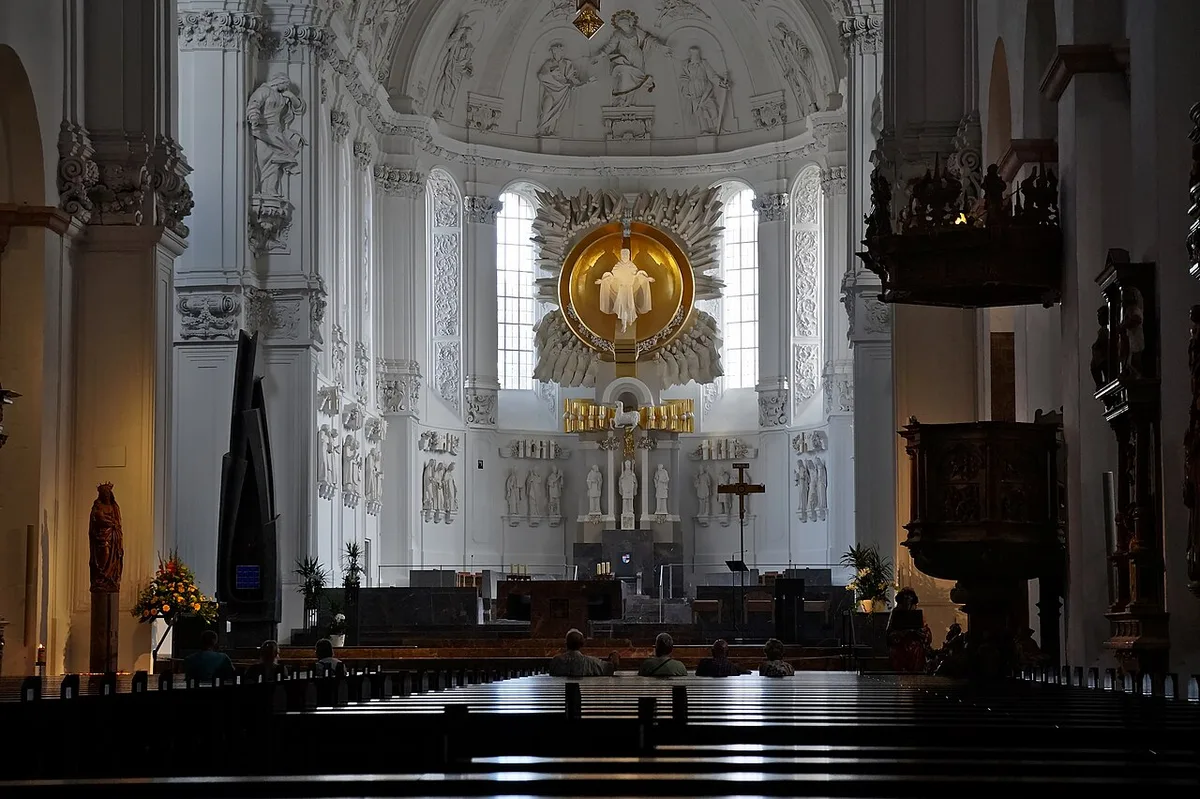
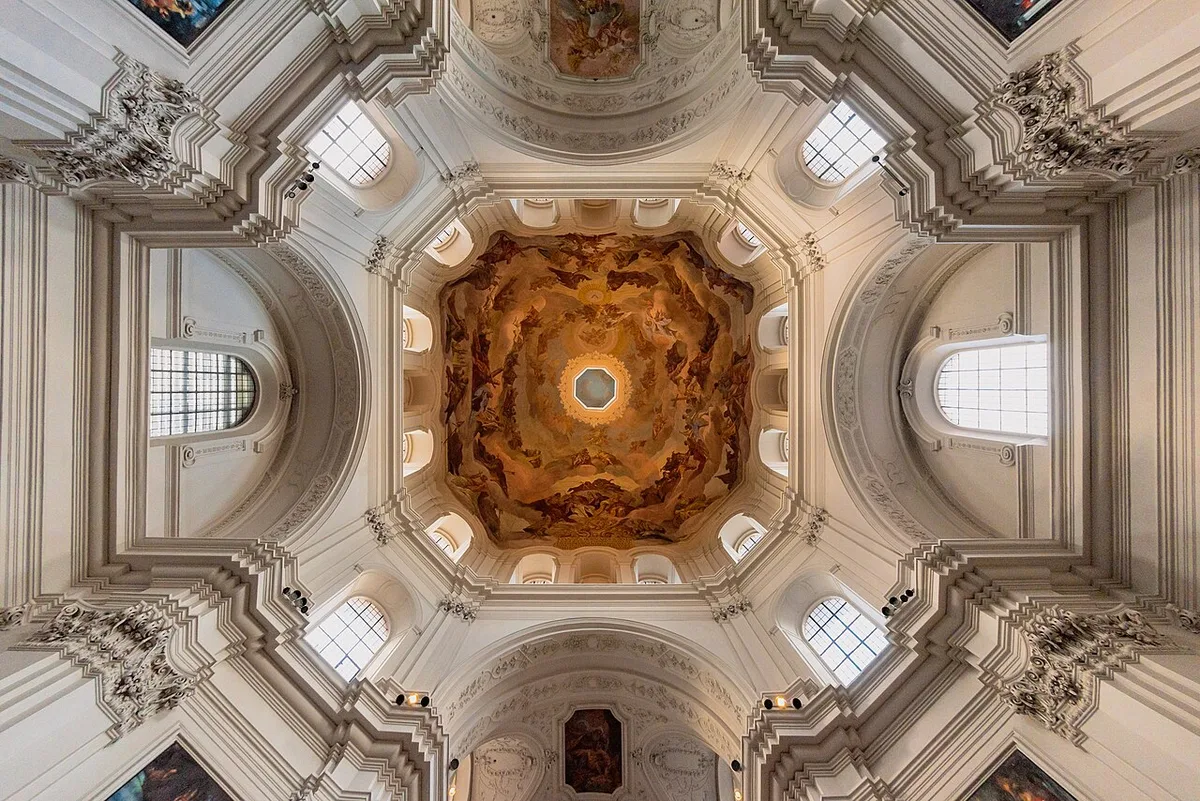
The Schönborn Chapel, attached to the transept, is an important creation by Balthasar Neumann and served as a burial place for the prince-bishops of the House of Schönborn, with frescoes by the court painter Rudolf Byß. Its rich decoration contrasts with the more restrained main space, which is why it tends to be the highlight of a short visit. To the south there is also a Gothic cloister and a sepulture with modern stained glass by G. Meistermann.
The crypt holds the relics of St. Kilian and is the quieter, slower part of the building. The cathedral was badly damaged in the bombing of Würzburg on 16 March 1945, and large parts collapsed in the winter of 1946; rebuilding until 1967 produced a deliberately mixed Romanesque, modern and Baroque result. The neo-Romanesque west facade was uncovered again during renovation work and the pre-war state was largely completed by the end of 2006, while the choir was redesigned in 1987 by Hubert Elsässer.
The 12:05 Organ Impulse and the Public Tour
From the Tuesday after Easter, 7 April, until the end of October, the cathedral organ sounds from Monday to Saturday at 12:05, paired with a short spoken impulse for reflection. Directly afterwards, the cathedral guiding service offers a one-hour public tour. Treating the impulse and the tour as a single block is the easiest way to plan an arrival, because the two are designed to run back to back.
This window only operates seasonally, so the schedule matters if you are visiting in winter. Outside the season the organ impulse and the associated tour are not available, and you rely on the general opening hours instead. The 16 and 17 October 2026 rehearsals removed the impulse and the 12:30 tour on both days, which shows how quickly the routine can change.
The operator publishes a weekly service and events PDF, which is the most direct way to see whether a funeral, ordination or rehearsal will displace the usual pattern. It is worth checking that week's schedule before committing to noon, even outside the dates already mentioned.
The Guiding Rule for Groups
The operator states that tours inside the Dom are reserved for the in-house cathedral guides. Other guest guides are only permitted with approval and under the cathedral's own guiding rules for outside providers. This is a real planning constraint for tour operators, school groups and cruise excursions, because a guide booked elsewhere may not be allowed to lead inside the building.
Request permission well before your date and build in time for the paperwork. If approval cannot be arranged, plan the guided commentary for the square outside and let participants enter individually, using the official tour slot instead.
The Dominfo on Domstraße 40 is the practical contact for these questions and also where lost property from the Dom and Neumünster is usually gathered. Its published opening times are Monday to Friday 09:30 to 17:30 and Saturday 09:30 to 17:00. The Dompfarramt is unstaffed until 20 October 2026, so the Dominfo is the safer first point of contact in the meantime.
Special Closures and Limited Viewing
The operator openly reserves the right to close the Dom at short notice for concert rehearsals and service preparations. This is not a rare exception; the autumn concert season and major feast days are the times when it is most likely. A rigid itinerary that assumes the church will be open at a specific hour can fail on exactly those dates.
The practical remedy is to treat the Dom as the flexible item in your day rather than the fixed one. If you arrive and find the doors closed or access limited, walk to the Neumünster or the Alte Mainbrücke and come back later; the old town is compact enough that a return costs only a few minutes. A glance at the visitor notices on the official site the morning of your visit is usually enough to catch a planned closure.
Pairing the Dom with the Neumünster and Lusamgärtlein
The city's tourism pages list St. Kilians-Dom and Schönbornkapelle, Neumünster and Lusamgärtlein, and the Marienkapelle among the sights of the old town, and the last two sit within a few minutes on foot. The Neumünster is a Romanesque building with a Baroque facade and a distinctive courtyard, while the Lusamgärtlein is the small garden associated with Walther von der Vogelweide. Neither is a substitute for the Dom, but together they round out a morning or afternoon. For wider planning, see Neumünster Würzburg Visitor Guide.
Do not assume the Neumünster's opening hours mirror the Dom's. The city page confirms it as a listed sight but does not publish a reliable daily schedule, so check locally or at the tourist information before you build it into a tight plan. If you want a free old-town walk that starts at the Dom, the Marienkapelle and the market square are a short distance further.
For a half-day route, start at the Dom, add the Neumünster and the Lusamgärtlein, then walk toward the market square for the Marienkapelle. That sequence keeps you inside the compact pedestrian core and avoids retracing your steps. It also gives you a natural fallback if the Dom is temporarily closed.
The Cathedral Treasury Question
The cathedral treasury is a separate collection with its own identity. It holds 182 objects across roughly 170 square metres, ranging from tiny relic particles to massive tombstones, with bishop's vestments and mitres among the displays. Much of it was believed lost after the Second World War before an extensive search and restoration work brought the material back into view.
What you should not assume is that a visit to the Dom includes the treasury, or that the two share a ticket. The operator's published visitor information does not set out the treasury's current opening hours or admission arrangements, and the Museum am Dom is listed as temporarily closed. Availability at the cathedral complex can therefore change independently of the church itself.
The safe approach is to verify access separately before you travel. Ask at the Dominfo on Domplatz or check the diocese's pages for the treasury and Museum am Dom, and treat any third-party listing that quotes a combined ticket as unverified. If the treasury is closed during your visit, the Dom, the Schönborn Chapel and the crypt are still more than enough for a satisfying stop.
A Practical Plan for the Day
A workable sequence is to arrive at Domplatz in the mid-morning, look at the west facade and the square, then enter the Dom while it is quiet. Spend 60 to 75 minutes inside, covering the nave, the Schönborn Chapel and the crypt. If you are there in season, time your exit so you are back for the 12:05 organ impulse and the tour that follows.
During services, the building is in liturgical use and sightseeing is not appropriate. Use that time for the Neumünster, the Lusamgärtlein or a coffee on the square, then return when the service ends. Sunday evenings run later, with the cathedral open until 19:30 after the evening Mass, which can suit a quieter final look.
If you want to extend the day beyond the old town, the Hofgarten and the Residenz are a short walk or ride away.
Plan Around the Rhythm, Not the Clock
Würzburg Cathedral rewards a flexible plan more than a precise one. The reliable anchors are the daily 08:00 to 18:00 opening and the seasonal 12:05 organ impulse with its following tour, while the variable is the operator's right to close for rehearsals, services and events. Check the visitor notices on the official site close to your date and you will rarely be caught out.
Treat the treasury as a separate question, ask about it at the Dominfo, and keep the Neumünster and the old-town lanes as your fallback if access is limited. With two hours set aside and a quick check the morning of your visit, the Dom fits neatly into a wider day in Würzburg.
Frequently Asked Questions
Is Würzburg Cathedral free to enter?
The cathedral operates as an active church rather than a ticketed museum, and the operator does not advertise admission for the church interior. Any separately run treasury or museum space is a different matter and should be verified on its own before you plan around it. Ask at the Dominfo on Domplatz for the current situation.
How long do you need at Würzburg Cathedral?
A suggested guideline, not an official figure, is about 30 minutes for a quick look, 60 to 75 minutes for a normal visit covering the nave, the Schönborn Chapel and the crypt, and around two hours if you stay for the organ impulse and the one-hour public tour. Add more time if you want to linger over the architecture or attend a concert.
Can you visit the cathedral treasury with the Dom?
Do not assume so. The treasury holds 182 objects across roughly 170 square metres, but its current opening hours, admission arrangements and any ticket relationship with the cathedral are not set out in the operator's visitor information. Verify access separately, either through the diocese or at the Dominfo, before you build it into your day.
What time is the organ impulse at Würzburg Cathedral?
From the Tuesday after Easter until the end of October, the organ impulse runs from Monday to Saturday at 12:05, followed directly by a one-hour public tour. It is paused in winter and can be cancelled on specific dates for rehearsals or events, so check the operator's current notices before you travel.
Is the Neumünster near the cathedral?
Yes. The city's tourism pages list the Neumünster and Lusamgärtlein as sights close to the Dom, both within a short walk in the old town. The city page does not publish reliable daily opening hours for the Neumünster, so confirm locally if that visit is essential to your plan.


