

The Marienkapelle stands directly on the Marktplatz, its red and white sandstone facade rising out of the market stalls rather than sitting behind a fence or a forecourt. Visitors who skim past it on the way to the Residenz often assume a building called a chapel must be small, then walk in and find a full-height late Gothic hall church. SpottingHistory notes that construction began in 1377 and finished in 1480 with the erection of the church tower, which places it firmly in the late Gothic phase of the city's architecture. That mismatch between the name and the scale is the main reason it is worth a deliberate stop rather than a glance from the fruit stands.
This guide covers what to look for outside and inside the church, how the post-war reconstruction changed the interior, and how to weigh a visit against the two larger churches a few minutes away. Practical details such as current opening arrangements belong with the parish and the city's tourism office rather than in a fixed list here. For context on the rest of the city's landmarks, the Würzburg: Landmark Visitor Guides collection covers similar buildings in the same central cluster.
What the Marienkapelle Actually Is
SpottingHistory describes the Marienkapelle as a late Gothic hall church, meaning the nave and the side aisles rise to roughly the same height, so the interior reads as one broad volume instead of a tall central tunnel with dark edges. That plan is what distinguishes it from the much larger Würzburg Cathedral, which began construction in the eleventh century and is described in secondary sources as among the largest Romanesque churches in Germany.
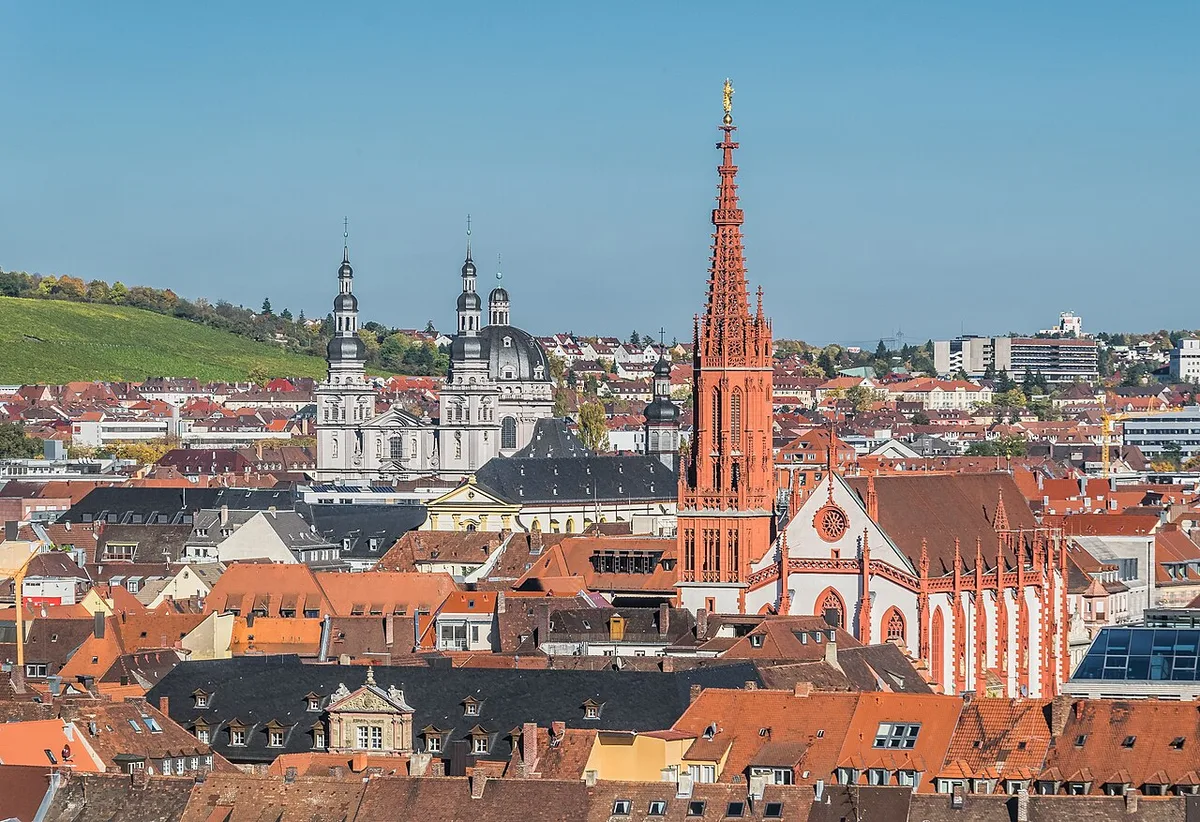
The address is Marktplatz 7 in the pedestrian heart of the Altstadt, and the building is squeezed so tightly into the square that you cannot see the whole west front from any single market-side position. Walking a few steps into the neighbouring lanes gives you the elevation needed to read the pinnacles, buttresses and pointed windows properly. One alley above the square is widely used as a photography vantage point for the tower, which carries a tall statue at its top.
Do not treat the word Kapelle as a signal that this is a five-minute stop. The footprint is closer to a mid-sized town church than to a wayside chapel, and the interior has enough sculpture and monuments to hold attention for a while. If you arrive expecting something small, you will probably under-budget your time.
The Portal Sculpture and the Adam and Eve Figures
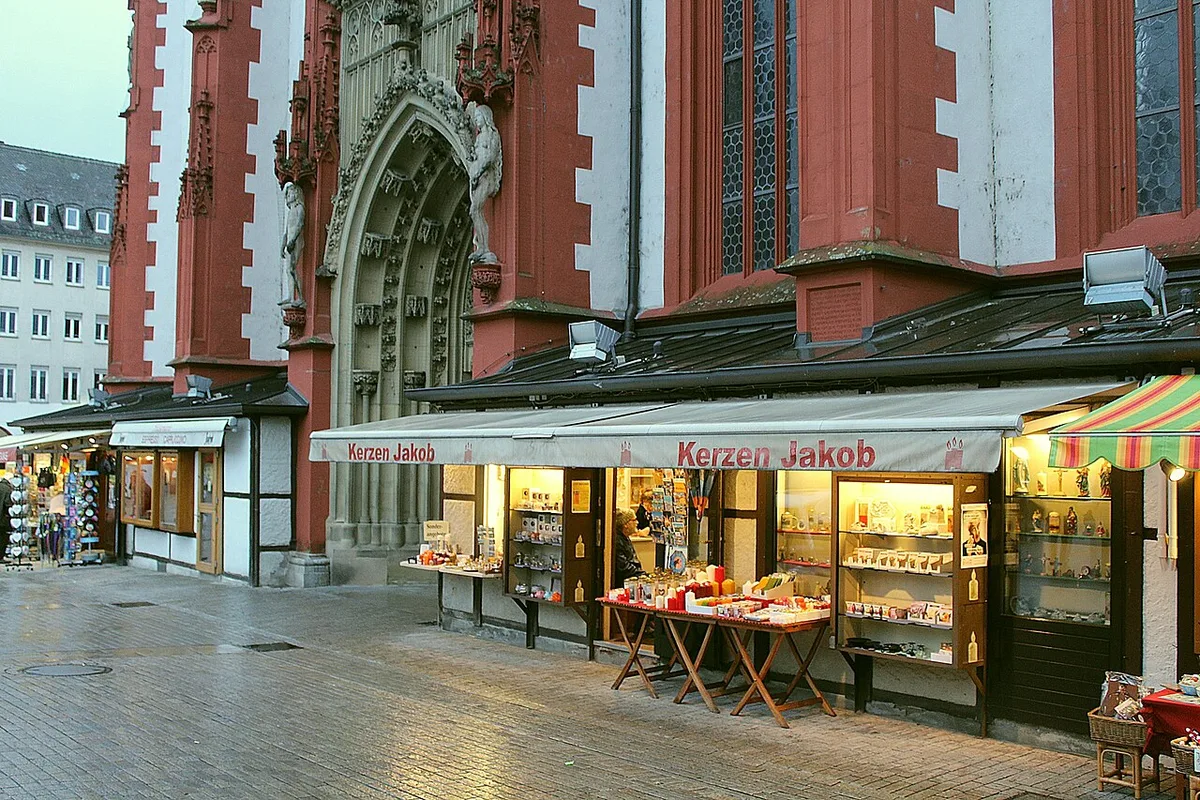
The ornamental carving around the doorways is the element most often singled out, and the figures of Adam and Eve are the best-known part of it. SpottingHistory states that the originals are by Tilman Riemenschneider and that they are now on display in the Mainfränkisches Museum, replaced by replicas from 1975. That is a secondary-source claim rather than something the parish publishes as a visitor instruction, so confirm before building a trip around it. The replica figures remain the ones you will see at the portal today.
Stand close to the jambs and look at the depth of the carving rather than the silhouettes alone. Gothic portal figures of this kind were designed to be read in sequence as you approached the threshold, which is why the best view is often a metre or two back rather than directly underneath. Photography of the exterior is straightforward, but if you want the figures without harsh midday contrast, the facade is easier to read in softer light.
A practical warning: these door figures are not the reason to skip the interior, and the interior is not the reason to skip the portal. Treat them as two halves of one visit. Readers comparing the city's religious buildings across the centre may also want the Würzburg Cathedral (Dom St. Kilian) visitor guide, since the Dom's sculptural and funerary programme is on a completely different scale.
Inside: Vaulting, Altar Panels and the Beautiful Madonna
Inside, the late Gothic vault closes over you at a lower, more intimate height than the Dom's nave, and the net-like rib pattern is the feature to look up for once you are a few rows in. SpottingHistory describes four painted altar panels dated to 1514, but because that date comes from a non-operator description rather than the parish, treat it as reported rather than verified and look for the church's own notice or leaflet if the dating matters to you.
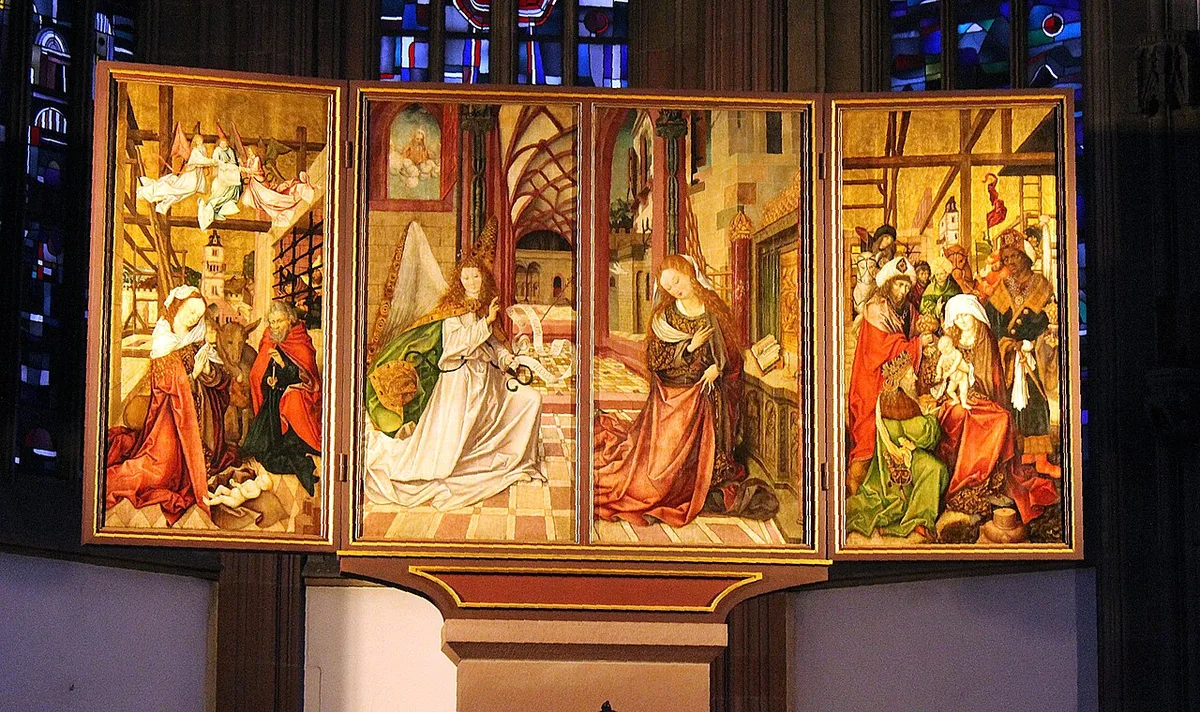
The devotional figure usually called the Beautiful Madonna is dated to around 1420 in the same secondary account, and a seventeenth-century Silver Madonna is also recorded among the furnishings. Both are small objects in a large room, so knowing they exist in advance is what stops you walking past them. If you are visiting for sculpture specifically, ask at the entrance where the pieces currently stand, since church interiors are rearranged for services and restoration.
Because the fittings were replaced after fire damage in 1945, as noted by SpottingHistory, the interior you see is largely a reconstruction rather than a survival. That is not a reason to skip it, but it does change what you are looking at: you are reading the community's rebuilding choices, not a continuous medieval ensemble. Set expectations accordingly and the visit is more interesting, not less.
Tombs, Memorials and Looking Down
The floor and the wall panels carry the burials and memorials of Franconian knights and Würzburg citizens, a group that guided tours tend to compress into a single sentence. SpottingHistory names the tomb of Konrad von Schaumberg, who died in 1499, associated with Riemenschneider's workshop. These are the pieces most visitors miss because they are looking horizontally at eye level while walking toward the altar.
The Baroque architect Balthasar Neumann, who died in 1753, is commemorated in connection with this church, but accounts differ over whether his burial place is inside the chapel or at the market gate. SpottingHistory places the tomb of Balthasar Neumann at the market gate, while other summaries locate him inside. Rather than assert one version, look for the marker and read the inscription; if you cannot find it, the parish or the city tourist information point can clarify.
Practically, this section rewards a slow lap of the perimeter before you sit down. Read the inscriptions you can reach, then look up at the wall monuments you cannot. Twenty focused minutes here gets you more than an hour of drifting.
What the War Changed
Würzburg's centre was heavily damaged in 1945, and the Marienkapelle lost its interior to fire, which is why the furnishings read as a later reconstruction. The rebuilding of the church belongs to the same citywide recovery that reshaped the Dom, the Residence and much of the old town's fabric. Knowing that, the comparison between the church's Gothic shell and its modern interior stops looking like an inconsistency and starts looking like history.
The Old Town Hall area holds a small display about the wartime destruction of the city, including a model of the town as it stood immediately after the bombing, which makes the reconstruction story concrete. If the church interior leaves you wanting the wider picture, that exhibit is a short walk away and adds useful context to everything else you see in the centre. It is a strong pairing with a Marienkapelle visit for anyone interested in how the city was put back together.
Marienkapelle, Dom and Neumünster Compared
The three central churches are close enough to visit in one loop, and the reward differs enough that they are not interchangeable. The Marienkapelle is compact and hall-church in plan; the Dom is a very large Romanesque building with Gothic and Baroque layers on top; Neumünster is a Baroque church associated with the site of the martyrdom of Kilian and his companions, as noted in the New Munster travel guide. Treat any ranking as a suggested priority rather than an official verdict.
SpottingHistory describes the Würzburg Cathedral as the fourth largest Romanesque church building in Germany, with construction beginning in the eleventh century, and it also holds the crypt associated with Saint Kilian. If your interest is big-architecture scale, the Dom wins; if it is a single readable Gothic interior you can absorb in one go, the Marienkapelle is the easier visit. The Neumünster Würzburg visitor guide covers the third option if you want the Baroque counterpart.
Opening arrangements, service times and any entry conditions for all three are the parish's to publish, and they change with the liturgical calendar. Check the city tourism site or the individual church's own page on the day you plan to visit rather than relying on a printed guidebook. A church that is open in the morning can be closed for a funeral in the afternoon.
Fitting It Into a Marktplatz Walk
Start in the Marktplatz and use the Marienkapelle as the anchor, because you can see the tower from most approaches and it makes an easy meeting point. The market itself fills the square with stalls on market days, which changes both the atmosphere and how freely you can walk around the building's base. Give yourself a lap of the square before going in, since the facade is best understood from several angles.
The Falkenhaus sits just behind the chapel, its Rococo facade the most photographed surface on the square, and the Ostrichtrails walking-tour guide notes that the city's tourist information centre is inside the building. That makes it the logical place to confirm current church access, pick up a city map, or ask about guided walks. Doing this early saves guesswork later in the day.
From the square, the natural continuation runs toward the Dom and then Neumünster, which keeps you in the pedestrian core and avoids doubling back. The Ostrichtrails guide describes the Dom and Neumünster as the next stops on its central walking route after the Marktplatz. If you have energy left, the Alte Mainbrücke visitor guide covers the riverside stretch beyond, where the old bridge and its statues carry you toward the fortress side of the river.
For readers building a longer day around the centre rather than a single stop, Würzburg: Itineraries and City Travel Guides groups the city-level planning material. Use it to slot the chapel into a larger route instead of treating it as an isolated sight.
Suggested Priorities Instead of a Fixed Plan
If you have very little time, do the exterior and the portal figures first, since they cost nothing but a few minutes of standing. A suggested interior stop for most visitors is roughly fifteen to thirty minutes, and that is a personal planning estimate rather than anything the church publishes. Anyone with an interest in Riemenschneider, late Gothic vaulting or Franconian funerary sculpture should allow considerably longer.
If you are choosing between this church and a larger one on a tight schedule, match the building to your interest rather than to size. The Marienkapelle suits visitors who want one coherent interior with a strong sculptural focus; the Dom suits those who want scale, a crypt and architectural layering. Neither is a substitute for the other.
Etiquette is the same as anywhere active: keep voices low, do not walk through a service, and check before using a flash. If a service is underway, come back later rather than photographing around the congregation. Quiet, brief visits are the ones that leave the building open to the next traveller.
Plan Your Visit
The Marienkapelle is worth a deliberate stop because it concentrates late Gothic architecture, portal sculpture and civic memory into a single compact interior on Würzburg's main square. Its small-sounding name is misleading, and the post-war interior is a reconstruction rather than a survival, but both facts make the visit more interesting once you know them. Read the portal, look down at the tombs, and look up at the vault.
Before you go, confirm current access arrangements with the parish or the city tourist information point, since services and seasonal changes affect when visitors are welcome. Plan the chapel as one leg of a Marktplatz loop that continues to the Dom and Neumünster rather than as a standalone errand. The two larger churches are minutes away, and the comparison is part of what makes the small one memorable.
Frequently Asked Questions
How much time should I give the Marienkapelle?
A suggested stop of about fifteen to thirty minutes covers the portal, the vault, the altar area and a lap of the monuments, and that is a planning estimate rather than an official duration. Visitors with a specific interest in Riemenschneider-linked sculpture or late Gothic vaulting will want longer. If a service is underway, shorten the visit or return later.
Is it free to go inside the Marienkapelle?
Entry arrangements and any seasonal changes are published by the parish and by the city's tourism office, so check directly before you travel rather than relying on an older guidebook. The church is an active place of worship, so access can be restricted during services or ceremonies. The city tourist information point on the Marktplatz is a convenient place to confirm the current situation on the day.
Where are the original Adam and Eve figures now?
The figures currently at the portal are replicas, installed in 1975 according to SpottingHistory. That same source states that the medieval originals are held by the Mainfränkisches Museum, but that is a secondary claim rather than a parish visitor instruction, so verify with the museum before planning a trip around it. Either way, plan to see the carvings at the church door.
Is the Marienkapelle the same as Würzburg Cathedral?
No. The Marienkapelle is a late Gothic hall church on the Marktplatz, while the Dom St. Kilian is a much larger Romanesque cathedral with Gothic and Baroque layers and a crypt associated with Saint Kilian. Neumünster is a third, Baroque church nearby. They sit within a short walk of each other and are easily combined in one loop.
Where is Balthasar Neumann's burial place?
The Baroque architect Balthasar Neumann, who died in 1753, is commemorated in connection with the Marienkapelle, but sources differ over whether the burial place is inside the chapel or at the market gate. SpottingHistory places his tomb at the market gate. Look for the marker and read the inscription rather than trusting a summary, and ask at the tourist information point if you cannot locate it.
How does the Marienkapelle fit into a Marktplatz walk?
Use the chapel as the anchor of the square, then continue past the Falkenhaus to the Dom and on to Neumünster, all within the pedestrian centre. The Alte Mainbrücke and the riverbank make a natural extension if you have more time. Confirm church access at the tourist information point before you set out, since service times vary.


