

Würzburg's tourism pages group the Residenz, Festung Marienberg, Käppele, Alte Mainbrücke and St.-Kilians-Dom into one walkable set of sights, while keeping a dedicated section for families. That clustering is the practical reason a single day works with children: the palace sits on the edge of the centre, the bridge and riverfront are minutes away, and the hillside viewpoints rise directly above the same old town. For wider planning, see Würzburg landmark visitor guides.
A family bike ride along the Main or the nice mini-golf course right along the river are among the recommendations from locals interviewed by 22places. As a suggested duration, not an official one, allow roughly half a day for the flat combination of palace grounds, bridge and river, and a full day if you add one uphill viewpoint. The core planning decision is to separate free outdoor ground from ticketed interiors before anyone tires.
Check practical details at the city source shortly before travelling. The tourism service runs a Tourist Information and Ticket Service in the Falkenhaus am Markt and publishes pages on the Welcome Card, accessible travel and family offerings. Opening times, admission scope and barrier-free arrangements are exactly the details worth confirming then rather than trusting older trip reports.
Why Würzburg Works for a Family Day
Two elevated vantage points, the fortress hill and the Käppele pilgrimage church, sit above the same old town that the bridge and riverfront cross at water level. A local guide describes Würzburg as seriously walkable, combining culture, Franconian cuisine and vineyard scenery, with the historic centre around the cathedral, the bridge and the palace inviting a slow pace rather than a checklist.
Würzburg also sits within reach of several larger German cities, which makes it practical as a stop on a longer family trip rather than a standalone destination. The trade-off is that one day only scratches the surface, so decide in advance whether you are doing a compact highlights loop or a slower version with real garden time. If you want a classic city route without the family framing, the One day in Würzburg itinerary is a useful comparison point.
Start at the Würzburg Residence: Exterior and Court Garden
The Residence is the obvious first stop, and it is the place to think carefully about what you are actually buying. Arriving to see the building, its forecourt and the surrounding garden costs nothing and still delivers the postcard moment. A local guide notes the palace was completed in 1744 and is particularly known for its imposing interior and gorgeous gardens.
The Court Garden behind the palace is where family days tend to find their rhythm. It is ground-level space where children can move and parents can sit, and it works as a buffer either before or after anything more formal. What the garden does not do is substitute for the palace interior, a separate visit with its own demands on attention and behaviour. For wider planning, see the Würzburg Residenz visitor guide.
If your children are old enough to enjoy art rather than endure it, the Martin von Wagner Museum sits inside the residence complex and is described by a local guide as Europe's largest university museum, letting you head straight into a tour of the Residence afterward. Treat it as a separate optional add-on rather than assuming one purchase covers everything. Garden and building arrangements can also change seasonally, so the palace's own pages and the city tourism site should be your final check.
The Garden as a Decompression Zone
Architectural sightseeing with children works best in short bursts with genuine breaks between them, and the Court Garden area is the natural place to spend one of those breaks. A loop of walking, sitting, a snack and a run around resets attention far more effectively than pushing straight from one monument to the next. If your children are flagging at the palace, that is useful information: skip the interior and put the saved energy into the bridge and river instead.
Families who prefer green space to stone can widen the garden theme beyond the palace grounds. A local guide names the Japanese Garden, the Rose Garden and the grounds of the former 1990 State Garden Show as quieter places to unwind, and treats them as flexible swaps rather than fixed stops. A garden visit that costs nothing is easy to drop when the day runs long.
Crossing the Alte Mainbrücke
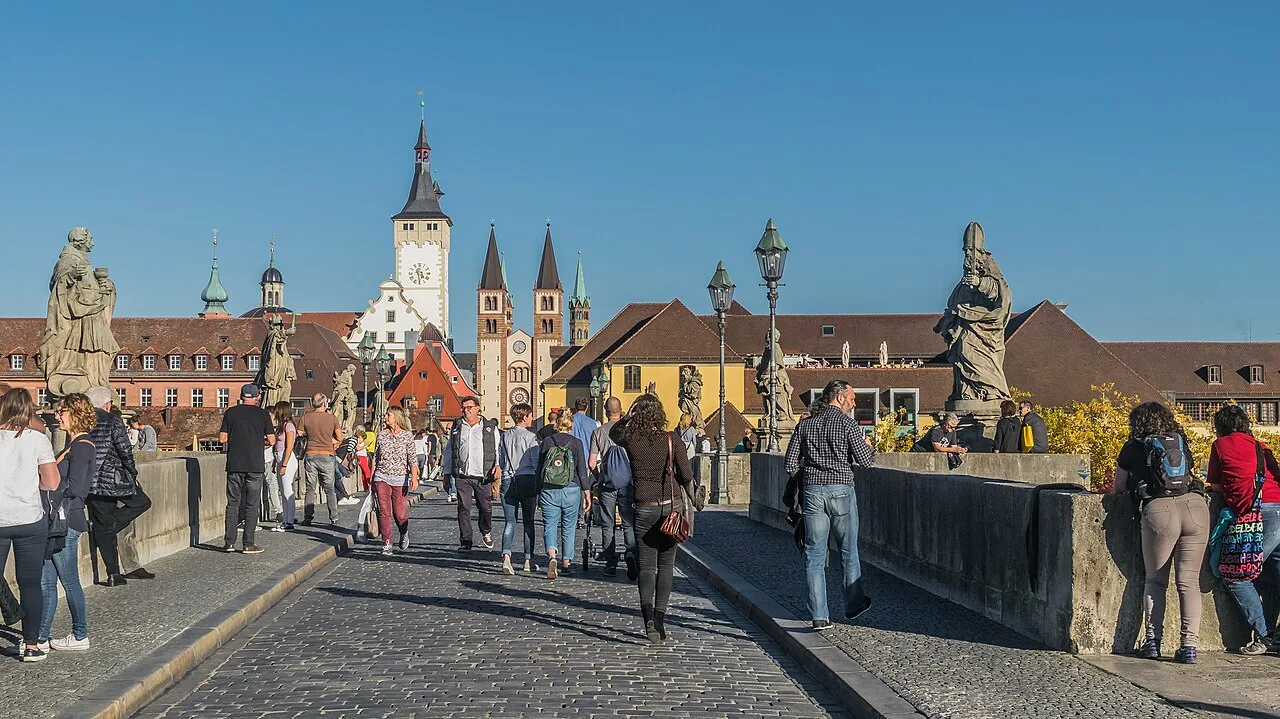
The Alte Mainbrücke is the best value moment of a family day: a short pedestrian crossing that children can walk end to end without complaint. Expedia notes it is decorated with twelve statues of saints, dates back to the 1400s, and is the oldest bridge on the Main, with a view toward the Marienberg Fortress to the southwest.
On pleasant days the bridge gets busy, and the Brückenschoppen wine-drinking tradition there is a firmly adult affair, so plan a crossing that fits your family rather than lingering. Mid-bridge is the natural pause for photos and for pointing out the climb you may or may not attempt later. With stroller-age children, treat the bridge as a viewpoint activity rather than a destination to camp on.
River Promenade Time Along the Main
When children need to move rather than look at architecture, the Main riverfront is your answer. Flat paths beside the water allow free-range walking, and the water provides continuous low-stakes entertainment. This is the part of the day where you stop counting sights and let the children set the pace for twenty or thirty minutes.
The riverfront is also the simplest place to fold in a picnic or snack stop, keeping cost and waiting time down compared with a full restaurant meal. A local guide recommends Franconian bratwurst on wine sauerkraut with sourdough bread as a local specialty, which tends to work for children who want something familiar. Sitting by the water with a view back toward the bridge and fortress gives the family a natural breather before any final uphill decision. Keep an eye on the water's edge with toddlers and treat the promenade as a walking route rather than a playground.
Fortress and Käppele: Choosing Your Viewpoint
The fortress and the Käppele are best treated as an either-or decision rather than two mandatory climbs. Both sit above the city and reward you with a panorama of the old quarter, but reaching them involves uphill walking of varying effort, and a local guide offers the note that the Käppele can be reached either by hiking up or by driving. Ask honestly how much climbing your group can handle and pick one.

Fortress Marienberg is the emblem of the city, a hilltop complex of Baroque buildings on the western bank that once housed the prince-bishops and now contains two museums, according to Expedia. It suits families whose children are comfortable with a longer walk and who want the full hilltop experience. For the wider choice of elevated spots, compare the Best Viewpoints in Würzburg options before committing to a route.
If you want the view without the museum debate, remember that the climb and the vantage point are separate questions from what is inside the buildings. The fortress interior museums are their own decision, so treat the hill as the goal and any indoor visit as optional. That keeps an uphill afternoon from turning into a museum marathon.
Rainy-Day Pivot: Indoor Family Options
A family day survives bad weather only if you have a backup ready. A local guide points to indoor leisure options including the Nautiland fun pool, described there as having an adventure pool, an 85-meter water slide and a water play area. An indoor swim is a reliable way to burn energy when sightseeing is off the table.
Mini-golf comes in two flavours: a course along the Main for dry-enough days, and Pit-Pat Wonderland near the train station, which a local guide describes as offering 3D and black-light mini-golf. Both are listed among local suggestions rather than tested recommendations, so confirm current opening and pricing directly with each operator before building your day around them. Museums such as the Martin von Wagner Museum and the Kulturspeicher offer a quieter indoor alternative.
Stroller-Hostile Spots to Plan Around
Würzburg's centre is walkable, but walkable for an adult is not the same as easy with a stroller. Cobbled streets in the old town, the climb toward the fortress or the Käppele, and historic buildings with layered entrances are where wheels get awkward. Build your route around the flat riverfront and bridge area first, and treat any uphill section as optional.
The city tourism service publishes accessibility information covering visitors with mobility restrictions, so that is the right place to check rather than trusting a general claim that everything is barrier-free. Verify current lift and ramp details with the specific operator before you travel, since these arrangements change and are not something to assume. If a particular sight turns out to be difficult, the flat riverside alternative is always available as a substitute.
Money and Logistics: Free Ground vs Ticketed Interiors
The cleanest way to budget a family day in Würzburg is to divide it into free outdoor time and paid indoor stops. Wandering the palace grounds and garden area, crossing the bridge and following the riverfront cost nothing, and they can easily fill a satisfying half day. Ticketed elements, from palace interiors to fortress museums to guided tours, then become chosen stops rather than endured ones.
Do not carry over prices from older reports, because admission and tour costs change and the scope of each ticket differs. The city sells a Würzburg Welcome Card, and the tourism service maintains current information on what it covers, so check there rather than guessing. Expedia lists several guided options, including a Bimmelbahn city tour marketed under a with-kids heading, but confirm current details directly before booking.
A ticket for one attraction does not imply entry to another, even where buildings sit close together on the same hill or in the same complex. The fortress, the palace and the university museum are separate propositions, each checked on its own terms. That habit of checking scope avoids the classic family disappointment of arriving at a second site expecting the first ticket to work.
Sample Half-Day and Full-Day Structures
A suggested half day, and this is a suggestion rather than any official schedule, runs from the palace exterior and Court Garden through the old town to the Alte Mainbrücke, ending with riverfront time. That sequence keeps you at ground level, avoids the uphill decision entirely, and suits families with toddlers or a tight timetable. It also leaves the interior visits for another trip without any sense of having missed the point of the city.
A suggested full day adds one uphill viewpoint in the middle of the afternoon, choosing either the fortress or the Käppele rather than both. Finish back at the river or in the old town for food, so the day ends downhill and close to transport. If you are combining this with other German city stops, the Berlin with kids and Dresden with kids guides follow a similar family-day logic.
Eating, Stopping and Avoiding Meltdown Territory
The most common family-day failure in a compact city is overrunning, so decide your stopping point before anyone is hungry and tired. Würzburg's historic centre has the highest concentration of eating options, which means you can end the sightseeing loop and be seated within minutes. A local guide recommends Franconian bratwurst on wine sauerkraut with sourdough bread as a local specialty, which tends to work for children who want something familiar.
Ice cream near the Alte Mainbrücke is a dependable mid-afternoon motivator, and a local guide names Vollkornbäckerei Köhlers right by the bridge and Bassanese Café am Dom as favourites. Market-square stands around the Marienkapelle and Falkenhaus area give you a quick option when nobody wants a sit-down meal. Whichever you choose, go before the energy drops rather than after.
Family-Friendly Add-Ons for a Second Day
If you have a second day, the surrounding region is where Würzburg's family appeal widens. A local guide suggests taking the boat to Veitshöchheim, strolling through its Rococo Garden and finishing with an ice cream. Expedia also lists Veitshöchheim among popular day-trip destinations, confirming the add-on rather than a local secret.
Within the city, slower alternatives include the Japanese Garden, the grounds of the former garden show, and the Kulturspeicher on the old harbour, which a local guide describes as combining a historic grain warehouse dating from 1904 with contemporary architecture. These work as decompression days rather than headline sightseeing and suit families who have already done the palace and bridge.
Plan Your Visit
Würzburg rewards a family that plans around energy rather than a list of sights. Anchor the day on the free, flat elements, the palace grounds, the bridge and the riverfront, and treat every ticketed interior or uphill climb as an optional upgrade you choose in the moment. That approach keeps a compact, walkable city from turning into a forced march.
Check the practical details that matter to you shortly before travelling: admission scope, garden and building arrangements, and barrier-free routes for your specific needs. The city tourism service and the palace's own pages are the places to confirm them, and they are updated more reliably than any blog. With those confirmed, the rest of the day is simply walking, looking and stopping when the children have had enough.
Frequently Asked Questions
Is Würzburg worth visiting with kids?
Yes, especially if your children cope better with short walks and outdoor space than with long museum visits. The palace grounds, the Court Garden area, the statue-lined Alte Mainbrücke and the Main riverfront sit close together in a walkable centre, so you can build a satisfying day without much travel between stops. The uphill fortress and Käppele options add a bigger outing if your family has the energy.
What can you do with kids in Würzburg?
Family-friendly options include the free outdoor sightseeing around the Residenz and its garden, crossing the statue-lined old bridge, and spending time on the flat riverfront. Local recommendations also name a mini-golf course along the Main, Pit-Pat Wonderland near the train station, and the Nautiland fun pool for wet weather. Confirm current opening days and pricing with each operator before you plan around them.
Is Würzburg walkable for families with strollers?
The central area is walkable, but cobbled old-town streets and the uphill routes toward the fortress or the Käppele are where a stroller becomes awkward. Build your route around the flat bridge and riverfront first, and treat any climbing as optional. The city tourism service publishes accessibility information, so check current barrier-free details with the specific operator rather than assuming a route works for wheels.
What can you do in Würzburg with kids when it rains?
Indoor options carry a rainy day: the Nautiland fun pool with its water play area and slide, and the 3D and black-light mini-golf at Pit-Pat Wonderland near the station. Museums such as the Martin von Wagner Museum and the Kulturspeicher are calmer alternatives if your children prefer looking to splashing. Check opening times and prices directly, since these can change with the season.
How do you split a family day between the Residenz and the fortress?
Treat them as different kinds of outing rather than one combined ticket. The Residenz exterior and Court Garden are free and ground-level, easy to fold into a morning, while a palace interior visit is a separate, more demanding stop. The fortress or the Käppele is an uphill viewpoint choice for the afternoon, and doing both climbs in one day is usually too much for young children.


