

Wiesbaden is a spa town that never really separated itself from its landscape. The old town, the Kurhaus and the main station all sit within a short walk of wooded hills, and Visit Wiesbaden notes that more than a quarter of the city consists of woods and green spaces, which is why a park walk here feels less like a detour and more like the main event. The practical question for visitors is not whether to visit a park, but which kind of green space suits the day you have.
This guide groups the city's parks by character rather than by ranking: the English-style landscape gardens by the spa buildings, the stream-fed valley that leads up to the Neroberg, the palace park out in Biebrich, and the smaller squares that fill gaps in a sightseeing day. Grounds and interiors are treated separately, because strolling a park and paying to enter a bath, casino or museum are different decisions. For a broader look at what the city offers beyond its gardens, the Wiesbaden city guide covers transport, sights and day-trip planning in more depth, and the landmark visitor guides hub gathers the individual attractions.
Why Wiesbaden Reads as a Green City
Wiesbaden's reputation as a leafy city comes from geography as much as from gardening. The Taunus hills rise directly behind the built-up area, and the Rheingau region begins on the city's doorstep, so woodland and vineyards are part of the everyday backdrop rather than a weekend excursion. That setting shaped how the town developed as a spa resort: guests came for the thermal springs, but the walks through the surrounding hills were part of the cure.
The green legacy is also architectural. The spa gardens behind the Kurhaus were laid out in the style of an English landscape garden and are planted with magnolias, azaleas, rhododendrons and cypress trees, with a fountain on an artificial island in the pond and an ornate, shell-shaped bandstand. The Kurhaus itself is now run as an event venue, so what most visitors experience is the park around it rather than the building's interior.
It helps to think in four categories before you set out. Landscaped spa gardens are manicured lawns and promenades; the Nerotal is a shaded valley walk with water running through it; Biebrich Palace Park combines a historic garden with a public recreation area; and the smaller green squares are compact, functional and useful for filling twenty minutes. Deciding which category you want on a given day prevents a lot of aimless walking.
Kurpark and Warmer Damm: The Classic Spa-Town Pair
The Kurpark is the park most visitors picture when they think of Wiesbaden: an English-style landscape garden behind the Kurhaus, with water, mature trees and the shell-shaped bandstand that once accompanied spa concerts. It is free public ground, and its central position means you can walk into it from the Kurhaus forecourt without planning anything. Because it absorbs a lot of people quietly, it works equally well for a ten-minute pause or a long afternoon.
Warmer Damm, the municipal park immediately to the south, extends the same green corridor toward Wilhelmstrasse and the theatre district. It is described as a municipal park and popular spot alongside the spa gardens, and is a gentler, shadier counterpart to the more formal Kurpark, with mature trees and water. Treating Kurpark and Warmer Damm as a single continuous walk rather than two separate stops is the simplest way to use them.
One practical distinction matters here. The grounds are free, but the buildings embedded in this area are not the same product: the Kurhaus runs ticketed cultural and private events, and the casino occupies part of the complex. If your plan is a park walk, you do not need to buy anything; if you also want a performance, a spa session or a casino visit, budget for it as a separate item and check the operator's own page for current terms.
The Nerotal and Neroberg: Valley Walk to Hill View
The Nerotal begins at the end of Taunusstrasse and runs as a narrow valley park along the Schwarzbach stream, ending below the Nerobergbahn viaduct. According to the city's tourism pages, it was laid out between 1897 and 1898, was planted with almost 6,000 plants from around the world across its six hectares, and has been a listed park since 1985; the war memorial completed in 1909 and a Bismarck memorial created in 1898 are both inside it. Those details come from the Visit Wiesbaden Nerotal page, and they explain why the valley has the dense, garden-like feel of a botanical collection rather than open parkland.
Walking up through the Nerotal is a different experience from the Kurpark: the stream, the ponds, the artistically designed bridges and the villas lining the slopes make it feel enclosed and slightly wilder, and the gradient is gentle enough for an unhurried stroll. The valley is the natural approach to the Neroberg, the hill above the city, which Visit Wiesbaden says can be explored on foot, by mountain bike or in a relaxed manner with the Nerobergbahn.
At the top, the reward is the panorama over the city and the Rhine valley, with the Russian Orthodox church's golden domes as the landmark, plus lawns that suit a picnic. If the view is the priority rather than the walk, it is worth comparing the funicular with the footpath before you commit, since both end in the same place. The best viewpoints in Wiesbaden guide details the hilltop viewpoints and what you can see from each.
Biebrich Palace Park: A Separate Outing
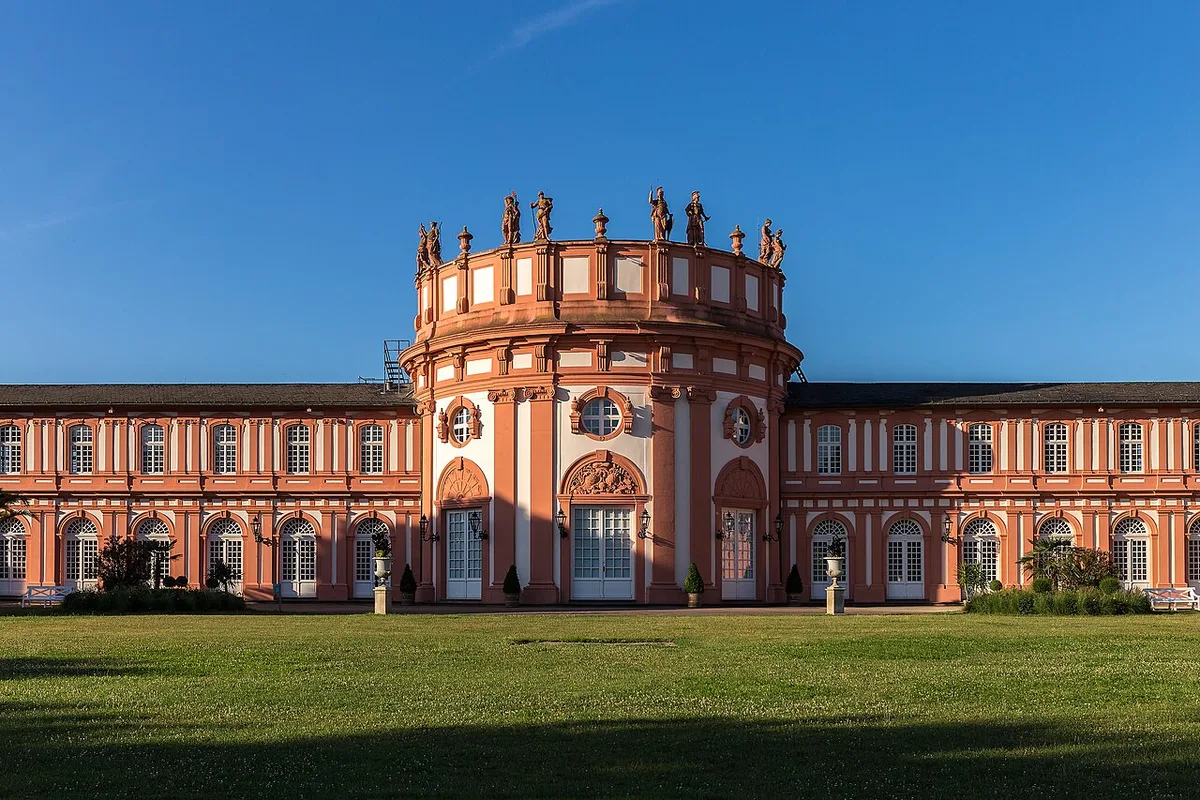
Biebrich Palace Park is not a city-centre stop: it sits in the Biebrich district on the Rhine, which means treating it as a half-day outing rather than something you fold into an old-town stroll. The palace was a Nassau residence, and the grounds were formerly a baroque garden before being redesigned in the English landscape garden style by the horticultural architect Friedrich Ludwig von Sckell, which is why the park now reads as open lawns and tree-lined paths rather than formal parterres.
The key distinction for visitors is that the park functions as a public recreation area, while the palace building is state property used for conferences and ceremonies rather than a museum you wander through casually. So a Biebrich trip is best planned as a riverside walk with the palace as a backdrop, not as a combined park-and-interior visit. If you want a proper interior on the same day, choose a city-centre museum instead and keep your expectations separate.
Getting there is straightforward by bus or train from central Wiesbaden, but the trip is long enough that you should decide in advance whether you are going for a short look at the palace from the park or for a full afternoon on the lawns. Because the park is open ground, there is no ticket to reserve, but you should confirm current access and any event closures on the city's own park information before travelling out.
Smaller and Quieter Green Spots
The Reisinger-Anlagen, on Bahnhofstrasse by the main station, is the green space most visitors meet first whether they plan to or not. It is a compact, well-kept city park with fountains and flower beds that serves as a station-side breathing space rather than a destination in its own right, and it is free ground. Its role in a Wiesbaden day is therefore practical: a place to sit for fifteen minutes between a train and a hotel check-in, or a first impression of the city if you arrive by rail.
The Apothekergarten on Aukammallee is a specialist garden devoted to medicinal plants, and its appeal is narrower and quieter than the big parks. It is a useful stop if you are already heading toward the northern districts or combining it with the spa baths in that part of town, but it is not worth crossing the city for on its own. Check the garden's own page for seasonal timing before making it the anchor of a walk.
The Alter Friedhof, the old cemetery park on Platter Strasse, is a different proposition again: mature trees and historic graves sit alongside play and recreation space, making it an unusual hybrid of park and memorial ground. It suits families and anyone who wants shade and space rather than manicured planting. Because these smaller spaces sit away from the main tourist axis, they work best as additions to a route you were already walking.
Free Grounds and Paid Interiors: How to Think About Cost
The clean distinction in Wiesbaden is between ground and interior. The Kurpark, Warmer Damm, the Nerotal, the Reisinger-Anlagen, the Apothekergarten and Biebrich Palace Park are all park ground that you enter without buying anything, and you can build an entire day around them. Walking them costs nothing, which is why a parks-focused visit is one of the most economical ways to see the city, and for a wider list of no-cost options see free things to do in Wiesbaden.
Paid interiors sit alongside, not inside, those grounds. The casino in the Kurhaus complex, the thermal baths and the city museums are separate venues with their own admission systems and their own reasons to visit, and a park walk does not include them. Treat each as an independent decision: decide whether the interior is worth the money to you, then check the operator's current prices and hours directly, since these change and are published on their own sites rather than in guidebooks.
The Kaiser-Friedrich-Therme is the clearest example of the split. The Visit Wiesbaden page describes it as an Art Nouveau building, constructed between 1910 and 1913 on the site where the foundations of a Roman sweating bath were found, and fed by the Adler spring; it is experienced as a ticketed bathing visit rather than a sight you look at. If you go, plan it as an activity with its own entry cost and check the operator's page for current terms before setting a day around it.
Linking Parks on Foot and by Public Transport
A sensible half-day starts at the Kurhaus, crosses the Kurpark, drops south through Warmer Damm, and then continues west to the head of the Nerotal for the walk up to the Neroberg. The whole sequence is on foot, in a single direction, and lets you stop wherever you have had enough; the Nerotal is the natural end point because the funicular or the downhill walk gives you a way back to the centre. A suggested duration for this route is roughly half a day at an easy pace, but that is a planning estimate rather than an official figure, and it will vary with how long you linger.
A full day adds Biebrich as a separate block rather than trying to thread it into the centre. Use public transport from the Hauptbahnhof or the city centre for the outward leg, spend the middle of the day in the palace park, and return to the city for a shorter square such as the Reisinger-Anlagen if you still have energy. Splitting the day this way keeps the centre, the hill and the Rhine district from competing for the same hours; the 2 days in Wiesbaden itinerary shows how that structure looks across a weekend.
For a slower visit, spread the same parks across three days and add the market square and the Kochbrunnen spring in the old town as a short connector walk between the spa gardens and the shopping streets. That pairing of green space and spa-town street life is what makes a Wiesbaden day feel complete rather than like a list of parks. A Slow 3-Day Wiesbaden Itinerary maps this out day by day if you want the fuller version.
Practical Notes: Seasons, Weather and What to Check
Spring and autumn are the most comfortable seasons for walking the Wiesbaden parks, with mild temperatures and colour in the planted gardens, while high summer is best handled by starting early and using the shade of the Nerotal or Warmer Damm in the afternoon. Winter does not close the parks, but it removes the flower displays and the appeal of sitting outside, so a cold-weather visit is more about walking than lingering. These are general seasonal patterns, not fixed rules for any individual garden.
Benches, lawns and picnic spots are plentiful in the Kurpark, Warmer Damm and the Neroberg, and the Apothekergarten and Reisinger-Anlagen give you shorter pauses near residential and station districts. Bring your own food and water if you want a simple picnic, and carry out what you bring, since the smaller squares depend on local users keeping them tidy. There is no single citywide pass needed for park access, so your only real planning is where you start and where you finish.
Before you go, verify the things that can change: whether a specific garden is open for the season, whether your chosen bath or museum is operating that day, and whether any event is using the Kurhaus or palace grounds. The city publishes park and nature information and the tourist office publishes current visitor guidance, so check those rather than relying on older summaries, and confirm opening times and admission for paid interiors directly with the operator.
Plan Your Visit
Wiesbaden rewards a simple plan: choose a park type rather than a checklist, keep the free grounds as your base and treat baths, casinos and museums as separate purchases, and let the geography do the work by walking the Kurhaus, Kurpark, Warmer Damm and Nerotal line in one direction. Biebrich is the one outing that deserves its own block of time, and the small squares near the station and in the northern districts are best used as fillers rather than destinations. With that structure, a parks-focused visit needs very little advance booking.
Check the city's park pages and the relevant operator's site for the day you are travelling, since seasonal openings and ticketed venue details are the only parts of this plan that can genuinely change. Everything else, from the stream in the Nerotal to the lawns on the Neroberg, is simply there to be walked.
Frequently Asked Questions
Are Wiesbaden's parks free to visit?
The park grounds themselves, including the Kurpark, Warmer Damm, the Nerotal, the Reisinger-Anlagen, the Apothekergarten and Biebrich Palace Park, are public green space rather than ticketed attractions, so walking them does not require a purchase. What costs money are the separate venues nearby, such as the thermal baths, the casino and the museums. Check each operator's own page if you plan to add one of those to your day, since their prices and hours are published there.
Which Wiesbaden park is best for a short stop near the station?
The Reisinger-Anlagen on Bahnhofstrasse is the practical choice, because it is a compact, well-kept city park beside the main station and is made for exactly that kind of short pause. It is not a destination in its own right and it is not somewhere to plan an afternoon, but it works well as a first or last stop of a visit if you are arriving or leaving by train.
How do you walk from the Kurpark to the Nerotal?
Start at the Kurhaus, cross the Kurpark, and continue south through Warmer Damm toward the theatre district, then head west to the end of Taunusstrasse, where the Nerotal valley park begins. From there the path follows the Schwarzbach stream up to the base of the Neroberg, where you can either walk on or take the Nerobergbahn funicular to the top. It is a single, mostly level route if you stop at the valley, with the climb only at the end.
Is the Neroberg worth visiting for the views?
The Neroberg is the city's main hill viewpoint, with a panorama over Wiesbaden and the Rhine valley and the golden domes of the Russian Orthodox church as the landmark, plus lawns that Visit Wiesbaden describes as ideal for a picnic. It is worth the trip if you want the view or a longer walk, especially combined with the Nerotal valley below it. If a viewpoint is your main goal, compare the hill with the other city viewpoints before deciding how much of the day to give it.
Which Wiesbaden park is best with children?
The Alter Friedhof park on Platter Strasse stands out for families, because the old cemetery grounds combine mature trees and historic monuments with play space and open recreation areas. The Neroberg also works well, since the lawns, the funicular and the hilltop setting give children something to do beyond walking. Both are free ground, so the decision is mostly about whether you want a playground or a hill.
Should Biebrich Palace Park be part of a city-centre day?
It is better treated as a separate outing. The park is in the Biebrich district on the Rhine rather than in the centre, so combining it with the Kurpark and the Nerotal in one day means a lot of moving around. Give it its own half-day, use public transport for the outward trip, and plan the centre and the hill for a different day.


