

One day in Rothenburg ob der Tauber is enough to see the town's headline sights on foot, because the walled centre is small and almost everything worth seeing sits inside it. The stops still add up, and the day disappears quickly once tour groups arrive. Treat the sequence below as a suggested order with suggested durations, not an official schedule. Related guide: Rothenburg ob der Tauber: Landmark Visitor Guides.
The town's tourism service lists the Plönlein, the walkable city wall, the Marktplatz, St. Jakob's Church and the Burgtor among its main historical sights, so those are the reasonable anchors for a first visit. Budget roughly a full day of gentle strolling with two proper sit-down breaks, and expect the middle of the day to feel the most crowded.
Why One Day Works Here, and What Pace to Expect
The tourism service describes Rothenburg as one of Germany's most beautiful medieval towns and a highlight of the Romantic Road, which makes it tempting to treat as a checklist. It works better as a walk: the Plönlein, the walkable city wall, the Marktplatz, St. Jakob's Church and the Burgtor all sit inside or at the edge of the old town, within comfortable walking distance. A realistic plan covers the squares, a section of the wall, one paid interior, and either a museum or a short valley walk.
The biggest variable is when you start. Arriving before mid-morning buys quieter lanes and better photographs, while a late arrival forces you to drop something. If you come by train or on an organised tour, your fixed arrival and departure times decide whether the valley walk or a museum survives the cut. A self-guided walking route through the old town's squares and gates can help you connect them in a sensible order.
Morning: Marktplatz, Plönlein and the Wall Walk
Begin at the Marktplatz, the central square where the old and new town hall face each other and the surrounding lanes fan out toward the gates. From there, walk the short distance to the Plönlein, the small square with the fountain and the slanted half-timbered houses that appears on nearly every postcard. Come here early or after dark if photographs matter, because midday is when the square is busiest and hardest to frame. This pair of stops is free and takes perhaps forty-five minutes at an unhurried pace, longer if you linger over coffee.
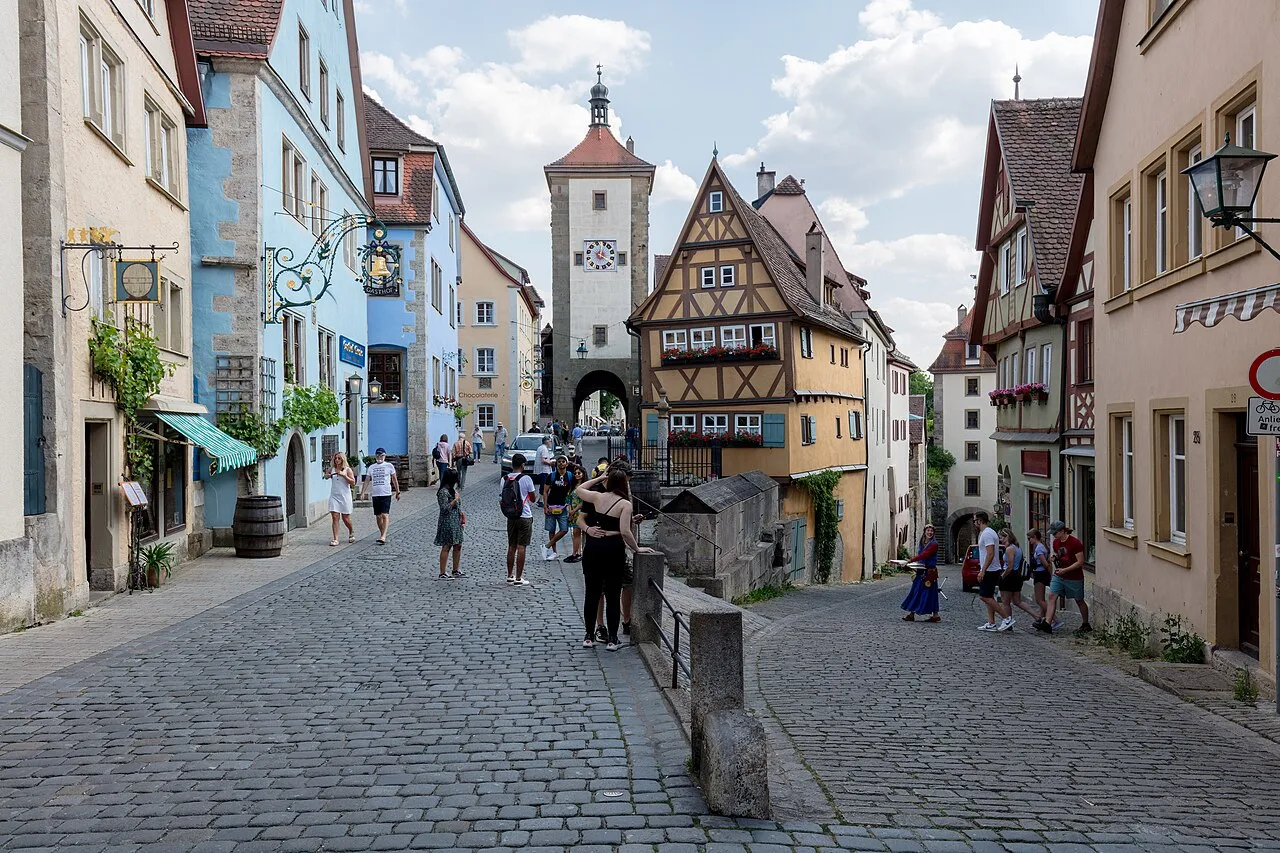
Next, climb onto the city wall and walk a stretch of the covered walkway. This is free and one of the most distinctive things to do in town, but it is not for everyone. One account of walking the walls notes that the steps up and down are steep, the walking path is fairly uneven, and the clearance in some sections is low enough that taller visitors are told to watch their head. If stairs, uneven footing or bending are a problem, see the wall from below instead. Allocate around forty-five minutes to an hour for a section rather than the whole circuit.
Pair the wall walk with a look at St. Jakob's Church, whose exterior you can admire for nothing but whose interior is separately ticketed. Rothenburg's churches, museums and any tower climbs are priced individually, so never assume one ticket covers several sights. Check the tourism service for current admission and opening times on the day you visit, since these change with the season.
Midday Break: Lunch and a Reset
By early afternoon you will have covered the core of the old town, so sit down properly rather than snacking on the move. Franconian cooking is hearty, and a long lunch is part of the rhythm here. One traveller account reports that many restaurants in Rothenburg serve only dinner, with some closed through the middle of the day, so it helps to check posted hours or ask your accommodation which places are serving when you want to eat. Booking ahead is wise for anywhere small, especially in the evening.
This is also the moment to try a schneeballe, the local fried pastry ball dusted with sugar or coated in chocolate. It is a snack rather than a meal and it travels well if you want something in hand while you walk. Buy one early enough in the day that the shops are still open.
The Afternoon Fork: Museum or Tauber Valley
After lunch you choose between two very different afternoons. Rain, cold or low energy point you toward a museum, where you are indoors and free to leave whenever you like. Good weather and reasonable fitness point you toward the Burggarten and the paths down toward the Tauber River, where the reward is the view back up at the town on its ridge. Deciding this in advance stops you drifting between both and doing neither properly.
For the museum option, Rothenburg has several distinct collections, and the Christmas Museum connected to Käthe Wohlfahrt is open year round for anyone who wants the festive side of the town regardless of season. One account of visiting notes that the museum and shop appeal most to people who are specifically into Christmas, so treat it as a personal-interest choice rather than a required stop. The tourism service's own listings are the reliable place to check what is open and what each collection charges. Plan on one collection per afternoon, because trying to see three in a day means rushing all of them.
For the valley option, head through the Burgtor to the Burggarten, whose grounds are free and whose terrace looks over the Tauber valley. From there, paths lead down through the vineyards toward the river, past churches and Toppler Castle, with views back up at Rothenburg the whole way. The descent is straightforward, but the climb back up is the part that catches people out, so wear shoes with grip, carry water in warm weather, and turn around early if the return looks like hard work. Allow an hour and a half for a comfortable out-and-back. Related guide: Getting Around Rothenburg ob der Tauber: Transport and Walking Guide.
Late Afternoon: Clock, Shops and a Second Look
Back in the centre, use the last hours of daylight for shopping and a slow loop through the lanes you rushed in the morning. The Marktplatz is the natural anchor, and the town hall clock is a traditional gathering point when visitors wait for the hour. Browse the Christmas shops and craft stores now rather than at closing time, when tills get busy and staff start packing up.
If you skipped the Plönlein in the morning, return now before the light goes. One itinerary for a single day here suggests popping back to the square again in the evening, when the day-trippers have left and it is quieter and easier to photograph. Either way, this is a good slot for coffee or a cold drink while you decide how to spend the evening.
Evening: Dinner, then the Night Watchman or an Empty Town
Rothenburg's evenings are quiet, and that is part of the appeal. Book dinner if you want a specific small restaurant, because popular rooms fill and some kitchens keep fixed seatings. One visitor account describes a small traditional restaurant with two evening seatings, at 5.30 and 7.30, which is the kind of arrangement worth asking about by phone before you rely on it. If you cannot get the table you wanted, the larger places around the centre are more likely to have space without a reservation.
The best-known evening ritual is the Night Watchman walk, in which a costumed figure leads visitors around the old town after dark telling stories about the medieval watch. Accounts describe a nightly walk meeting in the centre near the town hall, in English, with payment made directly to the guide. Treat any time you have read as something to verify rather than rely on. Confirm with the tourism service or your accommodation whether and when a walk is running during your stay, then decide on the spot. Even without the tour, walking the lit lanes after dark, with the wall and gates to yourself, is one of the strongest reasons to stay overnight rather than leave on the last train.
Seasonal Variations That Change the Plan
Summer brings the longest days and the biggest crowds, with the middle of the day hardest for both walking and photography. Shift your wall walk and valley detour to the early morning or late afternoon and use the middle hours for a museum or a long lunch. Spring and autumn are gentler, though autumn weather can close in quickly and shorten the daylight you have for the valley.
In early autumn, the region's young wine and onion tart appear briefly on menus, and in winter the town hosts the Reiterlesmarkt, its seasonal Christmas market on the Marktplatz. The tourism service publishes each year's event dates, and those dates move each year, so check them there rather than trusting a general guide. Note too that a year-round Christmas shop is not the same thing as the seasonal market, and only the market runs for a short winter window.
Arriving and Parking Without Wasting the Morning
If you arrive by car, aim for one of the parking areas on the edge of the old town and accept a short walk to the Marktplatz rather than hunting for a space beside the gate. One account of driving here suggests the large lot at Schrannenplatz and describes it as roughly a four-minute walk from the Marktplatz, with paid hours during the day. Streets inside the walls are narrow and residential, and driving them to save five minutes usually costs more than it saves. Fees and access rules at the town's lots are set locally, so check signage and the tourism service rather than assuming a figure quoted in an older guide.
By train you arrive at the station below the old town and walk up into the walls, which takes a matter of minutes and puts you directly into the lanes. Whatever your mode, build in a buffer if you have a fixed onward connection, because the afternoon can run long once you add a museum or the valley. A car gives flexibility on the Romantic Road but no advantage inside the walls, where everything is on foot.
Suggested Timings and What to Cut
A workable shape for the day is a morning on the squares and a stretch of wall, a proper lunch, an afternoon spent either in one museum or on the valley walk, and an evening around the Marktplatz with dinner. Those blocks are suggestions based on how far apart things are and how long people tend to linger, not an official timetable. Adjust by an hour either way without worrying that you are doing it wrong.
With only half a day, keep the Marktplatz, the Plönlein, a section of the wall and one church or museum, and skip the valley entirely. The valley walk is the part that needs the most time and daylight, so it is the first thing to drop when you are short. If you have a second day, spend it on the valley, a second museum collection, and the quieter lanes away from the main square; our 2 days in Rothenburg ob der Tauber itinerary lays that out in more detail. A third day opens up the surrounding countryside and the region's wine villages.
Plan Your Visit
The honest trade-off of one day in Rothenburg ob der Tauber is that you will see the famous sights and still feel the town is fuller than you expected. The compact centre makes that possible, but the price is a fairly disciplined pace and at least one thing left out. Choose the valley or the museums, not both, and let the wall walk and the squares fill the rest.
Staying overnight changes the experience more than any itinerary tweak, because the streets empty in the evening and the town reverts to something quieter. Before you travel, confirm current opening times, admission and event dates with the tourism service, and treat any figure you find in an older guide as needing verification.
Frequently Asked Questions
How much time do I need in Rothenburg ob der Tauber?
For the headline sights, including the Marktplatz, the Plönlein, a stretch of the city wall and one paid interior, allow most of a day on foot. Add the Tauber valley walk or a museum and you will comfortably fill a full day. If you only have half a day, keep the squares and the wall and skip the valley, which needs the most time and daylight.
What should I not miss in Rothenburg ob der Tauber?
The Marktplatz and the Plönlein are the essential orientation points, and the covered city wall is the sight most visitors remember, though its steep stairs and uneven, low walkway do not suit everyone. St. Jakob's Church is worth seeing from the outside regardless and inside if you are happy to pay separately. In the evening, the old town after dark is the part day-trippers miss entirely.
Can you do Rothenburg ob der Tauber as a day trip?
Yes, and many people do, since the old town is compact and walkable from the station. The limitation is that a day trip usually ends before the town empties out, so you miss the quiet evening atmosphere and the Night Watchman walk. If your timetable allows one night, staying over changes the visit more than any change to the itinerary itself.


