
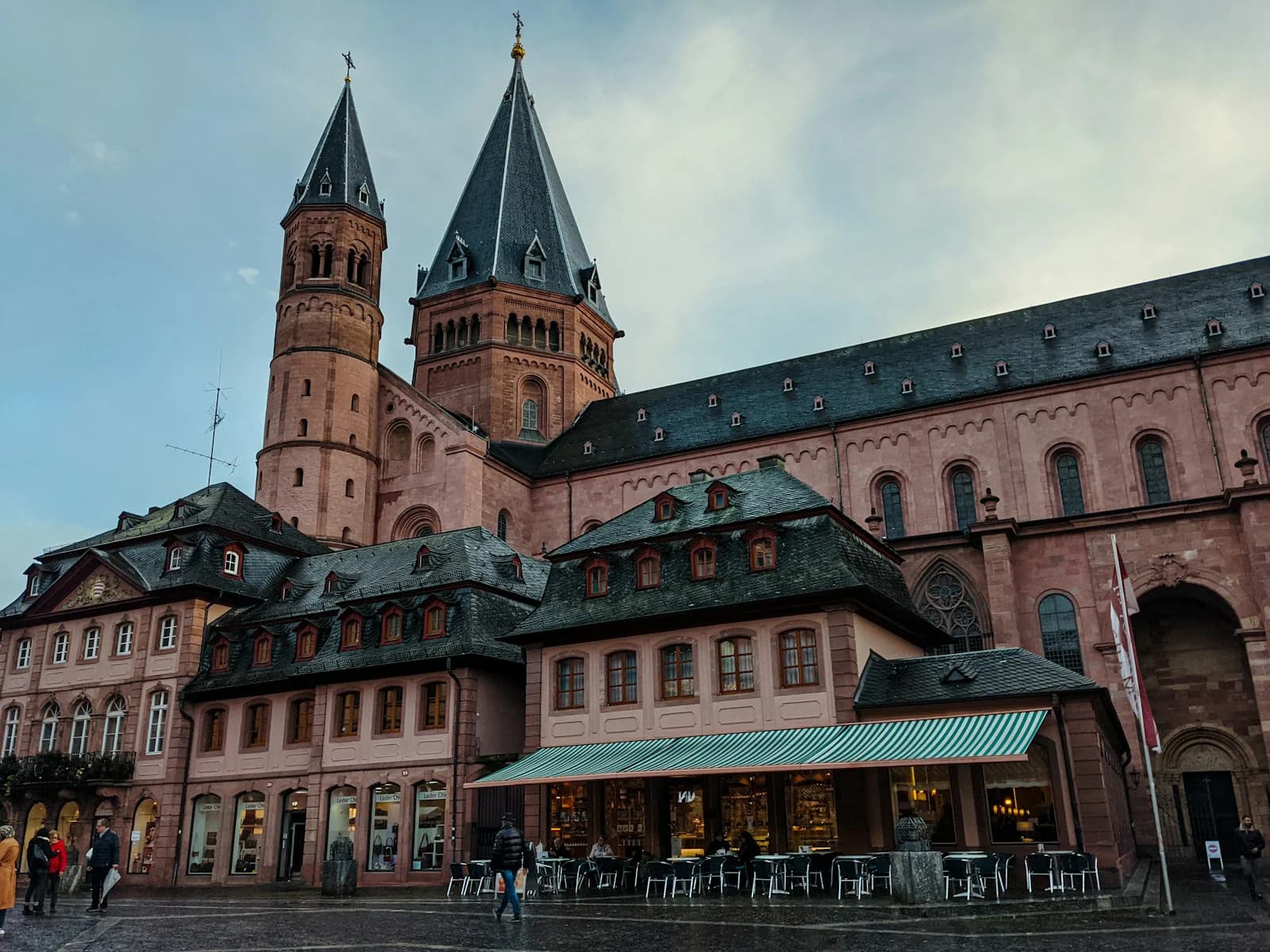
Mainz works for families because the old town is compact: cathedral, market square, St. Stephen's Church and the Rhine promenade sit within a walkable core, so you spend time looking rather than travelling. Instead of chasing a fixed checklist, pick one ticketed interior for the morning and leave the rest of the day open for squares, ice cream breaks and riverside wandering. The single most important planning fact is that the Gutenberg Museum is not in its old home: its long-standing location at Liebfrauenplatz closed in early October 2024 for rebuilding, and since the end of November 2024 the interim exhibition Gutenberg Museum MOVED has run at Reichklarastraße 1.
As a rough suggestion rather than an official figure, allow a full day for the old town plus one museum, and add a second day if you want the Citadel, a park afternoon and a river walk without rushing. Museum programmes rather than opening hours are the real constraint with children, because guided formats run at set times and often need a booking made in advance. Check current times and any closures on the organiser's own pages in the days before you travel, since maintenance shutdowns can interrupt a family visit.
Why Mainz Suits Families on Foot
Mainz is the capital of Rhineland-Palatinate and sits on the west bank of the Rhine, roughly forty kilometres west of Frankfurt, with the main station a short walk from the old town. That geography rewards families who plan around walking rather than timetables: once you are in the centre, the cathedral, market square and riverside are all reachable on foot. Guided city tours and the mainzcardplus discount card are sold through the tourist information office at Markt 17 by the cathedral, so practical questions can be answered in person.
For a wider picture of how the city fits together before you commit to a route, it helps to skim the Mainz city travel guides. Families often underestimate how much time children will happily spend simply moving between squares, fountains and churches without entering anything ticketed. Treat the itinerary as a shell and let the day's energy levels decide what you actually enter.
If you prefer to pick individual landmarks first and build the route around them, the Mainz landmark visitor guides collect named sights with their visiting angles. This is useful when one child wants the cathedral and another wants anything with a tower. Decide which single ticketed interior matters most, then arrange the free sightseeing around it.
Free Old-Town Wandering: Cathedral, Market Square and Lanes
The cathedral, officially St Martin's, was begun under Archbishop Willigis and consecrated in 1009, and its red sandstone towers still dominate the skyline; its interior mixes Romanesque, Gothic and Baroque layers that children can spot as differences in shape and colour. Around it, the pedestrian lanes of the Altstadt hold half-timbered houses and small squares such as Kirschgarten, so the walk between sights is itself the activity. Because the cathedral is also an active place of worship, keep voices down and check locally for any restrictions during services.
The market square beside the cathedral is the natural pause point: cafés and shops spill onto the paving, and there is usually something to watch. Budget roughly an hour for this free stretch with younger children and longer if you plan a sit-down break. Opening hours of the cathedral and any cathedral museum vary, so confirm the day's times before making it the anchor of your morning.
St. Stephen's Church and the Chagall Windows
St. Stephen's Church is easy to miss from the street, which makes finding it a small adventure, but the reward is the blue stained glass created by Marc Chagall. The windows were made between 1978 and 1985 and depict Old Testament scenes, bathing the interior in a deep blue glow that reads clearly even to small children. It is one of the few Mainz sights where the highlight is at eye level rather than high on a wall, so it works well for a mixed-age group.
Because it is an active church, visiting is generally a quiet, short stop rather than a long attraction, and it pairs well with the surrounding lanes and a drink nearby. If the interior is busy or closed, the elevated position still gives a view back over the city. Check locally for current visiting access, since church interiors are sometimes unavailable for services.
Gutenberg Museum: The MOVED Interim Exhibition and Printing Demos
The museum's long-standing site at Liebfrauenplatz closed in early October 2024 to make way for a new building, and since the end of November 2024 the interim exhibition has been housed at the Natural History Museum building. Inside, the museum displays outstanding objects from its collection and two copies of the 42-line Gutenberg Bible in a treasure chamber, with interactive elements aimed at younger visitors, including a selfie station in a historic printing workshop setting. One practical point parents repeatedly need clarified: the Gutenberg Museum ticket is its own ticket and is not a combined ticket covering the Natural History Museum as well, so budget for them separately if you want both.
The most reliable free-with-admission draw for children is the printing demonstration: a fifteen-minute session showing how printing was done in Gutenberg's day, repeated hourly through the day, with an extended final hour on Thursdays. That structure means you can plan around a demo slot instead of hoping to catch one. Current closing days and any maintenance periods are announced by the museum itself, so check its pages close to your visit date.
For a child-focused format, Family Saturday runs on the second and fourth Saturday of the month from 2 pm to 4 pm, with a meeting point at the museum ticket office. The children's tour is designed for ages six and up with an accompanying adult, and the printing activity carries a separate workshop fee of three euros per child on top of museum admission. Participation should be booked in advance using the museum's contact details, which is the detail that turns a good idea into an actual plan.
For a broader view of how this landmark compares with other Mainz sights before you commit a morning to it, the Mainz landmark visitor guides are a sensible cross-check. The museum reports attracting over 140,000 visitors a year, which is a useful signal to arrive earlier rather than mid-afternoon. Pair a museum visit with an outdoor stop afterwards so children are not indoors for two consecutive blocks.
Rainy-Day Backup: Choosing a Museum Programme, Not Just a Building
Mainz has several museums with programmes designed specifically for children and young people, spanning guided tours, craft activities and themed afternoons for families. The city's own overview of these children's programmes is the fastest way to see what is running across the Natural History Museum, the Gutenberg Museum, the Cathedral and Diocesan Museum and other venues. Read it as a menu rather than a schedule: you still need to confirm the day and book where required.
The Cathedral and Diocesan Museum is the strongest rainy-day add-on for younger children, because its programme includes a themed tour aimed at ages three to seven alongside adult formats. It occupies historic rooms next to the cathedral, so it slots neatly into a wet morning without a change of district. Specific session dates and times are published in its calendar, and themed children's tours typically need a booking, so check before setting out.
For a fuller set of indoor fallbacks, including how to sequence them around a wet afternoon, the guide to Mainz on a rainy day is worth reading alongside this one. A realistic rainy-day plan uses one booked programme and one flexible backup, because a single sold-out workshop should not sink the whole afternoon. Keep the walking portion short and accept that a wet day means fewer stops, not more.
Citadel and Roman Theatre: Outdoor History, Not an Indoor Museum
The Citadel was built in 1660 on the Jakobsberg and remains one of the few preserved modern citadels in Germany, with two thousand years of city history packed into one compact site, from the Roman Theatre to a twentieth-century church. It is not a classic ticketed museum: the complex today houses municipal offices and functions as a cultural venue hosting concerts, festivals and a Christmas market. Plan it as a park-like walk with historic walls, wide views and the Roman Theatre nearby rather than as a rainy-day indoor stop.
A particular draw for children is the chance to walk some of the site's upper and underground passages on the guided tours, some of which are given in historical costume; details and online tickets sit with the site's own tour operator. Those tours are the part that needs a decision in advance, because they run to a published programme rather than continuously. If you skip the tour, the outdoor grounds still give a rewarding hour with room to run.
Weather decides this one: the Citadel is an outdoor stop, so save it for a dry spell and keep a museum programme as your wet-weather alternative. Wear shoes that cope with uneven historic surfaces, and treat any slopes or passages as something to check on site rather than assume. A short outdoor block before lunch often works better than a long one after a museum morning.
Rhine Promenade and River Views
The riverside promenade is the city's most forgiving family space: flat, open and free, with boats passing and enough room for children to move after a museum. The Electoral Palace, a sandstone-red late Renaissance building stretching some seventy-five metres along the riverfront, anchors the walk and gives the stroll a landmark to aim for. Treat the promenade as the fixed part of an afternoon and the river ride as the optional extra.
A Rhine cruise is a genuinely good idea with children, but schedules, operators and fares change by season, so choose the sailing you want and book it directly with the operator rather than relying on a remembered timetable. Comparing options and boarding points in advance saves a wasted walk to the water. If the timing does not work with small children, the promenade alone delivers most of the experience for none of the cost. For wider planning, see Rhine River Cruises from Mainz.
Practical Decisions: Which Museum, Which Ticket, When to Split
The single most common family planning error in Mainz is assuming one ticket covers everything. Museum complexes here are separate: the Gutenberg Museum's interim exhibition has its own admission and is not a combined ticket with the Natural History Museum building in which it currently sits, and the cathedral's own museum sits apart again. Decide your one must-see interior, pay for that, and treat everything else as optional rather than buying on hope.
Prices change and are not fixed here, so check each venue's own page before you travel instead of working from a remembered figure; the city's children's-programme overview and the individual museum sites are the places to confirm. Where a programme charges a separate workshop fee on top of admission, as Family Saturday does, the museum states it explicitly. Urban families with a wider Germany trip in mind can also compare approaches in Berlin with kids or Dresden with kids, where museum programming and open spaces differ in character.
Splitting the group is the most useful tactic with mixed ages: one adult takes the older children into a print demonstration while the other stays outside with a toddler, then swap. Build the day around a booked slot and leave the rest loose, because the compact centre means regrouping is quick. If you are weighing how much to attempt, the one day in Mainz itinerary and the 2 days in Mainz itinerary show what fits at each length.
Plan Your Visit
Build a Mainz day with children around one booked programme, one free walking stretch and one outdoor block, and you will cover the city's best family material without overloading anyone. Confirm the Gutenberg Museum's interim location and current times, check whether the programme you want needs advance booking, and treat any riverside sailing and the Citadel tours as checks to make rather than assumptions. Because the centre is compact, a change of plan costs you a few minutes on foot rather than a journey.
Frequently Asked Questions
What can you do in Mainz with kids when it rains?
Start with Mainz's museums that run dedicated children's programmes rather than picking a building at random. The Gutenberg Museum's interim exhibition at Reichklarastraße 1 draws families with interactive exhibits and its printing demonstrations, while the Cathedral and Diocesan Museum offers a themed children's tour designed for very young visitors. Because workshop places and tours are limited and often require booking in advance, check the individual venue's calendar and contact details before you set out, and keep one flexible backup so a full session does not derail the afternoon.
Is the Gutenberg Museum good for children?
Yes, if you aim at the programme rather than trying to see everything. Children can watch a short printing demonstration on the historic press, and the museum's Family Saturday format pairs a children's tour with a hands-on printing activity for ages six and up with an adult. Family Saturday runs on the second and fourth Saturday of the month and should be booked in advance. Note the museum's long-standing site closed in late 2024 for rebuilding and the collection is currently shown in the interim Gutenberg Museum MOVED exhibition, so check the current location and times before travelling.
Are there free things to do in Mainz with children?
Several of the best family experiences in Mainz cost nothing to enter: wandering the Altstadt, crossing the cathedral square and market area, finding St. Stephen's Church and its Chagall windows, and walking the Rhine promenade. The Citadel also functions as an open, park-like historic site with the Roman Theatre nearby, though its guided tours, concerts and events are separate. These are outdoor or public spaces with access that can vary, so check locally on the day. Museum interiors are the parts that typically require tickets, and those should be checked venue by venue.
How long do you need in Mainz with kids?
As a suggestion rather than an official figure, a single day covers the old town, one museum interior and the riverside without rushing, and two days let you add the Citadel, a playground or park break and a slower afternoon. The city centre is compact and walkable, so the limit is usually attention span rather than travel time. If you are also considering a river trip, allow extra time around the sailing you book and confirm the schedule directly with the operator.
Sources
- Mainz Tourismus: Mainz Tourismus
- Mainz museums | Landeshauptstadt Mainz
- Electoral Palace: Mainz Tourismus
- Mainz Germany - travel guide and information from German Sights
- Gutenberg Museum: Mainz Tourismus
- Regular dates | Gutenberg-Museum
- Bischöfliches Dom- und Diözesanmuseum Mainz
- Citadel: Mainz Tourismus


