

The Zugspitze railway station in Garmisch-Partenkirchen sits at the western exit of the main Deutsche Bahn station, roughly 200 metres away, which is why changing from a Munich train onto the cog railway is a short walk rather than a separate transfer. Nearly all arrivals converge on that same point: regional and long-distance trains, Flixbus coaches and Oberbayernbus services all stop there, and the Eibsee buses pick up either at the station or on nearby Bahnhofstraße.
What catches visitors out is not the geography but the ticket logic. Free travel with a guest card, the restricted validity of the Germany Ticket on the rack railway, and the express Eibsee bus that accepts none of the usual passes are three different systems that look similar. Treat them as separate products rather than variations on one regional ticket.
Arriving by Train and Long-Distance Bus
GaPa Tourismus describes the arrival by rail as getting off directly in the town centre, and notes that the regional train from Munich runs hourly into the Bavarian Alpine region, with direct ICE connections to cities such as Berlin, Hamburg, Cologne, Munich, Frankfurt and Nuremberg added on weekends. For schedules and long-distance tickets, use the operator's own site rather than a reseller, since weekend ICE services and seasonal timetables are the parts most likely to change.
Coaches arrive at the same place. The Zugspitz Region transport page states that Flixbus and Oberbayernbus both stop at the train station, and that from there you continue to Eibsee and the Zugspitze by cog railway or Eibsee bus. GaPa Tourismus lists line 040 as running eight times a day between Munich and Innsbruck, five of those without a change, but frequencies move with season and demand, so confirm your specific departure on the operator's timetable.
One caution comes from the destination itself rather than from a blog: GaPa Tourismus advises anticyclical arrival times and use of public transport because traffic jams and long delays are common in peak seasons. That applies most sharply on winter weekends and during school holidays. Arriving by train removes that variable entirely for most visitors.
Station Transfers: The Zugspitzbahnhof Beside the Main Station
The cog railway station is not a separate trip across town. The Zugspitz Region public transportation page places the Zugspitze railway station at the western exit of the Deutsche Bahn railway station, approximately 200 metres away. In practice that means a change from an arriving train to the rack railway is a short walk with luggage rather than a connection you need to buffer an hour for.
Treat the transfer as part of planning the day rather than an afterthought. If you are heading straight for the lake or the summit on arrival day, buy the onward ticket at the counter or machine before leaving the station area and check the day's departure board while you are still inside. The access is nearly level, so a suitcase is manageable, but the walk is outdoors, which matters in rain or snow.
Note the deliberate ambiguity in how official pages describe local transport: the season, the school holidays and the time of day all change which buses run, so the station area is the right place to make the final decision rather than the booking screen weeks earlier.
The Bavarian Zugspitzbahn: Valley Route, Eibsee and the Tunnel to the Zugspitze
The Bayerische Zugspitzbahn cog railway leaves the valley station and climbs via Hausberg, Kreuzeck-/Alpspitzbahn, Hammersbach, Grainau and Eibsee before continuing through a 4,453-metre tunnel up to the Zugspitzplatt at around 2,600 metres. The Zugspitz Region page states that the ride from Garmisch-Partenkirchen to Eibsee takes just under 30 minutes, and that the cog railway stops approximately 300 metres from the shore of Lake Eibsee, which makes a rail-plus-lakeside-walk combination straightforward.
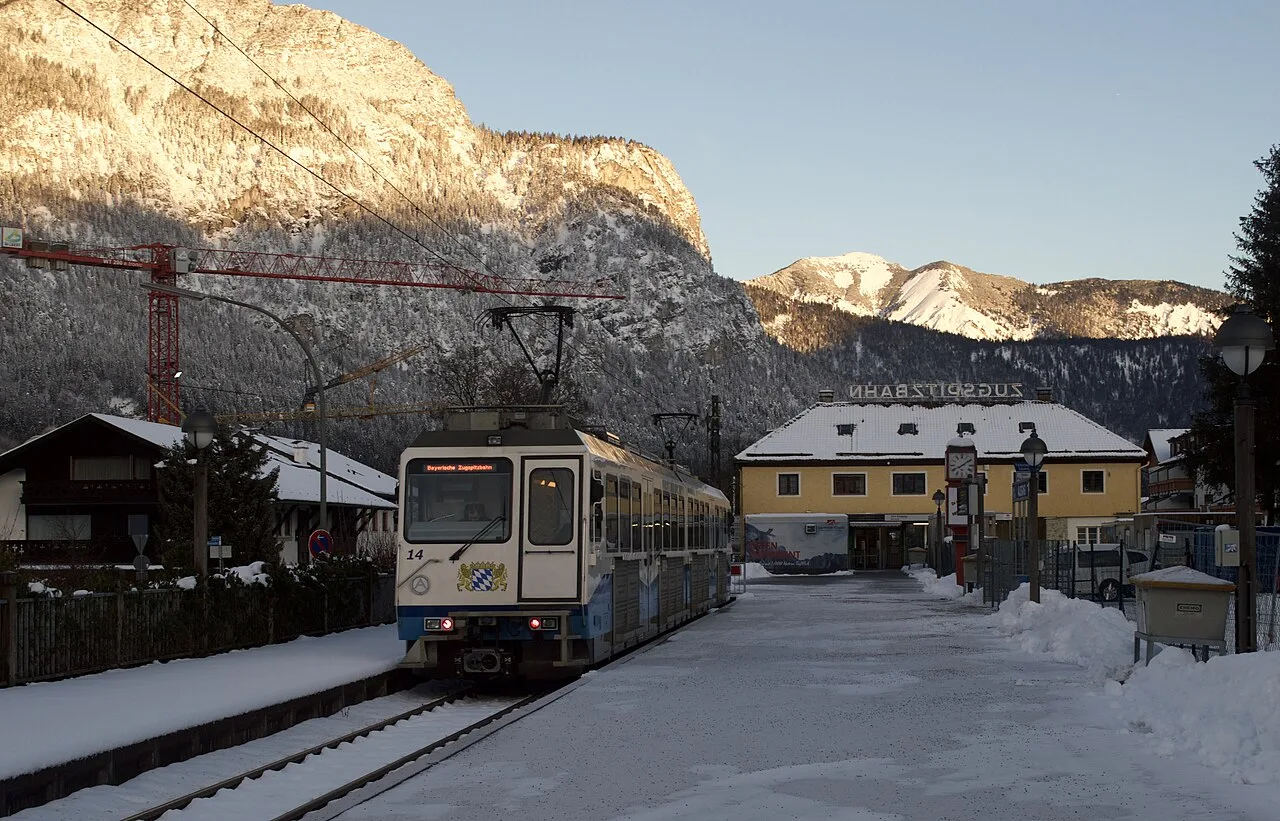
Going beyond Eibsee to the Zugspitze requires a valid mountain railway ticket, and that ticket condition is the single most important thing to check before boarding. The Zugspitz Region page describes the cog railway as one of the few still operating in Germany, running from Zugspitzbahnhof to the Zugspitze plateau with stops along the valley route. For the summit itself, including the cable car option and its separate ticketing, work through the Zugspitze Visitor Guide: Tickets, Cable Car & Summit.
If you only want the lake and the lower valley, the cog railway and the buses overlap usefully, and either can serve as the fallback when the other is full. If you want the summit, decide between the rack railway and the Eibsee cable car before you buy, because the two are separate products with separate tickets rather than interchangeable legs of one journey.
Germany Ticket Limits on the Cog Railway
The Germany Ticket is valid on the rack railway only between Garmisch-Partenkirchen and Grainau. The Zugspitz Region public transportation page states that a separate ticket must be purchased for the onward journey to Eibsee or the Zugspitze, that the Germany Ticket gives no discount on the mountain railway fare, and that it is not valid on cable cars at all. Anyone assuming a single nationwide pass covers the whole climb will be buying a second ticket at the counter.
There is also a capacity condition that is easy to overlook. The same page states that travel with the Germany Ticket on the cog railway is only possible if passenger numbers allow, and that guests holding a valid mountain railway ticket have priority on the cog railway when demand exceeds capacity, which is most likely on weekends and during holidays. The practical consequence is that if your day depends on reaching Eibsee or the summit, the Germany Ticket is not a guaranteed seat on a peak-day departure.
Eibsee Bus Routes 314, 315 and 323: Which Tickets Each Accepts
The three Eibsee routes do not share one ticket rule, so picking the wrong one can mean paying twice. According to the Zugspitz Region seasonal schedule, route 323 is the Eibsee express running directly to the lake during Bavarian vacations, weekends and peak summer, stopping at the train station (SEV stop); tickets are bought individually on board, and MVV tickets, the Germany Ticket and Zugspitz Region guest cards are not valid on it, with the Grainau guest card given as a stated exception. Route 315 is the Grainau regional route for everyday travel, stopping on Bahnhofstraße in front of the Post, and it accepts MVV tickets, the Germany Ticket and Zugspitz Region guest cards.
Route 314 is the off-season combination route, also stopping on Bahnhofstraße in front of the Post, and it accepts those same passes as far as Grainau and Badersee, with a transfer ticket needed for the Grainau and Badersee to Eibsee stretch including the return leg, bought on the bus. On the wider network, the Alpenwelt Karwendel bus page notes that the special line from Grainau to Eibsee is not included in the MVV, which is the exception worth remembering when you assume every regional bus takes the same passes.
Because the route in service depends on school holidays and season, check the Garmisch-Partenkirchen District Office or MVV channels for the current timetable rather than assuming the express is running. If Eibsee is your goal and you hold a guest card or Germany Ticket, the combination route or the cog railway will usually serve you better than the express.
The MVV Guest Card for the Garmisch-Partenkirchen District
MVV describes its guest card scheme as free use of the transport network for overnight guests, with districts issuing visitor cards that replace the previous local public transport fares with the MVV joint fare. In the Garmisch-Partenkirchen District entry on that page, the Zugspitze Region is broken down by issuing authority: GaPa Tourism for the Garmisch-Partenkirchen market and Grainau both fall in zones 9 to 12, while entries such as ZugspitzLand, Blaues Land, Ammergau Alps and Karwendel Alpine World are listed in zones 5 to 12. The zone range attached to your card is what determines how far you can travel without paying extra.
The same page sets out the conditions: the card covers all modes of transport integrated into the MVV network, second class must be selected on regional trains, one dog per guest card may be carried free of charge with the child fare applying to each additional dog, and a valid official photo ID must be carried and presented during ticket inspections. Validity runs for the duration of your stay, including the day of arrival and the day of departure.
Two limitations matter for trip planning. MVV states that the guest card cannot be combined with a short-distance ticket or with the special connection ticket for season tickets to extend its validity, and that a single ticket or day ticket is required for any additional fare zones. Read the card against the zone map before assuming a longer excursion is included.
What the Guest Card Does Not Cover: Attractions, Museums and Cable Cars
Free MVV travel is a transport benefit, not an attractions pass. Nothing in the MVV guest card terms extends to museum entry or cable cars, and the Zugspitz Region page states plainly that the Germany Ticket is not valid on cable cars. Budget separately for anything that lifts you off the valley floor or through a turnstile.
The Tiroler Zugspitz Arena guest card on the Austrian side is a different product with different rules. That region's getting-here page states that overnight guests receive a card allowing free use of bus connections in the region but not train connections, with route 150 and route 160X excluded, and that the Deutschlandticket is not valid on local bus lines in Austria. A card issued for one side of the border does not travel with you to the other.
The excursion bus linking Lermoos and Ehrwald with Garmisch-Partenkirchen is a separate case again. The same Tiroler Zugspitz Arena page lists weekday-only operating periods and states that non-card holders pay a per-journey fee on board, that only holiday guests with a valid Tiroler Zugspitz Arena guest card travel free, and that the guest bus is not a rail replacement service, so passengers with a train ticket cannot be taken along. Treat that fee as an Austrian-side rate rather than a Garmisch-Partenkirchen fare.
Peak-Season Crowding and How to Plan Around It
The Zugspitz Region transport pages warn that on weekends and during holiday periods the available capacity on trains and buses may be exceeded at certain times, causing delays or leaving passengers waiting for the next service and not all potential guests transported directly. That warning applies to the cog railway and the Eibsee buses alike. Building slack into a summit day is more useful than optimising the schedule to the minute.
A workable approach is to start early, keep the lake as the fallback if the mountain is congested, and decide the route once you are standing in the station with the day's board in front of you. The valley stretch between the town and Grainau is the portion covered by the common passes, so it is also the cheapest leg to repeat if plans change.
Matching Tickets to a Short Stay
For a short stay, decide first which single mountain day you want and buy that ticket deliberately, then let the guest card handle everything else in the valley. Use the cog railway or the combination bus for the lake if you hold a guest card, and reserve the express bus for when it is the only option running. A one-day version of that logic is set out in the One Day in Garmisch-Partenkirchen Itinerary, while a longer stay spreads the paid mountain days out.
If you are staying longer, group the paid mountain transport into the clearest-weather days and keep valley days for the card-covered routes between Garmisch and Grainau; the 3 Days in Garmisch-Partenkirchen Itinerary works on that assumption of one paid ascent plus local transfers. Either way, walk between the two halves of town rather than riding, and keep the orientation walk in mind when choosing where to sleep, as the Garmisch vs Partenkirchen: Neighbourhood Orientation Walk sets out how the two centres and their riverside crossing relate.
Plan Your Visit
The system falls into place once you separate three decisions: how you arrive, which mountain ticket you buy, and what your guest card already covers. Arriving at one station simplifies the first; the Germany Ticket restriction on the rack railway and the express bus ticket rules settle the second; the MVV zone list for your accommodation settles the third. For the city-level planning that sits around those transport choices, start with the Garmisch-Partenkirchen: Itineraries and City Travel Guides hub. Verify timetables and current fares with MVV, the district office or the operators before travelling, because services and conditions change with season, and use the Garmisch-Partenkirchen: Landmark Visitor Guides hub if you want to look up a single mountain or gorge in more depth.
Frequently Asked Questions
Does the Garmisch-Partenkirchen guest card cover buses and trains?
Yes for the transport integrated into the MVV network within the zones agreed for your card. MVV lists the Garmisch-Partenkirchen District, Zugspitze Region, by issuing authority: GaPa Tourism for the Garmisch-Partenkirchen market and Grainau both fall in zones 9 to 12, while entries such as ZugspitzLand, Blaues Land, Ammergau Alps and Karwendel Alpine World are listed at zones 5 to 12. Second class applies on regional trains, one dog travels free per card, additional dogs pay the child fare, and you must carry valid official photo ID for inspections. Any journey beyond your card's zones needs a single or day ticket, and the card covers transport only, not museums or attractions.
Can I use the Germany Ticket on the Zugspitzbahn cog railway?
Only on part of it. The Zugspitz Region public transportation page states that the Germany Ticket is valid on the rack railway between Garmisch-Partenkirchen and Grainau, and that a separate ticket must be purchased for the onward journey to Eibsee or the Zugspitze. It gives no discount on the mountain railway fare and is not valid on cable cars. Travel with it on the cog railway is also subject to available capacity, and guests holding a valid mountain railway ticket have priority when demand is high, which is most likely on weekends and during holidays.
Which bus goes to Eibsee from Garmisch-Partenkirchen station?
Three routes serve the corridor, and they differ in both season and ticket acceptance. Route 323 is the Eibsee express, running directly to the lake during Bavarian vacations, weekends and peak summer and stopping at the train station; tickets are bought individually on board, and MVV tickets, the Germany Ticket and Zugspitz Region guest cards are not valid on it, with the Grainau guest card as a stated exception. Route 315 is the Grainau regional route and route 314 is the off-season combination route, both stopping on Bahnhofstraße in front of the Post and both accepting those passes as far as Grainau and Badersee, with a transfer ticket needed for the stretch on to Eibsee.
Do I need a car to get around Garmisch-Partenkirchen?
No, and arriving by public transport removes the peak-season road delays the destination itself warns about. GaPa Tourismus advises anticyclical arrival times and public transport in peak seasons. Trains, Flixbus and Oberbayernbus all stop at the same station, the cog railway station is about 200 metres away at the western exit, and the Eibsee buses pick up at the station or on nearby Bahnhofstraße. A car becomes useful only if your plans reach beyond the valley network, in which case check parking and road conditions separately and expect congestion on busy weekends.


