Dresden is unusually generous with the things that cost nothing. Since 2004 the city has been building a tourist pedestrian wayfinding system; steles now stand at 46 landmark points such as stations and car parks, pointing the way to the most important cultural sights, and the network of cycle paths along main roads now runs to more than 360 kilometres. That infrastructure matters for a free itinerary, because it means the cheapest way to see the historic centre is also the intended one. The trick is knowing where free ends and a ticket begins.
The pattern repeats across the Old Town: a square, a terrace or a courtyard is open to anyone, while the museum, dome or treasury inside or beside it is ticketed. At the Zwinger you can walk into the courtyard and up to the walls without paying, while the collections in the surrounding pavilions are separate. At the Frauenkirche, visitors can enter the church free of charge, while climbing the dome is a paid extra. A suggested half-day covering the free cluster takes roughly three to four hours at an unhurried pace — an editorial suggestion, not an official figure.
This guide groups free Dresden sights by how they behave on the ground, so you can cluster them geographically rather than zigzagging. Distances in the Altstadt are short enough that the free pieces — squares, terrace, mural, riverbank — chain together naturally. Hours and any charges for specific interiors change, so confirm them with each operator before you build a day around them. If you prefer to plan by area first, the Dresden: Itineraries and City Travel Guides hub is the place to start.
What Counts as a Genuinely Free Dresden Sight
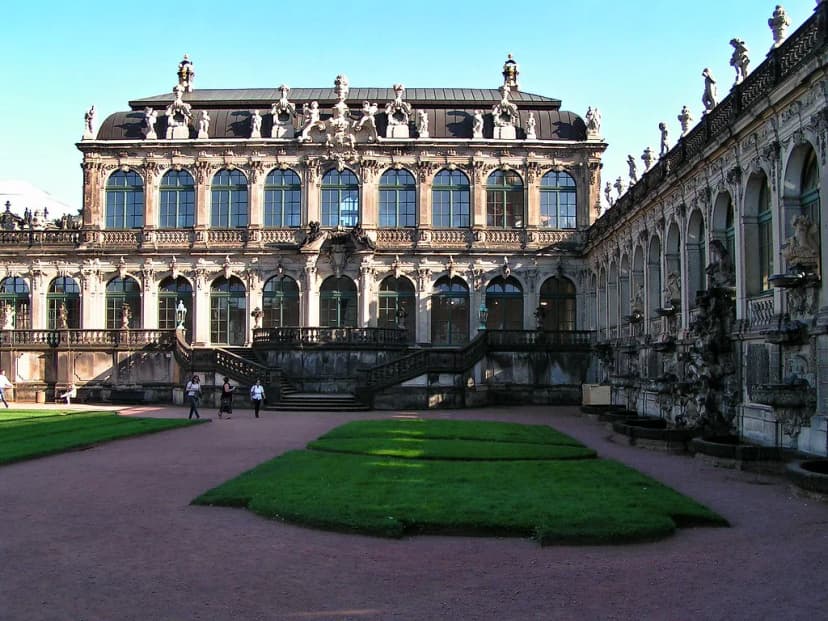
Three categories do most of the work. First, public space: squares, bridges, promenades and riverbanks are open to anyone, and no ticket window exists. Second, free-entry buildings: a church nave or a museum atrium you can step into without buying anything. Third, the free shell of a paid site — the Zwinger courtyard, the Albertinum atrium — where the architecture itself is the attraction and the collections are not.
The distinction matters most inside the palace complexes. The Zwinger courtyard is free to visit, but entry to the museum buildings is ticketed, and the museums are covered individually or by a joint ticket rather than a single blanket pass. Assume nothing about combined admission and check the ticketing details for whichever pavilions you actually want.
Expect hours to vary by season, day of the week and, for some spaces, by whether a service or event is running. Courtyard hours and church visiting hours are not the same as museum hours, and none of them are permanent. The operator's own site is the only source worth trusting on the day.
The Squares: Neumarkt, Schlossplatz, Altmarkt and Theaterplatz
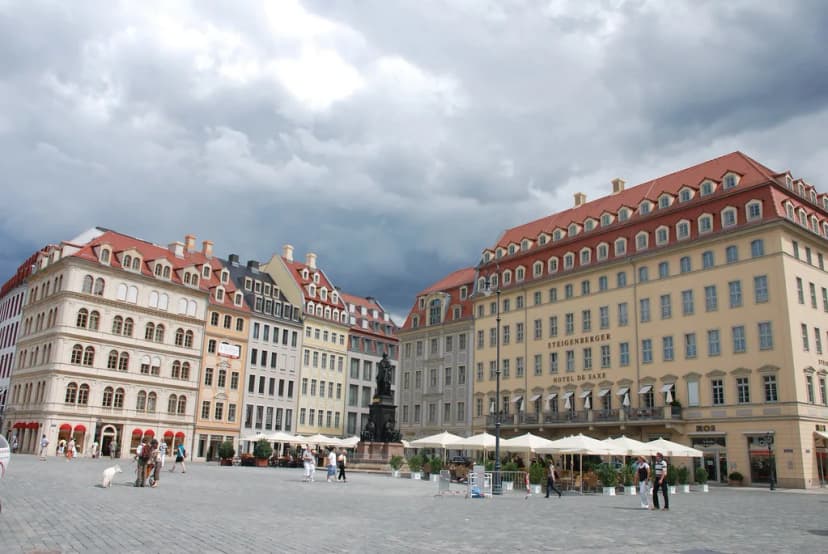
Neumarkt is the natural place to start, because the Frauenkirche rises directly out of it and the surrounding baroque facades are largely reconstructions behind historic-looking fronts; the square was rebuilt to reflect its earlier appearance rather than preserved intact. You can walk the square, look at the church exterior and use it as an orientation point without spending anything. It also gives you the clearest sense of how the Old Town was stitched back together.
Schlossplatz sits on the other side of the palace complex and offers one of the best free views in Dresden, framed by the Royal Palace, the Catholic Court Church and the state parliament building. Steps lead from Schlossplatz up to Brühl's Terrace, which is the single most efficient free transition in the city. Altmarkt, the historic market square, and Theaterplatz, ringed by the Semper Opera House, the cathedral and the Zwinger, complete a loop you can walk in one go.
All four squares are open public space, so the cost is zero and the main variable is crowd level; on weekends and through Advent, the market squares host seasonal stalls. If you want photographs of the architecture rather than the crowds, early morning is the practical answer.
Brühl's Terrace and the Elbe Banks: Free Views, Free Walking
Brühl's Terrace is free to visit and open all day, which makes it the most reliable stop on any free itinerary, with views down to the Augustus Bridge and the river. In the nineteenth century the terrace became a public promenade, with fountains and ornate buildings, and a flight of steps leads down towards Castle Square. The Brühl's Terrace, Dresden guide covers its layout and the adjacent sites in more depth.
The Elbe itself does the heavy lifting. Riverside paths run along both banks, and the most important inner-city cycle route, the Elberadweg, threads along the river away from road traffic. You do not need a bike to use the principle: walking the bank between the bridges is free and flat, and gives you the skyline from the water rather than from inside it.
Crossing the Augustus Bridge puts you between the Old Town and Neustadt and gives you river views in both directions. Treat the bridge as a viewing platform with a purpose rather than a detour. It also sets up the Neustadt end of a free day, which is covered later in this guide.
The Fürstenzug: Free, Outdoor and Easy to Combine
The Procession of Princes runs along Augustusstrasse on the exterior wall of the Stallhof, and because it sits outdoors it is free to view. The mural depicts the Wettin dynasty rulers across roughly 102 metres, and it was remade in weather-resistant Meissen porcelain tiles in the early twentieth century, which is why it survived the wartime bombing largely intact.
Its position is the real advantage. The mural sits between the Royal Palace and the cathedral, so it slots into a free walk that also takes in Schlossplatz and the Stallhof courtyard. Stallhof itself, the former tournament yard, is a quiet passage to walk through when no event is running, and the Procession of Princes (Fürstenzug) Dresden guide explains the figures and the tilework in more depth.
No ticket and no queue is the appeal, but the street can get crowded on weekends. If you want the mural without a scrum of photographers, walk it in the morning and step back across the street to take in the full length. It pairs naturally with the approach to the terrace and the river.
Zwinger: Free Courtyard and Walls, Paid Collections Inside
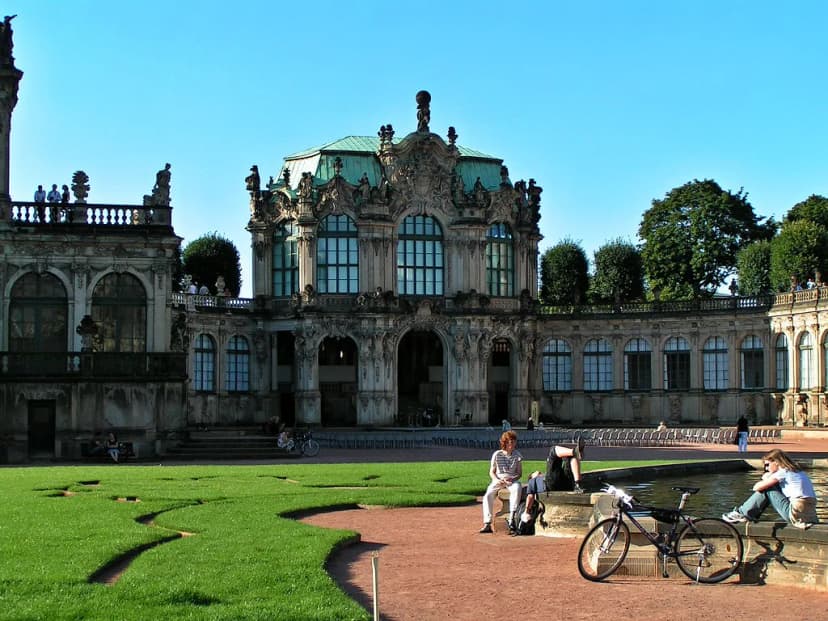
This is the clearest free-versus-paid split in Dresden. You can walk freely into the Zwinger courtyard, with its lawns, fountains and topiary, and up the steps to the walls that overlook the grounds. The courtyard was designed as an orangery and pleasure garden for the Saxon court, so treating it as a garden rather than a museum is exactly how it was meant to be used.
The pavilions around the courtyard hold separate collections, including the Old Masters Picture Gallery, the Porcelain Collection and the Mathematical and Physical Salon. You can pay to visit each individually or buy a joint ticket covering them all, so you should not assume one purchase covers everything; check each collection's own page for what is included and whether advance booking is required.
For a free visit, budget roughly half an hour to walk the courtyard and walls, treating that as a suggestion rather than any official figure. If you want the Old Masters or the porcelain, plan that as a separate, paid block of time and check current opening hours with the operator. The free version and the paid version are genuinely different experiences, not one with a shortcut.
Frauenkirche: Free Church Entry Versus the Paid Dome Climb
Visitors can enter the Frauenkirche free of charge, which makes the rebuilt church one of the strongest free stops in the city. The interior is the point: the church was destroyed in the wartime firestorm, left as a ruin for decades, and rebuilt between 1994 and 2005. Standing inside is the payoff, and it costs nothing.
Climbing the dome is the paid alternative and a different experience entirely — a climb to a viewing platform rather than a look at the interior. Decide which one you actually want before you queue. If your goal is the view, the dome is the option; if your goal is the building and its story, the free entry covers it.
Visiting hours vary by season and by day of the week, and services take priority over tourist access at times, so check the church's own website for the day you plan to visit rather than relying on a general listing. If you plan to climb the dome, confirm the current charge and whether timed slots apply before you go.
Albertinum: A Free Atrium, a Paid Collection
The Albertinum sits at one end of Brühl's Terrace, which makes it an easy add-on to a free terrace walk. You can go into the inner atrium without charge, but there is a charge to enter the collection. The museum covers art from the Romantic period to the present day and is especially known for its sculpture hall, so gauge your interest before deciding.
Be honest about what the atrium gives you. It is a short stop — a way to see the building's interior and orient yourself — not an afternoon of art. Treat it as a brief pause between the terrace and the river rather than a substitute for the galleries, and note that hours and any charges for the collection should be checked with the museum directly.
Because the Albertinum is on the terrace, combining it with the Elbe views costs you nothing but a few minutes of walking. That combination — free building shell, paid interior, free promenade outside — is the pattern that defines free sightseeing in Dresden's Old Town.
Grosser Garten: Free Baroque Parkland Outside the Centre
The Grosser Garten is Dresden's largest green space, laid out in baroque style with wide tree-lined paths radiating from the central Palais. Entry to the park is free, and it offers ponds, sculptures and paths to walk, plus a miniature railway among its attractions. It is the best free answer to a warm afternoon when the squares feel crowded.
It sits outside the historic centre, so getting there is the practical consideration; use the city's public transport information or walking routes to plan the approach rather than assuming a short stroll. Some attractions within the park are separately charged, so the free part is the landscape itself rather than everything inside it.
Treat this as a deliberate trip rather than a fifteen-minute detour. It works well paired with a walk along the Elbe, since both are about open space rather than ticketed interiors. Check opening arrangements for any specific facility inside the park before you build plans around it.
Walking and Cycling Without Paying for Transport
Dresden's tourist wayfinding system uses steles at major arrival points and landmarks to point you toward the main cultural sights, so you can navigate the centre on foot without a map app. The steles carry an overview map of the inner-city ring as well as directional targets, covering the area where nearly all the free sights sit. It is one of the reasons a car-free day here is realistic.
The Elberadweg is the key cycling route, running along the river away from road traffic, and the city's wider cycle network exceeds 360 kilometres. Cycling gives you a free way to connect central sights with the riverbanks and the Grosser Garten side of town. Note that route sections can be closed for works at times.
Everything here assumes you stay on foot or bike rather than using the tram or ferry network. That is the free option, but it does constrain how far you go in a day. Keep the free cluster central and treat the Grosser Garten as a single deliberate trip rather than an add-on.
Neustadt and Beyond: Where Free Wandering Ends
Crossing the Augustus Bridge puts you in Neustadt, the district on the north bank, which is free to wander and rewards aimless walking more than checklist sightseeing. It has cafés, bars and a distinct alternative character compared with the reconstructed Altstadt. There is no entry fee to the neighbourhood; the cost is whatever you decide to spend there.
The Kunsthofpassage is a set of interconnected courtyards with artist-decorated facades, and it is free to walk through. Be careful about expectation management: the rain-activated pipe feature is weather-dependent, so you cannot count on hearing it. Go for the courtyards and the small shops, and treat any acoustic effect as a bonus. The Kunsthofpassage Dresden guide covers what each courtyard contains.
This is where free stops start to thin out. Attractions outside the central free cluster, such as the Panometer, sit further out and require a purchased ticket and a trip beyond the centre. Plan them as their own outing rather than tacking them onto a free walking day.
Building a Free Half-Day and a Free Full Day
For a half-day, start at Neumarkt and the Frauenkirche, walk the Procession of Princes and the Stallhof, climb to Brühl's Terrace, and finish on the Elbe or across the Augustus Bridge. All of it is free, and the walking distances between these points are short. Allow around three to four hours at an unhurried pace — a suggestion, not official guidance, since how long you linger in a church or over a view is entirely personal.
For a full day, add the Zwinger courtyard and walls, the Albertinum atrium, and the Grosser Garten, then loop back via the river path in the late afternoon. This layers free architecture with free green space and keeps paid interiors as opt-in blocks. If you want to see the Old Masters or climb the Frauenkirche dome, slot those in as separate decisions rather than letting them define the day.
A two-day version of this gives you room to properly consider the paid interiors instead of rushing past them. If you are weighing how to structure two days, the 2 days in Dresden itinerary is a useful starting point for sequencing the same sights across a longer stay.
Free-Adjacent Cautions Worth Knowing
Tip-based walks are often advertised as free, but operators describe them as pay what you wish, with a reward for the guide expected at the end. If your budget is strictly zero, a self-guided walk using the city's signage is the honest alternative. Walkative's Dresden page explains how the payment model works before you slot in a tour.
Museum admission rarely covers everything in a complex. Free areas stop at the door of paid interiors, special exhibitions often sit outside standard entry, and timed-entry tickets for some collections can sell out in advance during busy periods. Confirm the scope of any ticket you buy rather than assuming a single purchase unlocks the whole site.
Sunday closures affect shops and pharmacies across Germany, so plan any purchases by Saturday if you need supplies; Walkative's Dresden FAQ notes that most shops close on Sundays, with limited exceptions such as shops at the main station. Tap water in Dresden is safe to drink, and public drinking fountains exist in some central locations during warmer months, but treat this as something to check locally rather than plan around.
Plan Your Free Dresden Day
The free version of Dresden is not a lesser version. The squares, the terrace, the mural, the riverbank and the park are the city's actual set pieces, and the paid interiors are add-ons you can choose deliberately rather than default into. Start with the central cluster and expand only when you have a reason to.
If you want to push further into the residential districts without adding tickets, the Dresden neighborhoods walk is a natural companion to this free-sightseeing loop. If you are comparing cities, the free things to do in Berlin and free things to do in Munich guides follow the same free-versus-paid logic. Before you go, check current opening hours, any charges for the specific interiors you want, and whether timed tickets apply, using each operator's own site; the Dresden: Landmark Visitor Guides hub is organised by site for that kind of pre-trip check.
Frequently Asked Questions
What can you see in Dresden for free?
The public squares — Neumarkt, Schlossplatz, Altmarkt and Theaterplatz — are open space and cost nothing. So are Brühl's Terrace, the Elbe riverbanks, the Fürstenzug mural on Augustusstrasse, and the Grosser Garten. Several buildings also have free-entry areas: the Frauenkirche church itself, the Zwinger courtyard and walls, and the Albertinum atrium. Each of those sits next to paid interiors, so check what a given free area actually includes before you go.
Is the Zwinger free to visit?
The courtyard and the walls are free to walk. The museum collections in the surrounding pavilions are ticketed, and the free area does not extend into them. Do not assume a single ticket covers every collection; you can pay for each individually or buy a joint ticket, so check the collection pages for what is included and whether advance booking is needed.
Is Frauenkirche entry free?
Visitors can enter the Frauenkirche free of charge. Climbing the dome is a separate paid experience with a fee and a climb to reach a viewing platform. Visiting hours vary by season and day, and services take priority at certain times, so check the church's own website for the day you plan to visit.
Are free walking tours in Dresden actually free?
No — they are tip-based. Operators describe them as pay what you wish, meaning a reward for the guide is expected at the end. If you want a genuinely zero-cost orientation of the Old Town, use the city's signposted pedestrian wayfinding steles and walk the free cluster yourself.
Can you see Dresden without paying for transport?
Much of the central sightseeing is walkable, and the city maintains a signposted pedestrian wayfinding system for visitors. The Elberadweg runs along the river away from road traffic, and Dresden's wider cycle network is extensive, so cycling is a realistic free way to connect the centre with the riverbanks. Route sections can be closed for works, so check the city's own pages before relying on a specific stretch.