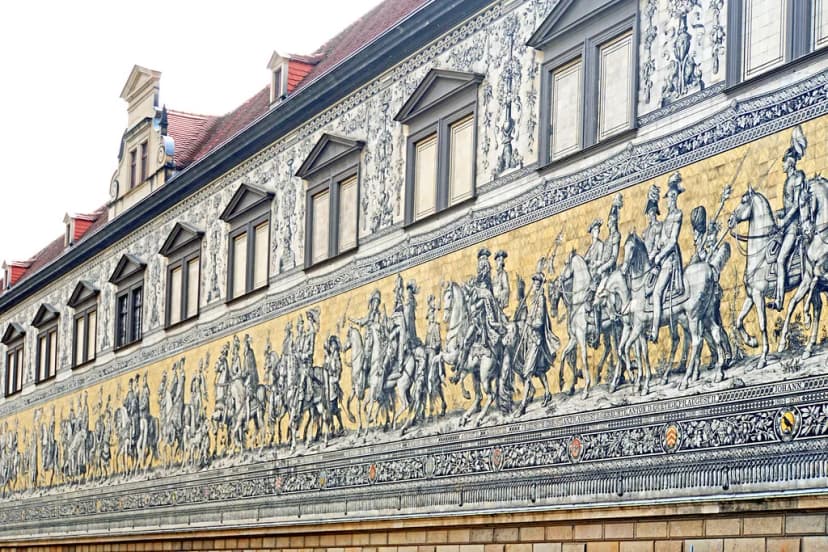
The Procession of Princes, known in German as the Fürstenzug, is a wall painting on the outside of a building on Schloßstraße, in the middle of Dresden's old town. The Saxon steamship operator describes it as a 102-meter-long mosaic made of Meissen porcelain depicting electors and kings of the Saxon House of Wettin. That single fact reshapes how you should plan your stop.
Because it sits in the open, there is no lobby, no queue, no closing bell and no ticket desk to find. You simply walk up and look. As an editorial suggestion rather than an official recommendation, allow five to fifteen minutes for the mural itself, and longer if you intend to work along the whole line reading the figures.
What the Procession of Princes Actually Is
The mural runs along the wall of what is historically the Langer Gang, part of the residential palace complex, and it faces onto the pedestrianised Schloßstraße. One source gives its length as about 101 metres, while the steamship operator describes a 102-meter mosaic. Either way, the scale is the reason it reads as a continuous frieze rather than a single framed picture.
Because the artwork is fixed to a public street wall, the correct mental model is a landmark you pass through rather than a place you enter. There is no admission charge to stand in front of it, and equally there is no published opening time that would let you in early or keep you out late. The thing to check is not a ticket page but your own route through the old town.
Why It Is Free, and What That Means for Planning
There is no admission fee for viewing the Fürstenzug, because there is nothing to enter. That distinguishes it sharply from the ticketed institutions nearby, which are separate attractions with separate admission and separate booking systems. Official tourist information for Dresden sells combined museum tickets covering sites such as the Zwinger, Residenzschloss, Albertinum and Deutsches Hygiene-Museum, and that scope does not include the mural for the simple reason that the mural needs no ticket. Current prices and what each ticket actually covers should be confirmed with the operator before you buy.
The practical consequence is that the mural can anchor a walk without any commitment or advance decision. You can stop for two minutes on the way to somewhere else, or you can use it as a fixed point around which you build an hour. Nothing is lost by arriving unplanned, and nothing is gained by reserving anything.
The History in Brief: Sgraffito, Then Porcelain
The mural's creator, Wilhelm Walther, produced the work between 1872 and 1876 as a sgraffito, a scratched plaster technique that is comparatively fragile outdoors. One source links the commission to the celebration of the Wettin dynasty's long rule over Saxony. A decoration this exposed to German weather was never going to hold its surface for long.
The solution was to translate the image into porcelain. The design was transferred onto more than 23,000 Meissen porcelain tiles in the early twentieth century, with one source describing roughly 24,000 tiles. The porcelain version was completed in 1907. That material change is why the procession still reads clearly today rather than as a faded ghost of a painting.
Who Is in the Mural
For most of its length the mural shows the Saxon electors and kings of the House of Wettin on horseback, in chronological order, moving in one direction. The arrangement is genealogical and ceremonial rather than narrative: you are looking at a dynasty presented as a procession. Reading the riders as a sequence is the main intellectual pleasure of the stop.
The end of the procession changes character. It closes with civic figures from science and the arts rather than with rulers, and one source names the painter Ludwig Richter among them, with Wilhelm Walther himself placed at the very end. Many visitors walk the length, photograph the horses and turn away before reaching this final stretch, which is arguably the most human part of the design.
How to Read the Procession on Foot
Walk the whole length before you stop to look at anything in detail, because the mural only makes sense as a continuous line. Then walk back and slow down at the tail end, where the civic figures and the artist himself appear. This two-pass approach costs only a few extra minutes and prevents the common mistake of treating the mural as a single photo opportunity.
Close up, the point to appreciate is the tiled surface itself, the fact that a painted design survives outdoors only because it was fired onto porcelain. Because there is no single officially designated best viewing angle published for the mural, treat any advice about the ideal spot as a personal preference rather than a rule. Lighting and how much of the wall is unobstructed will vary with the season and with whatever is happening on the street.
Getting There and Verifying Transport
The mural sits on Schloßstraße in the old town, within easy walking distance of Theaterplatz, the Residenzschloss and the river. Dresden's city tourism pages describe a well-developed local transport network of trams, buses, Elbe ferries and two mountain railways, but they do not publish specific lines to the mural. The city also maintains a tourist pedestrian signage system, built up since 2004, with information stele at stations, stops and car parks pointing towards the major cultural sights, which is a reliable way to orient yourself on foot. For current route planning, use the local transport operator's own journey planner rather than any third-party summary.
One older published source names tram stops for the area, listing Theaterplatz and Altmarkt among the access points, but line numbering changes over time and should not be relied on as current fact. Treat such listings as historical guidance and confirm your route and stop with the operator on the day. If a specific line number matters to your plan, verify it locally before you set out.
Suggested Time and Pacing
As an editorial suggestion rather than an official recommendation, allow five to fifteen minutes for the mural itself, and longer if you intend to work along the whole line reading the figures. The stop only becomes a half day when you attach it to the surrounding squares, palaces and riverfront. Decide which of those two visits you are making before you arrive, because the pacing is completely different.
If you are pressed for time, see the full length once and read the final civic section, then move on. If you have an unhurried afternoon, use the mural as the first station of a loop through the old town and return along the river. Neither approach requires any booking.
Nearby Old-Town Combinations
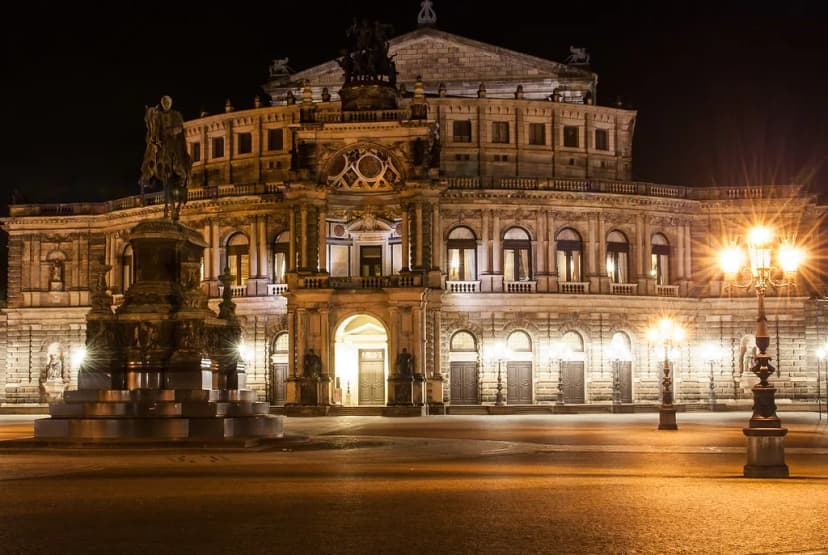
The most natural pairing is Theaterplatz, which the steamship operator describes as surrounded by the Catholic Court Church, the palace, the Semper Opera House and the Zwinger with its Crown Gate. From the mural you can reach this ensemble on foot in a few minutes, which makes it the obvious next stop rather than a separate excursion. Note that each of these buildings has its own ticketing or access rules, and the free mural implies nothing about any of them.
The Dresden Castle Residence visitor guide is worth reading before you continue, because the palace complex that carries the mural's wall also contains ticketed collections with their own admission arrangements. Separately, the Frauenkirche Dresden visitor guide covers the rebuilt church at the Neumarkt, a short walk away across the old town. Neither attraction shares a ticket with the mural or, in general, with each other.
If your priority is to keep costs down across the day, it helps to know which sights are genuinely free to approach and which require admission, and a roundup of free things to do in Dresden is a sensible planning companion. The Zwinger's outer courtyard and the Brühl Terrace promenade, which the steamship operator describes as a 930-metre walk above the Elbe bank, fall into the strolling category. The Old Masters Picture Gallery and the porcelain collection inside the Zwinger do not.
Adding the Elbe and the Steamship Piers
The old town sits above the river, and the Terrassenufer promenade below it is where the Saxon steamship piers are located. The operator currently publishes a cruise programme covering the Elbe valley between the Saxon Wine Route and Saxon Switzerland, with departures from Dresden itself. It also lists piers 1 to 5 on the Terrassenufer as accessible for walkers and wheelchair users, while some piers further upstream, above the Carola Bridge, are described as not yet accessible.
Fares, timetables and which pier serves which departure are set by the operator and change with the season, so check the current sailing information and buy directly through the company. One useful piece of published detail is that tickets can be purchased on site at Pier 2 during its opening hours, though those hours should be confirmed before travelling. Treat a river cruise as a separate decision from the mural, with its own cost and its own booking.
Common Mistakes to Avoid
The first mistake is hunting for a ticket or an entrance, which wastes time in a city where the main sights are densely packed and walkable from one another. The second is rushing the wall in one direction and missing the civic figures and the artist at the end. The third is assuming that the palaces and museums around the mural are included in the same visit, when in fact each has its own admission and its own opening times.
A related error is treating the mural as a destination that justifies a dedicated trip across the city. It works best as a fixed point inside a walking route through the old town, combined with the squares and the river. Plan it into the walk rather than scheduling it as an appointment.
Plan Your Visit
The Procession of Princes rewards a simple plan: walk the length once, come back slowly along the final civic section, then continue into the old town or down to the Elbe. Because the mural is outdoors and free to view, it asks nothing of your budget and nothing of your booking calendar. Build it into a walking route and it costs you minutes; treat it as a standalone attraction and you will have overestimated it.
Verify anything that changes before you travel: current museum admission and what each ticket covers, tram routes and stops, and steamship sailings and pier access. Use the operator and city sources rather than older listings, which may no longer reflect the network. With those checks done, the rest of the visit is simply a matter of walking.
Frequently Asked Questions
Is the Procession of Princes in Dresden free to see?
Yes. The mural is painted onto the exterior wall of a building on Schloßstraße in the old town, so there is no ticket desk, no entrance and no admission charge to stand in front of it. It is distinct from the ticketed museums and palaces nearby, which have their own admission arrangements.
How long is the Procession of Princes mural?
Published sources give the length as roughly 101 to 102 metres. It runs along the wall of what is historically the Langer Gang, facing the pedestrianised street, and reads as a continuous frieze rather than a single framed image.
What is the mural made of?
The original 1870s design by Wilhelm Walther was executed as a sgraffito on plaster. Because that surface did not survive well outdoors, the image was later transferred onto more than 23,000 Meissen porcelain tiles, with one source putting the figure at around 24,000 tiles. The porcelain version was completed in 1907.
How much time should I allow for the mural?
As a suggestion rather than an official recommendation, allow five to fifteen minutes to walk the length and read the final section. It becomes a half-day only if you combine it with Theaterplatz, the Zwinger courtyards, the Brühl Terrace or a river walk.
Which tram stop serves the Procession of Princes?
One older published source names Theaterplatz and Altmarkt as the nearest tram stops, with specific line numbers listed at the time of writing. Line numbering and routes change, so confirm the current stop and line with the local transport operator before you travel rather than relying on an older listing.