
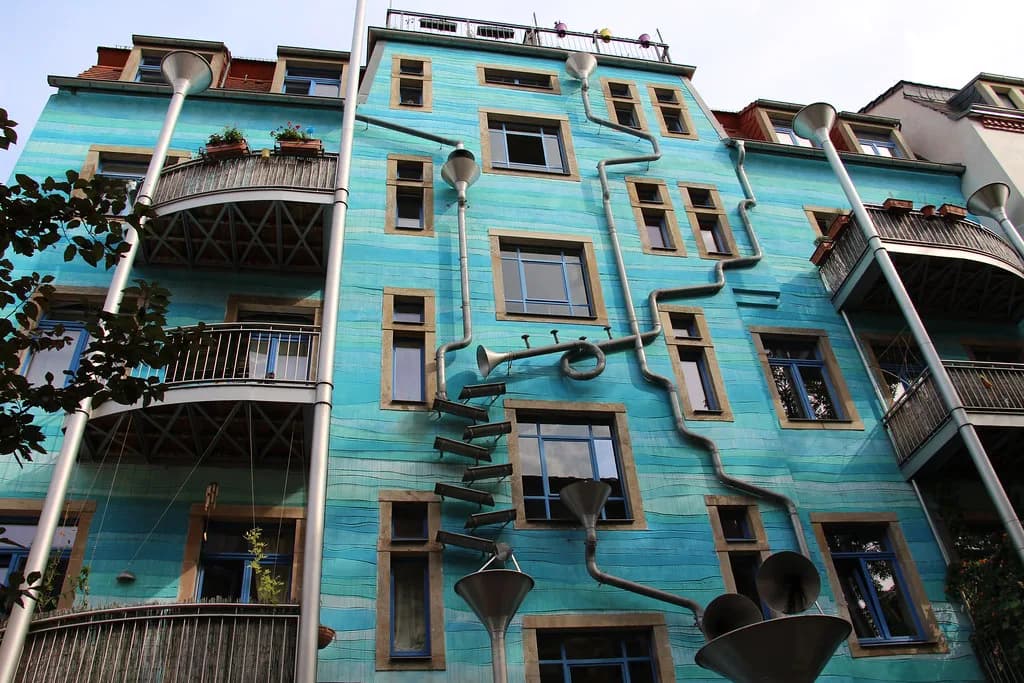
The Kunsthofpassage, usually shortened to Kunsthof, is easy to picture wrongly before you arrive. It is not one decorated building with a box office at the door, but several connected courtyards running between Alaunstraße 70 and Görlitzer Straße 21-25 in Dresden's Äußere Neustadt. The operator describes the site as an area of several hundred square metres that businesses and residents share, and says the courtyards live through that arrangement rather than despite it.
That single fact shapes the whole visit. You are walking through a working piece of city where people live above the shops and studios, so the courtyards are freely accessible grounds rather than a gated attraction with a single admission. Anything behind a shop or café door is a separate business with its own schedule, so the free courtyards do not tell you whether an interior is open.
On the operator's account the story began at some point in 1997, when a listed building was due for renovation and the question of what to do with its rear courtyard arose. Treat that as the founding context, not a full project timeline, and check the operator's own pages for anything more precise. If this is your first time in the city, the Dresden landmarks guide and the wider Dresden city guides are useful for deciding how much of the day the passage deserves.
Free Grounds, Separately Run Interiors
There is no entry fee to walk the courtyards, and no ticket gate to pass. The operator lists shops, ateliers, a bookshop and food and drink spots around and inside the passage, which means the free-access courtyards and the commercial units are two different things with two different sets of rules. Do not assume a single ticket covers the courtyards plus any interior, because no such shared ticket is described.
Because those units are independently run, their opening times and any prices are not published by the courtyard operator and should not be carried over from old blog posts or listings. Ask on the spot, or check the individual business before you build a meal or a purchase into your plan. This is the practical difference between a public passage and a shopping arcade: you can always walk through, but you cannot always buy something.
How Long the Five Courtyards Take
As an editorial suggestion rather than an official duration, allow roughly 45 to 75 minutes for the courtyards themselves. The operator publishes no recommended visiting time, so treat that range as a planning aid and adjust it to your own pace. The scale is small, and the passage is a stop within a neighbourhood walk rather than a half-day destination.
What pushes you toward the longer end is lingering: waiting for the water feature, reading the varied wall treatments, or stopping for a coffee if a courtyard café happens to be open. What pulls you toward the shorter end is a straight walk-through with a few photographs. If you want to slow the visit down and shoot properly, a Dresden photography guide gives you a structure for the surrounding streets as well.
The Five Courtyards, One by One
Hof der Tiere, the Courtyard of the Animals, carries a sandstone relief of savanna wildlife on a green house wall, with giraffes, monkeys and buffalo to pick out. The operator's own suggestion is to take a coffee and use the time to look properly, which is a good hint that the detail rewards slow reading. Hof der Metamorphosen, the Courtyard of the Metamorphoses, is framed by the operator as a long-term experiment in change on the walls rather than a fixed composition.
Hof der Elemente, the Courtyard of the Elements, puts water at the centre, with trumpet-like funnels winding across the facade and a water music sounding every half hour. Hof des Lichts, the Courtyard of the Light, is described as the central performance courtyard, where mirrors draw sunlight inward. Hof der Fabelwesen, the Courtyard of the Fable Creatures, is decorated with fabulous beings drawn from human and animal realms and assigned to the elements.
Each courtyard is small enough to cross in seconds, so the sequence matters more than the distance. Walk it in one direction and you cover everything; the risk is treating whichever courtyard you reach first as the whole passage. If you enjoy this kind of wall-scale work, the city's other offbeat corners are collected in the Dresden hidden gems guide.
Timing the Courtyard of the Elements
The water feature runs on a half-hour rhythm, according to the operator, which makes it the one element worth planning a pause around. Arrive, look at something else, and come back rather than walking straight through and missing the cycle. Build that pause into your 45-to-75-minute suggestion and you will usually catch it.
Set expectations honestly: this is a timed water-and-pipe feature on a working courtyard wall, not a concert or a scheduled performance. The operator describes water pouring through funnels and collecting vessels and falling into the courtyard in fine jets. Do not plan around rain making the pipes sing; the half-hour cycle is the behaviour the operator actually describes, and it is enough on its own.
Getting There by Tram
The operator lists four tram approaches, all ending in a short walk. Line 3 to Albertplatz, then roughly ten minutes on foot via Alaunstraße. Lines 7 and 8 to Bischofsweg, then about ten minutes via Bischofsweg and Alaunstraße. Lines 6 and 11 to Bautzner Straße / Rothenburger Straße, then about ten minutes via Rothenburger Straße and Görlitzer Straße. Line 13 to Görlitzer Straße, then roughly five minutes on foot.
The operator also notes a specific recommendation for wheelchair users and visitors with walking difficulties: use the Görlitzer Straße entrance to the courtyards. That is the only access guidance the operator publishes, so do not assume lifts, step-free guarantees or extra equipment beyond it. If your needs are specific, treat the Görlitzer Straße approach as the starting point and confirm the rest on arrival.
Finding the Entrances
The address pair itself is your orienting device: Görlitzer Straße 21-25 and Alaunstraße 70 mark the two ends of the passage. The operator gives both addresses, and knowing them stops you from hunting for a single front door. If you arrive from Albertplatz or Bischofsweg you are heading for the Alaunstraße end, while the Bautzner Straße / Rothenburger Straße and Görlitzer Straße approaches bring you in at the other side.
The passage is easy to walk past because it opens off the street rather than announcing itself. Pick one end, walk through, and use the far end as your exit into the next set of streets. The wider area is dense with small shops and cafés, so the surrounding quarter is where the bulk of your time will actually go.
Gates Closed at Night
The operator states plainly that the passage gates are closed at night. That makes the courtyards a daytime or early-evening stop, and it rules out late-night wandering as a plan. Do not substitute a third-party portal's stated hours range for this operator notice; the gate closure is the fact that matters for scheduling.
Because no courtyard opening hours are published, the sensible approach is to visit well inside daylight and not to build an evening around the passage. If you are planning a full day across the river, order the passage before your Old Town or Neustadt dinner rather than after it. Neustadt itself keeps going late, so the passage does not need to be your evening.
Quiet-Residential Etiquette
This is people's home as well as a public route, and the operator frames the courtyards as a symbiosis between those who trade there and those who live there. Keep voices low, do not photograph into windows, doors, balconies or private courtyards where residents are visible, and do not block stairwells or passageways. A working courtyard is not a stage set, and the residents have not agreed to be part of your pictures.
Practical self-restraint goes a long way here: step aside for people carrying shopping, keep tripods out of the walking line, and move on after you have taken your shot. Photographing the facades is what everyone comes for, and it is entirely reasonable, but it should not require a resident to close a curtain. If you want a broader sense of the district's character before you go, the Dresden neighborhoods walk is a useful orientation.
Putting the Passage in a Dresden Day
The Kunsthofpassage sits on the Neustadt side of the Elbe, so it pairs naturally with a morning or afternoon in the older part of the city across the river. Keep it proportionate: the courtyards take well under an hour to see, and they should not displace the museums and riverside landmarks if your Dresden time is short. The city's official tourism pages are the place to check what is currently on and how to book anything ticketed.
A sensible shape is Old Town first, then a tram or a walk across the river into the Äußere Neustadt, with the passage as one stop among several. If you want to compare a ticketed museum on the other side of the river against a free courtyard walk, the Albertinum Dresden visitor guide sets out what a paid interior actually involves. That contrast is useful when you are deciding how to spend a single day.
The surrounding quarter is genuinely the larger experience, with street life, small businesses and the ordinary texture of a lived-in neighbourhood. Build the walk around those streets rather than treating the passage as an isolated photo stop. You will spend more time in the district than in the courtyards, and that is the right proportion.
Plan Your Visit
The Kunsthofpassage works best when you treat it as a short, free walk through a residential and commercial block rather than a ticketed sight. Decide which end you are entering from, allow an hour or so including a pause at the water feature, and keep your voice and your lens pointed at the walls rather than at people's windows. Those three decisions cover most of what can go wrong.
Check the operator's pages before you travel for the current gate situation and the tram approaches, since those are the details that most often change. Then give the rest of your day to the wider city. The passage is a small, well-made part of Dresden, and it sits comfortably alongside everything else rather than competing with it.
Frequently Asked Questions
Is the Kunsthofpassage free to visit?
Yes. The courtyards are freely accessible grounds, and the operator publishes no entry fee. Any shops, ateliers, cafés or galleries around and inside the passage are separately run businesses, so their prices and opening times are not part of the courtyard visit and should be checked with each business directly.
How long does it take to see the five courtyards?
The operator publishes no official recommended duration, so treat any figure as an editorial suggestion. Somewhere between 45 minutes and 75 minutes suits most visits, depending on how long you linger at the water feature or stop for a drink. The courtyards are small, so this is a stop within a longer neighbourhood walk rather than a half-day outing.
Which tram stop is closest to the Kunsthofpassage?
It depends on which line you are on. The operator lists Line 3 to Albertplatz, Lines 7 and 8 to Bischofsweg, Lines 6 and 11 to Bautzner Straße / Rothenburger Straße, and Line 13 to Görlitzer Straße. The Görlitzer Straße stop gives the shortest walk at around five minutes; the others involve roughly ten minutes on foot.
Is the Kunsthofpassage open at night?
The operator states that the passage gates are closed at night. Treat the courtyards as a daytime or early-evening stop and do not build an evening plan around them. No courtyard opening hours are published, so you should not rely on a third-party site's stated hours range as an official time.
Can visitors with wheelchairs or walking difficulties access the courtyards?
The operator recommends the Görlitzer Straße entrance for wheelchair users and visitors with walking difficulties. That is the only access guidance published, and no lifts, step-free guarantees or additional equipment are described. If you have specific requirements, start from the Görlitzer Straße approach and confirm the details on arrival.
What should you not do at the Kunsthofpassage?
Do not treat the courtyards as a stage set. Keep voices low, avoid photographing into windows, doors, balconies or private areas where residents are visible, and do not block stairwells or passageways with tripods or groups. People live and work here, and the operator frames the site as a shared arrangement between residents and businesses.
Is the Kunsthofpassage worth visiting on a short Dresden trip?
It is if you are already spending time in the Äußere Neustadt, because the courtyards are free and quick to see. If your Dresden time is very short, the bigger museums and riverside landmarks deserve the priority, and the passage fits best as an addition to a Neustadt walk rather than a headline stop.


