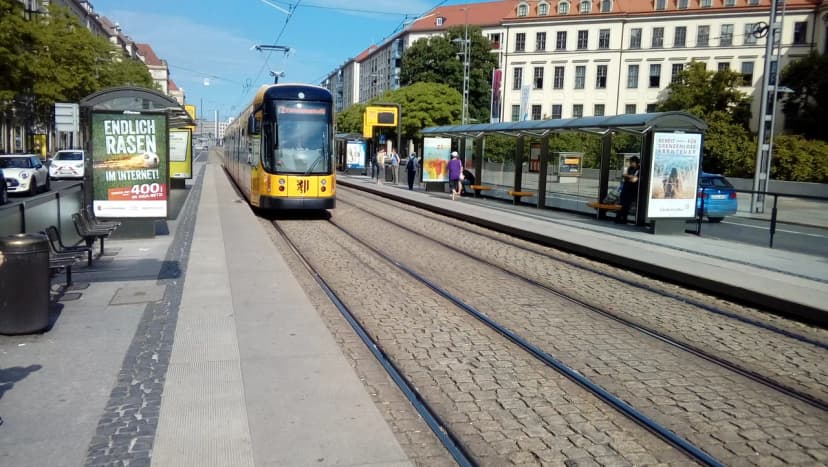
Dresden is unusually easy to move around without a car, but its fare system rewards one habit above all: counting the zones your actual route crosses rather than guessing a ticket type. The city runs trams, buses, S-Bahn trains, Elbe ferries and two mountain lines, and the regional transport association groups the whole area into tariff zones. Get the zone count right and almost every other decision, from a short hop to a day trip, falls into place.
Dresden itself sits in zone 10, while surrounding destinations carry their own numbers, so a trip out of the city is a different ticket question from a trip across it. The official zone map, not a rule of thumb, settles how many zones a specific route uses. Most visitor confusion comes from treating a network pass, a single ticket and a tourist railway as interchangeable when they are not.
What Actually Runs in Dresden
Within the city you can rely on a dense network of trams and buses, supplemented by S-Bahn trains and Elbe ferries that cross the river at several points. The city tourism office describes this as a well-developed local transport network and confirms that trams, buses, Elbe ferries and two mountain railway lines all operate in the Saxon capital. For a visitor, that means the river is rarely a barrier to your plans.
The distinction that matters most is between ordinary scheduled services and the two mountain lines, which look like public transport but behave differently at the ticket machine. Treating the mountain railways as part of the normal network is one of the most common planning errors, because the transport association explicitly excludes them from ordinary single-ticket validity. If a cable car or funicular is on your list, plan its ticket separately from your tram and bus fare; the Dresden Schwebebahn and Standseilbahn visitor guide covers what those two historic lines involve.
Because the network is citywide, most visitor itineraries can be built entirely around scheduled services plus walking, without hiring a car or booking taxis. That also makes the Dresden city hub a sensible starting point when you are deciding which landmarks to group together on one transport ticket.
The Zone System in Plain Terms
The regional transport association divides its area into 21 tariff zones, and the price of a journey depends on the zones you use, including any changes you make between a local train, S-Bahn, tram, bus or ferry. Dresden is zone 10, so any trip that starts and ends inside the city stays within a single zone. The moment you leave the city boundary, the count changes and so does the ticket you need.
This is why two journeys of identical length can cost differently: the calculation follows zones crossed, not kilometres travelled or minutes spent aboard. A route that touches three zones is a three-zone journey even if the ride feels short, and a long ride inside one zone is still a one-zone journey. The transport association's fare overview explains this logic and is the reference to check before you buy.
Some services leave the central association area but remain covered through additional zones, so an outbound trip does not automatically mean you need a different operator or a separate booking system. The practical takeaway is to look up your specific route on the official map rather than extrapolating from a previous trip. If you are planning several excursions, working out the zone count first will also shape how you plan day trips from Dresden by train or bus.
What a Single Ticket Costs and Covers
A single ticket is designed for one journey and carries both a zone scope and a maximum validity period, during which you may change between services. The published table effective 1 April 2026 lists one zone in Dresden at EUR 3.60 for adults with a one-hour limit, two zones at EUR 6.30 for ninety minutes, and three zones at EUR 9.50 for two hours. A reduced category also exists, listed at EUR 2.20 for the one-zone fare on the same page.
Two rules follow from that structure. First, changes of transport are permitted while the ticket remains valid, so switching from tram to bus to S-Bahn inside your window does not require a second fare. Second, the clock matters as much as the zone count on longer outings, because a ticket that has expired is no longer usable even if you are mid-journey. Fares are published figures and remain subject to change, so confirm the current amount before you travel.
For anyone staying a few days, combining a day or season pass with extra zones is a recognised arrangement rather than a workaround, and the fare pages include specific examples of how additional zones are added. The arithmetic is worth doing if you plan several trips beyond the city boundary in one day. Short central hops, by contrast, often sit comfortably inside the single-zone fare.
Buying Is Not Validating
On paper tickets, buying and validating are two separate steps, and skipping the second one turns a perfectly valid fare into an invalid one. The transport association advises validating paper tickets at the platform before boarding a local train, or on entering a tram or bus. Digital tickets are a separate case: the published stamping guidance concerns paper tickets, so follow whatever instructions come with the format you actually hold.
The safest habit is to validate before you step aboard rather than once you are seated, because on trams and buses the moment of entry is your window. If you are unsure where the machine sits at a given stop, allow an extra minute rather than assuming you can do it en route. This single routine prevents the most avoidable problem a visitor can have on Dresden's network.
Day Trips and Zone Numbers
The out-of-town zone numbers make the counting concrete: Meissen sits in zone 50, Pirna in zone 70 and Bad Schandau in zone 72. A trip from Dresden to any of those destinations crosses more than one zone, which immediately moves you above the basic single-zone fare. Which specific ticket applies still depends on the exact route you take, so the official map is what settles it.
Border stops and border areas are not the same thing, and conflating them leads people to under-buy. An identified stop sitting on a boundary can be approached with the fare for either relevant zone, while a designated border area has a narrower single-zone arrangement for short journeys inside it. The existence of that arrangement does not turn every trip that crosses a boundary into a one-zone journey, so check the map legend before assuming a discount applies.
What Your Ticket Does Not Include
Ordinary single-ticket validity does not extend to every vehicle that looks like public transport. The transport association expressly excludes Dresden's two mountain railways and the Meissen city tour from standard single-ticket coverage, and each of those services needs its own ticket check. Planning them as separate line items in your budget avoids an awkward moment at the gate.
A public transport fare also says nothing about admission to any attraction, so a tram ride to a museum district and entry to the buildings themselves are unrelated costs. Nothing about a transit ticket guarantees a connection either, so leave slack when a ferry or mountain line is part of a tight schedule. Budget for tourist transport separately and the rest of your planning becomes simpler.
Walking and Cycling as the Real Complement
Dresden's tourism office describes the pedestrian and cycling infrastructure as exceptionally well developed, which changes how often you actually need a ticket for short trips. A tourist wayfinding system has been built up since 2004, with steles at 46 prominent locations such as stations, stops and car parks pointing the way to the city's major cultural landmarks. Each stele carries an overview map of the inner-city ring plus directional destination information.
Cycling is a genuinely practical option rather than a niche one, with cycle paths running along many main roads for a total length exceeding 360 kilometres. The most important inner-city route is the Elberadweg, which follows the river bank away from road traffic as it winds through the city. For central sightseeing, walking or riding between clusters of landmarks can be quicker and more pleasant than boarding for one or two stops, which is worth factoring into a 2 days in Dresden itinerary.
If photography is part of your plan, the riverside paths also give you flexible positions along the Elbe, which is where many of the classic views open up. A Dresden photography guide can help you decide which stretches to walk rather than ride.
Six Mistakes Worth Avoiding
Under-buying zones is the most expensive error, because a ticket that does not cover your route is not a partial fare but an invalid one. Count the zones using the official map rather than assuming that any trip out of Dresden needs a specific ticket type. Forgetting to validate a paper ticket is the close second, and it produces the same practical result.
Assuming one ticket covers every boat, ferry or mountain railway is the third trap, since the two mountain lines and the Meissen city tour fall outside ordinary single-ticket validity. Treating a boundary stop as though it made the whole crossing a one-zone trip is the fourth. Letting the validity window lapse mid-journey is the fifth, and expecting a transit fare to include attraction admission is the sixth.
Plan Your Visit
Start every Dresden transport decision with two questions: which zones does my actual route cross, and do I need to validate a paper ticket before boarding? Answering those two covers the vast majority of situations a visitor encounters, and the official zone map resolves anything ambiguous about the count. Beyond that, keep tourist transport such as the mountain lines and the Meissen city tour in a separate budget line.
Briefly, singles run one zone for one hour at EUR 3.60, two zones for ninety minutes at EUR 6.30, and three zones for two hours at EUR 9.50, with a reduced one-zone fare of EUR 2.20, all as published for 1 April 2026. Changes are allowed within the validity window.
Fares and route maps are published with dates and remain subject to change, so confirm the current figures with the transport association before you travel. With the zone count sorted and a validated ticket in hand, Dresden's trams, buses, ferries and riverside paths make the city straightforward to explore on foot and by scheduled service.
Frequently Asked Questions
Is Dresden a walkable city?
The city's tourism office describes the pedestrian and cycling infrastructure as exceptionally well developed, and a tourist wayfinding system with steles at 46 prominent locations points the way to major landmarks. Cycle paths along many main roads total more than 360 kilometres, and the Elberadweg runs along the river bank away from road traffic. For central sightseeing, walking often competes well with taking a tram or bus for one or two stops.
How many zones do I need for a trip from Dresden to Meissen or Pirna?
The regional network is divided into 21 tariff zones, with Dresden in zone 10, Meissen in zone 50, Pirna in zone 70 and Bad Schandau in zone 72. That means each of those day trips crosses more than one zone and sits above the basic single-zone fare. The exact count depends on your specific route, so check the official zone map rather than assuming a fixed number.
Do I need to validate a paper tram ticket in Dresden?
Yes. The transport association advises validating paper tickets at the platform before boarding a local train, or on entering a tram or bus. Buying and validating are separate steps, and an unvalidated paper ticket is not a valid fare. The published stamping guidance concerns paper tickets specifically, so follow the instructions that come with whichever ticket format you hold.
Does a public transport ticket cover the Elbe ferries and mountain railways?
Elbe ferries are named among the services operating in the city and the fare calculation covers changes between local trains, S-Bahn, trams, buses and ferries. The two Dresden mountain railways are different: the transport association expressly excludes them from ordinary single-ticket validity. The Meissen city tour is excluded on the same basis, so treat those tourist services as separate tickets.
Is a single ticket valid if I change between tram, bus and S-Bahn?
A single ticket is intended for an individual journey and permits changes of transport while it remains valid. It carries both a zone scope and a maximum validity period, so the clock and the zones both matter. As long as you stay within the covered zones and the time window, switching between tram, bus, S-Bahn or ferry is part of the same journey.
What are the boundary stop and boundary area rules?
The official fare overview distinguishes a boundary stop from a boundary area. An identified stop sitting on a boundary can be approached with the fare for either relevant zone, while a designated border area has a narrower single-zone arrangement for short journeys entirely inside it. That arrangement does not make every trip that crosses a boundary a one-zone journey, so the map legend is the thing to check.