Dresden's two Loschwitz mountain railways have valley stations roughly 150 metres apart near Körnerplatz, according to Dresden Elbland tourism. One is a suspension railway whose cars hang from an overhead rail; the other is a cable-hauled funicular on rails. They end at different upper stations, so the walks at the top differ too.
The critical planning detail for late 2026 is that both railways close for autumn inspection work at staggered times: the city of Dresden lists the Schwebebahn as closed from 2 to 13 November 2026 and the Standseilbahn from 16 to 27 November 2026. Travelling outside those windows keeps both options open; a trip that straddles them may leave only one railway running.
Schwebebahn: Dresden's Suspension Railway to Schöne Aussicht
The Schwebebahn began operating in 1901 and carries passengers from Loschwitz up to the viewpoint known as Schöne Aussicht in roughly four and a half minutes, climbing 84 vertical metres on the way. Its cars hang from a fixed overhead rail rather than running on the ground, which is why the ride feels more like gliding than climbing. That engineering difference is the core reason to ride this one even if you have already tried the funicular.
The route links the Loschwitz district with the higher ground of Oberloschwitz, and the upper station includes a viewing platform that walkers on the local network treat as a highlight. Because the car hangs over the slope, the changing angle of the Elbe valley opens up over the course of the short trip. If photography matters to you, ride up facing the valley side and save the straight-on view for the top.
Historically minded visitors can look at the machine house at the upper station, which the city describes as open to those interested in the technology. Interior visits are presented as something that may be possible rather than guaranteed, so confirm on the day before planning your timing around it.
Standseilbahn: The Funicular to Weißer Hirsch
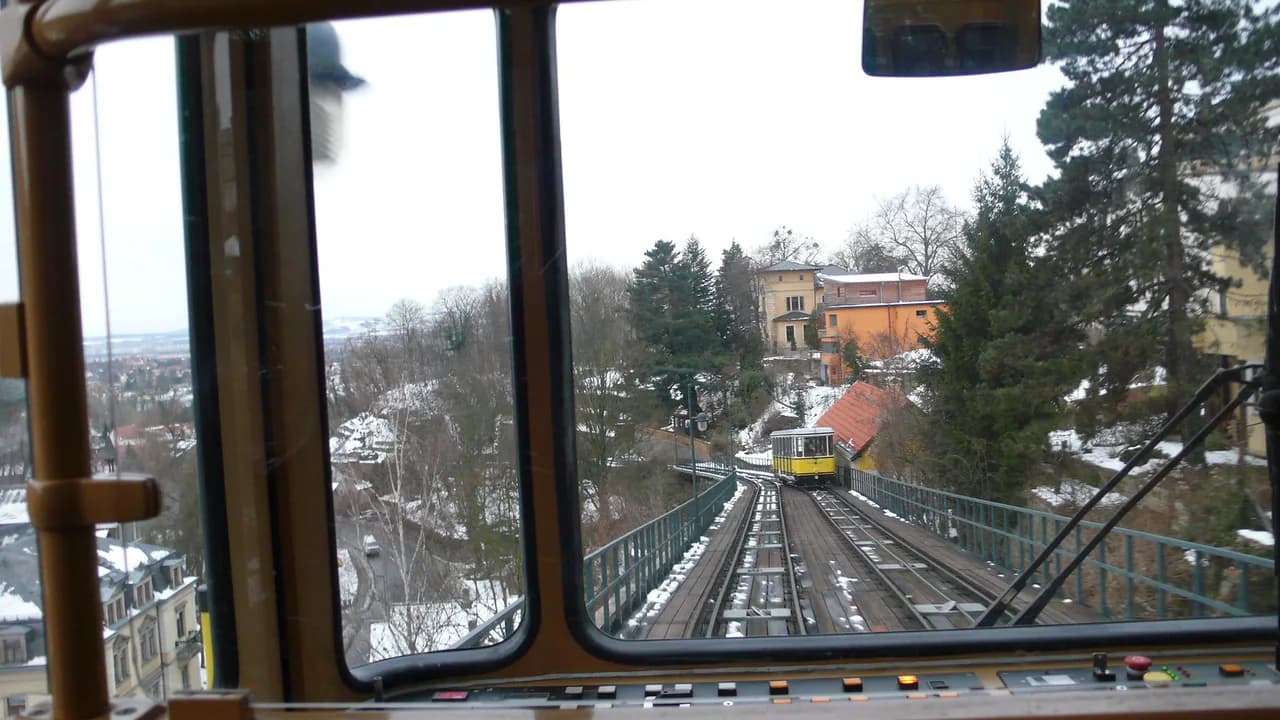
The Standseilbahn has connected Loschwitz with the villa quarter of Weißer Hirsch since 1895, and it lifts passengers 95 metres to an upper station with a broad view over Dresden. A funicular is hauled by cable on rails, so the sensation is a steady pull upward rather than the floating motion of the Schwebebahn. Riding both back to back makes the contrast obvious in a way that reading about it never quite does.
The upper terminus is at Bergbahnstraße, and its position above the Elbe slope is why the outlook here is often described as the better of the two summit views. Visits to the historic machine house are also possible at this end, along with the neighbouring Villa San Remo on Bergbahnstraße. Plan the funicular as the more rewarding summit stop if you only have time for one.
The path network above the funicular runs through villa streets such as Sonnenleite and Ulrichstraße and connects across to the Schwebebahn's upper platform. Keep the descent in mind: you can either ride back down or walk the connecting route through the wooded upper slope, which signals a trail section on the way. Choose the walk only if the weather is dry, because the path mixes asphalt and unpaved stretches.
How to Get to Körnerplatz and the Valley Stations
Both valley stations sit in Loschwitz close to Körnerplatz, which the city serves with bus lines 61 and 63 for each railway; the Schwebebahn's visitor address is Pillnitzer Landstraße 5 and the Standseilbahn's is Körnerplatz itself. The same bus corridor also reaches Schillerplatz on the opposite bank, where tram lines 6 and 12 and bus lines 61, 63 and 65 stop near the Blue Wonder bridge. If you prefer to arrive on the Dresden tram network first and change, that crossing point is the practical handover.
Dresden's broader network includes trams, buses, Elbe ferries and the two mountain railway lines, so the railways function as public transport as well as attractions. That dual role is useful: you do not have to treat the ride as an excursion separate from your normal travel around the city. Allow extra time for connections on days when either railway is under revision.
Saxony's tourism board frames both railways as tourist attractions that are simultaneously part of the public transport system, which is a fair way to set expectations. Treat them as reliable short hops rather than theme-park rides, and check the current service notices before travelling if a specific railway is the point of your trip.
What You See and Do at the Top
The funicular's upper station gives a wide view over Dresden from 95 metres above its valley terminus, which is the strongest single panorama of the two. The Schwebebahn platform at Schöne Aussicht looks along the Elbe valley from Oberloschwitz instead, so the framing is different rather than simply better or worse. If you want one clean city view, ride the funicular; if you want the valley and the bridge below you, ride the suspension railway.
Above the funicular, the walk toward the Schwebebahn passes villa architecture including Villa San Remo on Bergbahnstraße and characterful houses on Sonnenleite. The route has roughly 130 metres of ascent and descent in total and is rated easy, so it suits most walkers but still requires sensible shoes. Expect a mix of street, path and some unclear surface sections rather than a manicured promenade.
The upper Loschwitz slopes have long been one of Dresden's favoured residential areas because of the outlook across the Elbe valley, which is why the walk between the stations is worth doing rather than just riding. Set aside time at the top instead of treating the railways as a quick in-and-out. A coffee or a slow loop through the villa streets is the difference between a transit leg and a half-day.
Combining Both Railways in One Visit
A sensible sequence is to start at Körnerplatz, ride one railway up, cross the upper slope on foot, and come down on the other, which turns two short rides into one loop. Riding up the funicular first and down the Schwebebahn means you finish near the Elbe side and the walk back toward the bridge area. Reverse it if you prefer to end among the villa streets.
The two valley stations are about 150 metres apart, so switching railways down in the valley is short and easy, though the connecting walk between the upper stations is the more interesting version. Walking at the top gives you the viewpoints, the villa streets and the sense of the slope rather than just the two rides. Either approach works; the upper walk is a suggestion, not an official route.
As a rough planning figure, allow two to three hours if you want both railways plus the upper walk and a pause at a viewpoint; that is a suggestion, not an official duration. Without the walk, the two rides and the transfer at street level take far less. If your day is tight, one railway plus the Blue Wonder bridge area is a coherent half-day in itself.
Accessibility: What Is Documented and What Is Not
For the funicular, Saxony's tourism board publishes detailed barrier-free information: step-free access to the platform and car at both stations, with the upper terminus reached via a slope of 10 to 12.6 percent over 160 centimetres. The gap between car and platform is given as 2 to 3 centimetres high and 8 centimetres wide, and a separate compartment accommodates a wheelchair with a 79-centimetre door and a 120 by 192 centimetre turning space, with a maximum of two wheelchairs per car. Disabled parking is available at the upper terminus on Bergbahnstraße.
The Schwebebahn does not have the same documented barrier-free detail in the public sources, so do not assume the funicular's specifics carry across to the suspension railway. Ask the operator directly if step-free boarding or wheelchair space matters for your visit. Planning around the documented funicular and treating the Schwebebahn as unconfirmed is the safer approach.
General city information on accessibility and public transport in Dresden is published by the municipality and is a reasonable starting point for wider trip planning. Use it to check accessible routes to and from Loschwitz rather than for railway-specific rules. Confirm the railway details themselves with the operator before you travel.
Autumn 2026 Revision Closures and How to Plan Around Them
The city of Dresden lists autumn revision closure windows for both railways in 2026: the Schwebebahn is closed from 2 to 13 November 2026, and the Standseilbahn from 16 to 27 November 2026. These are inspection periods, so they close each line entirely for the dates given. Treat those windows as fixed for 2026 and recheck before travelling, since they are specific to that year.
Overlapping both windows, the two railways are closed for a total stretch of roughly four weeks, with only the Standseilbahn running in early November and only the Schwebebahn running in late November. If your trip falls in that month, decide which railway is the priority and build the day around it. Outside November, both are normally available subject to the operator's own service notices.
Revision windows also mean the machine houses and station areas can be affected by works, so treat any interior visit as something to confirm close to your date. Do not plan a trip whose sole purpose is a specific railway in those windows without a fallback. The Elbe valley views from the slopes and the bridge area remain available even when one railway is down.
Mistakes to Avoid
The most common planning error is assuming both railways run continuously and always together, when autumn revision closures affect each line at different times. A second is treating the pair as one attraction with one ticket; they are separate railways with separate operations, and nothing in the official information suggests a shared ticket. Buy and plan for each separately.
A third mistake is budgeting no time at the top, which turns a genuine Loschwitz experience into two short transits. The summit walks, the viewpoints and the villa streets are the point of going up. Give the upper slope at least a short loop and you get far more from either railway.
Also avoid assuming machine house interiors are open. The city says visits are possible, which is not the same as guaranteed daily access. Check with the operator on the day, and treat the railway ride itself as the reliable part of the visit.
Beyond the Railways: Blue Wonder, Heritage Transport and More
The Loschwitzer Brücke, known as the Blue Wonder, has linked Loschwitz and Blasewitz since 1893 and stands close to the railway valley stations, which makes it a natural add-on. It is a steel truss structure with its own history and viewpoints from the riverbank below. Pairing a bridge walk with the railways gives the eastern districts a clear half-day shape.
Dresden's historic transport scene goes well beyond the mountain railways, including paddle steamers of the White Fleet, narrow-gauge steam routes in the surrounding region and the Dresden Transport Museum. The Saxon steam railway route converges on Dresden, so railway enthusiasts can extend the day considerably. Keep the mountain railways as the anchor and treat the rest as optional additions.
Viewpoints across Dresden vary in what they show, from the Elbe valley to the baroque skyline, and the two railway summits are only one option among several. If you are collecting panoramas across a longer stay, compare the alternatives before committing an afternoon. The Loschwitz slopes reward a slower approach rather than a rushed list-ticking circuit.
Plan Your Visit
Decide first whether you want the suspension railway's valley glide or the funicular's summit panorama, then check the November 2026 revision dates before locking in a day. If both are running, use Körnerplatz as your start and link the upper stations on foot for the fuller experience. If one is closed, the other plus the Blue Wonder area still makes a solid outing.
Confirm current operating status, access arrangements and any machine house visits with the operator close to your travel date, because the published sources cover history and closures but not day-to-day service. Use the city's transport pages for routes to Loschwitz and the tourism board's accessibility notes for the funicular. Plan around what is confirmed and keep the rest flexible.
Frequently Asked Questions
What is the difference between the Dresden Schwebebahn and the Standseilbahn?
The Schwebebahn is a suspension railway, opened in 1901, whose cars hang from an overhead rail and climb 84 metres to Oberloschwitz in about four and a half minutes. The Standseilbahn is a cable-hauled funicular on rails, running since 1895 between Loschwitz and the villa quarter of Weißer Hirsch with a 95-metre climb. Their valley stations sit roughly 150 metres apart near Körnerplatz.
Do the Dresden Schwebebahn and Standseilbahn close in autumn 2026?
Yes. The city of Dresden lists autumn revision closures for both: the Schwebebahn from 2 to 13 November 2026 and the Standseilbahn from 16 to 27 November 2026. Those dates apply to 2026 only, so check the operator's current notices if you are travelling in a different year or month.
Can you ride both Dresden mountain railways in one visit?
You can, and it is the best way to see how different the two systems are. Ride one up from Körnerplatz, walk across the upper slope to the other station, and ride back down. Allow a few hours if you want the walk and a stop at a viewpoint; that timing is a suggestion, not an official figure.
Is the Dresden funicular wheelchair accessible?
Saxony's tourism board documents step-free access at both funicular stations, a separate wheelchair compartment with specific door and turning dimensions, and a maximum of two wheelchairs per car, plus disabled parking at the upper terminus. The Schwebebahn does not have equivalent published detail, so confirm boarding arrangements with the operator before relying on them.
How do you get to Körnerplatz to start the Dresden mountain railways?
Körnerplatz in Loschwitz is served by bus lines 61 and 63, and the city gives the Schwebebahn's visitor address as Pillnitzer Landstraße 5 and the Standseilbahn's as Körnerplatz itself. From the opposite bank near Schillerplatz, tram lines 6 and 12 and bus lines 61, 63 and 65 connect across the Blue Wonder area.
What can you see at the top of the two railways?
The funicular's upper station gives a wide view over Dresden from 95 metres above its valley terminus, and the Schwebebahn platform at Schöne Aussicht looks along the Elbe valley from Oberloschwitz. Above the funicular, villa streets such as Sonnenleite and Ulrichstraße lead toward the Schwebebahn, with Villa San Remo on the way.