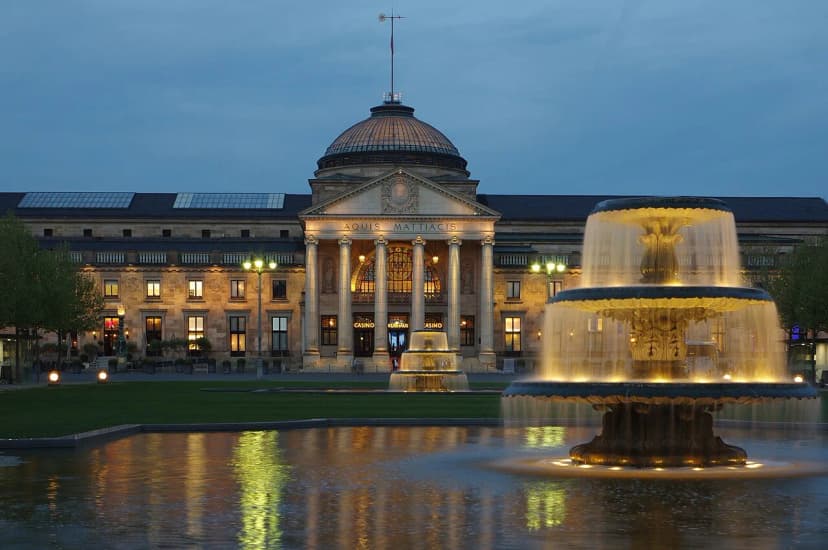
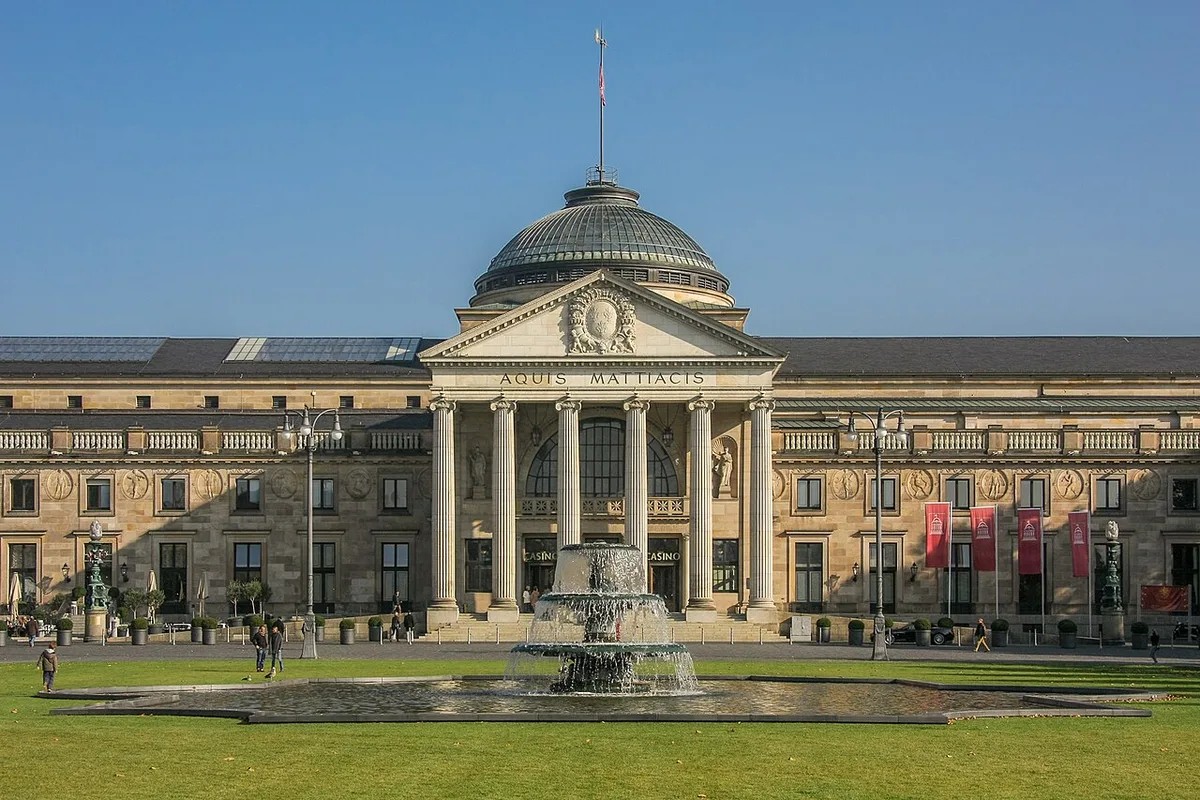
The Kurhaus is the building most people picture when they picture Wiesbaden: a neo-classical spa house from 1907 with a columned entrance at Kurhausplatz and the Kurpark behind it. The operator, Wiesbaden Congress & Marketing GmbH, publishes 2,500 visitors capacity, 12 event rooms and five outdoor areas, which tells you the building is sized for congresses, galas and performances rather than a steady flow of sightseers.
This guide separates what you can reasonably do without buying anything from what needs an event ticket, casino admission or a guided tour booking. It treats the Spielbank Wiesbaden casino as its own decision with its own rules, because that is how the operator presents it. For a wider look at how this building fits a longer stay, the Wiesbaden city travel guides cover routes and day planning.
What the Kurhaus Actually Is
The Kurhaus was built in 1907 and is described as one of the Rhine Valley's major conference and event venues, with ballrooms, bars, a casino, theatres and concert halls inside. It sits on Kurhausplatz in the centre of Wiesbaden, next to the Wilhelmstrasse shopping street and in front of the Kurpark. That combination of location and function is the key to planning a visit: you are visiting a working venue in a park setting, not a heritage site with rooms kept open for tourists.
The operator's visitor page is deliberately thin on room-by-room access, opening hours and admission, and instead directs people to the event programme and to enquiries. That absence is worth reading literally: the Kurhaus does not publish guaranteed daily sightseeing access, so do not plan a trip around the assumption that the halls will be open when you arrive. Instead, check the programme and confirm on the day.
Free Areas Versus Ticketed Events
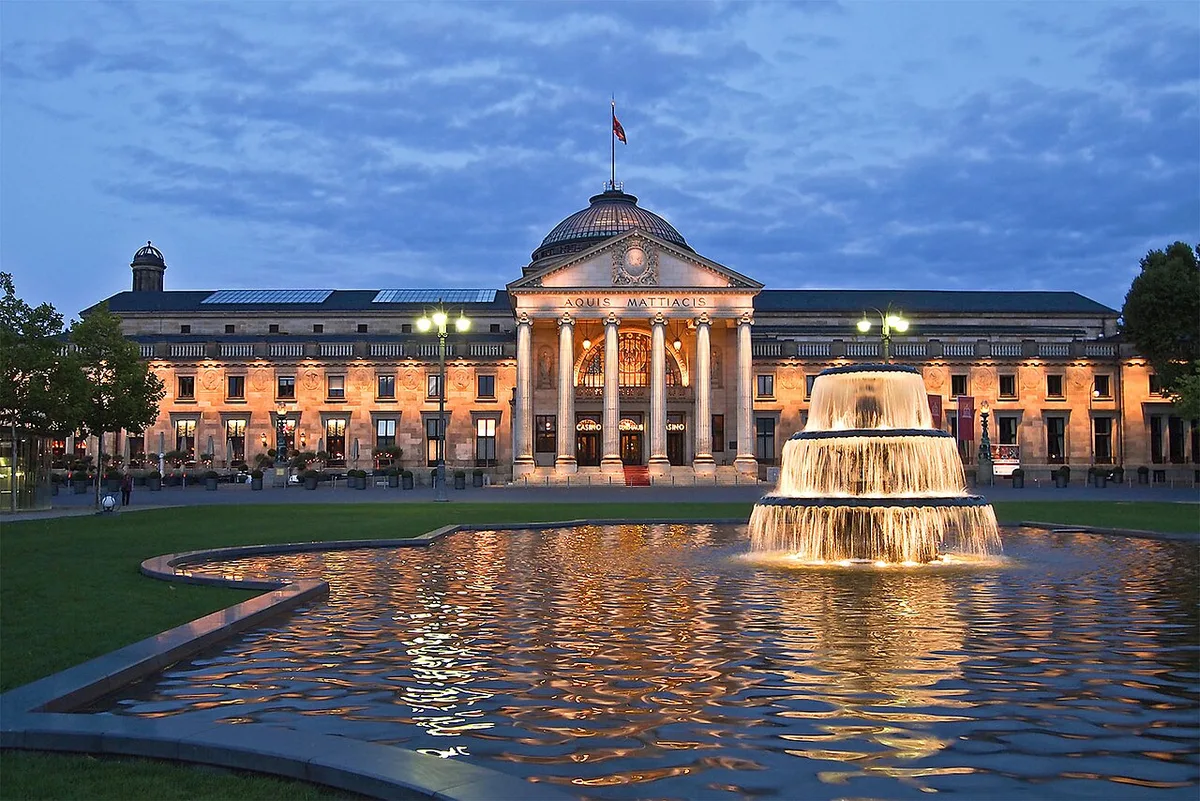
Treat the building in two layers. The exterior, the colonnaded entrance, Kurhausplatz and the Kurpark behind it are public spaces you can walk through, and the Bowling Green fountains in front of the building are part of that same outdoor ensemble, as described in city coverage of the complex. The interior event halls, on the other hand, are booked for performances, congresses and private functions, so entering them generally depends on holding a ticket for whatever is happening that day.
Public guided tours of the interior are described in a travel blog, but that post does not give reliable current times, prices or booking rules, and it should be read as a personal account rather than as the venue's policy. The safe approach is to ask Wiesbaden Congress & Marketing or the Tourist Information Office whether a tour is running during your dates before you build your day around it. Do not assume a tour exists simply because one was reviewed online.
One practical trap: the Kurhaus shares a complex with the casino, restaurants and the Kurpark, but that does not mean one ticket covers everything, or that museums elsewhere in Wiesbaden are included. Museum Wiesbaden, for example, is a separate institution with its own admissions policy, covered in the Museum Wiesbaden visitor guide. Check each element on its own terms.
The Event Halls and What the Numbers Mean
The two names you will encounter most often are the Friedrich von Thiersch Hall, the large columned hall that functions as the ceremonial centrepiece, and the Salon Kolonnade, a smaller, lighter space along the colonnade side; both appear in visitor descriptions of the interior. The operator publishes 12 event rooms in total, plus five outdoor areas, and a capacity of 2,500 across the building. Those numbers are the visitor's best clue about scale: this is a venue where a single event can absorb most of the building.
That capacity has a direct practical consequence. On a large congress or gala day, halls can be closed to casual visitors, security may be tighter around the entrances, and the foyer can be full of delegates rather than tourists. On a quiet day, you may be able to stand in the foyer and take in the architecture without much fuss. Neither outcome is guaranteed, so treat the event calendar as your planning tool rather than your expectations.
The Spielbank Wiesbaden Casino
The casino occupies part of the Kurhaus building and presents itself as one of Europe's most beautiful gaming halls alongside a modern slot-machine floor, with roulette and black jack in the classic rooms and poker as a significant part of the offer. It also runs its own bar and restaurant and a recurring Ladies Night on the first Thursday of the month. If you want the casino experience, it is a separate visit with its own admission arrangements.
The operator's site is the place to confirm entry requirements, minimum age, identification and dress expectations, because those rules change and this guide will not guess at them. Do not rely on older reviews for casino prices or opening times; check the Spielbank's own pages immediately before you go. If gambling is not your interest, the building itself and the neighbouring park are still worth the walk, so treat the casino as an optional layer rather than the reason to come.
Kurpark and the Bowling Green Fountains Without a Booking
The easiest no-booking visit is a loop: arrive at Kurhausplatz, walk the forecourt and the Bowling Green fountains, then continue into the Kurpark behind the building. The Kurpark is an English-style landscape park with a lake, old trees and paths, and it is the part of the ensemble that needs no ticket or reservation. Fountains and water features are operated seasonally, so do not build a plan around them being on outside the warmer months.
This loop also links naturally to the city's spa identity. Wiesbaden's thermal springs, including the Kochbrunnen, are a short walk from the Kurhaus, and pairing the two gives you both the architectural and the wellness sides of the spa town in one outing. The Kochbrunnen Wiesbaden hot springs guide explains what to expect at the spring itself.
Two Suggested Visit Lengths
For a walk-through look at the exterior, the forecourt and the Kurpark, allow roughly 45 to 90 minutes at a relaxed pace; this is a suggestion, not an official duration, and it assumes you are not stopping for food. You will spend most of that time outdoors, so weather and daylight matter more than scheduling. If the building happens to be open and quiet, you can add a short look inside without extending the plan much.
If you are adding a performance, a gala or a casino session, plan a half-day or an evening instead, and confirm the start time and entry requirements with the organiser in advance. Arriving early gives you time to find the right entrance and to walk the park before the doors open. A longer block also makes it easier to combine the Kurhaus with dinner on Wilhelmstrasse or a show at the Hessisches Staatstheater Wiesbaden.
Practical Planning and Tickets
The Wiesbaden Tourist Information Office at Marktplatz 1 is the most reliable first stop for advance ticket sales, city maps and brochures, and it also handles reservations for city tours and boat cruises. It is open Monday to Saturday from 10:30 a.m. to 5:30 p.m. and closed on Sundays, so plan a morning visit if you want to combine ticket buying with a same-day walk to the Kurhaus. You can also reach the office by public transport via the Dern'sches Gelände stop.
Wiesbaden's main station, Wiesbaden Hauptbahnhof, sits just south of the historic centre, and the city is part of the Rhein-Main S-Bahn network with S1, S8 and S9 services running through the Frankfurt area. From the station, the Kurhaus and Marktplatz are a manageable walk or a short bus ride. Because fares and timetables change, check current connections with the local transport operator rather than relying on older figures.
Where the Kurhaus Fits in a Wiesbaden Day
Wilhelmstrasse runs alongside the Kurhaus and is the city's main shopping street, which makes the building an easy anchor for a half-day in the centre. The Hessisches Staatstheater Wiesbaden is nearby for opera, ballet and plays, and the Marktkirche and the old town sit a short walk south. If you have time for one more stop, the Kaiser-Friedrich-Therme offers a historic bathing experience with an Art Nouveau interior and Roman-Irish bathing traditions.
For a change of scale, the Neroberg hill and its water-powered funicular give you a view back over the city, and Schloss Biebrich, in the separate Biebrich district on the Rhine, offers a Baroque palace and riverside gardens. If you want to push further out, an Eberbach Abbey day trip from Wiesbaden covers the Rheingau wine country. The Wiesbaden landmarks guide is the place to compare these options before committing.
Decide by What You Want from the Building
The Kurhaus rewards a simple decision. If you want the architecture, the square and the park, go without booking anything and treat it as a walk with a landmark at its centre. If you want the halls, a performance or the casino, choose that specific experience, check the programme and confirm entry rules with the operator beforehand. Trying to do both at once on an event day is where visitors get frustrated.
Build the day around what is actually published: the operator's event calendar for the halls, the Spielbank's own pages for the casino, and the Tourist Information Office at Marktplatz 1 for tickets and maps. Anything else, from fountain operation to interior access, is a variable rather than a right. Confirm before you travel and the Kurhaus will be a good half-day rather than a missed one.
Frequently Asked Questions
Is the Kurhaus Wiesbaden free to enter?
There is no single answer, because the Kurhaus is a working event venue rather than a museum. The exterior, Kurhausplatz, the Bowling Green fountains and the Kurpark behind the building can be walked without a ticket, and that is the reliable free experience. The interior event halls are typically tied to whatever event is taking place, so access depends on the day's programme rather than a permanent sightseeing ticket. Check the operator's event calendar before you go.
Do I need to book to see inside the Kurhaus?
For the event halls, yes in practice: entry is normally connected to a ticket for a performance, congress or private function. Public guided tours have been described by visitors, but times, prices and booking rules change, so treat those accounts as a starting point rather than a rule. Ask Wiesbaden Congress & Marketing or the Tourist Information Office at Marktplatz 1 whether a tour is running during your dates, and do not build your day around an interior visit that has not been confirmed.
What is the difference between the Kurhaus event halls and the casino?
The event halls are the Kurhaus's own rooms, including the Friedrich von Thiersch Hall and the Salon Kolonnade, and they host concerts, galas and congresses under the operator's programme. The Spielbank Wiesbaden casino occupies part of the same building but operates as its own business with its own admission rules, age requirements and dress expectations. A performance ticket does not give you casino access, and casino entry does not include a concert. Check each side separately.
How long should I spend at the Kurhaus and Kurpark?
For an exterior-and-park visit, a relaxed walk of roughly 45 to 90 minutes is a sensible suggestion, though this is not an official figure. If you add a performance, a gala or a casino session, plan half a day or an evening and confirm the start time with the organiser in advance. The Kurpark itself can absorb as much time as you give it, especially in good weather, so decide first whether you are sightseeing or attending something.
What can I see near the Kurhaus without buying a ticket?
You can walk Kurhausplatz, the colonnaded front of the building, the Bowling Green fountains in front of it and the Kurpark behind, including the lake and the landscaped paths. Wilhelmstrasse shopping street runs alongside, and the Marktkirche and old town are a short walk away. These are public spaces and do not depend on the event programme, though fountains and some outdoor features are seasonal, so check locally if they matter to you.
Is the casino part of the Kurhaus building?
Yes, the Spielbank Wiesbaden casino is housed within the Kurhaus complex, which is why the building is often described as combining event halls, restaurants and gaming rooms. That does not make it free or open to everyone: the casino has its own entrance arrangements, identification and age rules, and dress expectations that you should confirm on the operator's own site before travelling. The rest of the building and the park are unaffected by those rules.
Sources
- Startseite | Kurhaus Wiesbaden
- Home
- Wiesbaden Germany - travel guide and information from German Sights
- Wiesbaden Travel Guide | Wiesbaden Tourism - KAYAK
- Tourist Information | Visit Wiesbaden
- Kurhaus Wiesbaden Tour: A Detailed Review & Guide – travelwhirl.family.blog
- Für Besucher | Kurhaus Wiesbaden
- Kaiser-Friedrich-Therme | Visit Wiesbaden