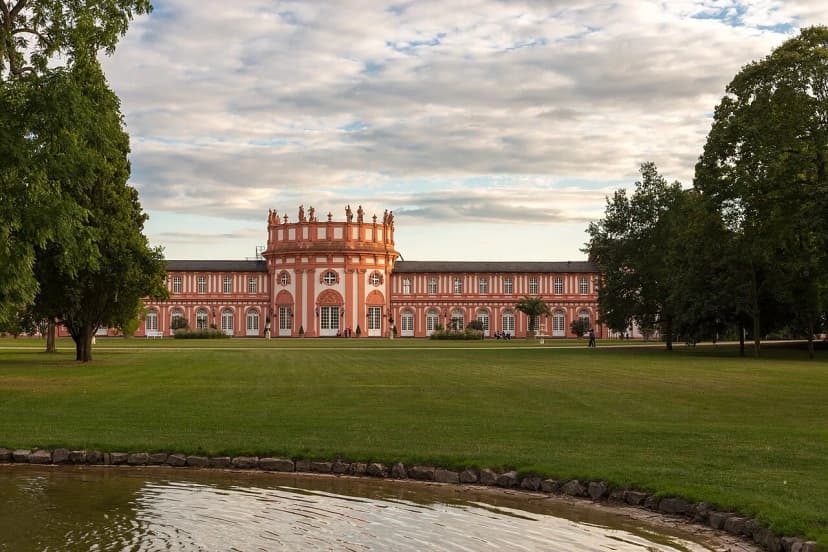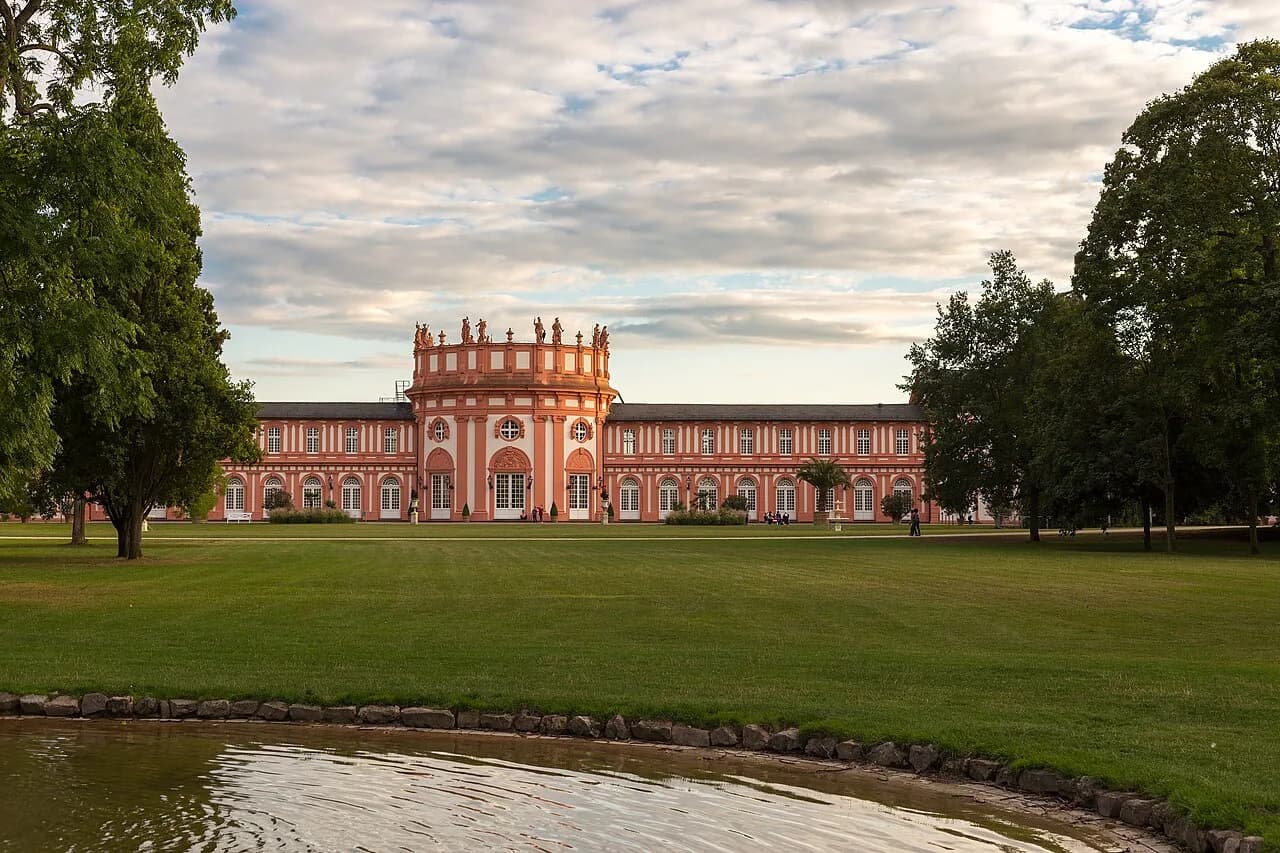
Schloss Biebrich is one of the rare German palaces that sits directly on a major river, occupying the Rhine bank in Wiesbaden's Biebrich district rather than a hilltop or a town square. The single most useful planning fact is that the palace itself is not a museum: the Wiesbaden tourism office describes it as home to various authorities and regularly used for celebrations and receptions, while the former chapel and, in summer, the large outdoor terrace serve as cafe and restaurant space. The park behind it, by contrast, is listed by the state palaces and gardens authority as an outdoor area freely accessible to all.
That split shapes everything about a visit. You come for the baroque exterior, the Rhine front and the landscape garden, not for furnished state rooms. This guide explains the palace's origins and its Versailles comparison, what the three-winged building and Rotunda look like from outside, why the interiors are largely closed, what makes the park worth the walk, and how to think about reaching Biebrich from central Wiesbaden. For the wider city picture, the Wiesbaden itineraries and city travel guides cover how the palace fits into longer stays.
Why Schloss Biebrich Is Called Versailles on the Rhine
The palace started smaller than its present name suggests. Castleholic records that Count Georg August Samuel of Nassau-Idstein, raised to princely rank in 1688, bought land on the Rhine and began construction in 1701; the first building was completed in 1702 to plans by Julius Ludwig Rothweil, with an identical second structure added in 1706. The two pavilions originally housed the prince and his wife separately, which is why the earliest palace reads as a pair rather than one block.
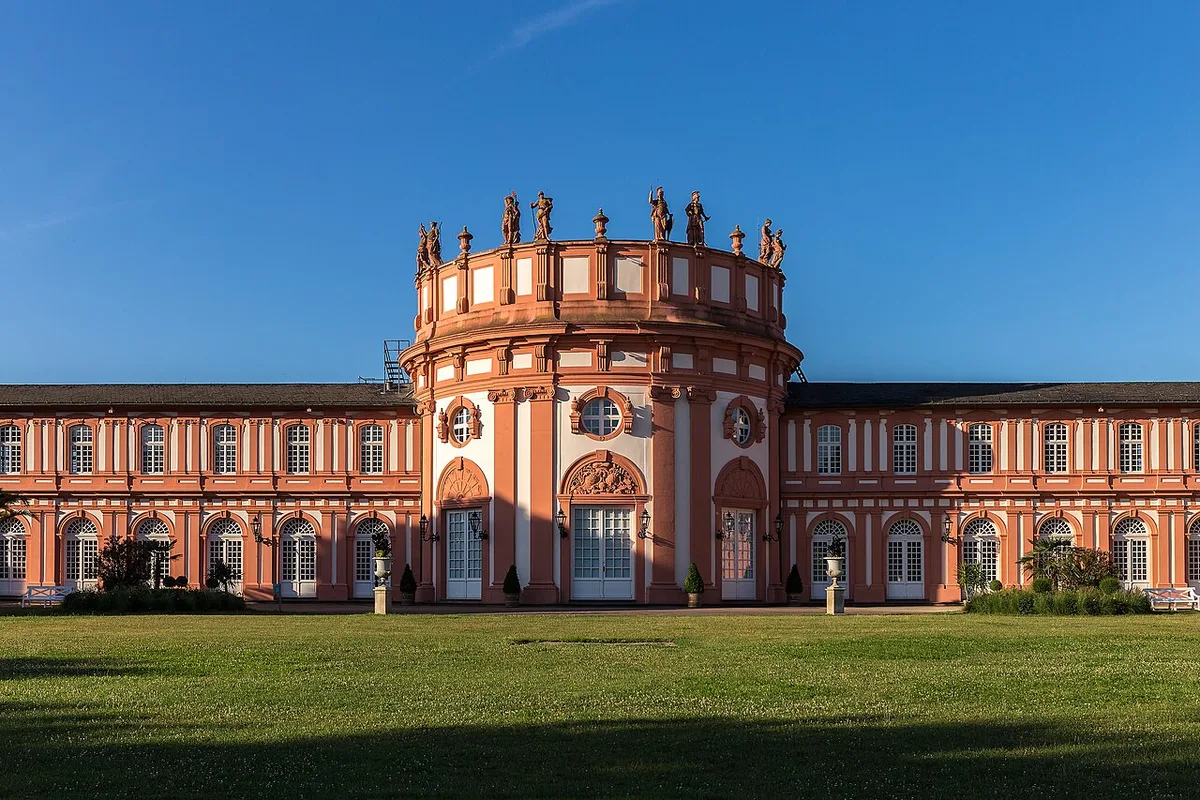
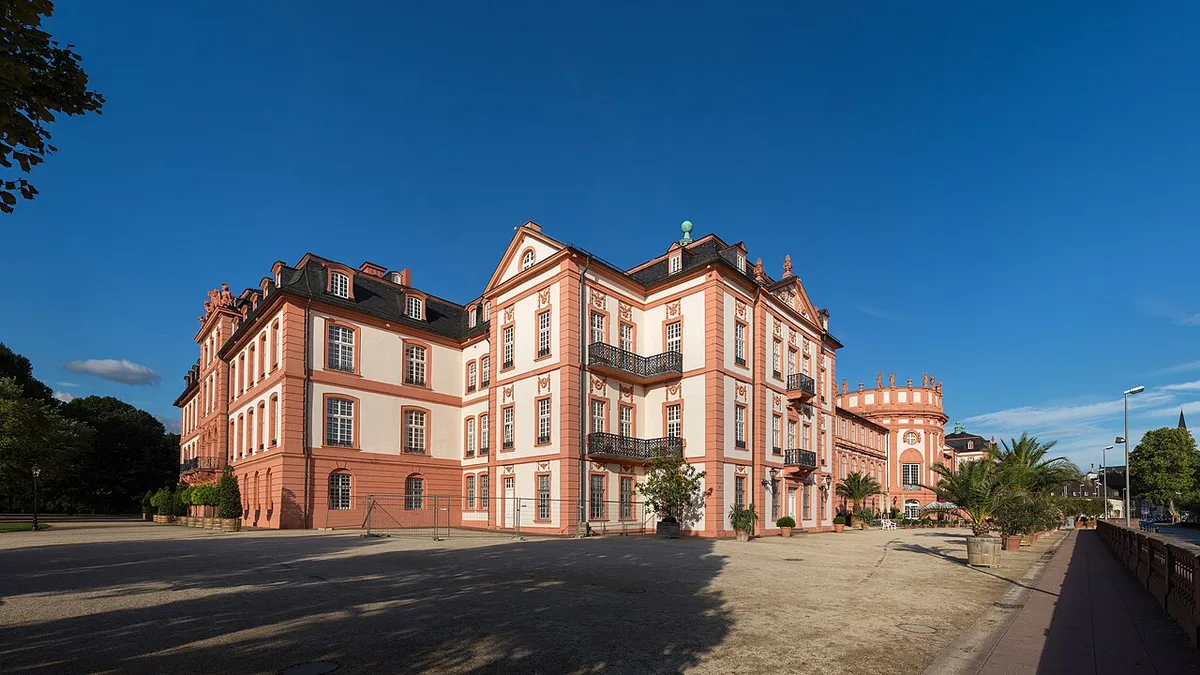
The building acquired its recognizable silhouette when the baroque architect Johann Maximilian von Welsch joined the pavilions with a gallery and placed a circular ballroom on the central axis. Castleholic dates the Rotunda's completion to 1721, and the state palaces and gardens authority notes that local patriots like to call the result a small Versailles. Prince Karl of Nassau-Usingen then commissioned two further wings in 1734, with main construction ending around 1750.
The Wiesbaden tourism office tells the story more playfully, tracing the palace to a prince who wanted a garden shed on his Rhine property and kept adding until it became a three-winged baroque residence, and confirms that Biebrich served as the main residence of the princes and dukes of Nassau until 1841, when the court moved to the new city palace in Wiesbaden. The Versailles nickname, then, is about ambition and setting rather than any literal imitation.
The Exterior: Courtyard, Rhine Front and Rotunda
Seen from the land side, the palace is a long three-winged complex arranged around a broad courtyard, with the flat Rhine front closing the composition on the water side. The Rotunda sits on the central axis, so the exterior is best read as baroque planning rather than a single decorated facade. Circling the court lets you follow how the original pavilions, the connecting gallery and the later wings fit together.
The river aspect explains the palace's original purpose as a summer residence for a court that valued its position on the Rhine, and it is the view most visitors photograph. Because the park runs inland behind the palace, you can walk much of the building's perimeter without ever entering it. That makes Schloss Biebrich an easy companion to Wiesbaden's spa architecture, and the Kurhaus Wiesbaden visitor guide is a useful comparison for how the city's grand buildings are used today.
Can You Go Inside Biebrich Palace?
For most visitors the honest answer is no. The Wiesbaden tourism office states that the palace houses various authorities and is often used for celebrations and receptions, with the former chapel and the summer outdoor terrace operating as cafe and restaurant space. That is a working building with occasional hospitality uses, not a palace museum with a permanent display of state rooms.
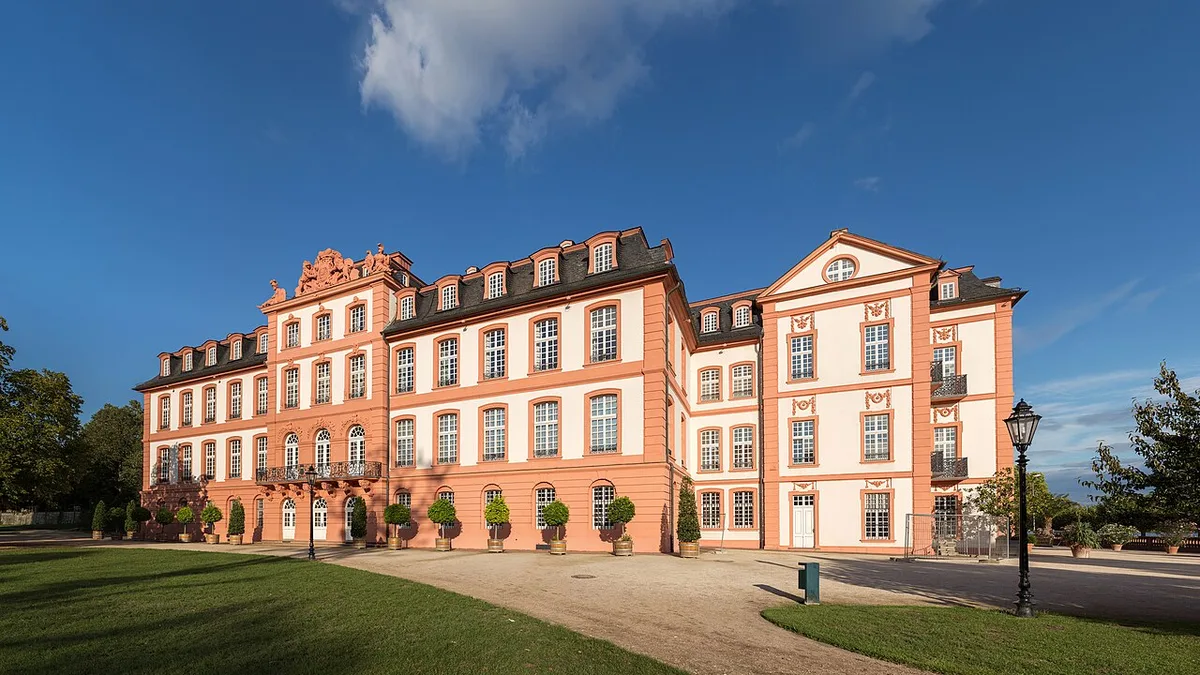
Because the interiors are largely closed, anyone hoping to see the Rotunda from inside or tour historic rooms should confirm current access directly with the operator before travelling, rather than assuming a ticket exists. Castleholic likewise notes that the palace is occasionally used as a venue but remains closed to the general public, while the park is very much worth visiting. Treat any interior access as something to verify, and plan the palace as an outdoor stop by default.
The building's condition today reflects a difficult history. The tourism office explains that with the end of the duchy most interior furnishings were sold, the east wing was destroyed in the Second World War, and the state of Hesse only restored the baroque building from the 1960s. That sequence explains why you encounter a preserved and administratively used exterior rather than reconstructed royal apartments.
Biebrich Palace Park: Sckell's Landscape Garden
The park is the main event for most visitors. The state palaces and gardens authority describes a narrow, elongated site only 1,200 metres long and as little as 250 metres wide, covering 31 hectares, which uses manipulated sightlines to feel far larger than its dimensions. Friedrich Ludwig von Sckell, also the designer of Munich's English Garden, reworked the grounds into an English landscape garden between 1817 and 1823.
The meadow valley was a Sckell speciality, and in Biebrich it runs north through the park toward the Mosburg pond, opening a long view from the palace toward the Taunus hills. The park is characterised by meandering paths, but one baroque remnant survives in straight form: the Dicke Allee, the old central access road to the palace. Walking that axis one way and the winding paths back shows both layers of the garden in a single loop.
For anyone comparing green spaces in Wiesbaden, Biebrich is a very different experience from the enclosed central gardens, and it pairs naturally with the wider parks and gardens in Wiesbaden. The palace park is longer and more landscape-driven, while the spa gardens near the Kurhaus are more formal and urban. Which to prioritise is mostly a question of how much walking you want and whether river views matter to you.
The Mosburg: A Neo-Gothic Castle, Not a Mock Ruin
At the far end of the meadow valley the park narrows toward a pond with the Mosburg on its bank, and this small castle anchors the whole composition. The state palaces and gardens authority is explicit that the Mosburg is not a mock ruin, as is repeatedly claimed, but was built in neo-Gothic style in 1805 and 1806 on earlier foundations as a habitable pleasure house, on the orders of Prince Frederick August von Nassau-Usingen.
Architect Carl Florian Goetz even had demolition material from a church in Mainz brought in so the illusion of an old building would be convincing. The Wiesbaden tourism office gives a slightly different construction history, describing the Mosburg as a romantic residential castle built at the start of the 19th century on the foundations of a thirteenth-century moated castle. Both accounts support the same point for visitors: this is a designed romantic building, not a preserved medieval ruin.
Free Grounds, Closed Interiors: Planning Around What Is Accessible
The practical split at Schloss Biebrich is simple: outdoors is open, indoors generally is not. The state palaces and gardens authority lists the park as an outdoor area freely accessible, which means you can walk the grounds, the meadow valley and the path along the Mosburg pond without any admission arrangement for the park itself. No opening hours for the grounds are given in the sources used here.
Because the palace is not a conventional museum, do not build a day around going inside it. If your interest is architecture, the exterior and the garden are enough; if your interest is collections, Wiesbaden's museums are the better choice, and the Wiesbaden museums guide helps you weigh which one fits your time. The city museum on the market square documents local history, and its service page carries the address and visiting information, including that it is closed on Mondays — an internal note: confirm current hours on the operator's page before you go.
Getting to Biebrich from Central Wiesbaden
Biebrich lies west of the city centre, on the Rhine. German Sights describes Wiesbaden's public transport as organised by ESWE, covering both buses and rail services in the Wiesbaden and Mainz area, with local trains in the core zone included on ESWE tickets, and day and group tickets available. That is a useful framework for planning, but it does not name the vehicle that takes you to the palace.
Because the specific lines, journey times and fares to Biebrich are not reliably covered in the sources used here, check your connection on the local transport operator's own journey planner for your travel date and confirm which stop puts you closest to the palace. The park has more than one approach, and the riverside position makes the final walking route worth checking in advance. Five minutes with a live timetable beats fixed advice from any older guide.
A sensible approach is to ride to the Biebrich area and finish on foot, so the palace and park become one continuous walk. If you want to extend the day, crossing the Rhine toward Mainz is a natural continuation, and the Wiesbaden to Mainz Rhine excursion covers options on the opposite bank.
How Long Should You Allow, and When to Go
As an editorial suggestion rather than official guidance, allow around one to one and a half hours for the exterior and a walk through the garden to the Mosburg pond, and closer to two hours if you want to cover the full 1,200-metre length of the park and sit by the water. The park is long and narrow, so distances add up faster than the scale suggests, and a cafe stop or a longer river walk will push the visit past a half day.
Weather matters more here than at an indoor attraction, because the whole experience is an outdoor walk with little shelter along the meadow valley. Spring and autumn tend to be comfortable for walking, while a winter visit is really about the bare architecture and the river rather than the garden. Carry what you need, since indoor facilities cannot be assumed to be open when you arrive.
Pairing Schloss Biebrich with Other Wiesbaden Sights
Schloss Biebrich works best as one panel of a broader Wiesbaden day rather than a standalone destination. The central Kurhaus and its adjoining Kurpark give you the spa-town side of Wiesbaden, while the palace gives you the princely, riverside side; doing both in one day means one trip into town and no wasted travel. The Kurhaus Wiesbaden visitor guide covers what that landmark offers in its own right.
Alternatively, the Neroberg hill and its water-powered funicular offer views back over the city that contrast with the flat riverside walk at Biebrich, as German Sights notes. Either combination keeps travel time low and gives you two very different impressions of the same city. For a longer stay, build the palace into one of the city itineraries rather than treating it as an afterthought, since it sits slightly away from the centre and rewards a deliberate visit.
If you are using Wiesbaden as a base, the palace can also be the first stop on a day that continues into the Rheingau wine country or across the river. Give it a clear time box, take the long walk to the Mosburg pond, and leave the rest of the day open for the city's other sights.
Plan Your Visit
Schloss Biebrich is best understood as a riverside architectural walk, not a palace museum. The park is listed as a freely accessible outdoor area, the Mosburg and the meadow valley are the highlights of the grounds, and the three-winged exterior with its central Rotunda is what you actually came to see. Plan around the outdoors, verify any interior questions directly with the operator, and check transport and any cafe opening on the day.
If your trip continues toward the Rheingau or across the Rhine, the palace also works as an easy first stop rather than a fixed appointment. Give it a clear time box, walk all the way to the pond, and leave the rest of the day for Wiesbaden's spa architecture and gardens.
Frequently Asked Questions
Is Schloss Biebrich free to visit?
The palace park is listed by the state palaces and gardens authority as an outdoor area freely accessible to visitors, so walking the grounds, the meadow valley and the path to the Mosburg pond does not involve any admission arrangement. The interior is a different matter: the Wiesbaden tourism office describes the palace as housing authorities and being used for events, and it is not run as a public museum with state-room tickets. Check the operator's own page before travelling if that distinction matters to you.
Can you go inside Biebrich Palace?
Generally not as a tourist. The Wiesbaden tourism office describes the building as home to various authorities and often used for celebrations and receptions, with the former chapel and the summer outdoor terrace serving as cafe and restaurant space, which is not the same as regular public access to the historic rooms. Castleholic likewise notes the palace remains closed to the general public while the park is worth visiting. Anyone hoping for interior access should contact the operator directly, because event use can affect what is possible on a given day.
How do you get to Schloss Biebrich from central Wiesbaden?
Biebrich lies west of the centre and is covered by the local transport network serving Wiesbaden and Mainz, which German Sights describes as organised by ESWE, with buses and rail services and ESWE tickets valid on local trains in the core zone. The most reliable way to plan the trip is to check the operator's live journey planner for your date and confirm which stop puts you closest to the palace, since the park has more than one approach. Avoid relying on fixed line or timing advice from older guides.
What is the Mosburg in Biebrich Palace Park?
The Mosburg is a small castle built in neo-Gothic style on the park pond, and the state palaces and gardens authority stresses that it is not a mock ruin despite the popular claim. It went up in 1805 and 1806 on earlier foundations as a habitable pleasure house, with demolition material from a Mainz church brought in to complete the romantic effect. It anchors the far end of the meadow valley and is the natural turning point of a park walk.
How long does a visit to the palace and park take?
As a non-official suggestion, plan roughly one to one and a half hours for the exterior and a walk to the Mosburg pond, or up to two hours if you want to cover the full length of the garden and linger by the water. The park is only about 1,200 metres long according to the state palaces and gardens authority, but it is narrow and the paths wind, so the walking adds up. Add time for a riverside pause if you want one.