

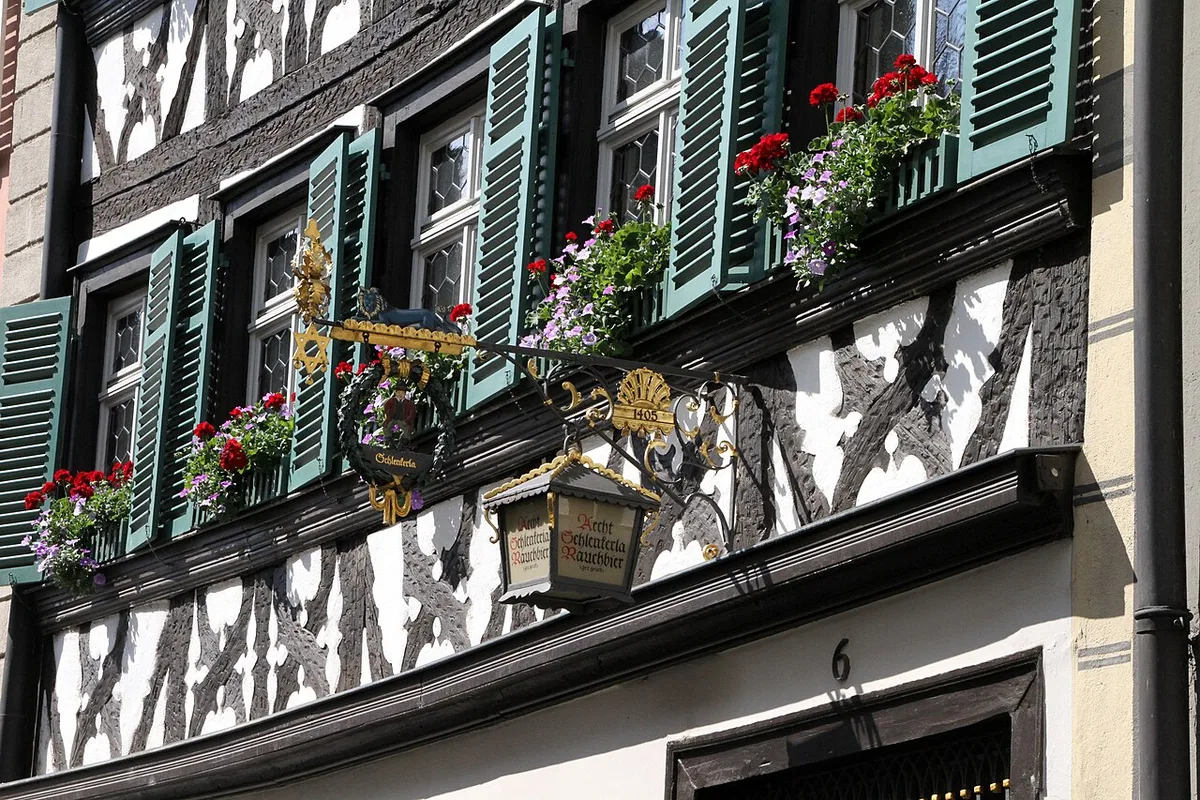
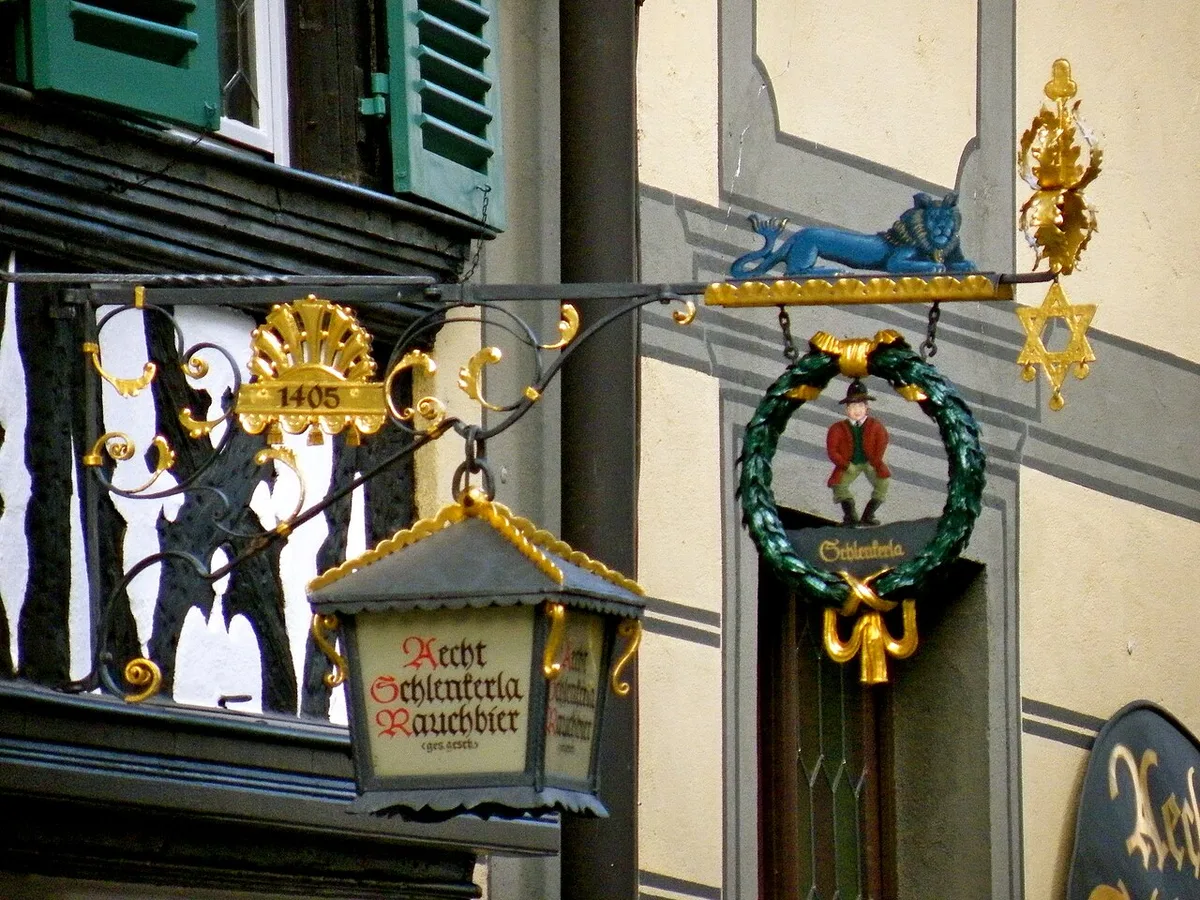
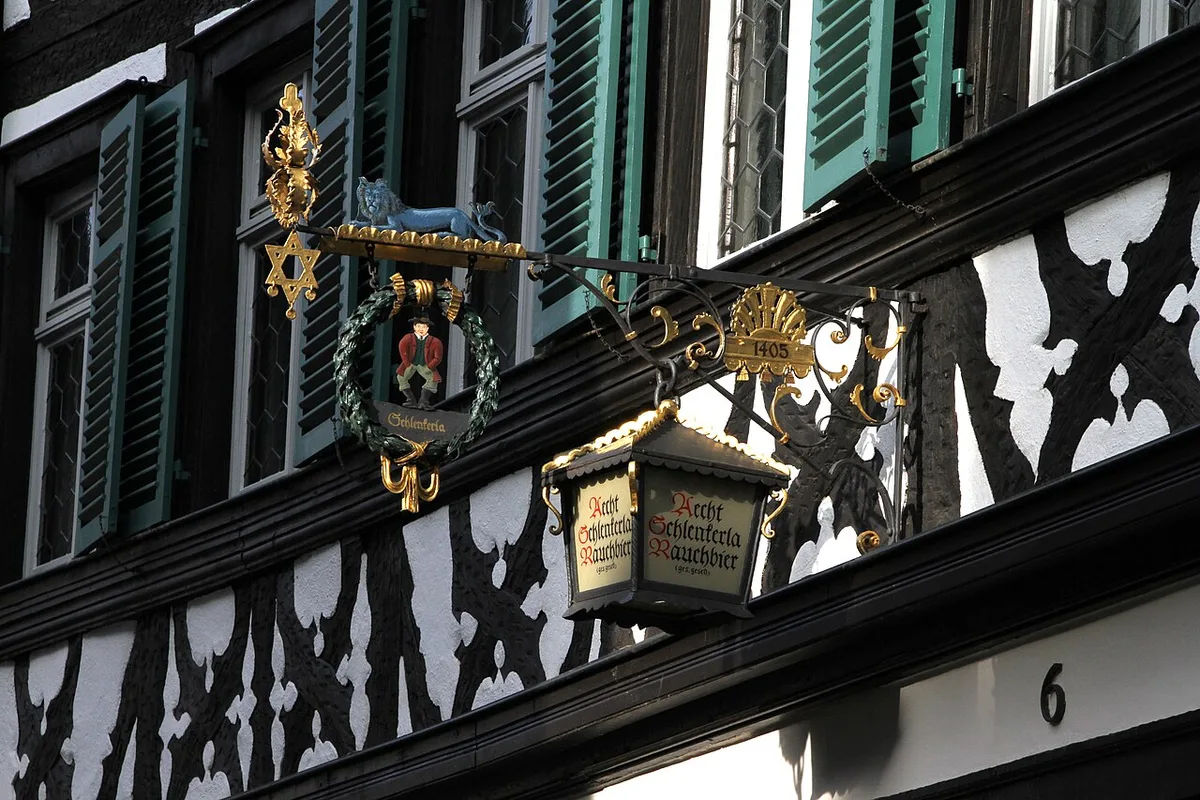
Schlenkerla sits at Dominikanerstrasse 6, in the middle of Bamberg's old town directly beneath the cathedral, and it is the address most visitors mean when they say they want to try Franconian smoked beer where it is made. The house is documented as the "House of the Blue Lion" in 1405 and has been run by the Trum family for six generations, which makes it a working brewery tavern rather than a museum piece about brewing history.
The brewery's own published information states that the tavern is open all year daily from 9:30 to 23:30, with the kitchen serving continuously from 11:00 to 22:00 and the morning pint starting at 9:30. Those are the operator's hours, not an estimate, and they are the single most useful thing to know before you decide whether to come early or late.
The beer here is still tapped from oak wooden barrels in the old tradition, and that detail shapes what the visit actually feels like: a low-ceilinged inn with dark beams, wooden tables, and a crowd that mixes students, musicians and locals rather than a staged tasting room. If you only have one evening in the city, this is the single stop that explains Bamberg's beer identity fastest.
What Schlenkerla Is, and What It Is Not
Schlenkerla is a brewery whose beer is served in its own tavern, so the site you visit is a place to eat and drink rather than a standard visitor attraction with a ticket desk. The brewery's pages describe the house, the tavern rooms and the beer; they do not present public brewery tours or cellar visits as a bookable product. Accounts of going behind the scenes come from a private group visit that a blogger describes as something the brewery does not typically allow, so treat cellar access as something to ask about directly rather than something to plan around.
The practical consequence is simple: your visit is measured in time at a table, not in a circuit of exhibits. Budget your evening around eating, drinking and conversation, and put the brewing-history context elsewhere in your day. The Franconian Brewery Museum on Michaelsberg covers that side of the story properly if you want the technical background.
Rauchbier Explained Before Your First Sip
The smoke in Rauchbier is not an added flavouring but a result of how the malt is dried: barley malt roasted over a wood fire picks up smoke, and that character carries into the finished beer. In the nineteenth century, coal became cheaper and easier to control than wood, and malt roasted over coal picked up flavours brewers did not want, which pushed the industry toward purpose-built kilns. Schlenkerla's ancestors stayed with the wood-fired method, and the brewery still produces its own malt, which is unusual in a region where large malting companies operate nearby.
Knowing this changes what you taste. The smokiness reads as a roasting character rather than an artificial aroma, similar to the difference between a boiled and a roasted nut, and it sits alongside malt sweetness and a dry, bitter finish. Expect a dark brown beer with a pronounced aroma the moment the glass reaches the table.
One practical first-timer technique comes from a tasting tip on a visitor blog rather than from the brewery: take several full swallows instead of sipping slowly, so your palate adapts quickly instead of registering only smoke on the first mouthful. Ordering food alongside helps for the same reason, because a bite between sips resets your perception of the beer.
What to Order Beyond the Standard Rauchbier
Start with the standard Aecht Schlenkerla Rauchbier, the beer that defines the house, and decide afterwards whether you want to work through the stronger seasonal releases. The brewery's news pages list the annual first tapping of the Urbock on 8 October and the Eiche Doppelbock becoming available from the first Advent, so those are the dates to check if you want to catch a specific style rather than the year-round range.
On food, the menu is Franconian and built for beer: robust, meaty plates rather than delicate courses. A visitor account singles out the stuffed onion as a natural partner for smoked beer, and the logic holds, because a rich, savoury dish stands up to smoke instead of being buried by it. Order one plate to share if you plan to try more than one beer.
Because the kitchen runs continuously through the day, you are not locked into a single dining window, which makes it easier to split the visit into a drink early and a meal later. Check the current menu on the brewery's own pages before you go if a particular dish is the reason for your visit, since dishes change with the season.
The Rooms: Old Inn, Klause and Courtyard
The tavern is really three different experiences. The old inn has a low ceiling whose wooden beams were originally painted with ox-blood for protection and darkened over the centuries, with historic Bamberg engravings on the walls; it is the busiest and most social space, where brewer and factory worker end up at the same table. If you want the classic Schlenkerla atmosphere, this is the room to aim for.
The Klause was formerly the house chapel of the Dominican monastery and has an arched ceiling from 1310, later decorated with a fifteenth-century neo-Gothic painting on gold leaf; it was sold to the Trum family after secularisation. It feels quieter and more enclosed than the main inn, which suits smaller groups who want to talk. The courtyard in the Dominikanerhof is the third option, filled with tables and geraniums in summer and open weather permitting from Easter until early October, so it is never something you can count on outside that window.
Choose by weather and group size rather than by reputation. A large group on a mild evening belongs in the courtyard; two people on a cold, wet day will be far happier squeezed into the inn or the Klause.
Opening Hours, Kitchen and the Morning Pint
According to the brewery's own published information, Schlenkerla is open all year daily from 9:30 to 23:30, the kitchen serves continuously from 11:00 to 22:00, and the morning pint starts at 9:30. The same source states that opening hours differ at Christmas and New Year without giving the alternative times, so treat those days as needing a direct check rather than an assumption. Re-check the brewery's pages close to your travel date, because these are the hours the operator publishes and they can change.
That structure creates two genuinely different visits. A morning pint at 9:30 is a calm, local, daytime affair with the room barely awake; an evening visit from around 18:00 onwards is loud, full and social. Pick one deliberately instead of drifting into whichever happens to be convenient, because the experience you get depends far more on the hour than on the beer.
Timing a Visit Without Getting Stuck at the Door
Schlenkerla does not take reservations for the current day online; the brewery asks that same-day table requests be made by telephone on 0951 56050, and it also offers a reservation route for other dates. Booking ahead is the only way to reduce uncertainty, and the operator does not promise a specific table or guaranteed availability, so plan a fallback. If you cannot reach the tavern by phone, arrive outside the main meal peaks and accept a short wait.
In practice, the safest windows are shortly after the 9:30 opening, mid-afternoon between the lunch and dinner rushes, or late in the evening. The likeliest pinch point is the stretch around conventional dinner time, when tour groups, day-trippers and locals all converge on the same few rooms. If you find the inn full, walk through to check whether the Klause or the courtyard has space before giving up.
A reasonable visit is something you plan for yourself: allow around an hour for a beer and a snack, or closer to two hours if you are eating a full meal and working through more than one style. That is a suggestion for pacing your day, not an official duration published by the brewery.
Fitting Schlenkerla Into a Day in the Old Town
The tavern's location below the cathedral puts it inside the cathedral quarter, so it pairs naturally with the Domberg sights rather than needing a separate trip. You can walk the old town, take in the cathedral and the surrounding squares, and arrive at Dominikanerstrasse on foot. The city's compact layout means the tavern is a convenient break rather than a destination at the edge of town.
A sensible structure for one day is a morning of walking, an early afternoon break at Schlenkerla before the dinner crunch, and the river and bridge area afterwards. If you are staying overnight, split it the other way: morning pint early, then the museums and the Michaelsberg brewery collection while the tavern is quiet.
Either way, keep the beer visit flexible. The courtyard only works when the weather cooperates from Easter to early October, and the indoor rooms are what you fall back on for the rest of the year.
Plan Your Visit
Schlenkerla rewards a little preparation more than most beer stops, because the difference between a good visit and a frustrating one is mostly timing. Check the brewery's own pages for the current daily hours, kitchen window, courtyard season and seasonal beer releases before you travel, and note that Christmas and New Year hours differ without being published in detail.
Then decide which visit you want: a 9:30 morning pint in a quiet room, a mid-afternoon plate with the standard Rauchbier, or a loud evening in the old inn. Reserve by telephone for the same day, arrive outside the dinner peak, and keep the Klause and courtyard in mind as alternatives when the main room is full.
Frequently Asked Questions
Is Schlenkerla worth visiting in Bamberg?
Yes, if you want to understand Bamberg's beer identity in one stop. Schlenkerla is a working brewery tavern where the smoked beer is still tapped from oak barrels, and the building itself, documented as the House of the Blue Lion in 1405, has the dark beams and historic interior that make it more than a place to drink. It is also a social room rather than a formal attraction, so the value depends on you settling in at a table for a while rather than passing through.
What does Schlenkerla smoked beer taste like?
The smoke comes from drying malt over a wood fire, so it reads as a roasted, savoury character rather than an added flavour. Expect a dark brown beer with a pronounced smoky aroma, malt sweetness behind it, and a dry finish. A visitor blog suggests taking several full swallows rather than slow sips and eating something alongside it to let your palate adjust; that is one drinker's advice, not a brewery instruction.
Do you need a reservation at Schlenkerla?
The brewery does not present reservations as a requirement for entry and does not promise a specific table. Its published guidance is that same-day table requests should be made by telephone on 0951 56050, and there is a separate reservation route for other dates. Booking ahead reduces uncertainty, but you should still treat a seat at peak dinner time as something that may involve a wait.
What should you order at Schlenkerla?
Start with the standard Aecht Schlenkerla Rauchbier, which is the beer that defines the house, and add a Franconian plate rather than treating the visit as a tasting flight. The kitchen serves continuously so you can eat whenever suits your schedule. If you want a specific seasonal style such as the Urbock or the Eiche Doppelbock, check the brewery's current notices, because those appear at particular points in the year.
Can you tour the Schlenkerla brewery?
The brewery does not present public tours or cellar visits as a standard offer on its own pages. A blogger describes seeing behind the scenes as part of a private group tour that the brewery does not typically allow, so do not plan a trip around the assumption that you can book one. If you want brewing context in Bamberg, the Franconian Brewery Museum covers that ground.
When is the Schlenkerla beer garden open?
The courtyard in the Dominikanerhof opens weather permitting from Easter until early October, according to the brewery's published information, so it is a seasonal and weather-dependent space rather than a year-round one. Outside that window, plan on the indoor rooms. Because the opening depends on conditions as well as dates, check current notices close to your visit.
Sources
- Aecht Schlenkerla Rauchbier - DAS original Rauchbier aus dem UNESCO Weltkulturerbe Bamberg. Die Bier Spezialität der Brauerei Heller.
- Historical brewery tavern Schlenkerla in Bamberg (Germany, Bavaria) Aecht Schlenkerla Rauchbier
- Schlenkerla Smokebeer - THE original smoked beer. From the UNESCO world heritage city Bamberg.
- What is Smoked Beer? A Visit to Schlenkerla in Bamberg!


