

The Fuggerei in Augsburg is the oldest existing social settlement in the world, founded in 1521 by Jakob Fugger and his brothers. It is not a museum that happens to have houses in it, but a working residential quarter with 67 buildings, 142 apartments, and its own church, where around 150 residents live under terms that have been continuous for five centuries. The official operator describes the quarter as a city within a city: a walled grid of lanes with gates, a church, and an administration of its own. Understanding that distinction before you arrive is the difference between treating the site as a heritage attraction and visiting it as the living neighbourhood it remains.
A suggested duration for a full visit, including the museums, is roughly ninety minutes to two and a half hours. That is a planning figure, not an official one. If you only want to walk the streets and see the architecture, forty-five minutes to an hour is usually enough. This guide separates what you can walk through without a ticket from what sits behind the paid museum scope, covers the resident rules that shape a respectful visit, and explains why the four museums are distinct stops rather than one undifferentiated attraction.
What the Fuggerei Actually Is
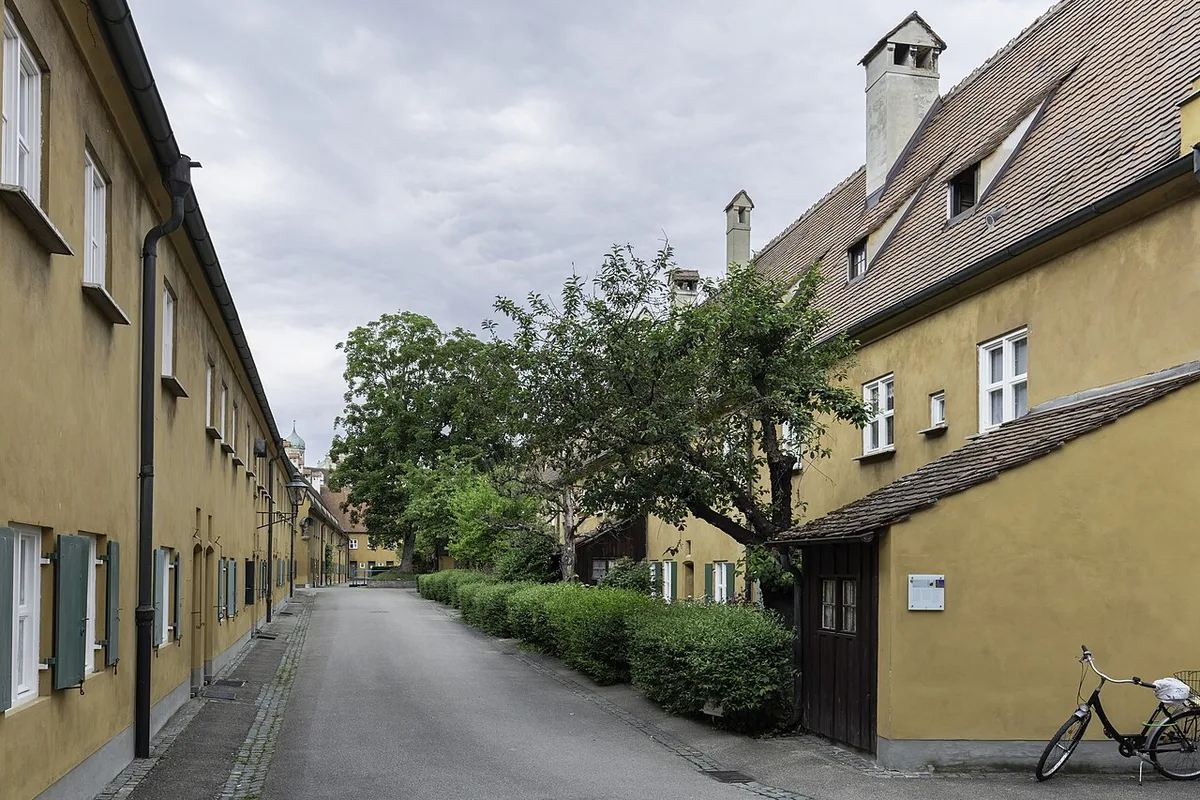
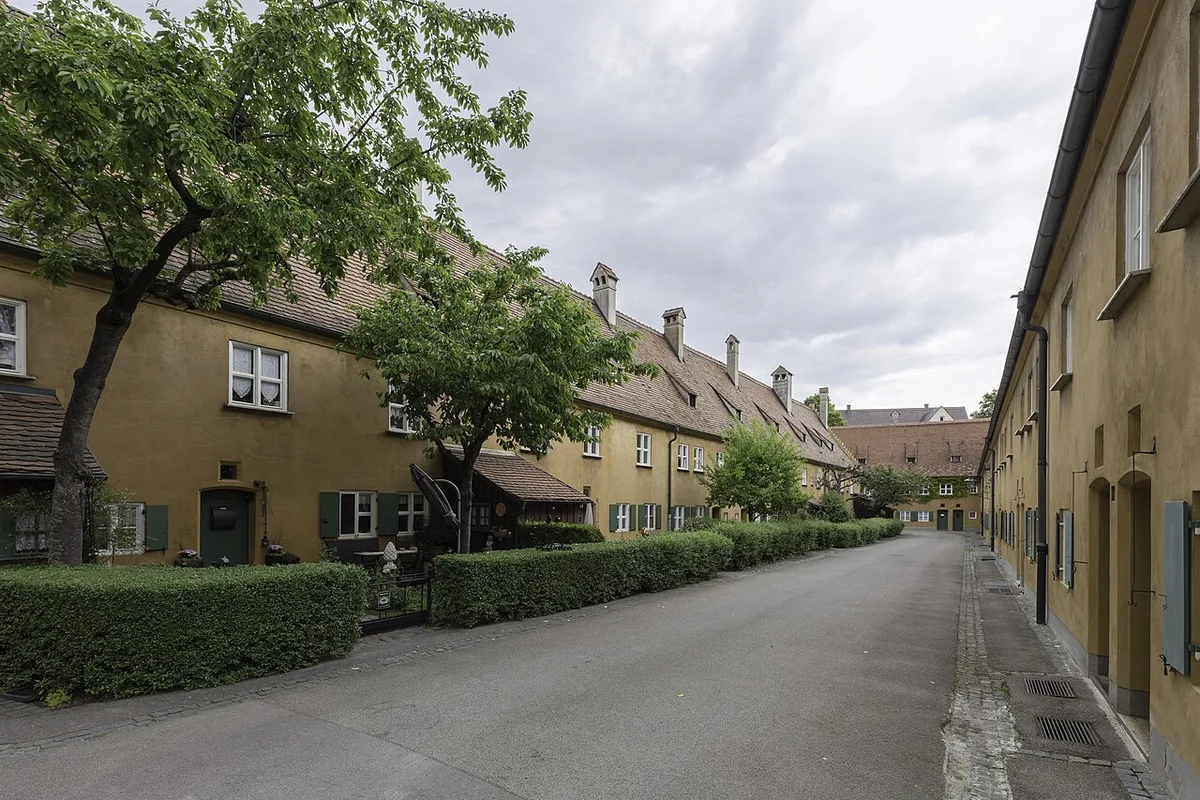
The Fuggerei is a walled enclave in the Jakobervorstadt district, a compact grid of narrow cobbled lanes lined with two-storey houses under high gabled roofs. It has its own gates, which close at night, its own church, and its own administration. The official operator describes it as a settlement of 67 houses and 142 apartments, with a resident community of roughly 150 people.
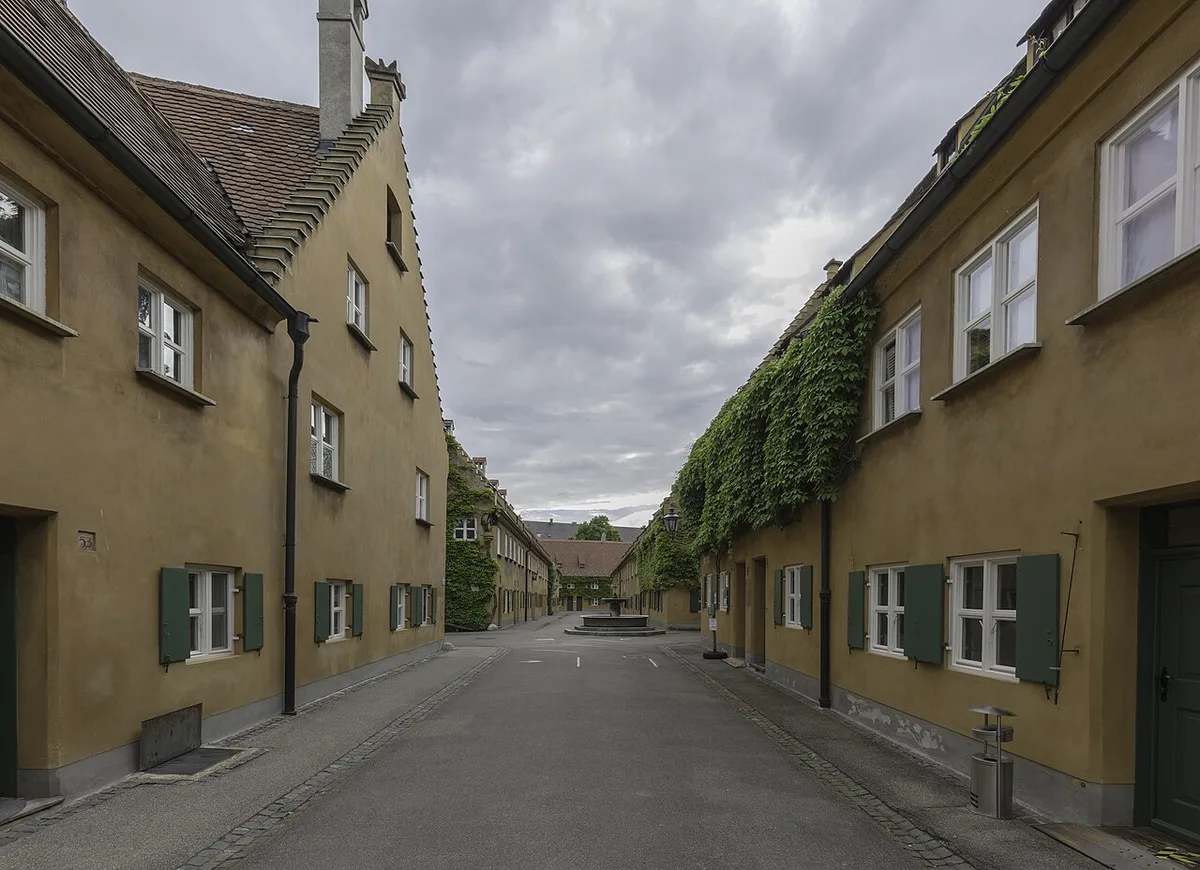
That scale matters for planning: the quarter is small enough to walk end to end in minutes, but dense enough that its lanes carry pedestrian traffic, deliveries, and the ordinary business of daily life. Visitors are guests in that routine, not the reason it exists. The official operator confirms the founding year as 1521 and notes that the four museums in the Fuggerei, including a reconstructed historical apartment and the exhibition in the World War II bunker, can be visited daily against an entrance fee.
The address often cited for the main entrance is Jakoberstraße 26, 86152 Augsburg, which places it in the historic Jakobervorstadt neighbourhood on the eastern edge of the old town. The site is not a single building you enter and tour; it is an area you step into. Keep that mental model and the rest of the visit logistics fall into place.
Why the Free-to-Walk Streets Matter More Than the Ticketed Buildings
The single most useful thing to understand is that the Fuggerei is not one paid attraction. The streets and lanes are walkable without a museum ticket, while the four museums operate against an entrance fee. If you want only to see the architecture, read the plaques, and get a feel for the place, you can do that without committing to the museum route. If you want to see inside a reconstructed historic apartment or the exhibition in the former air-raid shelter, that is where the ticket applies.
This split is not a loophole; it reflects what the site is. A paid ticket to a residential quarter would be strange when the point is that people live there. The museums exist to explain that life to outsiders without opening every front door. Decide before you arrive whether you are there for the atmosphere or for the interpretation, because the two experiences are genuinely different. The official operator page confirms that the four museums can be visited daily against an entrance fee, and that the quarter itself remains the primary experience.
If your interest is mainly in the lanes, gables, and the church exterior, you can treat the Fuggerei as a wander rather than a ticketed visit. If you want the interior context, plan for the museums. Either way, the streets are where the place makes its argument, not the exhibition rooms.
The Founding Vision: Jakob Fugger, 1521, and Five Centuries of Purpose
Jakob Fugger, known as the Rich, founded the Fuggerei in 1521 in his own name and that of his brothers. He was one of the most influential bankers of his era, and the settlement was an act of religious and civic charity aimed at needy but respectable Augsburg citizens. The dedication was not to a generic poorhouse but to a specific category of resident: people of good standing who had fallen on hard times.
The founding year is not a matter of dispute and is repeated consistently by the operator and independent sources: 1521. What is more interesting for a visitor is the continuity. The Fuggerei has operated without interruption for five centuries, surviving wars, destruction, and rebuilding, including significant damage in the Second World War. That continuity is the site's real claim to significance, more than any single architectural feature.
The Fugger family connection remains live. The settlement is administered through the Fugger Foundations, and the endowment structure still supports the original purpose. When you walk through the gates, you are entering a charitable institution that has been running longer than most nation-states, which is a strange and useful thing to hold in mind.
Resident Rules Today: Rent, Prayers, and Living Tradition
Residents today live under terms that would be recognisable to the first tenants. The official operator states that the annual cold rent is approximately 0.88 euros, historically one Rhenish guilder, and that residents commit to three daily prayers for the founder and his family. These are conditions of tenancy, not visitor fees, and it is important not to conflate them with any ticket you might buy. They are the terms on which people live there.
The prayers and the symbolic rent are not folkloric decorations; they are contractual obligations that have been maintained for five hundred years. This is why the Fuggerei is best understood as a living institution rather than a heritage site with residents as set dressing. The rules also explain the atmosphere: a quiet, orderly quarter with a strong sense of internal life that visitors are permitted to observe, not to join.
For a visitor, the practical implication is simple. You are walking through other people's front yards. The rent and prayer rules are not part of your itinerary, but knowing they exist should shape how you behave. The official operator source is the place to confirm current resident terms, because these are administrative facts that can be updated.
The Four Museums: What Each One Adds
The Fuggerei's four museums are distinct in scope, and the operator names them clearly: a museum of history and living, a museum of residents, a museum of everyday life, and the exhibition in the former World War II air-raid shelter. They are not four separate attractions competing for your time; they sit behind a single ticketed scope, so the decision is whether to commit to the whole museum route or to skip it entirely.
The reconstructed historic apartment is the anchor for most visitors, because it shows a lived interior rather than objects in vitrines. The residents' museum adds personal testimony and institutional perspective. The everyday-life museum covers the postwar period and the present. The bunker exhibition is the most historically specific of the four, dealing with the bombing and reconstruction of the quarter.
If you have limited time, the reconstructed apartment and the bunker exhibition are the two that most visitors find indispensable, but that is a judgement call rather than an official recommendation. If you have a strong interest in social history or twentieth-century Augsburg, all four reward attention. The ticket covers the museums as a group, so there is no need to choose between them at the door if you have already committed.
How to Pace the Visit: A Suggested Duration
A suggested duration for a full visit, including the museums, is roughly ninety minutes to two and a half hours. That is a planning figure, not an official one, and it assumes you walk the quarter, visit the church, and spend meaningful time in the museums. If you only want to walk the streets and see the architecture, forty-five minutes to an hour is usually enough.
The main variable is how much time you spend in the museums. A quick pass through the reconstructed apartment takes fifteen minutes; reading the panels in the residents' and everyday-life museums can take considerably longer. The bunker exhibition rewards slow reading because it deals with a specific and difficult period. If you are visiting with children or on a tight schedule, the streets alone are a legitimate visit.
A practical pacing suggestion is to walk the full circuit first without stopping, then decide which museums to enter. That way you know the layout before you commit to interiors, and you avoid the common mistake of spending all your time in the first museum and rushing the rest.
Entry Logistics Without Guesswork
The entrance fee applies to the museums, not to walking the streets. The official operator page directs visitors to a section labelled entry prices, opening hours and more, which is where current figures are published. Because prices and hours are volatile, the reliable approach is to check that page shortly before you travel rather than relying on third-party listings, which may be out of date or may quote a scope that does not match the actual ticket.
Advance booking requirements are not something to guess at. The operator publishes an online ticket option on its Fuggerei page, but whether individual visitors need to book ahead, and whether tickets are available on the day, are administrative facts that can change. Check the operator's ticketing page directly for the current position rather than assuming either way.
The ticket covers the four Fuggerei museums. It does not cover other museums elsewhere in Augsburg, and it does not grant access to residents' homes or private courtyards. It also does not cover guided tours, which are a separate offering. Keep that scope in mind so you are not surprised at the door.
Respecting Residents: Practical Behaviour
The Fuggerei is a residential quarter with roughly 150 people living in it. Photography in the lanes is generally part of the visit, but photographing residents, their windows, or their doorways without permission is intrusive and should be avoided. The distinction is simple: architecture is fair game, people and their homes are not.
Keep noise low, especially in the early morning and evening, and do not enter courtyards or stairwells that are not part of the museum route. The church, St. Mark's, is a working place of worship as well as a site of interest; if a service is in progress, wait or return later. These are basic courtesies, but they are the difference between a respectful visit and an intrusion.
Doors and gates that are closed are closed for a reason, and the residents' prayer obligations and daily routines continue regardless of visitor traffic. Treat the quarter as you would any neighbourhood you were passing through, with the added awareness that this particular neighbourhood has been welcoming outsiders on its own terms for five hundred years.
Pairing the Fuggerei with the Rest of Augsburg
The Fuggerei sits in the Jakobervorstadt district, a short walk from the old town core. Rathausplatz, the Town Hall, and the Golden Hall are all within roughly half a kilometre, which makes the Fuggerei easy to combine with a broader half-day in the city. You do not need to treat it as a standalone excursion.
A sensible sequence is to start at the Fuggerei in the morning, when the lanes are quieter, then walk west into the old town for the Town Hall and Rathausplatz. If you have a full day, the Maximilianmuseum Augsburg visitor guide covers a natural afternoon addition, and the Augsburger Puppenkiste is another nearby option for families. For a broader itinerary framework, the Augsburg: Itineraries and City Travel Guides hub sets out how the city's sights fit together.
The Fuggerei is compact, so it works well as one stop among several rather than as a destination in itself. Build it into a walking day and you get the contrast between a working charitable settlement and the grand civic architecture of the old town, which is a more interesting pairing than either on its own.
Plan Your Visit
The Fuggerei is best approached as a living residential quarter with a museum component, not as a conventional paid attraction. Walk the streets, understand the founding purpose, and decide separately whether the four museums are for you. Check the official operator page for current prices, hours, and any booking requirements before you go, because those details change.
If you are building a day in Augsburg, the Fuggerei fits naturally into a morning or early afternoon alongside the old town. For more Augsburg planning, the Augsburg: Landmark Visitor Guides collection and the Augsburg: Itineraries and City Travel Guides hub cover the wider context.
Frequently Asked Questions
Do you have to pay to enter the Fuggerei in Augsburg?
No, walking the streets of the quarter does not require a museum ticket. The entrance fee applies to the four Fuggerei museums, which sit behind a single ticketed scope. You can visit the lanes, see the architecture, and view the church exterior without paying. If you want to see the reconstructed historic apartment or the World War II bunker exhibition, that is where the ticket applies. Check the official operator page for current prices and hours.
Is the Fuggerei entrance fee worth it if I only want to walk around?
If you only want to walk the streets, you do not need to pay at all. The ticket is for the museums. Whether it is worth it depends on your interest in social history and the specific stories the museums tell. The reconstructed apartment and the bunker exhibition are the two stops most visitors find most rewarding, but that is a judgement call rather than an official recommendation.
How long should I set aside for a Fuggerei visit?
A suggested duration is roughly ninety minutes to two and a half hours if you include the museums. If you only walk the quarter and see the architecture, forty-five minutes to an hour is usually enough. This is a planning figure, not an official one, and the main variable is how much time you spend reading the museum panels.
What exactly is included in the Fuggerei museum ticket?
The ticket covers the four Fuggerei museums: the museum of history and living, the museum of residents, the museum of everyday life, and the exhibition in the former World War II air-raid shelter. It does not cover other museums elsewhere in Augsburg, guided tours, or access to residents' private homes. The operator publishes the current scope and price on its official page.
Can I visit the Fuggerei if people still live there?
Yes, visiting is permitted, but the quarter is a working residential community with roughly 150 residents. Walk respectfully, keep noise low, avoid photographing people or their homes without permission, and do not enter courtyards or doorways that are not part of the museum route. The church is a working place of worship, so time your visit around services.
Is the Fuggerei close enough to combine with Augsburg's old town?
Yes, the Fuggerei is in the Jakobervorstadt district, within walking distance of the old town. Rathausplatz, the Town Hall, and the Golden Hall are all roughly half a kilometre away. A sensible plan is to visit the Fuggerei in the morning and walk into the old town afterwards, making it part of a half-day rather than a separate trip.


