Potsdam works as a single day because its two halves sit close together and pull in opposite directions. Sanssouci Park spreads out east of the city centre, while the historic core packs squares, churches and cafés into a compact grid. The choice that decides your whole day is which half you start with; start with the park. For wider planning, see the Potsdam landmark visitor guides.
The reason is asymmetry. Sanssouci Park itself is free to enter, but if you want to visit any of the palaces inside you have to pay, as one self-guided Potsdam walk states plainly. That means interiors can absorb an unpredictable chunk of your day. The old town, by contrast, can be compressed at will, cutting a museum or a side street without losing the shape of the visit.
This plan assumes a full day, roughly eight to nine hours on the ground, and every duration below is a suggestion rather than an official schedule. If you are coming from Berlin, build the return leg into your thinking from the start. For a wider set of routes and themes, the Potsdam city guide hub collects them in one place.
Start in Sanssouci Park at Its Own Station
The park has its own train station, and one well-established self-guided walk treats Bahnhof Park Sanssouci as the natural starting point, because it turns a potentially long approach walk into the itinerary itself. Entering here puts you near the New Palace and the Communs and lets you walk the park roughly west to east. The Sanssouci Park walking guide sets out the same sequence at a comfortable pace.
Begin with the New Palace and the Communs, the paired service buildings with their double staircases. The Communs once housed kitchens and servants' quarters, while the New Palace was raised in the 18th century after Frederick the Great's victory in the Seven Years' War as a display of restored power. Turn around as you walk away from the New Palace, because the facade reads completely differently from the reverse angle. That walk notes that the statues adorning the palace are largely Greek demigods.
Sanssouci Park itself is free to enter, but palaces inside the grounds charge separately, and it is a mistake to assume one ticket covers the ensemble. Plan on the basis that any interior you add is a discrete commitment, and check the operator's own pages for what is open and how entry is arranged.
Walking East: Orangery, Historic Windmill and the Climb to the Palace
Heading east from the New Palace, the Orangery Palace appears on the ridge, a mid-19th-century addition by Friedrich Wilhelm IV, who drew on Romantic taste and used the building to overwinter the garden's exotic plants. Nearby stands the Historic Windmill; as the same walk explains, the original was the only part of the park destroyed in the Second World War, smashed by Soviet artillery fire. The windmill has a small café at its base and views from inside over the palace and park.
Then comes the main event, Sanssouci Palace itself, Frederick the Great's small Rococo vineyard house with terraced vines stepping down to the Great Fountain. The palace has twelve rooms and was used to entertain guests almost nightly. The Sanssouci Palace visitor guide explains what a visit involves so you can decide before you are standing at the entrance.
Treat the palace interior as a scheduled item rather than a casual detour, and confirm the operator's current terms for admission before you commit. If your day is tight, a circuit of the terraces and the Great Fountain still delivers the essential Sanssouci experience without the interior stop. Frederick the Great's grave sits on the terraces, where the walk notes visitors traditionally leave a potato in thanks for his role in popularising the crop in Prussia.
Great Fountain, Church of Peace and Potsdam's Own Brandenburg Gate
Below the palace terraces, the Great Fountain marks the meeting point of the park's two grand axes and gives you the classic upward view of the vineyard terraces with the palace crowning them. As the self-guided walk puts it, the fountain sits where the park's east-west Axis of Might and north-south Axis of Wisdom cross. Take the descent slowly, because the terraces behind you are steep.
Continue to the Church of Peace, where the altar mosaic was originally from Venice and was saved from destruction by Friedrich Wilhelm IV in the 19th century after he saw the church it belonged to being demolished. The walk records that entrance to the church is free, with donations welcome, which makes it one of the few interiors in the park you can add without a ticketing decision. Nearby you can also find the tomb of Kaiser Wilhelm I.
Your exit from the park is one of Potsdam's best-kept surprises: the city has its own Brandenburg Gate, built after the Seven Years' War to signal that Prussia, though exhausted, was not finished. Passing through it puts you directly onto Brandenburger Strasse and into the old city. The city describes the area around the gate and Luisenplatz as a principal approach to Potsdam from the west, which is why the gate belongs in the route rather than in a separate detour.
Crossing Into the Old City: Brandenburger Strasse for Food and Coffee
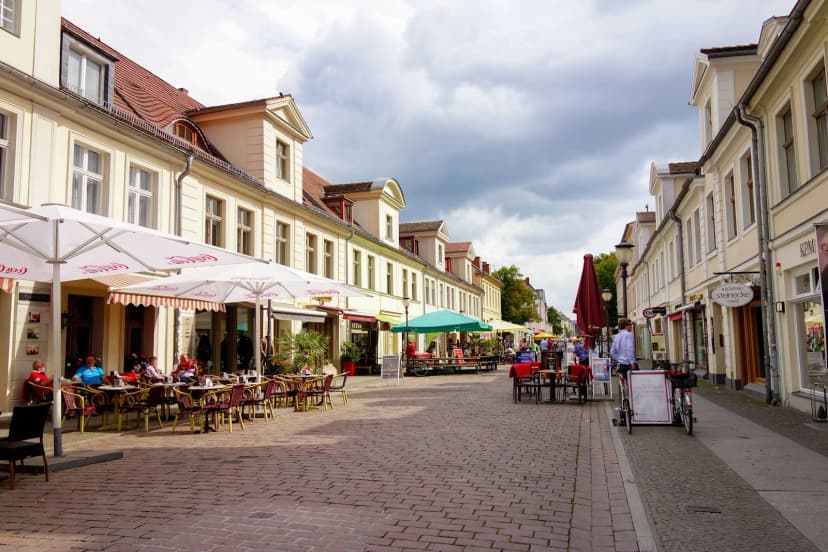
Brandenburger Strasse is the natural first contact with the old town and the right place to stop for food, whether that means a bakery pretzel, an ice cream in the sun or coffee and cake in one of the side streets. The self-guided walk recommends exactly this: a break for food or shopping before the city portion. Eat here rather than pushing straight on.
Partway up the street, on the left-hand side, Lindenstrasse holds a building that served grim purposes under two successive regimes. The walk describes it as originally a prison, then used by the Nazis as a hereditary health court, and after the war run by Soviet security services and later the Stasi as a prison. It takes only a few minutes to acknowledge.
The Compact Core Loop: Alter Markt, St. Nicholas Church and Bassinplatz
The Alter Markt was laid out under Frederick the Great in the mid-18th century as an Italian-style square near the Havel, and the city notes that 19th-century eyewitnesses rated it among the most beautiful squares in Europe. The marble obelisk was erected in 1753 and altered in 1979. St. Nicholas Church dominates the square, and the city's own page on the Alter Markt sets out the square's history alongside the old town hall.
The Altes Rathaus on the same square houses the Potsdam Museum, which returned to its founding location after restoration work carried out from 2010 to 2012, and today displays valuable exhibits on the city's history. The city records that the baroque core was destroyed by fire in 1945, rebuilt as a cultural centre between 1960 and 1966, and then joined to the Knobelsdorff House. If you want one interior in the old town and you are interested in the city rather than palaces, this is the strongest candidate.
A short walk from the square, Bassinplatz takes its name from the swamp-draining basin that once occupied the site, and a city itinerary listing notes that it now holds a 19th-century church and a Soviet war cemetery. Together with the Dutch Quarter just beyond, it rounds out the old town without demanding a separate trip.
Dutch Quarter or Museum Barberini: Pick One, Not Both
The Dutch Quarter and Museum Barberini sit close enough that the temptation is to do both, and that is exactly the mistake. The quarter, built from 1732 to attract Dutch artisans who largely never came, is a district of gabled brick houses now filled with shops and restaurants, and it rewards unhurried wandering rather than a checklist. Museum Barberini is an art museum in the rebuilt palace on the old market, with a collection strong in Impressionist and Post-Impressionist work alongside temporary exhibitions.
Choose according to your energy. If the day has been long and your legs are done, the Dutch Quarter gives you streets, cafés and an easy exit towards transport. If you have a genuine appetite for art and are content to lose ninety minutes indoors, the museum is the better use of the time.
Photographers should note that light in the old town softens towards late afternoon, and the Dutch Quarter's narrow streets benefit from it. The Potsdam photography guide is worth a look if you want to plan around the best hours rather than arriving at random.
What to Skip on a One-Day Trip, and Why
Several named sights on Potsdam's wider list are genuinely good and genuinely impossible in a single day. Belvedere Pfingstberg, the 19th-century Italianate lookout with its double towers and Schinkel's early Pomonatempel on the slope below, sits north of the centre and requires a climb plus a return leg that will cost you the old town. The operator's own site presents it as a visited destination with its own touring season and opening arrangements, which is precisely the complication on a one-day plan.
Marmorpalais in the New Garden is another substantial detour on the far side of the city. Glienicke Bridge, famous as a Cold War spy exchange point, lies a long way west of everything else here, and the view of Babelsberg Palace that draws people there is a viewing experience rather than a visit. The New Palace interiors are the subtler trap: you will already have walked past the building, and adding the interior after a full park circuit is how people miss their return train. One travel blog describes reaching the New Palace only to find the last entry had passed about an hour before closing, which is exactly the hazard to plan around.
If you have two days rather than one, everything above changes. A Potsdam 2 day itinerary lets you put the New Garden, Pfingstberg and Babelsberg on a second day and treat the park and the old town as two separate visits, which is how the city is best absorbed. On a single day, discipline in what you cut is what makes the itinerary work.
Getting Back to Berlin and Protecting Your Departure Window
The end of Brandenburger Strasse brings you to a tram stop that connects to Potsdam Hauptbahnhof; the self-guided walk records that trams 92 and 96 run from here to the main station, and that S-Bahn trains from there serve Zoo, Hauptbahnhof, Friedrichstrasse and Alexanderplatz among other stops. Ride the tram rather than walking to the station, because the walk along the main road is neither scenic nor short. Routes and timetables change, so confirm current details with the transport operator, and check the Potsdam public transport guide for the practical framework.
Alternatively, if you finished the park early and skipped the old town entirely, Bahnhof Park Sanssouci puts you back on the Berlin line without entering the city centre at all. One self-guided route notes that the park station can be reached directly from Berlin on a regional train with no changes, which makes it a useful fallback. The city's own site publishes local visitor information you can check for current access details before travelling.
Protect your departure by setting a hard leave-the-old-town time and working backwards from it, rather than deciding when you feel finished. Allow a buffer at the station for platform changes and ticket machines. If you are travelling on a time-limited ticket, check which zones you cross with the transport operator rather than guessing.
Suggested Timings at a Glance
These are suggested durations for a comfortable one-day pace, not official opening hours or a published schedule. Park arrival and a first look at the New Palace and Communs: around sixty to seventy-five minutes. Orangery, windmill and the walk up to Sanssouci Palace: another forty-five to sixty minutes, before you add any interior.
Sanssouci Palace interior, if you take it: allow sixty to ninety minutes including queue and security, and treat that as the single biggest variable in the day. Great Fountain, Church of Peace and the exit through the Brandenburg Gate: forty minutes. Lunch or coffee on Brandenburger Strasse: forty-five to sixty minutes.
Old town core loop, including Alter Markt and Bassinplatz: sixty minutes at a walk. Dutch Quarter or Museum Barberini, one of the two: sixty to ninety minutes. Return to the station and trains: thirty minutes with buffer. Add these up and a full day is comfortably filled, provided you resist the outlying detours.
Plan Your Visit
A one-day Potsdam itinerary succeeds or fails on sequencing. Put Sanssouci Park first while your legs and your schedule allow, exit through Potsdam's own Brandenburg Gate, and let the compact old town be the flexible half of the day. Anything that gets cut when time runs short should come from the outlying palaces, not from the core.
Before you go, confirm current admission arrangements for any palace you intend to enter and check the transport operator's timetable for the return leg, since both change and neither should be guessed. If a single day leaves you wanting more, the sensible response is a second day rather than a faster walk. The Potsdam old town walk is the natural companion if you decide to give the historic core a visit of its own.
Frequently Asked Questions
Is a one-day Potsdam itinerary enough to see Sanssouci and the old town?
Yes, at a walking pace and with one interior stop. The park and the historic core are close enough to combine, but only if you treat the outlying sights, such as Belvedere Pfingstberg, Marmorpalais and Glienicke Bridge, as optional. Pick your palace interior deliberately rather than adding them as you go.
Is entry to Sanssouci Park free?
The park grounds are free to enter, but the palaces and other buildings inside have their own separate admission, as a self-guided Potsdam walk states. Do not assume a single ticket covers the whole complex. Check the current position on the palace administration's own pages before you travel, since arrangements change.
Do you need to book Sanssouci Palace in advance?
Entry arrangements and any booking requirements should be confirmed directly with the palace administration before your visit, because they vary by season and by building. Treat the interior as a scheduled item rather than something you can assume you can walk into on impulse, and decide in advance whether the time cost is worth it to you.
Should you see the palaces or the city centre first?
Start with the park. Its grounds are free and its scale means it takes longer than it looks, while the old town is compact and can be compressed if you run late. Doing the city first usually means arriving at Sanssouci with less margin and skipping the interior you came for.
What should you skip in Potsdam if you only have one day?
Belvedere Pfingstberg, Marmorpalais, Glienicke Bridge and the New Palace interiors are the realistic casualties. Each sits away from the park-to-old-town spine and each consumes travel time in both directions. Save them for a second day rather than trying to squeeze them in.
How do you get from Potsdam back to Berlin at the end of the day?
The old town connects by tram to Potsdam Hauptbahnhof, where trains run back into Berlin and serve Zoo, Hauptbahnhof, Friedrichstrasse and Alexanderplatz among other stops, according to a self-guided walk covering the route. If you finish in the park instead, the park's own station is on the Berlin line. Check the operator's current timetable and make sure your ticket covers every zone you cross.