
As a suggested duration, allow a comfortable half day for Sanssouci Park by tram or bus rather than treating it as a quick hop from the station. The palace foundation describes the park as spanning nearly 300 hectares along an east-west axis of more than two kilometres, so the stop you choose can save or cost you a lot of walking. That is why transport planning in Potsdam starts with the entrance you want, not with the nearest vehicle.
Potsdam rewards travellers who leave the car behind. The historic centre is walkable, the parks sit on tram and bus corridors, and the regional network ties the city to Berlin. This guide covers the network, how to buy and check tickets, and the specific stops you need for the major sights.
Expect two separate decisions on any palace day: how to move between stops, and what you are paying to enter. The park is free, the palace interiors are not, and those choices belong to different systems. Planning them together is what turns a rushed stop into a comfortable day.
Who Runs Potsdam's Public Transport
Potsdam has no separate transport universe of its own. The Verkehrsverbund Berlin-Brandenburg, usually shortened to VBB, is the regional authority that publishes the line networks, ticket products and disruption notices for the whole Berlin-Brandenburg area. That structure is why one journey can cross the city boundary without a change of ticket type. The official VBB site is the place to confirm what currently applies.
In practice, that means you plan by network rather than by city. Trams, buses, the S-Bahn and regional trains all appear in the same timetable and map systems. When people ask whether Potsdam needs its own ticket, the honest answer is that the question is about zones and ticket scope, not about a separate municipal operator. Check your exact journey on the VBB timetable before assuming a boundary applies.
The Network at a Glance: Trams, Buses, S-Bahn and Regional Trains
Think of the network in three layers. Trams do the dense work inside Potsdam, buses reach districts and edge-of-town sights, and the S-Bahn and regional trains carry you between Potsdam and Berlin. Which layer you use depends on whether your destination sits on a tram corridor or only on a bus route. The VBB line maps show this geography far better than any written description.
Potsdam Hauptbahnhof is the main rail gateway and also the point where many travellers first meet the local network. From there the city centre, the parks and the surrounding districts are all reachable without a car. Treat the station as a transfer hub rather than a destination, and build your day outward from it.
If you are comparing German cities, the logic in Potsdam will feel familiar. Our Dresden public transport guide walks through the same questions of trams, buses and ticket zones in another compact eastern German city, which is a useful sanity check when you are budgeting a multi-city trip.
Buying Tickets and Finding Timetables
Buy through official channels and you avoid guessing at fares. VBB publishes its ticket range and pricing on its own site, and tickets are also sold through machines and apps; because fares change at set dates, confirm the current price at the moment you travel rather than relying on an older figure. If a booking platform quotes you an average fare for a Potsdam route, treat it as a rough market indicator, not an official tariff.
The VBB website also carries the online timetable and the current disruption notices, including scheduled construction work. Those notices are time-bound by definition, so the only reliable habit is to look them up shortly before you leave, not to memorise them months ahead. A route that worked on your last visit may be rerouted this week.
Berlin-based visitors should check what their ticket already includes. Some Berlin WelcomeCard variants are sold with public transport included, and the card's own product pages set out which durations come with a transport ticket and which do not. The same card provides partner discounts at attractions such as the Biosphäre Potsdam, which matters if your day mixes transport with a paid indoor sight.
How to Plan a Route Before You Travel
Start with the VBB tools rather than a search engine. The VBB site publishes line networks and an online timetable, which lets you check whether a route is direct or needs a change. Build the plan around stops, not around vague neighbourhood names, because Potsdam's sights are spread across several distinct areas.
For local traffic information, the palace foundation points travellers to mobil-potsdam.de alongside its own stop listings. That pairing is useful: the foundation tells you which stop belongs to which sight, and the local traffic site helps you work out how to get there. Check both before committing to a tight schedule.
Finally, plan your walking distances honestly. Sanssouci Park alone covers nearly 300 hectares and stretches along an east-west axis of more than two kilometres, as the palace foundation describes it, so choosing the right entrance saves real time. A stop that looks close on a map can still leave you with a long walk to the building you actually want to see.
Reaching Sanssouci Park by Public Transport
The Stiftung Preussische Schlösser und Gärten names the stops it expects visitors to use for Sanssouci Park: Potsdam, Schloss Sanssouci; Potsdam, Neues Palais; Potsdam, Schloss Charlottenhof; and Potsdam, Luisenplatz-Nord/Park Sanssouci. Working from those names removes the guesswork that comes from picking a stop off a generic map. Which one suits you depends entirely on which part of the park you want to see first.
The park itself is free to enter and opens daily from 8 am until dark, according to the foundation's own visitor information. That combination matters for transport planning, because you can arrive early without a timed booking and simply walk. Individual palace visits are a separate matter, with their own tickets and admission times.
If the park is your main objective rather than a single palace, a Sanssouci Park walking guide is a better planning companion than a transport map, because the constraint is distance on foot rather than track layout. Match your arrival stop to the section of the park you intend to cover, then let the walk do the rest.
Getting to Schloss Sanssouci and Separating Park from Palace
For the palace itself, the foundation lists the stop Potsdam, Schloss Sanssouci and links onwards to the VBB timetable and to local traffic information. Arriving at that stop puts you at the historic core of the park rather than at the far end. From there, the terraced vineyard and the palace sit above you.
The critical distinction is between the grounds and the interiors. The park is free, while visits to Sanssouci Palace run on fixed admission times and are ticketed, and the foundation recommends buying in advance online because daily numbers are limited. In the main season the palace opens Tuesday to Sunday from 10 am to 5.30 pm, and it is closed on Mondays; last admission is 30 minutes before closing.
Sanssouci Palace is one of several separately ticketed buildings in the park, not a single ticket covering everything. The foundation sells a combined ticket that covers a single visit to the SPSG palaces open that day, with a fixed time at Sanssouci Palace, but that is a palace product and not a transport product. Budget the transport and the palace ticket as two lines, and check the current combined-ticket inclusions before you buy.
Practical restrictions apply inside the exhibition rooms, and they are worth knowing before you travel. The foundation states that luggage cannot be left in the entrance area or stored in the listed premises, and that prams and baby strollers are not permitted in the exhibition rooms for conservation reasons. Plan to travel light on a palace day rather than carrying bags around the park.
Other Palace and Park Stops Worth Knowing
The New Palace anchors the western end of the park, and the foundation lists both a stop for it and a paid car park on the Am Neuen Palais side. If your priority is the largest of the Prussian palaces rather than the vineyard palace, targeting that end of the park avoids a long walk across the grounds. Check the palace's own page for current opening times before setting out.
Charlottenhof Palace has its own named stop, which is a strong hint that it sits at a distance from the main palace complex. The same applies to Luisenplatz-Nord/Park Sanssouci, an approach from the town side that suits visitors coming from the centre rather than from the rail hub. Pick the stop that matches your entry point, not the one that sounds most famous.
Note too that some park buildings close for restoration, and that availability changes over time. The foundation's own overview of the park lists which interiors are open on selected days or currently closed, so a stop-based plan should always be checked against that list. Transport gets you there; the buildings decide whether the door opens.
If you are short on time, a structured route helps more than a list of stops. A one-day Potsdam itinerary forces you to choose which palace cluster to walk and which to leave for a return trip, which is exactly the trade-off the park's size demands.
Reaching the Belvedere on the Pfingstberg
The Belvedere on the Pfingstberg is a separate excursion rather than a corner of Sanssouci Park, and the site presents its own suggested approaches. It groups the Belvedere, the Pomonatempel and the Lenné garden as one ensemble, and its route suggestions cover arriving by tram, bus, bicycle or on foot. That framing is useful: this is a hilltop site, so the last stretch is part of the experience.
A general Potsdam attraction listing associates the Pfingstberg address with bus stops at Am Pfingstberg and Langsahnsstrasse/Grosse Weinmeisterstrasse. Treat those names as a starting point for planning rather than a timetable, and confirm current services on the VBB journey planner. The hill sits north of the centre, so build in time for the climb once you leave the vehicle.
The site's own seasonal information matters more than any fixed plan. The Pfingstberg association publishes opening periods and a small seasonal calendar, noting that it closes over the winter and reopens in spring, with additional openings around Advent and New Year. Because those windows shift, check the site's current notice rather than assuming the towers are open on the day you visit.
One useful ticket detail: the palace foundation states that holders of its combined Potsdam palace ticket receive the reduced rate at the Belvedere Pfingstberg. That does not fold the Pfingstberg into the palace ticket, but it does soften the cost of adding the belvedere to a palace day. Confirm the arrangement at the entrance rather than assuming it applies automatically.
The Historic Centre on Foot Once You Leave the Tram
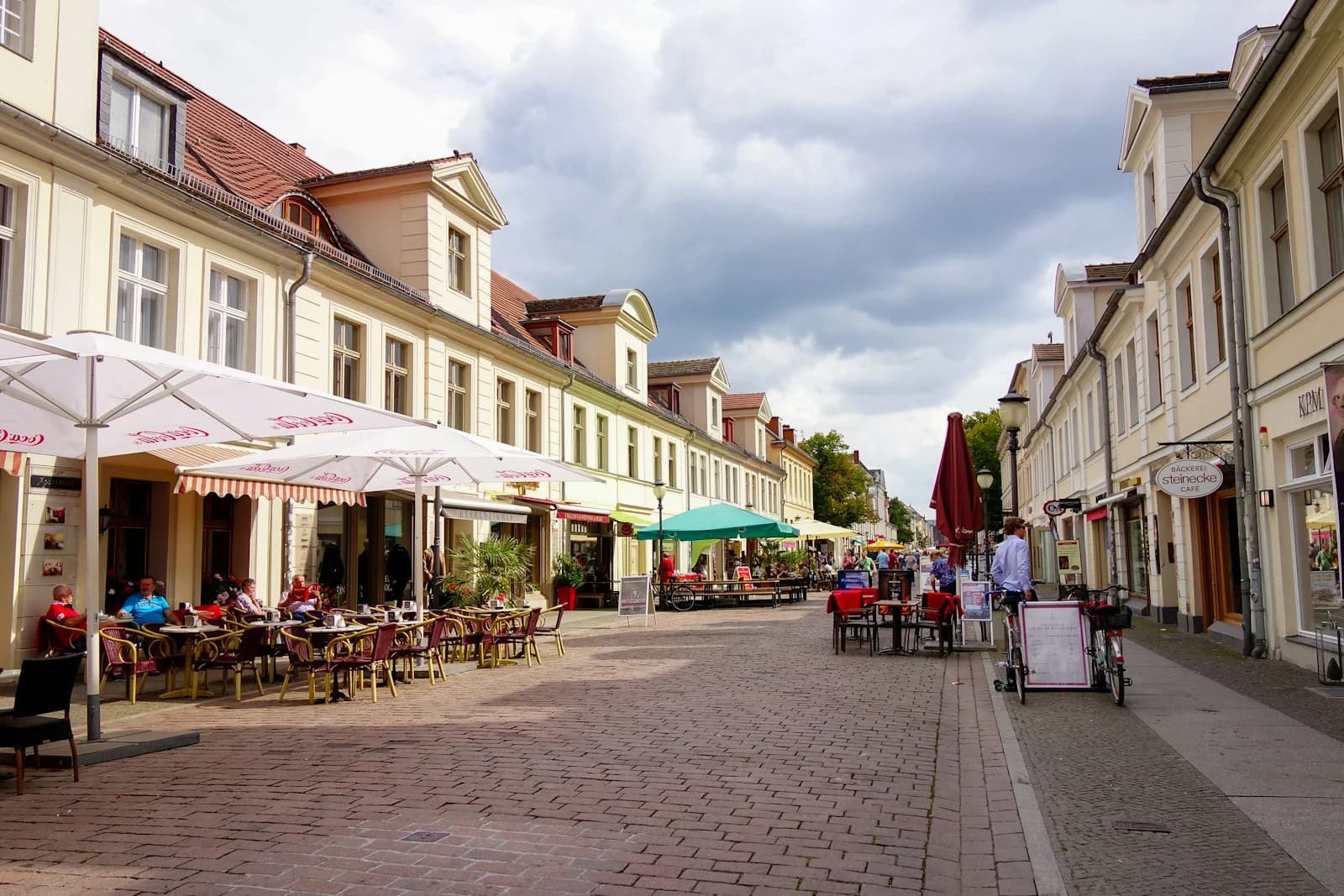
Potsdam's centre is where the transport plan ends and walking takes over. The Alter Markt, the historic market square around the Nikolaikirche, sits at the heart of the old town and is described by the city as once having been among the most beautiful squares in Europe. It is also the location of the Potsdam Museum, which occupies the Old Town Hall after its restoration between 2010 and 2012.
From there, the central sights cluster tightly enough that hopping back onto a tram between them wastes more time than it saves. A self-guided Potsdam old town walk keeps the day coherent and lets you drift toward the Dutch Quarter and the gates without re-planning each leg. Save the vehicles for the long hops to the parks.
Photographers should think about light as well as distance here, because the central squares and the park face different directions and reward different times of day. A Potsdam photography guide helps sequence the walk so you are not crossing the city twice for the same view. Transport gets you to the area; timing decides what the area looks like.
Accessibility and Assistance
VBB runs a companion service for travellers who feel uncertain using public transport because of mobility limitations, and its site carries the details. That is a service to arrange rather than something to assume on arrival. If you need assistance, read the operator's own conditions first and build the request into your schedule.
At the palaces, accessibility is described carefully rather than absolutely. The foundation describes Sanssouci Park as conditionally barrier-free and recommends a low-barrier route for visitors with limited mobility and for blind and visually impaired visitors, while Sanssouci Palace is described as suitable for people with disabilities in accompaniment, with a wheelchair-accessible restroom in the visitor centre at the Historic Windmill. Assistance dogs are welcome. Note that ramps or lifts are not the same as access to every room.
Common Planning Mistakes to Avoid
The most frequent error is treating the transport ticket and the palace ticket as one purchase. They are separate products from separate providers, and a transport pass does not open a palace door. Buy the palace admission for the time you actually want, then plan the journey around that slot.
The second is underestimating the park. Because Sanssouci Park spans close to 300 hectares, choosing an arbitrary stop can leave you with a long walk before you reach anything. Match the stop to the entrance and the building, as the palace foundation's own stop list allows you to do.
The third is relying on outdated travel writing. Older guides quote fares, hours and line details that have long since changed. For anything volatile, use the operator or the palace foundation directly, and treat third-party summaries as background only.
The fourth is planning only Sanssouci and then discovering the Pfingstberg too late in the day. The belvedere is a separate hilltop site with its own access routes and seasonal openings, so it deserves its own half-day rather than a rushed add-on. Decide before you travel whether it makes the cut.
Plan Your Visit
Potsdam works well without a car as long as you treat the day as two problems: moving between stops, and deciding what you are paying to enter. Use the VBB tools for the network, the palace foundation for the stops that serve each sight, and the site's own pages for anything seasonal. Then check the details again shortly before you travel.
Once you have your stops, the rest is sequencing. Browse more Potsdam city and itinerary guides to slot the transport plan into a realistic day, and look at the landmark guides if a particular palace is driving the trip. Building the route around one or two anchors beats trying to see everything in a single loop.
Frequently Asked Questions
Which tram or bus stop do I use for Sanssouci Park?
The palace foundation names four stops for the park: Potsdam, Schloss Sanssouci; Potsdam, Neues Palais; Potsdam, Schloss Charlottenhof; and Potsdam, Luisenplatz-Nord/Park Sanssouci. The right one depends on which entrance and which building you are aiming for, since the park is large and stretches over a long east-west axis. Look up the stop names on the VBB journey planner before you travel rather than choosing by name recognition.
Do I need a separate transport ticket for Potsdam if I already have a Berlin ticket?
Potsdam sits inside the same regional network as Berlin, which is why a single journey can cross the city boundary, but whether your specific ticket covers that journey depends on its scope and duration. Rather than assuming, enter your actual start and end points into the VBB timetable and check what the planner says your ticket needs to cover. If you hold a Berlin WelcomeCard, check the variant details, because only some versions are sold with public transport included.
How do I get to the Belvedere on the Pfingstberg by public transport?
The Pfingstberg site publishes its own suggested approaches by tram, bus, bicycle and on foot, which is the best starting point because the last stretch is a climb. A general Potsdam attraction listing associates the address with bus stops at Am Pfingstberg and Langsahnsstrasse/Grosse Weinmeisterstrasse, but treat those as planning hints rather than a timetable. Confirm current services on the VBB journey planner, and check the site's seasonal opening notice, since it closes over winter and reopens in spring.
Is Sanssouci Park free to enter, and is the palace separate?
The park is free to enter and opens daily from 8 am until dark according to the palace foundation. The palace interiors are a different matter: visits are ticketed and bound to fixed admission times, and same-day tickets are limited, so advance online booking is recommended. The foundation also sells a combined ticket covering a single visit to its Potsdam palaces open that day, with a fixed time at Sanssouci Palace, which is a palace product rather than a transport product.
Can I bring luggage or a pram into the palaces?
The palace foundation states that luggage cannot be left in the entrance area and cannot be stored in the listed premises, and that prams and baby strollers are not permitted in the exhibition rooms for conservation reasons. These are rules for the palace interiors, not general statements about the transport network. If you are travelling with bags or a stroller, plan the day so you are not carrying them through a palace visit.
Sources
- VBB.de - Verkehrsverbund Berlin-Brandenburg | VBB
- Transportation in Potsdam | Check prices for Bus, Train, and Carpool - Busbud
- UNESCO-Welterbe Schloss Belvedere Pfingstberg in Potsdam entdecken
- Belvedere auf dem Pfingstberg in Potsdam
- Biosphäre Potsdam | Berlin WelcomeCard
- Old Market (Alter Markt) | Landeshauptstadt Potsdam
- Sanssouci Park - Garden Design at the Highest Level | SPSG
- Sanssouci Palace - Retreat on the Vineyard | SPSG


