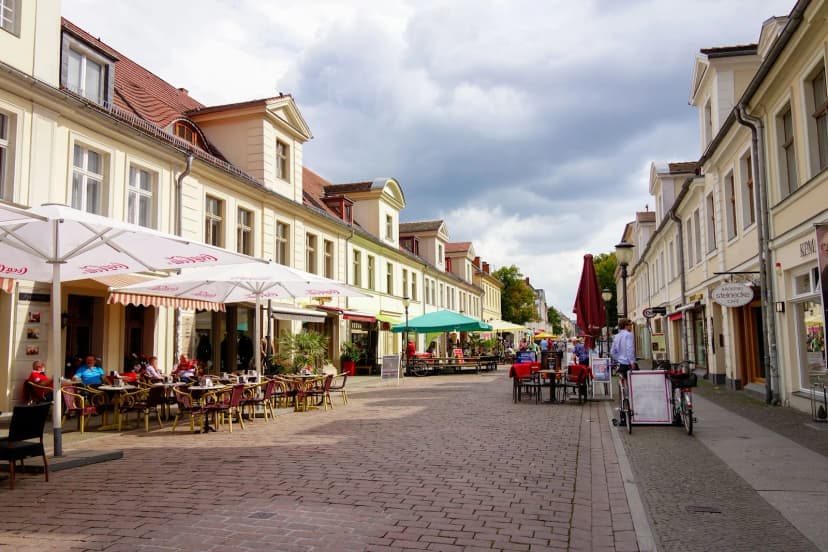
Potsdam's historic core rewards walkers because the interesting decisions come close together: which square to linger in, which gate to pass through, and which paid interior deserves your time. The compact old town holds a rebuilt market square, a baroque town hall, several city gates and the red-brick Dutch Quarter within a walkable area. This route runs from Alter Markt north to the Dutch Quarter, with branches you can drop or add depending on your energy.
One practical anchor point comes from the city's official tourism listing for a guided old-town tour, which names the obelisk on Alter Markt as its meeting point and describes a route reaching the Old Town Hall, Brandenburg Gate, Nauener Gate and the Dutch Quarter. That same listing puts the guided tour at roughly two hours, which is a useful benchmark even if you walk independently. Use it to calibrate your own pace rather than as a fixed schedule.
The walk is almost entirely through public streets and squares, so you can complete it without buying a single ticket. Paid interiors are optional add-ons in separate buildings, not one combined admission. Budget roughly a half day if you include one museum and keep the rest as a stroll.
Start at Alter Markt: Obelisk, St. Nicholas Church and the Old Town Hall
The city describes Alter Markt as Potsdam's historic heart, laid out under Frederick the Great in the mid-eighteenth century as an Italian-style square near the Havel. Most of the surrounding ensemble was destroyed in the bombing of April 1945, and the ruined City Palace was demolished in 1959-60 before the Fortunaportal was rebuilt in 2002 on the site of today's state parliament building. Reading the square as a layered reconstruction rather than an intact baroque set changes what you notice.
The marble obelisk, erected in 1753 and altered in 1979, makes a reliable meeting point in the open square. St. Nicholas Church dominates the space, and the Old Town Hall carries the tiered dome and Atlas figure the city's own description highlights. Stand back far enough to see how the church, the hall and the reconstructed palace facade frame one another.
The Old Town Hall has always stood here, though its appearance changed repeatedly; the version you see now was rebuilt between 1960 and 1966 as a cultural centre and later restored. Since a 2010-2012 renovation, the Potsdam Museum has occupied it as a forum for art and history. If you want one interior on this walk, this is the most historically coherent choice.
Optional paid interiors: Potsdam Museum and the Film Museum
Treat museum visits as separate purchases rather than a single old-town ticket. The Potsdam Museum sits inside the Old Town Hall, and the Film Museum occupies the former Royal Stables near the New Market, so they are different buildings with different operators. Check each venue's own page for current admission and hours before you commit.
The city's own Alter Markt page is the best starting point for verifying what is currently open, because it links onward to the museum and to digital city tours. Avoid assuming that a ticket for one collection covers another, and avoid planning your day around opening times copied from older guides. Confirm on the day you go.
If your interest is Prussian court culture rather than municipal history, the Film Museum's setting in the stables may appeal more than the museum in the town hall. Pick one, because two interiors will swallow the afternoon you need for the walk north. The route itself loses nothing by skipping both.
Heading north: Brandenburg Street and the Great Military Orphanage
From Alter Markt, walk north into the pedestrian zone around Brandenburg Street, which is where the old town becomes a shopping street with cafes and everyday city life. The nearby Great Military Orphanage on Breite Strasse is described by the city as Potsdam's largest preserved baroque ensemble, founded in 1724 by Frederick William I as an institution for soldiers' children. It is a strong example of how much of central Potsdam was built to house and train people, not to impress tourists.
This stretch is where you feel Potsdam's dual identity as a garrison town and a royal residence. The architecture is deliberately individual rather than repetitive, which is why the facades are worth a slow look instead of a fast transit. Keep the orphanage as an exterior stop unless a specific exhibition is advertised.
Choosing your gate: Brandenburg Gate, Hunter's Gate or the canal
Potsdam's old town is ringed by surviving gates, and the guided-tour description names the Brandenburg Gate, Hunter's Gate and Nauener Gate as part of the standard circuit. Each gives a different approach to the northern quarter. The Brandenburg Gate, modelled on a Roman arch, faces the wider city; Hunter's Gate and Nauener Gate sit closer to the residential streets you are heading toward.
The Stadtkanal is another optional thread. The city notes that the canal once wound through Potsdam and was filled in during 1965, and that it is being reconstructed step by step. Because the work is long-running, treat the canal as a passing look rather than a planned stop, and do not build your route around a completion date.
If you only have time for one gate, choose Nauener Gate, because it puts you directly at the edge of the Dutch Quarter. If you want the broader architectural sequence, pass the Brandenburg Gate first and loop back north. Either way, the gates are free public structures you walk through rather than ticketed monuments.
Nauener Tor and the square around it
Nauener Gate is the natural hinge of this walk because the square around it opens toward the Dutch Quarter while still looking back over the old town. The operator's route description includes the gate and its art installation among the highlights, which tells you the square is treated as a destination rather than a traffic point. Pause here, check where you have been, and decide whether to continue or turn back.
The square works as a break because it has space, seating and passing city life without being an attraction with an entrance. This is a good place to reset your plan if the weather turns or your group is flagging. From here the quarter is short and the walking is easy.
Into the Dutch Quarter: red brick, four squares and real residents
The Dutch Quarter was built by Dutch families in the 1730s and 1740s, and it is recognisable by its red brick and gabled houses. Only a fraction of the families who were recruited actually stayed, which is why the quarter reads as a planned settlement that became an ordinary neighbourhood. Today it is residential, with workshops, small businesses and courtyards rather than a staged open-air museum. For wider planning, see Holländisches Viertel Potsdam.
Walk the four squares and the connecting streets slowly, and look at the craft and workshop signs rather than hunting for a single photo spot. Because people live here, keep voices down in courtyards and treat doorways as private. The quarter rewards an unhurried half hour more than a checklist.
If you want more context on how the quarter fits into the wider city, read it as one of several distinct Potsdam neighbourhoods rather than the whole of the old town. The walking area is small, so a wrong turn costs you only a few minutes. Use that freedom to wander.
A longer variant: continuing toward Sanssouci Park
Sanssouci Park is a separate walking day, not the next block of the old town, so decide deliberately whether to add it. Its grounds are extensive, with several palaces and buildings that carry their own admissions, and the New Palace alone has a substantial interior. If you add the park, cut the museum stops and start earlier.
The park is free to enter, but individual palaces and galleries are ticketed and their interiors are often visited on timed entries. Choose one interior and treat the rest as landscape. Walkers who try to see the whole park after a full old-town loop usually end up hurrying through both.
One trade-off worth naming: the old town is dense and human-scaled, while the park is open and monumental. Combining them in one day is possible but not relaxed. Keep the shorter loop distinct so you actually enjoy the quarter instead of rushing it on the way out.
Self-guided or guided: time, cost and when a guide earns the money
Guided old-town tours cluster around a two-hour format and typically start at a fixed meeting point such as the obelisk on Alter Markt. One Potsdam operator advertises an old-town walk at roughly two hours for groups, while city tourism publishes individual adult and concession rates for its own tour. Both figures come from operator listings, prices change, and you should confirm before booking.
Commercial booking platforms list a range of Potsdam walking products, from short group tours of the old town to longer combinations with the park. These listings mix durations, languages and group sizes, so compare the actual itinerary rather than the headline. Marketplace pages are also third-party summaries, not official operator confirmations.
Self-guiding wins when you want to stop for photographs, change route at a gate, or leave at the point your energy ends. A guide earns the money when you want the stories behind facades you would otherwise pass, or when you have limited time and want the highlights sequenced for you. Neither option is wrong; they solve different problems.
Practical timing, season and surface notes
Allow about half a day for the walk itself if you add one interior, and treat two hours as the floor rather than the target. Give the old town a morning when the streets are quieter, and keep the Dutch Quarter for later when the squares fill with people. If you are visiting from Berlin, remember that Potsdam is a separate city and the old town is not adjacent to the palaces.
Spring and autumn suit this walk because the distances are short and the stop-start rhythm is comfortable. Summer brings the fullest terraces and the most people; winter strips the squares back to architecture and short daylight. Rain matters more here than in a museum-heavy day, so keep one indoor option in reserve.
The surfaces are city streets and paved squares, but do not assume step-free access to every building, church or tower. Check individual venues for current access arrangements rather than relying on general impressions of the route. Cobbles, thresholds and historic entrances are common in the old town.
Where to end and how to continue
The Dutch Quarter is the natural end of the walk because it is compact, walkable and clearly separate from the old town's monumental core. From there you can return south through the gates, drift back toward the market square, or continue onward if you have saved energy for the park. Decide before you set out which of those you actually want.
If you are building a wider Potsdam trip, the old-town loop pairs well with a separate day in the parks and palaces rather than being stretched to cover both. The one-day itinerary format works best when you choose a main anchor and accept that some sights get only a passing look. Keep the walk as the anchor when the city center is the point.
Plan Your Visit
A good Potsdam old town walk is less about covering ground than about sequencing decisions: start at Alter Markt, choose one interior at most, pass a gate, and finish in the Dutch Quarter while you still have attention left. Check museum hours and any tour prices on the operator's own page on the day, because those details change. The streets, squares and gates themselves cost nothing and remain the most reliable part of the day.
If you only do one thing, walk the quarter in the late afternoon when residents are coming home and the facades read clearly. If you do two, add a single museum in the old town and leave Sanssouci for another visit. That is the honest trade-off this route is built around.
Frequently Asked Questions
How long does a self-guided Potsdam old town walk take?
Plan on roughly two to three hours for the core route from Alter Markt to the Dutch Quarter, and treat that as a suggestion rather than an official figure. Add time for any museum interior, a longer pause at Nauener Gate, or a detour toward the canal. Guided old-town tours are commonly listed at around two hours, which shows how much ground the highlights alone cover.
Is the Dutch Quarter in Potsdam free to walk through?
Yes. The Dutch Quarter is a residential neighbourhood of public streets and squares, so walking through it costs nothing. You are passing people's homes and courtyards, so keep noise down and treat private doorways as private. The quarter is the endpoint of this route rather than a ticketed attraction.
Can I walk from Alter Markt to Sanssouci Palace on the same route?
You can continue in that direction, but treat Sanssouci Park as a separate walking day rather than the next stage of the old-town loop. The park is extensive, its palaces and galleries are separately ticketed, and interiors often use timed entry. If you want both, choose one interior in the old town, keep the Dutch Quarter brief, and start earlier.