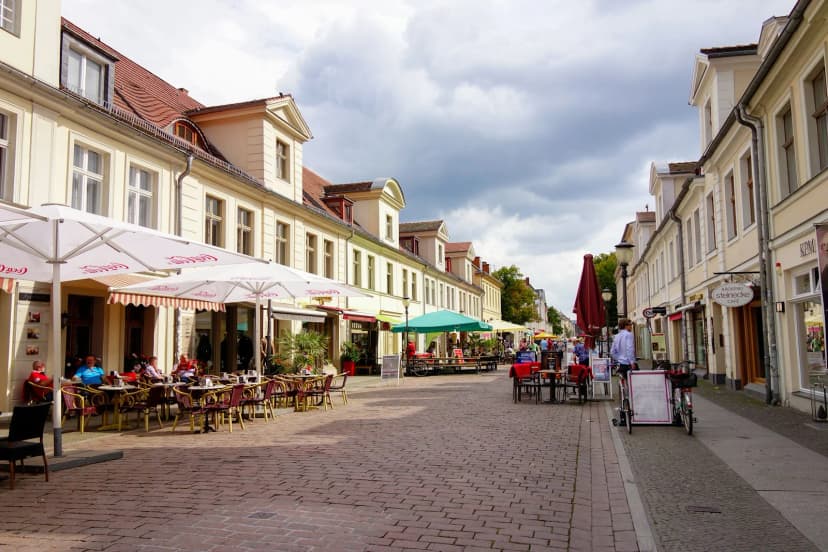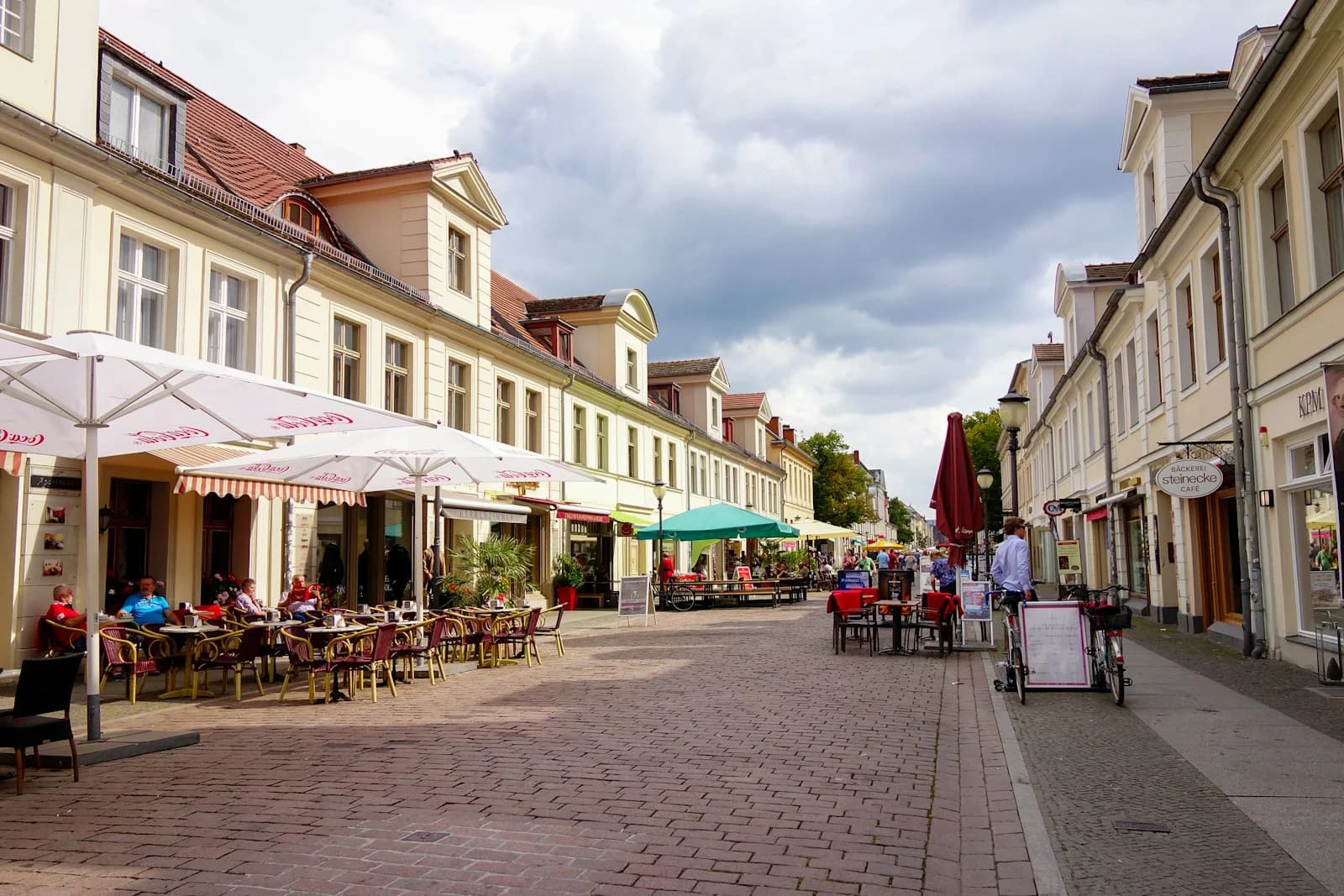
The Holländisches Viertel is a residential quarter in central Potsdam, not a single walled attraction with one entrance and one ticket. It consists of four quarees, or blocks, of red-brick houses arranged around lanes such as Mittelstrasse and Benkertstrasse, and the streets themselves are public space you can walk at no cost. That is the first decision to make: treat the quarter as a district to wander, and treat its museums as separate, individually ticketed stops.
The figures differ by source, and the difference is worth knowing before you repeat one. The city of Potsdam describes four quarees with about 150 brick houses, while visitBerlin states exactly 134 red, two-storey brick houses arranged in four quarees. Both agree the houses were built between 1734 and 1742 for Dutch immigrants and craftsmen, under the direction of the architect Jan Bouman, and that the ensemble is the largest closed Dutch building group outside the Netherlands.
Allow roughly an hour for a self-paced loop through the lanes, then add separate time if you want to go inside a museum. Walkers mainly follow Mittelstrasse and Benkertstrasse, and Bassinplatz, a square just outside the quarter, works well as either the start or the finish of that loop. Everything below explains what you are looking at, how the quarter came back from near-dereliction, and where the free experience ends and the ticketed one begins.
The Ensemble in Numbers: Four Quarees, One Building Programme
The quarter takes its shape from four quarees, each a closed block of houses around an inner courtyard, laid out so the streets between them form a compact grid. The city of Potsdam puts the total at roughly 150 brick houses; visitBerlin counts 134 red, two-storey brick houses. Whichever figure you carry away, the useful point for a visitor is that this is a dense, walkable cluster rather than a scattered set of individual sights.
Construction ran from 1734 to 1742, commissioned as part of the recruitment of Dutch craftsmen to Potsdam under King Friedrich Wilhelm I, and the building work was led by Johann Boumann. The houses were designed in a recognisably Dutch idiom: brick facades left unplastered, white mortar joints, shutters, and in some cases curved gables. That combination is what makes the streets read as a coherent ensemble rather than as ordinary 18th-century town houses.
If your interest is in how the district compares with its neighbours, it helps to see it as one piece of central Potsdam rather than an isolated oddity. The historic centre around Alter Markt, the squares and the palace landscape all sit within the same compact city, so a Dutch Quarter walk can be slotted between other stops without a long transfer. A neighborhoods overview is useful for deciding how much of the centre to group into one day.
Reading the Architecture as You Walk
The facades are the main exhibit, and they reward slow looking. Because the brick was left unplastered, you can see the individual bricks and the deliberately contrasting white joints that outline them; shutters frame the windows, and some houses carry curved gables that lift the roofline above the neighbouring buildings. These details are why the district is described as a closed Dutch building ensemble rather than a collection of loosely related houses.
Stand back far enough to see a whole quaree and the repetition becomes obvious: the same brick, the same jointing, the same shutter pattern, repeated across a terrace. That repetition is the design, and it is easier to appreciate from the middle of a street than from directly in front of any single door. Look for where a curved gable breaks the line, and for the corner houses that turn the block and define the lane.
One caution about expectations: the quarter is a lived-in neighbourhood, and not every courtyard or interior behind a facade is open to the public. Treat the streets as the reliable, publicly walkable layer of the visit, and treat anything behind a door as something to check individually rather than assume. That framing avoids the disappointment of arriving with an assumption that all four quarees can be entered.
Lanes That Matter: Mittelstrasse and Benkertstrasse
Two streets anchor the quarter, and the address given for the district confirms it: Mittelstrasse and Benkertstrasse. Mittelstrasse carries the densest concentration of shops, workshops and cafes, and it is also where the Jan Bouman Haus sits at Mittelstrasse 8. Benkertstrasse runs through the same block system, so walking one and then the other gives you a cross-section of the quarter in a short distance.
Bassinplatz sits immediately outside the quarter and is a sensible frame for a loop. The square takes its name from the drainage function it once served for the surrounding marshy ground, and today it holds a 19th-century church and a Soviet war cemetery, with a farmers market on weekday and Saturday mornings near the church. Starting or ending there lets you pair street architecture with a square that has a different history and a different scale.
A loop of roughly an hour suits most walkers who want the architecture and a pause, though that figure is a suggestion rather than an official duration. If you add museum time, shopping, or a meal, the visit stretches accordingly. Because the lanes are short, the practical risk is not distance but repetition: plan a route that crosses the quarter once in each direction rather than circling the same block.
Free Streets Versus Ticketed Interiors
The public streets of the Dutch Quarter are free to walk, and that is the core of the visit for most people. The quarter is explicitly described as a residential district and a tourist sight in the historic centre of Potsdam, which is a different model from a single gated attraction. Budget your time, not your entrance fee, for the streets themselves.
Two museums sit within the quarter and should be treated as separate, individually ticketed visits. The Jan Bouman Haus at Mittelstrasse 8 presents the origins of the Dutch Quarter through display boards and video, while the Potsdam Museum shows views of old Potsdam alongside paintings and graphics from the 18th to the 20th century, plus a photography exhibition of the city before and after the Second World War. There is no indication that the two share a combined ticket, so check each museum's own current admission and opening arrangements before you go.
That separation matters when you are planning a half day. Deciding to enter one museum will change how much street time you have left, and the two cover different subjects: one the district's own construction history, the other the wider city's art and photographic record. If you only have an hour, spend it on the lanes and save the interiors for a return visit.
Shops, Galleries and Workshops in the Quarter
The ground floors of the quarter are occupied in a way that keeps the streets active. Across the district you find arts-and-crafts shops, galleries, workshops, antiquarian bookshops and comfortable cafes, according to visitBerlin, and the city likewise points to a large number of distinctive shops and cosy cafes and restaurants alongside the architecture. That mix is what gives the lanes their atmosphere beyond the brickwork.
Browse rather than work from a checklist. Because the businesses are small and independent, what is open on a given day is not something you can reliably predict from a distance, and quality judgements about individual shops and cafes are not something to take on trust from any single listing. Let the streets decide the stops, and treat any specific shop as a bonus rather than the purpose of the walk.
This is also where the quarter overlaps with the wider question of what costs money in Potsdam. The lanes are a free activity that fits alongside other no-ticket options in the city, which is useful if you are balancing a palace-heavy itinerary against your budget. See what else is free in Potsdam before committing your paid hours elsewhere.
Decline and Renewal: Why the Quarter Looks Like This Today
The streets you walk were not always in this condition. By the end of the 1980s the quarter was in a sorry state, and the political change of 1989 to 1990 opened the way for its rehabilitation. The decisive instrument was an urban-renewal statute for the Dutch Quarter passed by the city councillors on 12 September 1990, which created the conditions for a revival built on cooperation between public and private effort.
Knowing this changes what you notice. The uniform brickwork and the intact rooflines are the result of a coordinated restoration rather than untouched survival, and the fact that a functioning residential quarter emerged from it is part of why the district feels lived in rather than museum-like. When you see a restored facade, you are looking at the outcome of a specific decision made in 1990.
For visitors interested in Potsdam's wider urban history, the renewal story sits alongside other districts that were shaped by deliberate planning rather than chance. If you want to compare the Dutch Quarter with another historically planned colony in the city, that contrast sharpens both. The comparison is worth a separate stop rather than squeezing it into this walk.
Seasonal Events: Tulips, Pottery and the Advent Market
Large festivals take place in the Dutch Quarter three times a year, according to visitBerlin: the Tulpenfest in April, the pottery market in September, and the Dutch Christmas market during Advent. The same source characterises these as the quarter's major events rather than small side attractions, which is why they draw crowds into lanes that are otherwise quiet.
Treat the months as a planning signal, not a schedule. Festivals of this kind are set by organisers year by year, and exact dates are not something to assume from one edition to the next; check the city's own event calendar or the organiser's announcements close to your travel dates. If the market is the reason for your trip, confirm the dates before booking anything else.
Event days and ordinary days give you genuinely different experiences, so pick according to what you want. A market day means stalls, crowds and a festive atmosphere, but the streets are harder to read and the lanes are harder to photograph; an ordinary weekday morning is quieter and better for looking at brickwork. Neither choice is wrong, but the trade-off is real and worth deciding in advance.
Pacing and Pairing the Walk with Central Potsdam
Give the quarter a clearly defined slot in your day rather than drifting into it. Roughly an hour covers the two anchor streets and a sample of the surrounding lanes; add time for a museum, a coffee, or browsing the shops if that is part of your plan. Mornings tend to be calmer than market days or weekend afternoons, which is when the lanes are busiest.
The quarter pairs naturally with the historic centre, because the two are close and you can move between them on foot without planning transport. The Alter Markt area, the reconstructed city palace and the squares around them sit in the same central zone, so a morning here and an afternoon there is a reasonable shape for a day. If you prefer a fixed structure, use a city itinerary as scaffolding and place the Dutch Quarter into one of its slots.
For the larger palace and park sights further out, plan them as separate outings rather than trying to tack them onto this walk. Sanssouci and the surrounding parkland are a different kind of day with different logistics, and the Dutch Quarter works best when you are not watching the clock for a transfer. Keep the walk local, keep the palaces separate, and both will be better.
Where the Dutch Quarter Sits in Potsdam
The district occupies part of the historic centre of Potsdam, with Mittelstrasse and Benkertstrasse as its named address, and the surrounding streets connect it directly to the rest of the old town. Because it is a residential quarter rather than a fenced site, there is no single front gate or ticket desk to find; you arrive at a street and you are in it. That is worth knowing before you set out looking for an entrance.
Bassinplatz, immediately outside the quarter, is the most useful landmark for orienting yourself, and it gives the walk a clear edge. The square's market, its 19th-century church and its Soviet cemetery give you something to look at before or after the brick lanes rather than a plain boundary. If you are meeting someone, agreeing on the square is simpler than naming a street corner inside the grid.
How you get to Potsdam is worth checking against current public transport information rather than a remembered route. This guide deliberately avoids stating specific lines or journey times, because those change and should be verified at the time of travel. Check the operator's own journey planner on the day you intend to go, and treat the quarter as the destination rather than the starting point of your planning.
Plan Your Visit
The Dutch Quarter rewards a simple plan: walk the lanes, read the brickwork, and decide separately whether the Jan Bouman Haus or the Potsdam Museum justify an interior stop. Since the streets are free and the two museums are separate ticketed venues, you can shape the visit around whatever time you actually have. Check each museum's current opening arrangements and admission directly before you go, because those details are the ones most likely to change.
If a festival is part of the appeal, work backwards from the month rather than assuming a date: April for the tulip festival, September for the pottery market, Advent for the Christmas market. Confirm the current year's dates with the organiser or the city before booking travel, and keep a quieter weekday morning as your fallback for seeing the architecture without crowds.
Frequently Asked Questions
Is the Holländisches Viertel free to visit?
Yes, the streets of the Dutch Quarter are public space and cost nothing to walk. The quarter is a residential district rather than a single gated sight, so there is no entrance fee for the lanes around Mittelstrasse and Benkertstrasse. The two museums inside the quarter, the Jan Bouman Haus and the Potsdam Museum, are separate venues with their own admission arrangements, so check each one's current details directly before planning your day around them.
How long does it take to walk the Dutch Quarter in Potsdam?
Roughly an hour is a reasonable suggestion for a loop covering Mittelstrasse, Benkertstrasse and a sample of the surrounding lanes, though that is a recommendation rather than an official duration. Add time if you want to browse the shops, stop in a cafe, or visit one of the two museums. Because the district is compact, the limiting factor is usually how long you spend looking rather than any distance you have to cover.
How many houses are in the Dutch Quarter and when were they built?
The city of Potsdam describes four quarees with about 150 brick houses, while visitBerlin gives a precise count of 134 red, two-storey brick houses in four quarees. Both agree the houses were built between 1734 and 1742 for Dutch immigrants, under the direction of the architect Jan Bouman. The discrepancy is a difference in how the sources count, so quote whichever figure you prefer along with its source.
Which museums are in the Dutch Quarter and do they share a ticket?
Two museums sit within the quarter: the Jan Bouman Haus on Mittelstrasse, which covers the origins of the Dutch Quarter through display boards and video, and the Potsdam Museum, which shows views of old Potsdam, paintings and graphics from the 18th to the 20th century, and photography of the city before and after the Second World War. There is no indication that the two share a combined ticket, so check each museum's own admission and opening information separately.
What events take place in the Dutch Quarter during the year?
Three large festivals are held in the Dutch Quarter each year: the Tulpenfest in April, the pottery market in September, and the Dutch Christmas market during Advent. Exact dates are set year by year and can shift, so confirm the current edition with the city or the organiser before you build a trip around one of them. On ordinary days the quarter is much quieter, which suits anyone who wants to look at the architecture rather than the stalls.
How did the Dutch Quarter come to look the way it does today?
By the end of the 1980s the quarter was in a poor state, and the political change around 1990 made a coordinated restoration possible. Potsdam's city councillors passed an urban-renewal statute for the Dutch Quarter on 12 September 1990, which created the basis for public and private effort to bring a vital residential quarter back. The intact brick facades and uniform rooflines you see on a walk today are the product of that restoration rather than untouched survival.