
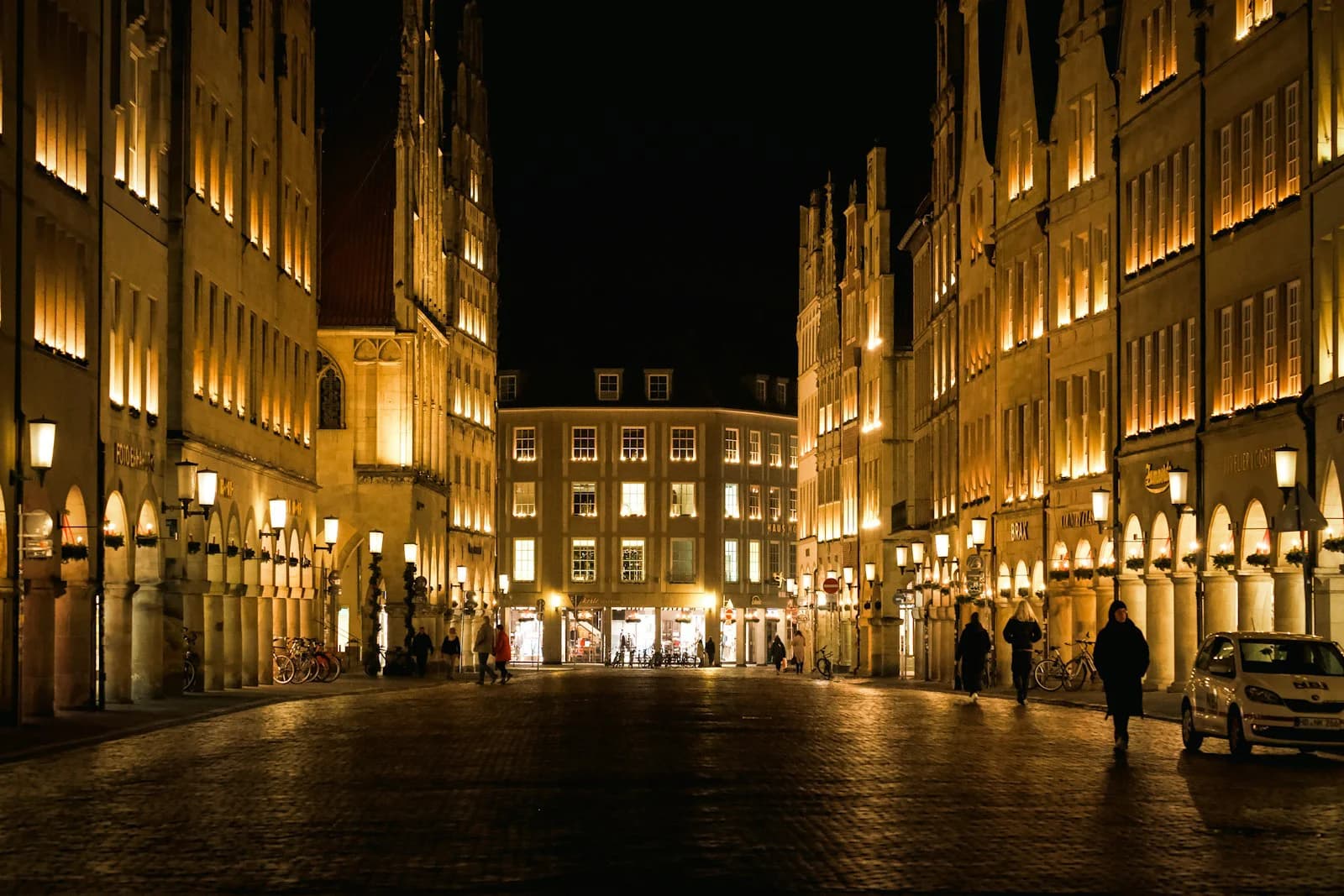
Münster rewards travellers who use it as a base rather than a single stop. The compact old town, the flat Münsterland plain and a rail network radiating in several directions mean you can leave the car parked and still reach moated castles, manor houses and river landscapes within a day. One practical reference is a regional operator's centre-based cycling tour, which uses Münster as its hub and lists daily rides of 25 to 69 kilometres on mostly flat, paved paths. Use those figures as route context from that operator, not as a universal measurement of every possible outing.
The shortlist below is deliberately narrow: Nordkirchen Castle, the two separate moated castles at Lüdinghausen, and the two Droste-Hülshoff sites. Each answers a different question about how you want to spend a day, whether that means gardens, interiors, cycling or literary history. Think of this as a set of trade-offs rather than a ranking, because the right choice depends on how much of your day you want to spend moving between places.
One clarification before anything else: this is the German Münster in North Rhine-Westphalia, not the French Munster associated with soft cheese. The two places are unrelated, despite the shared name. If you are also planning time in the city itself, pair this article with a One day in Münster itinerary and keep the day trips for the days when you want to leave the ring road behind.
Why Münster Works as a Day-Trip Base
Münster's old town is walkable, and the surrounding Münsterland is famously flat, which makes cycling a realistic way to cover the last few kilometres from a station to a castle gate. Germany's national tourism board describes Münster as a bicycle city where as many as 100,000 people cycle around the city every day, and it names Nordkirchen Palace among the city's top sights. That combination of a cycle-friendly city and a flat hinterland is the core reason day trips here feel less like logistics and more like a ride.
The city itself gives you a soft landing before you leave it. The Prinzipalmarkt square is lined with 48 gabled buildings, many joined by arcades, and the Peace of Westphalia was signed in the city on 24 October 1648. That historical weight is worth an afternoon, but it also explains why so many visitors use Münster as a hub: the city is compact enough to cover on foot, leaving full days free for excursions.
If you want more city time either side of your excursions, a 2 days in Münster itinerary or a 3 days in Münster itinerary can absorb the cathedral, the Picasso Museum and the Aasee without rushing. Landmark-focused travellers may also want the Münster: Landmark Visitor Guides hub to line up the city's churches and museums before committing to day trips.
How to Choose Your Day Trip: Four Decisions
The first decision is grounds versus interiors. A castle estate can be a landscape experience, a museum visit or both, and the two are often managed separately. Rather than assume that a garden stroll and a museum ticket go together, check the operator's own site for what is open and what requires a ticket, and treat free grounds and paid interiors as two separate questions.
The second decision is your mode of travel on the ground. Cycling extends your reach and matches the flat terrain, but it also adds rental logistics and weather exposure. Walking keeps things simple but effectively limits you to one or two sites per day. A reasonable compromise is to ride to a site, lock the bike and explore on foot, then ride back to the station.
The third decision is one castle or two. Lüdinghausen's two moated castles sit close enough that pairing them makes sense on a map, yet each is a distinct site with its own story. Treating them as one visit risks arriving at the second after it has closed. The fourth decision is how much transit you tolerate, and that is where honest, operator-sourced distances become more useful than optimistic itineraries.
Münster's own city website is the sensible first stop for orientation and for links into tourism information, but it does not publish a consolidated day-trip ticket or a single castle pass. Plan each site as its own booking question. This article deliberately avoids quoting train times, tram lines or prices because the verified sources do not provide them; confirm those with the transport operator and the site directly.
Nordkirchen Castle: The 'Münsterland Versailles'
Schloss Nordkirchen is the headline act of the region, nicknamed the Versailles of Westphalia and once a prince-bishop's residence. It sits roughly 25 kilometres from Münster, which is why it appears on so many day-trip lists. The estate's gardens, with their manicured landscapes and lines of statues and fountains, are the part most visitors remember, and they reward a slow lap rather than a quick photo stop.
The practical caution is that a grand estate is not automatically one visit. The castle building, its interiors and its gardens can each have their own access rules, so check with the operator before you travel rather than assuming a single ticket covers everything. What the visitor-facing sources support is the setting and the architecture, not the current contents of an interior museum or its opening regime.
Nordkirchen also appears as a highlight of a regional cycle itinerary that runs from Münster through Münsterland castles, including Vischering and Lüdinghausen, on the longest day of that tour. If you want one big-name destination with a garden walk, this is the obvious pick. If you want variety and smaller sites, the Lüdinghausen pair may suit you better, and a longer Münster itinerary can accommodate both.
Lüdinghausen's Moated Castles: Two Sites, Not One
Lüdinghausen is often described as a castle destination, which can create the false impression that you buy one ticket and see one attraction. In practice, two named sites anchor the area: Vischering Castle, a moated fortress with medieval roots, and Lüdinghausen Castle, the less famous of the two but with its own structure and grounds. Day-trip coverage treats them as a combined excursion because they are close to each other, not because they are the same place.
Plan for separate admission and separate hours. Because the sites are distinct, it is safer to verify each one individually with its own operator or local tourism office than to assume a shared ticket or a shared closing time. Vischering's moated setting makes it the more photogenic of the two, while Lüdinghausen Castle's quieter grounds suit travellers who want space rather than crowds.
Lüdinghausen also sits on the same regional cycle route that connects Münster, Vischering and Nordkirchen, so it can be paired with the bigger castle if you are on a bike and keep the day moving. If you are on foot or relying on rail, treat the two castles as a full outing rather than a quick add-on. Cyclists who want the castle country in one sustained ride may find a 3 days in Münster itinerary a useful frame for spacing the days.
The Droste-Hülshoff Trail: A Literary Afternoon
Annette von Droste-Hülshoff is Münsterland's most celebrated literary figure, and two sites carry her story. Hülshoff moated castle was her birthplace, while Haus Rüschhaus was a former residence, and the two are distinct places rather than one estate. The regional cycle itinerary dedicates a full day of roughly 54 kilometres to following her tracks, via Bösensell and Tilbeck Abbey, and also passes Haus Vögeding and Haus Rüschhausen.
Because the two Droste-Hülshoff sites are separate, literature-minded visitors should budget more time than a quick stop allows. Reading about her life in Münster and then standing in the landscape she grew up in is the real reward, and it works best at walking or cycling pace. The regional operator frames the route as easy, mostly flat and suitable for beginners, which matters if you are not a confident rider.
Admission and opening details for both sites are best checked directly with their operators before you set out, since this guide does not carry verified current times or prices. If you are unsure whether a bike or a train-and-walk approach suits the day, the region's cycling credentials are a fair argument for trying the bike at least once. Münster's flat terrain and dense cycle culture make it a forgiving place to experiment.
The Werse River and Hohe Ward: A Quiet Landscape Day
Not every good day trip needs a castle. The regional cycle itinerary includes a stage of about 45 kilometres along the Werse cycle path, passing manor houses near Rinkerode and continuing into the Hohe Ward forest area with its historic Hiltrup waterworks. It is a low-key landscape day: hedgerows, water, woodland and small manors rather than ticketed interiors.
This kind of outing suits travellers who have already seen the headline castles or who simply want a slower day between sightseeing days. Because the route is mostly flat and paved, it is also a reasonable choice for mixed-ability groups. Bring your own repair kit and water, and treat refreshment stops as pleasant finds rather than fixed itinerary points.
A shorter city-focused stage of about 25 kilometres runs along the Dortmund-Ems Canal to the city harbour and the Kreativkai, loops through the old town and returns along the Werse river past the Pleistermühle mill. That makes a useful half-day option when you want to be back in Münster for the evening. Combine it with the Best photo spots in Münster for a lighter, camera-oriented day rather than a full excursion.
Building a Realistic Rail-Plus-Bike Day
The single planning mistake that ruins a Münsterland outing is treating the last few kilometres as an afterthought. Confirm how you will cover the gap between the station and the site before you commit: rental availability, whether bikes are allowed on the service you plan to use, and how long the ride actually takes. The regional operator lists rental bikes including touring, premium and electric models, which shows that demand for bike hire in this region is real.
Reserve in advance whenever your date is fixed, particularly in the warmer months. If you cannot reserve, have a walking backup and a shorter destination in mind. Because the terrain is flat and the paths are mostly paved, the ride itself is usually the easy part; the hard part is matching your route to your energy and to daylight at the end of the day.
Do not build your day around unverified journey times. Sources that discuss rail travel to Münster confirm the city is served by train and even warn against confusing it with the French Munster, but they do not give usable timings for individual castle trips. Check current schedules with the transport operator when you plan, and keep a buffer for the return leg.
Should You Skip the Big Names?
Sometimes a shorter, unglamorous trip beats a packed castle itinerary. If you have only one free day, choosing either Nordkirchen or the Lüdinghausen pair and doing it properly will usually feel better than racing between both. The distance between them, and the time needed to explore properly, argue for depth over breadth.
If you are in Münster primarily for the city, keep your excursion modest. A half-day ride along the Dortmund-Ems Canal and the Werse, or an afternoon at one moated castle, leaves the evening free for the Prinzipalmarkt and the Kreativkai. The A Two-Day Münster Itinerary is a useful reference for fitting one excursion into a short city break without losing the city itself.
Skip anything you cannot verify. Some destinations that appear in general search results are not supported as practical Münster day trips by the sources available here, and promoting them would only send you somewhere you cannot comfortably reach. The honest approach is to treat the verified castles, the Droste-Hülshoff sites and the cycle routes as your core options, and to add anything else only after you have checked it yourself.
Plan Your Münster Day Trip
Münster's value as a base comes from three things: a walkable historic centre, flat terrain that suits cycling, and a set of castles and literary sites within reach of the city. Choose Nordkirchen for a grand estate and gardens, Lüdinghausen for two distinct moated castles, or the Droste-Hülshoff route for a literary landscape day. Whichever you pick, verify opening details and transport with the operator rather than relying on secondary summaries.
Keep your booking simple: one main destination per day, a confirmed way to cover the last few kilometres, and a conservative plan for the return. Use a One day in Münster itinerary for the city itself and save the castles for the days when you want to leave it. If your schedule allows, add a slower Werse or Hohe Ward day rather than squeezing a third castle into the same trip.
Frequently Asked Questions
Can you do a day trip from Münster without a car?
Yes. Münster is a compact city with a rail network serving the surrounding Münsterland, and the region is flat and cycle-friendly once you leave the station. The practical work is covering the last few kilometres to a castle or trailhead, either on a rented bike or on foot. Check current train schedules and bike-carrying rules with the transport operator before you commit to a route, since verified sources do not provide journey times for individual castle trips.
Is Nordkirchen Castle worth visiting from Münster?
It is the region's signature estate, often called the Versailles of Westphalia, and it appears on reputable day-trip lists alongside the Münsterland's other castles. Whether it is worth it depends on what you want: garden walks and architecture versus smaller, quieter sites. Check directly with the operator about which parts of the estate are open and whether gardens and interiors are ticketed separately, because a single visit may not cover everything.
How far is Lüdinghausen from Münster, and can you visit both castles?
Lüdinghausen is treated in regional trip planning as a day-trip destination from Münster, with Vischering Castle and Lüdinghausen Castle as two separate sites. They are close enough to pair, but they are distinct attractions, so expect separate opening details and admission rather than one shared ticket. Verify hours for each castle individually with its operator, since this guide does not carry confirmed current times.
Do you need a bike for Münsterland day trips?
You do not need one, but a bike makes the castles and landscape routes far more accessible. The region is flat and the cycle paths are mostly paved, and a regional cycling operator runs centre-based tours from Münster with daily rides listed at 25 to 69 kilometres. Rental bikes, including electric models, are part of that operator's offering, which suggests hire is a realistic option. Walking works for a single site; a bike is better for linking several.
What should you do if a castle interior is closed?
Do not treat a closure as a wasted trip. The grounds, gardens and moated settings at sites such as Nordkirchen and Vischering are part of the appeal, and a landscape walk or a Werse river ride can fill the day. Before travelling, check the operator's own site for current access, and keep a backup destination in mind. Because opening regimes can change, confirm before you set out rather than relying on older blog posts.


