

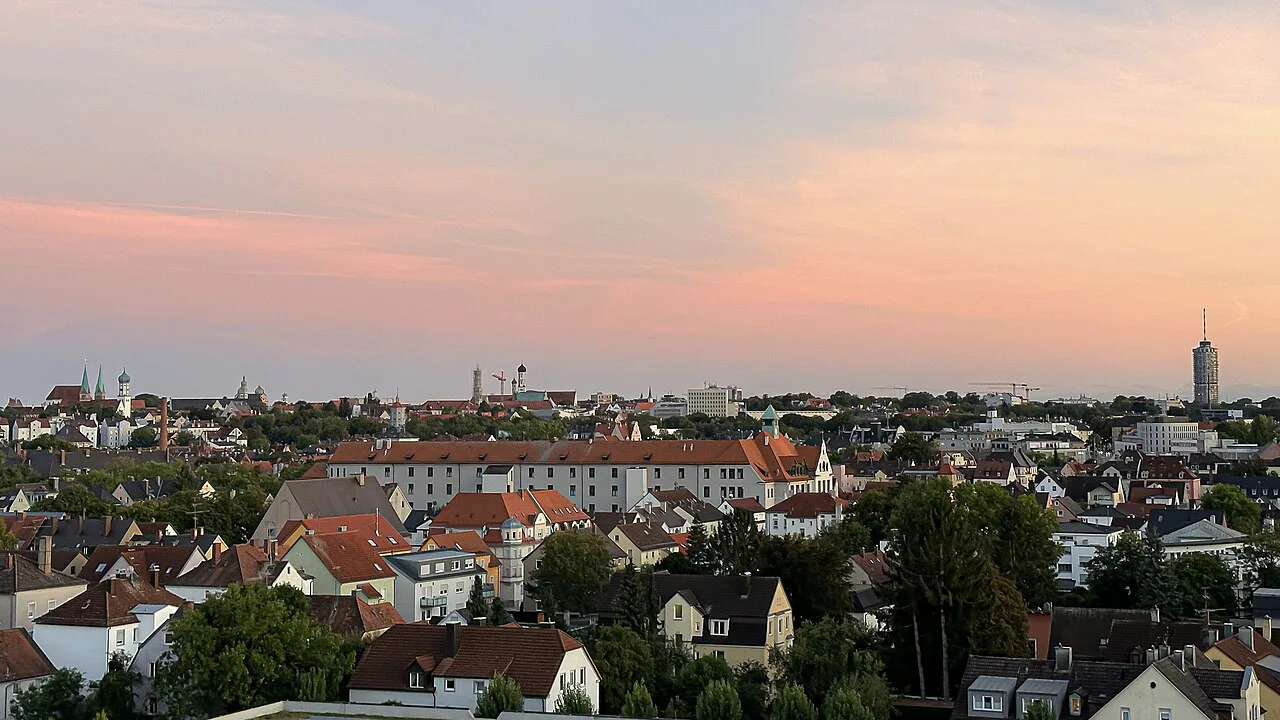
Sunset in Augsburg is less about finding one secret location and more about answering two questions before you leave your accommodation: where is the sun actually going down, and do you have a clear line of sight towards it. A sunset forecast source describes the useful viewpoints in broad categories rather than naming a winner, listing waterfronts, hilltops, rooftop terraces, bridges and open parks as the kinds of places with an open western horizon. That is a strong hint that your decision should be driven by light direction and access, not by a checklist of names.
Start with the forecast page for the day you are actually going out. A worked example is useful: a published October 12 snapshot lists sunset at 6:35 PM, golden hour from 5:53 PM to 6:35 PM, sunrise at 7:32 AM and just over 11 hours of daylight, with a note that the day was already three minutes shorter than the previous one. Treat those clock times as a dated snapshot of a single day, not as year-round times for Augsburg, and expect them to shift noticeably across the year.
The second source for the same date gives sunset at 18:35 with a west bearing of 260 degrees, a 39 percent quality score classed as fair and zero percent cloud cover. Zero cloud sounds ideal but is not always the most colourful outcome, because the quality score is designed around how much light the clouds near the horizon can reflect back. That distinction matters when you decide whether an evening is worth rearranging your day for.
What the Sunset Forecast Actually Tells You
Most sunset forecasts for Augsburg do two separate jobs. The first is astronomical: they give the time the sun crosses the horizon, the direction it sets in and the boundaries of golden hour and blue hour. The second is meteorological: a quality score or a set of icons indicates whether the sky is likely to reward the effort of going out at all.
Sunsethue publishes a quality band system that is worth learning before you rely on any single number. Scores under 20 percent are classed as poor because too much cloud is present, 20 to 40 percent is fair, 40 to 60 percent is good, and 60 percent and above is classed as great or excellent and described as rare. That framing is useful for expectations: a fair evening can still be pleasant, it simply carries a bigger chance of a flat sky.
The same source states plainly that the forecast is inherently uncertain and should be treated as an estimate, and it suggests reopening the prediction a few hours before sunset to catch the latest weather data. So build a habit of checking twice: once the night before to pick a rough direction of travel, and again in the late afternoon before you commit to a spot across town.
The Westerly Bearing Is Your Real Planning Tool
A sunset time on its own tells you when to be outside, but the bearing tells you where to stand. For the October 12 snapshot the sun was recorded setting in the west at 260 degrees, which points broadly along the axis between the city centre and the districts to the west. Whatever day you visit, look up that bearing on your phone compass and sketch a quick line on the map from your position towards it.
Then ask what sits between you and that line of sight. A low wall, a row of buildings or a dense line of trees at eye level will end your sunset earlier than the published time, while a rise in the ground, a river corridor or a wide open green space keeps the horizon intact for longer. This one check eliminates more bad sunsets than any ranking of locations ever will.
Choosing Between Riverside, Elevated and Bridge Viewpoints
Riverside and waterfront promenades are the easiest category to plan around, because water generally keeps the horizon open and reflects whatever colour the sky produces. The trade-off is competition: an accessible promenade on a pleasant evening attracts walkers, cyclists and dog owners, so a foreground full of other people is part of the deal. Arriving well before golden hour begins is the simplest way to pick your spot rather than accept what is left.
Bridges function as temporary tripods. They lift you above the bank and give a clean sightline along the water in both directions, which is genuinely useful when the colour is strongest well to one side of the setting point. The drawback is that bridges are thoroughfares, so expect vibration, passing bicycles and limited space for a wide stance.
Elevated decks and tower views offer the widest horizon, but they come with planning risk. You have to check whether the platform is actually open and whether you can reach it before the light turns, and you have to accept that you are looking at the whole city rather than at the sun sitting behind one particular landmark. Prepare a fallback at ground level rather than discovering the problem on arrival.
The Perlachturm: A Viewpoint You Should Not Build Plans On
The obvious candidate for an elevated sunset view is the Perlachturm, and it is a good illustration of why viewpoint advice needs a date attached. The tower began around 989 as a roughly 30 metre watchtower, then the city architect Elias Holl raised it to about 70 metres between 1612 and 1618, adding the octagon and the onion-shaped dome that echo the neighbouring town hall. It reopened as a viewing tower in 1950 after burning out during the Second World War.
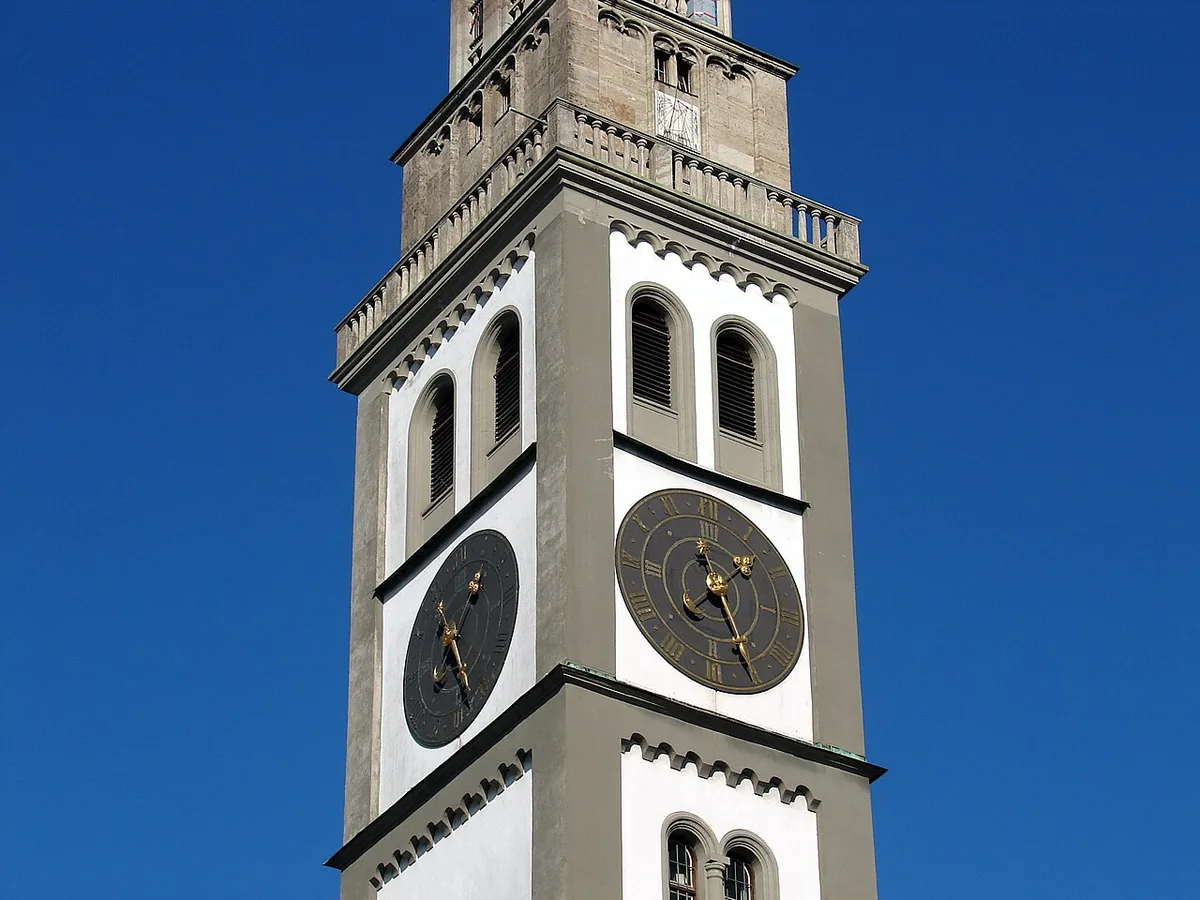
Reaching the observation platform involves a climb of 258 steps, and the same listing records that the tower is currently closed for renovation. That makes it a poor centrepiece for a sunset evening right now: no reopening date is published there, and the same page does not give current admission, lift access or daily opening times. Check the city's own tourism pages before counting on the tower, and keep a street-level option in reserve.
Open Parks and West-Facing Lawns
Parks solve the access problem because they usually stay open later and offer several angles within a short walk. The trade-off is soft foreground: grass and trees rarely give you the clean geometric lines that a bridge or a terrace does, so think about how the middle distance frames the view before you set up. If you want a wide, low horizon, walk to the edge of a lawn rather than sitting under the first bench you find.
Why the Blue Hour Often Beats the Sunset Itself
Many people leave the moment the sun disappears, which is exactly when the second half of the show begins. On the October 12 snapshot the evening blue hour ran from 6:35 PM to 7:07 PM, the period between sunset and the end of civil twilight. During that window the sky deepens into blue while city lights come up, which tends to give city scenes a better balance of sky and buildings than the intense but brief colour of golden hour.
The forecast source also notes that colours can persist for up to about 30 minutes after the published sunset time, depending on conditions and on where you are standing. Plan your visit as a two-stage evening: one position for the last of the direct light, then a short move if you want a different composition for the blue hour. Staying put for both is perfectly reasonable, but decide in advance so you are not packing up during the best ten minutes.
Pairing Golden Hour With an Indoor Stop
Autumn and winter sunsets arrive early enough that the evening is not over when the light fades, so it makes sense to pair a viewpoint with something indoors. Museums in central Augsburg generally close in the late afternoon, which means the realistic order is museum first and sunset afterwards rather than the reverse. That improves the odds of your indoor stop still being open.
The Römerlager im Zeughaus, the exhibition presenting Roman Augsburg, is listed with Tuesday to Sunday opening from 10:00 to 17:00 and closed on Mondays, with a note that opening times can differ. Use that listing on the day rather than assuming the pattern holds through holidays. A museum-goers' route could also include the H2 Centre of Contemporary Art, which German National Tourist Board pages describe as closing on Mondays while otherwise running 10 am to 5 pm, so check the individual venue pages before you build a sequence.
Seasonal Reality: A Shorter Light Budget
The single most useful seasonal fact is that the light window shrinks fast in autumn. The October 12 snapshot recorded 11h 3m of daylight and noted that the day was three minutes shorter than the one before, which means the practical golden-hour window keeps arriving earlier week by week. If you are planning an evening around a fixed dinner reservation, work backwards from sunset rather than forwards from lunch.
Because the same source offers its own list of nearby cities, one practical habit for a short trip is to check whether the Augsburg prediction page is still showing today's live forecast rather than a cached seasonal estimate. If in doubt, open the live view for current conditions and confirm the sunset time, the quality score and the direction before deciding how far across the city you are willing to travel.
A Same-Day Workflow That Takes Ten Minutes
First, check the forecast on the day itself and note three numbers: sunset time, golden-hour start and the bearing. Second, open your map and look for anything in that direction within an easy walk, tram ride or short taxi hop of wherever you will be in the late afternoon. Third, pick a backup from a different category, because a riverside plan fails differently from an elevated one if the choice turns out to be unavailable.
Then aim to be in position about half an hour before golden hour begins rather than at the sunset minute. Arriving early gives you time to test the framing, find a stable footing and decide whether the sky is developing. If you are building a wider city itinerary, this sunset slot fits neatly at the end of a Two days in Augsburg itinerary day, after the churches, town hall squares and museum stops are done.
What You Cannot Plan Around
Forecasts are estimates, and the sources themselves say so: a high score is not a promise of vivid colour and a low score does not guarantee a dull sky. Wind, haze and fast-moving cloud can all change the outcome within an hour, so treat any specific quality number as a reason to go or stay, not as a result you can rely on.
You also cannot assume that an elevated viewpoint will be available, which is why the renovation closure at the Perlachturm matters so much for planning. Where a site publishes no current access, staffed opening window or lift details, the only responsible move is to confirm directly before travelling and to have a street-level alternative already chosen.
Plan Your Evening Around the Light
The most reliable way to see a good sunset in Augsburg is to treat it as a small logistics exercise rather than a bucket-list item. Read the forecast on the day, note the direction the sun is setting in, choose a category of viewpoint that matches your available time, and arrive early enough to change your mind. Elevation buys you horizon, water buys you reflection, and bridges buy you height without a climb, but none of them outperform simply being in the right place before golden hour starts.
If you are still assembling the rest of the trip, the city overview at Augsburg: Itineraries and City Travel Guides and the landmark pages in Augsburg: Landmark Visitor Guides cover the daytime sights that pair naturally with an evening out. A sunset slot of roughly an hour to ninety minutes, including the blue hour, is a reasonable suggestion rather than an official recommendation, and it slots into most days without crowding out anything else.
Wherever you end up standing, the same principle applies in other German cities with rivers and old towns. The comparison guides for where to watch sunset in Munich and where to watch sunset in Berlin show how the same forecast-reading approach travels, and the Best viewpoints in Augsburg page groups the city's elevated and open-air options in one place for when the tower and the terraces are back in play.
Frequently Asked Questions
What time is sunset in Augsburg?
It changes every day, so there is no fixed answer to carry around. On a published October 12 snapshot, sunset was listed at 6:35 PM in Augsburg, with golden hour running from 5:53 PM to 6:35 PM and the evening blue hour following until 7:07 PM. Treat those figures as an example of what the data looks like rather than as current times, and check a sunset forecast for Augsburg on your date a few hours before you plan to go out, because conditions and light times both shift.
Will the sunset be good tonight in Augsburg?
No forecast can guarantee it. One service publishes a quality score for the evening with bands described as poor below 20 percent, fair from 20 to 40 percent, good from 40 to 60 percent and great or excellent at 60 percent and above, while another offers its own scale out of 100. Both are estimates based on conditions near sunset time, and the service itself notes that weather forecasts are inherently uncertain, so use the score to decide whether an evening out is worth it and recheck closer to the time.
Which direction does the sun set in Augsburg?
It depends on the time of year. For a published October 12 date, the setting direction was recorded as west at 260 degrees, which is a useful planning reference but not a year-round constant. Open the compass app on your phone, confirm the bearing shown for your date on the forecast page you use, and then look for a place where that line of sight is not blocked by buildings, walls or dense trees at eye level.


