

Augsburg's headline lookout cannot be climbed at the moment. The Perlachturm, a 70-metre tower directly beside the town hall, is closed for renovations, and reaching its observation platform means a climb of 258 steps when it is open. For wider planning, see Perlachturm Augsburg.
That single fact reshapes a viewpoint itinerary. Augsburg is flat, river-built and low-rise, so its views come from towers rather than hills, and the most famous tower is out of action. The honest options are a square-level composition in front of the town hall, a low-angle walk along the water corridors, and a wait for the tower to reopen.
What Counts as a Viewpoint in a Flat, River-Built City
Augsburg sits in the Swabia region of Bavaria and is divided into 42 city districts and 17 planning areas, with most historic fabric concentrated in the central Altstadt. Height in this city comes from towers rather than topography, so genuine elevated viewpoints are limited, and planning around one structure is more realistic than assembling a ranked list of lookouts.
It helps to separate three different products. Looking down means a tower. Looking at means a composed skyline photograph from street level. Looking along means a river or canal walk where the payoff is water, greenery and reflections rather than a panorama. Each suits a different weather window and a different appetite for stairs, and only the first is seriously constrained in 2026.
Climbing the Perlachturm: Height, Steps and the Renovation Caveat
The Perlachturm began in 989 as a watchtower of around 30 metres and was raised to its current 70 metres by city architect Elias Holl between 1612 and 1618, adding an octagon with Doric columns and a dome with an onion-shaped cap. The tower was burned out during World War II, reopened in 1950, and has since served as a viewing tower.
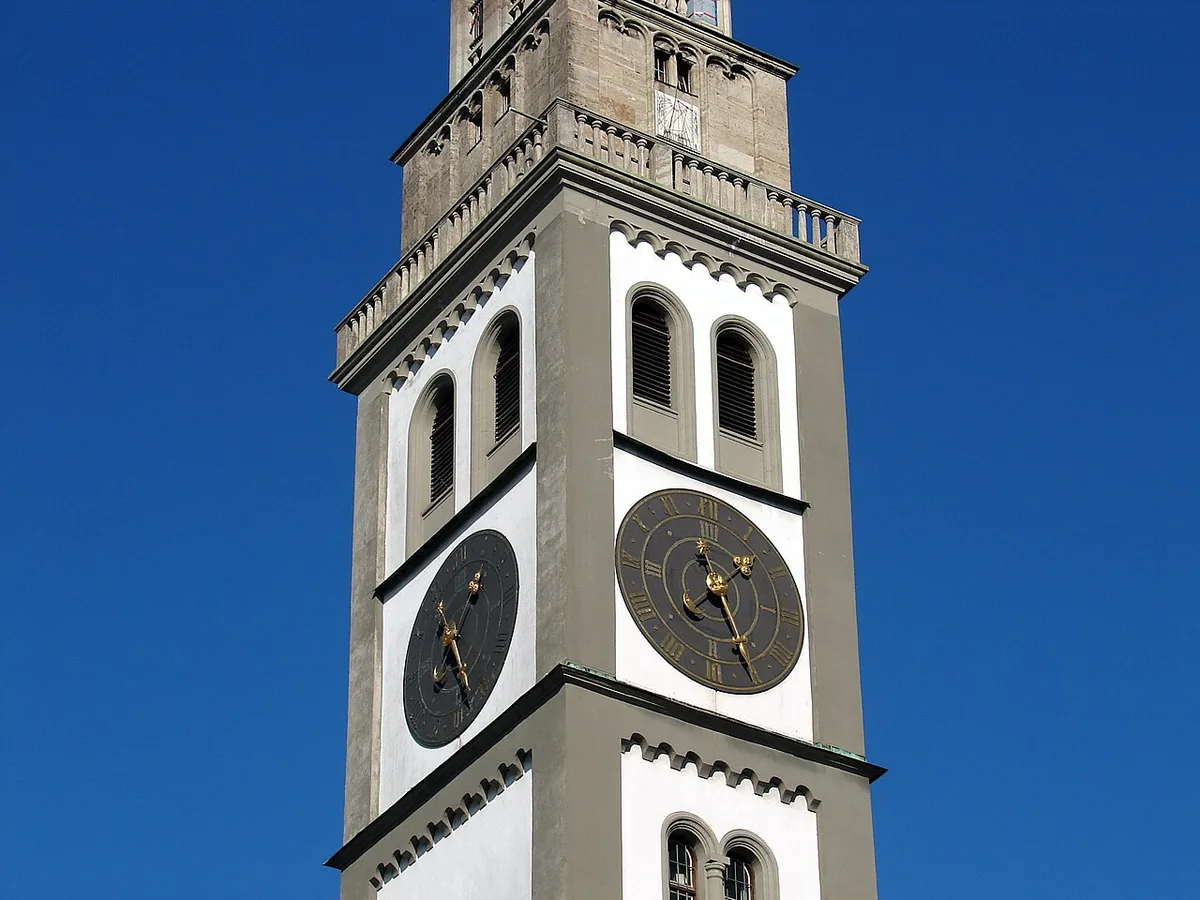
Inside, a climb of 258 steps awaits those heading for the observation platform. Although the tower is currently closed for renovations, that ascent traditionally rewarded visitors with sweeping views over Augsburg and, on clear days, the distant Alps. Treat the Alpine sightline as a clear-day bonus rather than a predictable feature of any visit.
Because restoration work continues, the practical step is to check the city's official tourism pages for the current visiting arrangement before you travel, rather than trusting a reopening date quoted in an older article. Where the operator has not published a status for your dates, plan your day around the equally rewarding street-level sights instead of assuming the platform will be accessible.
One tradition worth knowing even if you cannot climb: the Turamichele, a mechanical figure of the Archangel Michael, appears at the tower's window every September on Michaelmas Day, reenacting the battle with the devil and drawing crowds who gather to count the strikes of Michael's sword.
Rathausplatz: The Most Reliable Skyline Composition
Rathausplatz gathers the Renaissance town hall, the tower and the Augustus fountain into a single frame, which is why it remains the most dependable skyline composition in the centre. A photo-spot guide identifies the historic town hall square, with the town hall, Perlach tower and Augustus fountain forming a picturesque backdrop, as the natural starting point for a photographic walk.
Think of this as a looking-at viewpoint rather than a looking-down one. You are layering architecture, not surveying the city from above, and the return comes from the tower silhouette rising behind the town hall facade. The square is also a busy meeting point with markets, cafés and events, so an early start tends to give you cleaner frames and quieter pavement.
If you want a suggested shape for a half day, a reasonable editorial suggestion is to spend roughly an hour working the square and its immediate alleys at ground level, then continue into the surrounding Altstadt on foot. That is a recommendation for pacing, not an official duration, and it assumes you are photographing rather than queueing for an interior. For wider planning, see Augsburg landmark visitor guides.
Rivers, Canals and Green Corridors for Low-Angle Views
Augsburg's water management is a UNESCO World Heritage feature, and the Lech and Wertach floodplains function as green walking and picnic space. A city guide describes the green spaces along the Lech and Wertach rivers as ideal for walks, jogging or picnics, and highlights the picturesque canals and the Lech river as settings for nature and landscape photography in any season.
Be clear about what this delivers: water, bridge frames, reflections and riverside greenery rather than a commanding skyline panorama. No published source we reviewed establishes a recognised elevated viewpoint on either river corridor, so treat the embankments as atmosphere and leg-stretching rather than a substitute for a tower. Late afternoon light along the water is a sensible window for this kind of photography. For wider planning, see Where to Watch Sunset in Augsburg.
The riverside plan is also weather-dependent. Rain quickly removes the appeal of a water-and-green walk, so keep an indoor fallback in reserve and check forecasts before committing to the longer loop.
Judging a Viewpoint by What You Actually Want
If altitude matters most, the honest position is that Augsburg's headline climb is unavailable during renovation, so you would be choosing the city for its streetscape rather than its panorama. If a single strong photograph matters most, the town hall square delivers a composed Renaissance ensemble without any ticket, queue or stair climb.
If a relaxed half day outdoors matters most, the river and canal corridors give you a walkable green edge with water views and no admission question. These are three different products, and the sensible approach is to pick the one matching your energy and the weather rather than chasing a ranking of the single best viewpoint.
It is also worth noting that Augsburg's wider sightseeing can absorb the time a tower climb would have taken. The Fuggerei, the cathedral with its stained glass, and the palace collections all sit within the central area, so a viewpoint-led visit can fold in an indoor block without much detouring.
Before You Go: Verifying Status and Separating Tickets
The city's official tourism pages publish operator-level information, so they are the right place to confirm the tower's status and current visiting arrangements. Where an attraction has not published details for your dates, plan around it rather than assuming it will be open. Further visitor details appear in Official event website.
Old trip reports are not reliable for current access or charges. A 2017 account, for instance, described a seasonal window for the tower and a small entry charge, which reflects what applied then rather than what applies now, and renovation work has changed the situation since. Cross-check anything you find against the operator or the city before committing to a special journey.
Museum sites in Augsburg are run by different institutions, so do not assume a single ticket covers several venues. Check each institution's own pages for what is included in its admission, and treat any combined-ticket claim you read elsewhere as unverified until the venue confirms it.
The Honest Trade-Off in Augsburg
Augsburg's viewpoint question comes down to a simple trade-off: the tower that would settle it is closed for renovation, while the square beneath it remains a free, reliably photogenic composition. Choose the city for its compact Renaissance centre and water corridors, and treat an elevated panorama as something to confirm rather than assume.
Plan one strong photographic stop in the Altstadt, add a riverside walk or an indoor collection depending on the weather, and check official pages in the days before travelling. That way a closed tower costs you one disappointment rather than the whole day.
Frequently Asked Questions
Is the Perlachturm in Augsburg open to visitors?
The tower is currently closed for renovations, so the observation platform is not being presented as climbable at the moment. Renovation schedules can shift, so confirm the current status on the city's official tourism pages shortly before your visit rather than relying on older guides or trip reports.
How many steps are there up the Perlachturm?
Reaching the observation platform involves a climb of 258 steps inside the tower. The structure rises to 70 metres and stands directly beside the town hall, forming the Renaissance ensemble that defines Rathausplatz.
What can you see from the top of the Perlachturm?
Published descriptions associate the platform with views over Augsburg and, on clear days, the distant Alps. That describes the traditional character of the view rather than a guarantee for a specific date, since long-distance visibility depends on conditions and the platform is currently closed during renovation work.
Where can I find a good Augsburg view without climbing a tower?
Rathausplatz is the most reliable alternative, because the town hall, the tower and the Augustus fountain form a layered composition you can photograph from ground level without a ticket. River and canal corridors along the Lech and Wertach offer pleasant water-and-green walks, but they are low-angle scenery rather than elevated panoramas.
Is Augsburg worth visiting for views alone?
Probably not, since the headline lookout is closed during renovation and the city is flat rather than hill-framed. It is more compelling for its Renaissance architecture, water heritage and compact Altstadt, with the square-level composition as a strong photographic bonus rather than the primary reason to come.


