

The square around Augsburg's town hall is the easy part: Rathausplatz is listed as open year-round, around the clock, with free admission, and one listing suggests about half an hour to an hour there. The town hall interior, including the Goldener Saal, is a separate paid visit, and the neighbouring Perlachturm has been reported closed for renovation. That split is the single most useful thing to know before you go.
This guide treats the Rathaus, the Goldener Saal and the Perlachturm as one stop on Rathausplatz. It explains which parts are free, which are ticketed, and what you should confirm with the operator rather than assume from older travel writing.
Rathausplatz: the free layer of the visit
Rathausplatz is the centre of Augsburg's old town, and Maximilianstrasse, Philippine-Welser-Strasse, Eisenberg, Fischmarkt and Steingasse radiate from it. The square holds the town hall with its pinecone gable ornament, the Perlach Tower, the Augustusbrunnen and the Perlach Church in one view. It is a public space, and one attraction listing gives it free admission and a suggested sightseeing time of half an hour to an hour.
Treat that figure as a planning estimate for the free layer, not an official timing. It covers the fountain, the facades and the walk between them. If you are building a wider day, the city hub for Augsburg itineraries and travel guides is the place to start, and the landmark index for Augsburg collects the individual sights around the old town.
Because the square is free and unscheduled, it is also the part of the visit that cannot be closed on you at short notice. Buildings can shut a hall or a tower; the pavement between them stays open, and the outdoor cafe seating along the square is a legitimate way to spend an hour without buying a ticket to anything.
The Rathaus: Elias Holl's Renaissance town hall
Augsburg Town Hall is the administrative centre of the city and one of the most significant secular Renaissance buildings north of the Alps. It was designed and built by Elias Holl, the city's Stadtbaumeister, between 1615 and 1624, and it is protected under the Hague Convention for the Protection of Cultural Property in the Event of Armed Conflict.
It is worth knowing that the building is a historic landmark and a working town hall at the same time, which is why interior access is not the same as a museum's. A first-hand account of the town hall records that the building was destroyed in 1944 and rebuilt, with the outside restored as closely as possible to its original facade between 1980 and 1984 and the inside restored the following year. That account also notes there is a small fee to see the inside, and that posted hours were usually 10 a.m. to 5.30 p.m. Monday to Saturday but should be confirmed before going in.
The restoration history is the reason the interior can read differently from an untouched Renaissance hall, and the fee note is the reason you should budget for a paid element rather than expecting to walk in. Entrance arrangements and any restrictions tied to civic use or events change, so the operator is the only reliable check.
The Goldener Saal on the third floor
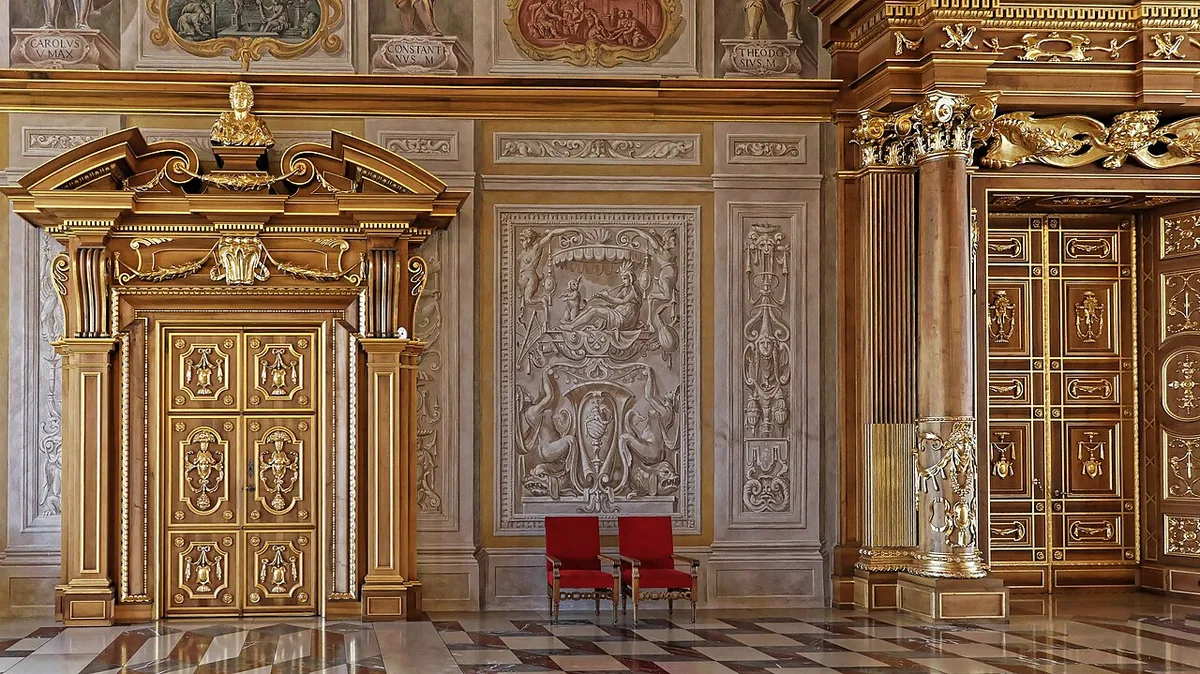
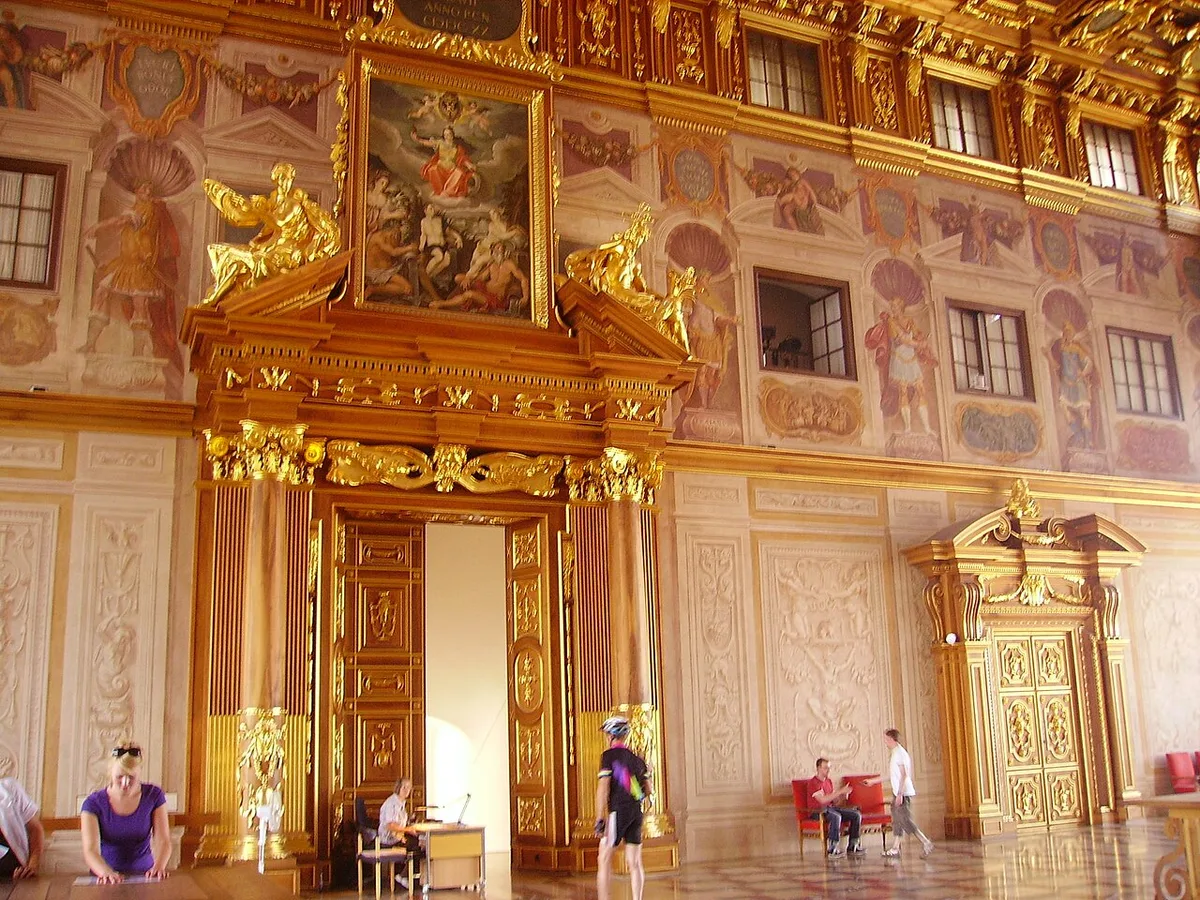
The Goldener Saal is a ceremonial room on the third floor of the town hall, famous for its ceiling paintings, murals and golden wall decoration. It was finished in 1643 and is described as one of the most important cultural monuments of the late Renaissance. This is the paid interior most visitors mean when they search for the Augsburg Rathaus.
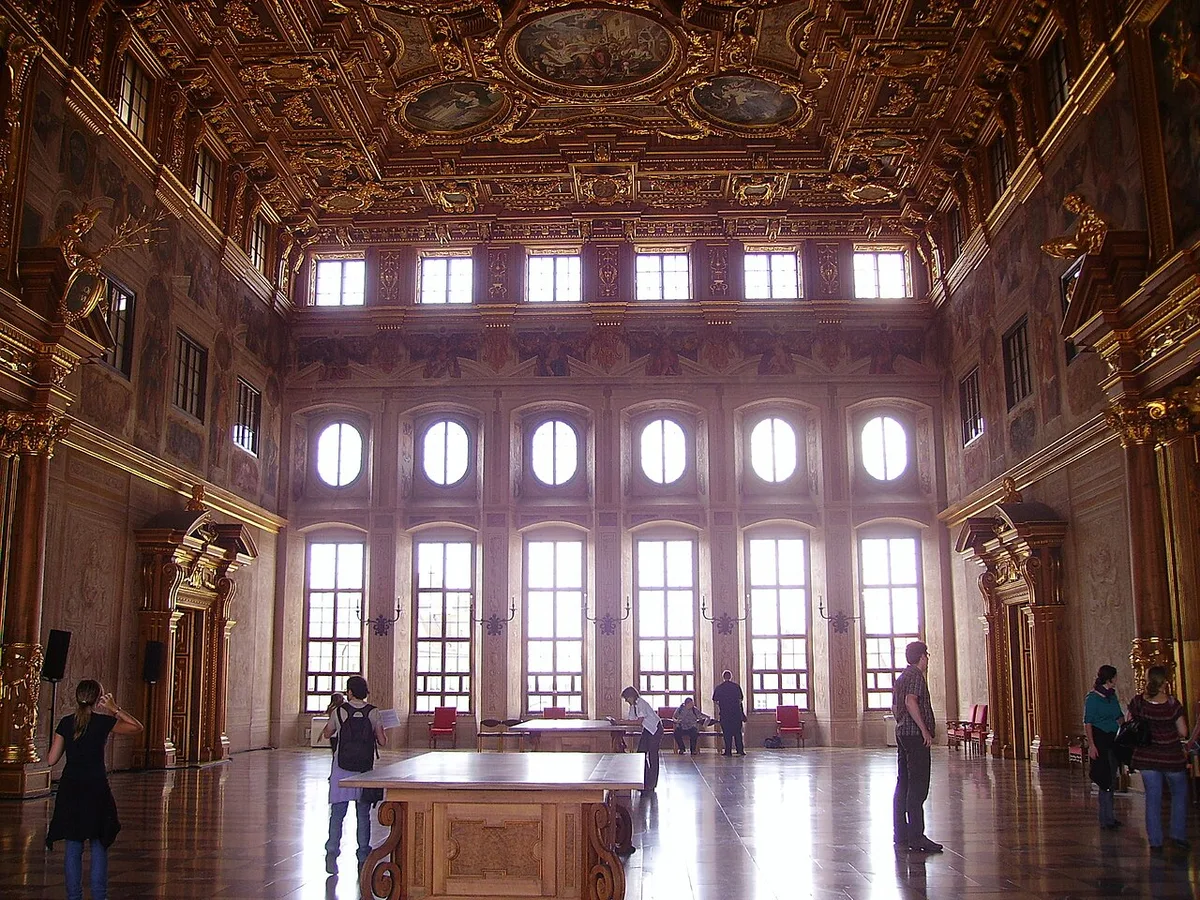
Sources differ on the level and on the scale of the room, and that difference is useful rather than annoying. One listing places the hall on the third floor; a first-hand account says the Golden Hall is on the second floor and gives its area and height, adding that it was almost completely destroyed in the Second World War and restored over later decades. Because the two accounts disagree, confirm the level and the route on site instead of relying on either.
The same account describes ground-floor memorials to Holocaust victims and to the wartime bombing, but it is not an operator statement and it conflicts with other descriptions, so treat those memorials as something to look for rather than a guaranteed part of a paid route. The practical point stands: the Goldener Saal is a paid component of a town hall visit, not a free public room, and its scope is defined by the operator.
Ticket scope: what one admission covers
Do not plan on a single combined admission covering the town hall, the Goldener Saal and the tower. The interiors around Rathausplatz are separately ticketed, and even inside the town hall the Goldener Saal is one part of a visit rather than the whole of it. Augsburg's wider museum landscape is organised institution by institution, which is why the city's art collections app links four major institutions and their exhibits rather than one pass.
Confirm at the point of purchase what your admission includes, whether the Goldener Saal is covered, and whether entry is timed. The same caution applies to combining this stop with the Fuggerei or a city pass. The Fuggerei is a separate attraction: ticket listings show admission to the Fuggerei social housing complex sold on its own and guided tours of it as another product, with no indication that town hall admission is bundled in.
If you want to compare this stop with the rest of the city's paid sights, including the cathedral and the water management system, the Augsburg landmark index is a reasonable starting point. If you are weighing a high viewpoint against an interior, the separate Perlachturm Augsburg viewpoint tickets and hours page deals with the climb on its own terms.
Free square, paid interiors: how to split the visit
The visit divides into three layers. The square, the fountain and the building exteriors cost nothing and are available whenever you pass through. The town hall interior and the Goldener Saal are paid. The Perlachturm viewpoint is a separate paid climb when it is operating.
The free layer is genuinely substantial, so visitors who mainly want the architecture lose little by skipping the interiors. The paid layer is for people who specifically want the Goldener Saal's ceiling and gold decoration, or a view from height. Augsburg's other major sights, including the cathedral and the UNESCO-listed water management system, sit elsewhere in the city with their own access arrangements.
The Perlachturm next door
The Perlachturm began as a watchtower of around 30 metres, built in 989, and was raised by Elias Holl to about 70 metres between 1612 and 1618, gaining an octagon and a dome with an onion-shaped cap. It burned out during the Second World War and reopened in 1950 as a viewing tower. Its base holds the southern and middle chapels of St. Peter's Church.
The climb is the point of the tower, and sources give slightly different step counts, 258 in one account and 261 in another. A climb-focused page also states that the Perlachturm is currently closed for renovations, so the ascent should be treated as unavailable until the operator confirms otherwise.
Some details circulating about the tower should be treated loosely. One weekend guide mentions a carillon playing several times a day and a museum at the top, but that is not the operator speaking, and it also repeats the 258-step figure. Michaelmas traditions tied to the tower are seasonal and separately organised, so check the current programme if that is your interest.
Tower or hall: deciding if you only do one
If the tower is closed, the decision largely resolves itself and the Goldener Saal becomes the paid interior to prioritise. If both are available, the choice comes down to what you want: a decorated late-Renaissance hall with ceiling paintings and gilding, or an outdoor panorama after a long stair climb. They are not interchangeable.
Choose the hall in poor weather, or if you are travelling with people who cannot manage many stairs, or if interior art and architecture is the reason you came. Choose the tower if it is open, the sky is clear, and you want the city from above. Doing both in one day is possible but rarely necessary, and it doubles the cost of the stop.
The reliable way to decide on the day is to check the tower's status before committing. A closed tower with a good forecast is not worth waiting for; a hall with a temporary closure is worth rescheduling around if the ceiling is your priority.
Checking hours, closures and prices before you travel
Opening hours, admission and renovation status for the Rathaus, Goldener Saal and Perlachturm all fall to the operator to publish, and they should be checked shortly before your visit rather than planned months ahead. The city's own museum page for the Rathaus is where a change to the interior route would appear first. Third-party listings frequently carry outdated times and should be used only as a rough cross-check.
Closure history matters here. One first-hand account describes the Goldener Saal as closed for renovations from August 2024 to April 2026, which places that reported period in the past, but a reported reopening does not by itself confirm normal daily access today. The tower has also been described as closed for renovation with no settled reopening date.
Do not rely on any specific admission figure in older travel writing, or on a stated daily 10 a.m. to 5.30 p.m. schedule, which the same account itself flags as something to check before going inside. Neither the current fee nor the current hours can be assumed from such posts. Check the operator page, and if the information is missing there, contact the museum service directly before building your day around it.
Pairing the stop with the rest of the old town
Rathausplatz is compact enough to combine with two or three nearby stops without rushing. Maximilianstrasse runs from the square, lined with the Hercules Fountain, which one listing dates to 1596 to 1600 and attributes to Adriaen de Vries, and with the city's grand burgher facades. Walking it in one direction and returning by parallel streets fills an hour comfortably.
A second cluster sits south and east. Augsburg Cathedral, with stained glass windows that are among the oldest still in their original positions, is a short walk away. The cathedral is a working church with its own visiting arrangements, so check access separately rather than assuming it follows the town hall's schedule.
For families, Augsburg Zoo sits at the northern edge of the Siebentischwald, with around 1,200 animals across more than 240 species. Getting there is a short walk from the Augsburg Haunstetterstrasse railway station, and the zoo's own site listed opening hours of 9:00 to 17:00 on the day we checked, with last admission and the ticket desk closing at 16:00, so verify those for your date.
If you want a fuller city plan rather than a single stop, build the day around walking distances and let the ticketed interiors flex. Augsburg rewards that approach: the free architecture carries the day, and the paid interiors are additions you can take or leave.
Plan Your Visit
Treat Rathausplatz as a free architectural stop and the Goldener Saal as an optional paid interior. Confirm the hall's current access and the Perlachturm's status with the operator in the days before you go, because both have a recent history of closures. Build the rest of your old-town day around walking, the fountain and the facades, which cost nothing and are always there.
If you only have a short stop, see the square and walk Maximilianstrasse, and save the interiors for a return with more time. If the Goldener Saal is your main reason for visiting Augsburg, check its status first and let that decide your date.
Frequently Asked Questions
Is the Goldener Saal in Augsburg free to enter?
No. The Goldener Saal sits inside the town hall and is part of a ticketed interior rather than an open public room. The square outside is a separate, free public space. Because the exact scope of any admission is set by the operator, confirm what your ticket includes at the point of purchase and check the city's museum page for the current position.
How many steps is the Perlachturm climb?
Sources give slightly different counts, 258 in one account and 261 in another, so expect a climb in that range rather than an exact number. The tower has also been reported as closed for renovation, so the climb should be treated as unavailable until the operator confirms otherwise. Check the current status before planning a visit around it.
Can you visit the Augsburg Rathaus without a ticket?
You can see the Rathaus from outside and walk around Rathausplatz without paying anything, since the square is public. The interior, including the Goldener Saal, is a paid, separately ticketed area. The town hall is also an active civic building, so interior access depends on the operator's arrangements at the time of your visit.
How long should you spend at Rathausplatz?
For the square, the fountain and the building exteriors alone, one attraction listing suggests about half an hour to an hour. If you add a paid interior such as the Goldener Saal, allow roughly another hour, so a two to three hour block covers the stop comfortably. These are planning estimates rather than an official recommendation.
Is the Perlachturm open?
A climb-focused source describes the tower as currently closed for renovation and does not give a settled reopening date, so it should not be assumed open. Rather than relying on older travel posts, check the operator's own pages shortly before you travel. If the tower is closed, the Goldener Saal is the alternative paid interior at the same location.


