

Augsburg fits a full day of sightseeing into a flat, compact centre, but only if you pick a direction and stick to it. The three sights most visitors come for sit in different quarters: the Rathausplatz near the middle, the Fuggerei east in the Jakobervorstadt, and the Dom to the north. This is a suggested walking route, not official tourism-board guidance, and it assumes you have most of a day on foot.
A published self-guided tour by Visit Sights follows the same broad logic, placing the Rathaus, Goldener Saal and Perlachturm early in its sequence and the Fuggerei, Markuskirche and Fuggereimuseum later, and it lists its own circuit at 3.1 km. That figure belongs to that published route, not to any official measurement, so treat it as a rough sense of scale.
For planning purposes, a suggested split is roughly two hours around the Rathausplatz cluster, a comparable block at the Fuggerei, and an hour or more at the cathedral. Anyone with spare time can spread the same ground over a Two days in Augsburg itinerary without repeating the route.
Why the Order Rathaus, Fuggerei, Dom Works
Augsburg's old town is compact but not symmetrical, so the sequence matters more than the distances. Starting at the Rathausplatz, pushing east through the Lechviertel to the Fuggerei, and then curving back north-west to the Dom covers the ground once. The Visit Sights tour follows that shape, and its 3.1 km figure belongs to that published route rather than to any official measurement.
The order that fails is the reverse one. Begin at the Dom and end at the Rathausplatz and you spend the last hour of the day walking back through streets you already crossed, usually with less energy and worse light. Committing to the eastward push early is the single decision that makes the rest simple.
Do not count on a fixed number of minutes between stops. Check a live map on the morning of your visit, because building work and pedestrian routing change, and no article can promise you the same walk twice. If you want a wider set of Augsburg landmarks before choosing your stops, browse the landmark visitor guides first.
Starting Point: Rathausplatz, Rathaus and the Goldener Saal
The Rathausplatz is the natural start because the square itself is free to walk through and immediately shows you the scale of the ensemble. Augsburg's town hall was designed and built by city architect Elias Holl between 1615 and 1624, and it is widely described as one of the most significant secular Renaissance buildings north of the Alps. Lonely Planet lists the Rathaus among Augsburg's headline attractions, which is a reasonable independent check that this is where to begin.
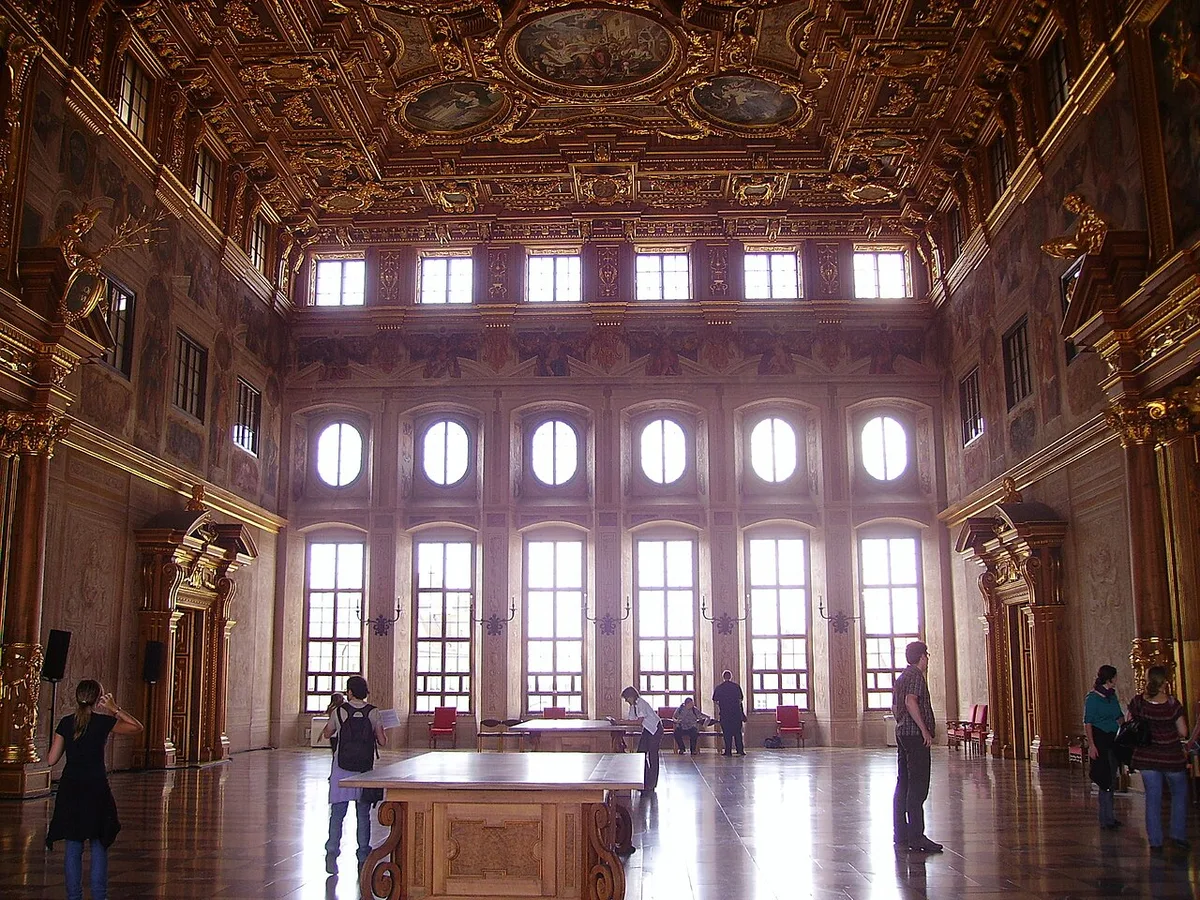
The Goldener Saal, on the upper floor of the Rathaus, is the interior that justifies going inside. Visit Sights describes it as a ceremonial room famous for its ceiling paintings, murals and golden wall decoration, finished in 1643 and counted among the most important cultural monuments of the late Renaissance. Ticket scope, prices and daily hours belong to the operator, so check the city's own visitor pages before building your morning around it.
A practical split: spend twenty minutes on the square, then decide on the Goldener Saal based on the queue and how much of the day you still want. Note that the Rathaus is an administrative building first, so parts of it can be unavailable when the city is using them. The Rathausplatz alone is still worth the stop.
Perlachturm and St. Peter am Perlach: Verify Before You Climb
The Perlachturm stands directly beside St. Peter am Perlach and, together with the town hall, forms the silhouette most people picture when they think of Augsburg. MyCityHunt records that it began as a watchtower in 989, was raised by Elias Holl between 1612 and 1618 to 70 metres with an octagon, dome and onion cap, burned out during the Second World War, and reopened in 1950 as a viewing tower.
Access has changed repeatedly over the years, and that same source states the tower is currently closed for renovations. As of 2026 there is no reliable general answer about when it will reopen, so plan the tower as a bonus rather than a fixed element. Ask at St. Peter am Perlach next door or check the city's tourism pages on the day.
Inside the church you will find the painting of Mary Undoer of Knots, which is why the church appears on Catholic travel itineraries as a stop in its own right. Church interiors are free to enter by custom, but that is a convention rather than a published rule, so keep voices low and dress respectfully.
Walking East: Lechviertel Canals and the Water System
Heading east from the Rathausplatz takes you through the Lechviertel, where narrow lanes run beside canal channels. The Stadtmetzg, a late-Renaissance building Elias Holl worked on between 1606 and 1609, sits at the lower end of the Perlachberg and served as the city's butcher's hall for centuries, as the Visit Sights tour describes.
This is also where Augsburg's UNESCO story becomes visible on the ground. The Water Management System of Augsburg was inscribed in 2019 and comprises canals, water towers from the 15th to 17th centuries, a water-cooled butchers' hall, a system of three monumental fountains and hydroelectric power stations, with the strict separation of drinking water from process water introduced as early as 1545.
Use this stretch as connective tissue rather than a formal stop. It is free, it moves you east towards Jakobervorstadt rather than back towards the cathedral, and it lowers the pace before the Fuggerei's walls close in around you.
The Fuggerei: A Living Neighbourhood, Not a Museum
The Fuggerei was founded in 1516 by Jakob Fugger as housing for needy citizens of Augsburg, and by 1523 fifty-two houses had been built. It is a walled enclave with its own streets, small squares and church, still inhabited today, which gives it the status of the oldest public housing project in the world.
The founding rent tradition is one Rhenish guilder per year, which one encyclopedia entry renders as a symbolic euro equivalent, paid alongside daily prayers for the Fugger family. Treat that as the historical tradition it is rather than a guaranteed current amount, and do not assume the euro figure is what residents pay today. The administration publishes actual conditions on its own site.
Residents live behind the doors visitors photograph, so keep voices down in the residential lanes and stay out of private courtyards and entrances. The published tour material even carries an explicit reminder not to enter private property, which is a good rule to carry through the whole day.
Inside the Fuggerei: Museum, Show Apartments and St. Mark's
The Fuggereimuseum was founded in 1957 and sits at Mittlere Gasse 13 and 14. Alongside a permanent exhibition it houses a historic apartment showing life in the early 19th century and a modern show apartment, and a Second World War bunker has been attached to it since 2008. That combination gives the site a second layer beyond the Fugger story itself.
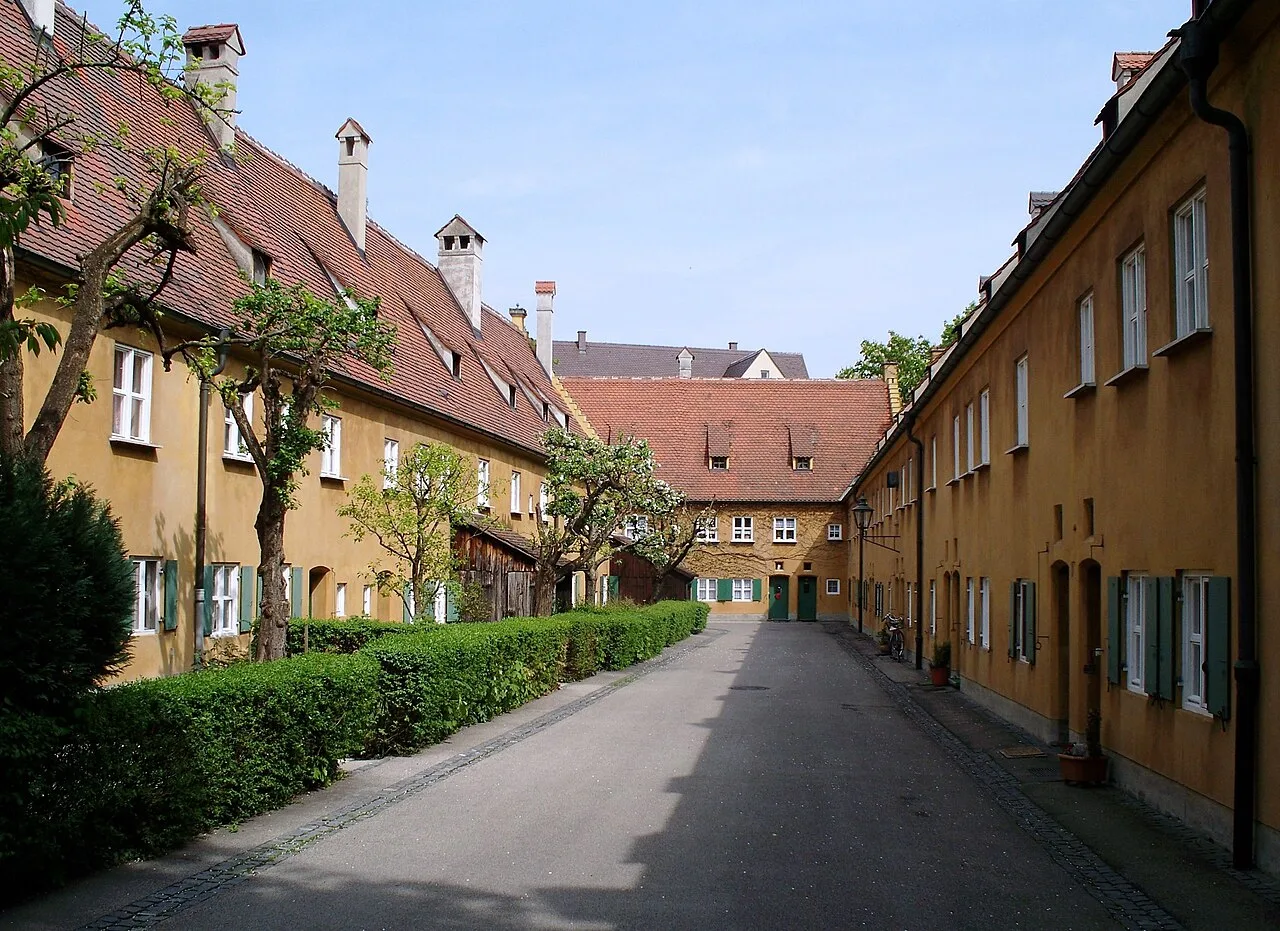
St. Mark's Church within the enclave was built between 1580 and 1582 and rebuilt until 1950 after wartime destruction. The complex also includes the house associated with Mozart's forebears, which several independent guides mention. Do not assume the church, the museum and the bunker share one ticket or one set of hours; the operator's own page is the only reliable source.
One published estimate suggests setting aside roughly one and a half to two and a half hours here, enough to walk the lanes, visit the museum and see the bunker without rushing. That is a suggestion rather than an official timing, but it is a fair warning that the Fuggerei rewards more time than its size suggests.
Finishing at the Dom (Cathedral of the Virgin Mary)
The Dom is the right last stop if you have come from the east, because you arrive at its northern edge already heading back towards the centre rather than starting your day with a detour. The Catholic Travel Guide lists the Cathedral of the Virgin Mary among the churches of interest in Augsburg, and it notes that the city is one of the oldest in Germany, with a rich religious history behind the building.
Photography inside is restricted, so plan on looking rather than shooting, and remember that this is an active place of worship where services take priority over visitors. Church etiquette applies: quiet voices, covered shoulders, and no wandering into cordoned areas. Closing times are usually earlier than visitors expect, so build slack into the afternoon rather than arriving an hour before you think you need to.
If you have energy left, the Hofgarten park lies close by and makes a calm place to sit before the walk back. Otherwise the route returns you to the centre in a broadly straight line, which is the whole point of putting the Dom last.
Where This Itinerary Breaks Down
The first failure mode is overfilling the Rathaus stop. Between the square, the Goldener Saal and a possible tower visit, the first cluster can quietly consume half the day, and everything after it gets compressed or dropped. Set your own ceiling before you arrive and hold to it.
The second is treating the Fuggerei as a photo opportunity. Walking through the gates, taking a picture of a lane and leaving takes twenty minutes and misses the museum, the show apartments and the bunker entirely. Budget real time there or accept that you have seen the exterior only.
The third is arriving at the Dom too late. Cathedral closing times are earlier than many visitors expect, and a service can close the interior with little notice. Build slack into the afternoon and check the day's times before you set out.
Adding One Extra Stop Without Breaking the Loop
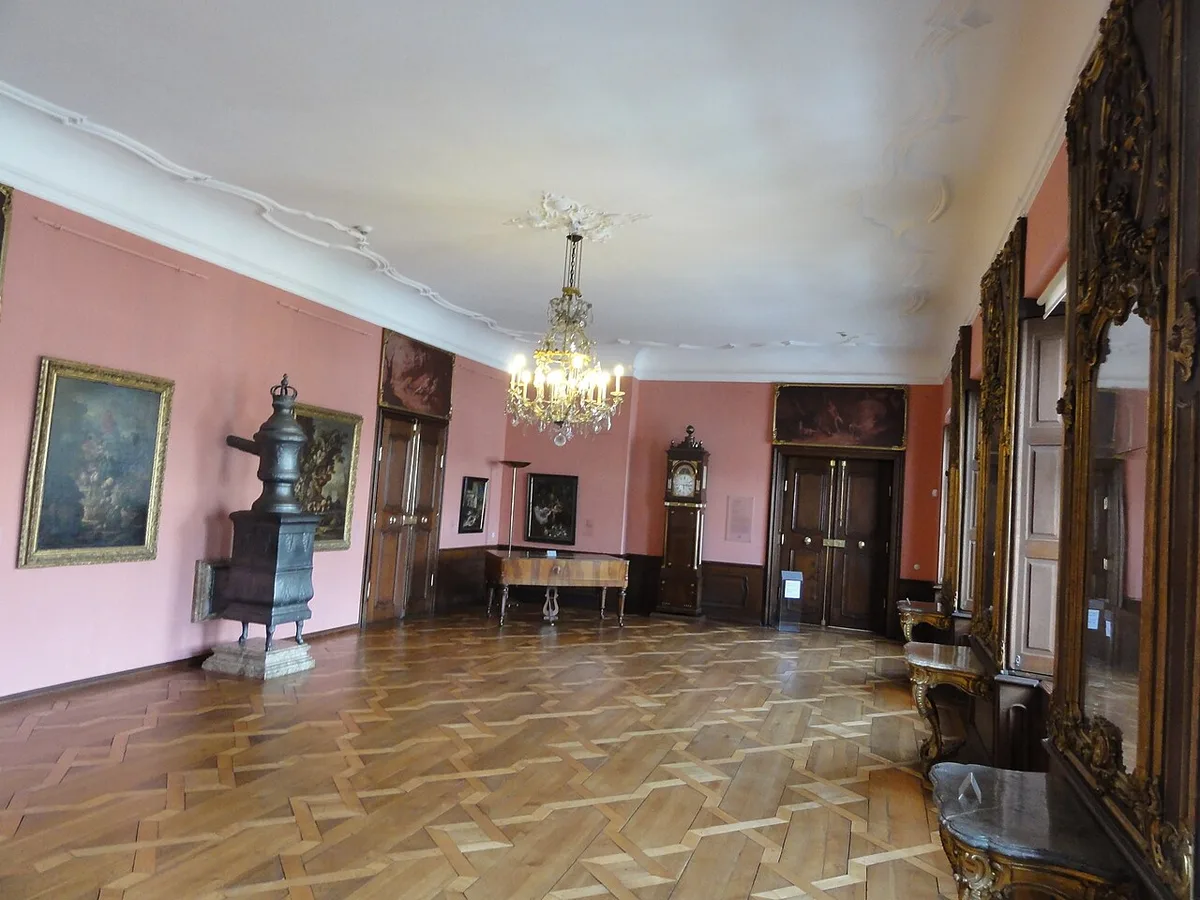
The route has one natural slot for a fourth stop, and it sits between the Rathausplatz and the cathedral rather than off to the side. Options along Maximilianstrasse include the Schaezlerpalais, a baroque palace whose surviving ballroom is often singled out, and the Brechthaus, the playwright's birthplace and now a small memorial museum. Both appear in the Visit Sights sequence, which is a useful check that they sit on the line of travel rather than off it.
Families and anyone travelling with children might prefer the Augsburger Puppenkiste, a marionette theatre that has performed in the city since the 1940s and which many Germans grew up watching on television. A weekend guide to the city notes that performances sell out and that booking ahead is the norm.
Adding two of these instead of one is where the plan usually collapses, because the Dom is the stop that gets sacrificed. Choose one, place it in the slot before the cathedral, and leave the rest for a Three days in Augsburg itinerary another time.
Decisions That Do Not Depend on Volatile Details
Cobblestones and canal-side lanes make comfortable shoes the single most consequential packing decision for this route. The old town is flat, so the difficulty is surface rather than gradient, and thin soles will make a full day feel noticeably longer than it needs to be.
In shoulder season, count daylight backwards from the cathedral rather than forwards from the Rathaus. If the sun sets early, the Fuggerei moves earlier and the Rathaus cluster absorbs whatever slack remains, which keeps the loop intact.
Before leaving your accommodation, write down which stops are free grounds and which need a ticket, then confirm the paid ones on their own operator pages. That single list is what prevents a day from stalling at a closed door.
Half-Day and Slower Full-Day Versions
With only half a day, cut the loop rather than compressing it. Start at the Rathausplatz, walk east through the Lechviertel to the Fuggerei, and stop there; the Dom becomes the sacrifice, and the route still finishes without doubling back.
If rain sets in, the same shape works with more time spent indoors. The Goldener Saal and the Fuggereimuseum absorb a wet hour each, and the walk between them stays short enough to manage between showers.
For a slower version, add a sit-down lunch in the Lechviertel and treat the canal stretch as a proper stop rather than a corridor. That version still ends at the Dom, and it needs the daylight check more than the compressed one does.
Plan Your Visit
The one decision to make before you set out is whether you commit to the eastward order or drop one of the three headline sights. Committing keeps the day simple; dropping a sight is usually better than sprinting through all three and remembering none of them properly.
Then verify the volatile parts on the operator's own pages: opening hours and ticket scope for the Rathaus and Goldener Saal, the Fuggerei's museum and church arrangements, cathedral times, and whether the Perlachturm climb is available at all. Those four checks turn this outline into a day that actually runs. For related planning, see Augsburg Transport Passes and Tickets: AVV Tram and Bus Guide.
Frequently Asked Questions
Can you see the Rathaus, Fuggerei and Dom in one day in Augsburg?
Yes, the three sit within a compact old town and the distances are walkable. The realistic constraint is not distance but pacing: each of the three rewards more than a quick look, and paid interiors run on their own hours. Start early, hold to a self-imposed ceiling at the first stop, and allow real time at the Fuggerei rather than treating it as a photo stop.
Do you need to pay to enter the Fuggerei?
The enclave charges an entrance fee for visitors, and the residential lanes remain a lived-in neighbourhood rather than a free public square. The museum, the show apartments and the bunker sit inside that visit. Current fees and seasonal hours are published by the Fuggerei administration itself, so check that page before you go, since an article cannot confirm today's arrangements on your behalf.
Is the Perlachturm open for climbing?
Access has changed repeatedly over the years, and one city guide source states the tower is currently closed for renovations. As of 2026 there is no reliable general answer. The practical move is to ask at St. Peter am Perlach next door or check the city's own tourism pages on the day, and to treat the climb as a bonus rather than a fixed part of your plan.
Which order should you visit the Augsburg sights in to avoid backtracking?
Start at the Rathausplatz, walk east through the Lechviertel to the Fuggerei, and finish at the Dom. That order moves in one broad direction instead of crossing the centre twice, and it is the same logic a published self-guided tour uses when it places the Rathaus, Perlachturm and Goldener Saal early and the Fuggerei cluster later. It removes most, not necessarily all, doubling back.
How far is the Fuggerei from the Augsburg Rathaus?
It is a short walk east through the Lechviertel and into the Jakobervorstadt, comfortably done on foot rather than by transport. Exact distances vary depending on which entrance and which lanes you use, so treat any single figure as approximate. A live map on the morning of your visit is more useful than a number quoted in advance.
How long should you allow for the Augsburg Rathaus and Goldener Saal?
Allow around two hours for the square, the Goldener Saal and a look at the Perlachturm from outside. The Goldener Saal is a single ceremonial interior rather than a large museum, so the risk here is queueing rather than exploring, and a long line can halve the value of the stop. If the wait looks excessive, walk on and keep the day's shape intact.
What should you do if it rains during your one day in Augsburg?
Keep the same order but shift weight indoors. The Goldener Saal and the Fuggereimuseum each absorb an hour, and the walk between them stays short enough to manage between showers. Cobblestones get slippery in the Lechviertel, so grip matters more than speed on the canal-side lanes.
Can you add a fourth stop without losing the Dom?
Usually only one. The natural slot sits between the Rathausplatz and the cathedral, along Maximilianstrasse or in the surrounding lanes. Choose a single addition such as the Schaezlerpalais, the Brechthaus or a Puppenkiste performance. Adding two extras is the point at which the cathedral tends to fall off the end of the day.
Sources
- Self-guided Sightseeing Tour #1 in Augsburg, Germany | Visit Sights
- Augsburg, Germany - The Catholic Travel Guide
- Rathaus | Augsburg, Germany | Attractions - Lonely Planet
- Perlachturm (Augsburg)
- Water Management System of Augsburg | World Heritage Explorer
- Fuggerei in Augsburg: The Oldest Social Housing in the World
- Staycation Collection — Exploring Augsburg: Our Comprehensive Weekend Guide


