

Aachen sits in a shallow bowl on Germany's western edge, which is why its views work differently from a big-city skyline. The old town is compact and low, so a modest ridge north of the centre delivers more roofscape than any tower in the middle of town. The best-known free option is the Lousberg, and a mapped loop from the city centre runs roughly 8.4 kilometres with about 140 metres of climbing, passing viewpoints over the Soers and the Eifel valley.
Deciding between viewpoints is really a question of what you want to look at. An open-air overlook gives you the town hall, the cathedral roofs and the Soers; the cathedral interior gives you the octagon, mosaics and windows; and the Belvedere terrace above the Soers gives you the borderland toward Belgium and the Netherlands. One stop is enough if you only want the skyline, but a half day lets you pair the ridge with the old town. For wider planning, see Aachen landmark visitor guides.
The city's official tourism site lists the Lousberg on Belvedereallee among its activity entries and confirms the Balcony of the city reachable on foot, with the Lousberg Belvedereallee also appearing as a walking and hiking location in its activity listings.
How Aachen's Geography Shapes Its Viewpoints
The centre of Aachen sits low, ringed by gentle ridges rather than dramatic peaks. North of the old town, the Lousberg rises above the streets and gives the city its most accessible elevated ground. That northward orientation matters: from up there you look back into the bowl rather than out toward the horizon in every direction.
To the north and west, the landscape opens toward the Soers and the Eifel foothills. A long-distance hiking route from the cathedral, past the Lousberg, through the Wurm Valley to Rode Castle in Herzogenrath shows that this ridge is a natural viewpoint on a walking corridor rather than a standalone attraction. Expect tree cover on much of the slope, so the panorama appears where the ground opens up, not continuously along the way.
Because the old town is so flat, upper-floor windows around Markt and the Rathaus give framed, partial views rather than a true panorama. That is worth knowing before you plan a day around views as if they were all the same category. Treat the open-air overlook, the interior perspective and the town-centre window view as three different experiences.
Lousberg: The Free, Reliable Panorama
The Lousberg terraces are open outdoor ground, not a ticketed platform, so there is no opening time to plan around. A mapped loop from the city runs roughly 8.4 kilometres and passes a series of named stops, including a sundeck with swings facing the Eifel valley, a terrace with hammocks and a viewpoint looking over the Soers. As a suggestion, allow about two hours for the full loop and breaks at an easy pace, or considerably less if you walk straight up and back; the loop itself is rated medium difficulty.
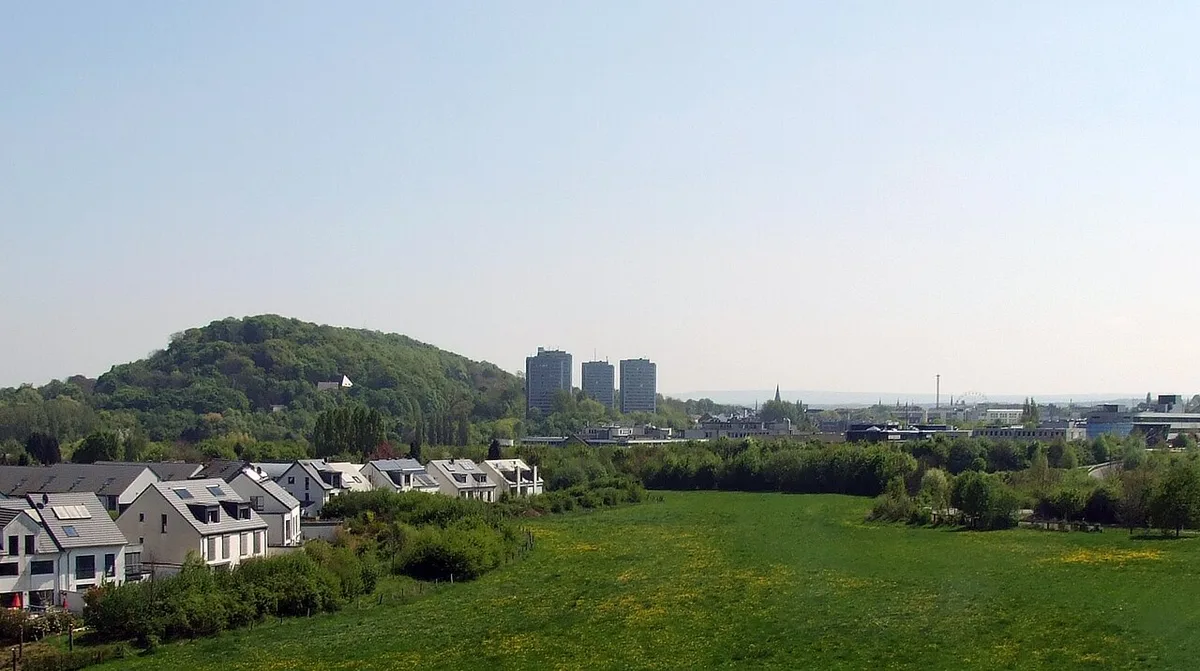
What you actually see from the terraces depends on where you stand along the ridge. One recorded viewpoint looks out over the Soers, the open ground and horse-sport area north of the centre, while another frames the town hall on the skyline. The ridge is high enough that documentary photographs taken from the Lousberg show the city spread out beneath.
The walk up carries its own reward for anyone interested in local storytelling. Markers along the route retell the legend of the devil and the shrewd Aachen market woman, and a bronze pair of figures stands between the Lousberg and the neighbouring Salvatorberg. Even a short visit gets you both the legend and the overlook, so you do not need to commit to the full loop.
The Belvedere on the Lousberg: What Remains and What to Expect
Higher on the Lousberg stands the Belvedere, a hilltop structure that was destroyed in the Second World War. What survives are its columns, which locals nicknamed their Aachen Acropolis because of the Greek look. The setting is the reason to walk up: the terrace position above the Soers gives a wide sweep over the city and the open country beyond.
Do not treat interior access or regular public viewing hours as guaranteed. The Belvedere now appears primarily as an event venue, and a single visitor description mentions a Sunday viewing window and coffee and cake there, but that is an individual report rather than a published condition. Confirm current event and access arrangements before making it the centrepiece of a walk.
The safest plan is to treat the Belvedere as a viewpoint you pass on the Lousberg ridge rather than a destination with a reliable schedule. If the terrace happens to be open when you arrive, that is a bonus; if not, the nearby Lousberg viewpoints still deliver the panorama. Build the walk around the ridge, not around one building.
Cathedral Perspectives: A View You Walk Into
Aachen Cathedral offers a different kind of view entirely: an interior one. The Carolingian octagon is the historic core, and the Gothic choir hall added in the fifteenth century is taller and longer, so the space shifts character as you move through it. Climbing to the level where the organ stands gives a raised look at the windows and toward Charlemagne's shrine.
Admission to the cathedral is free, but the choir and the Hochmünster with the imperial throne are only accessible as part of a guided tour, so a walk-in visit will not deliver that specific perspective. Do not rely on fixed weekly hours for tour planning: the cathedral states that services, concerts and events can change opening hours at short notice and asks visitors to check the current week on its own pages.
Photography inside follows conditions published by the cathedral. Visitors who want to photograph the interior pay a contribution to the cathedral warden, and tripods, selfie sticks and flash are not permitted. Commercial, media and academic photography requires a written permit requested in advance, so casual visitors and professional shoots operate under different rules.
Anyone with mobility needs should check the cathedral's published accessibility notes rather than assume step-free access. The cathedral itself describes a bell at the entrance and portable ramps, access for power chairs via the Krämertür entrance in the Krämerstraße, and a lift weight limit in the entrance area of the Cathedral Treasury. Confirm these details directly if they affect your visit.
The Cathedral Treasury: A Different Kind of Seeing
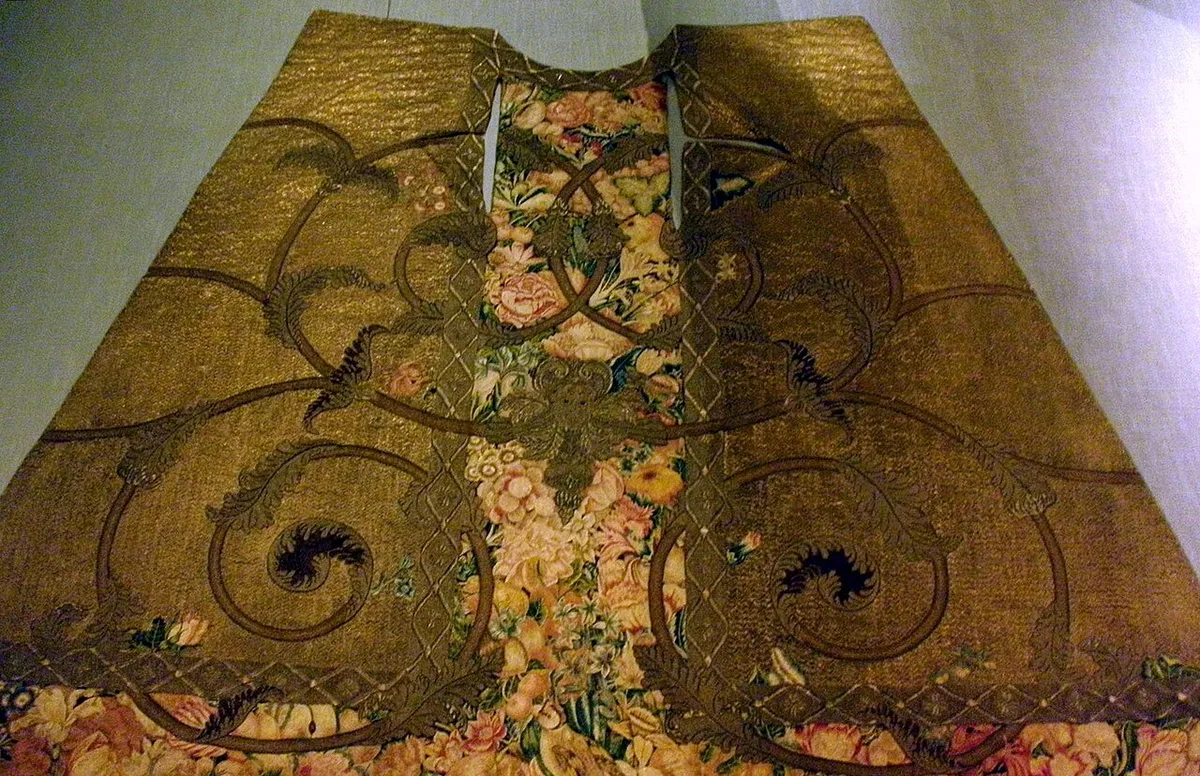
The Cathedral Treasury is a separate visit with its own admission, not an extension of free cathedral entry. Around 130 works of art are displayed across three floors, including reliquaries and vestments accumulated over centuries. Because it is a museum interior rather than an overlook, the reward is close-up detail rather than distance.
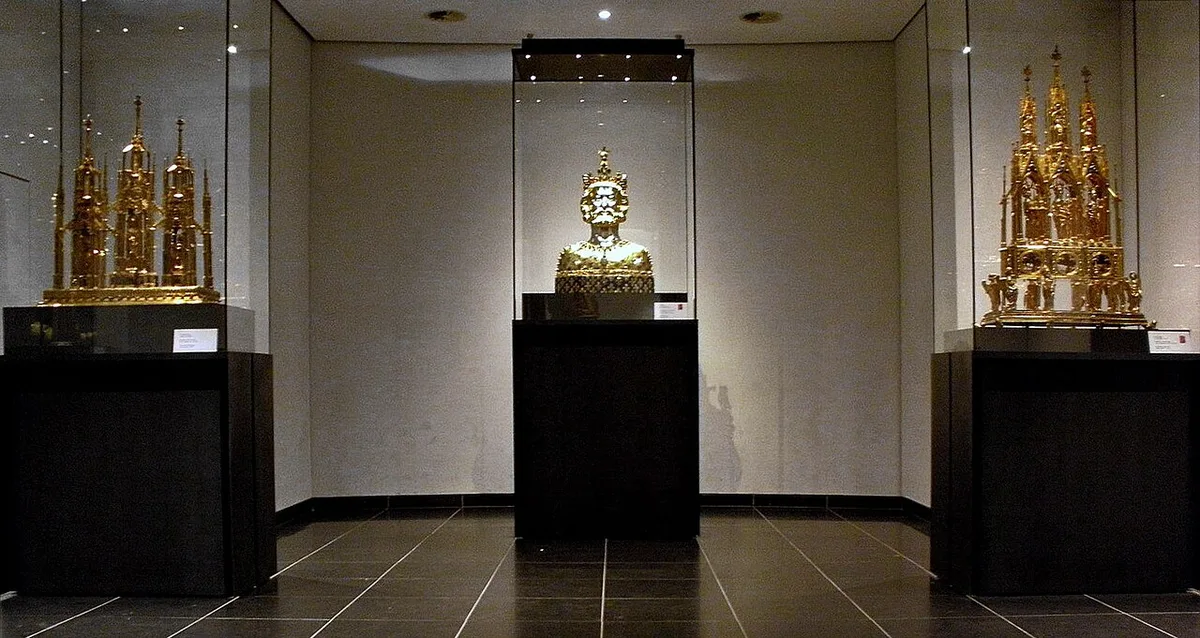
The treasury was entered on the UNESCO World Heritage list alongside the cathedral in 1978, which is why many visitors treat the two as one stop. The practical distinction matters more: the treasury is a separately ticketed museum with its own opening pattern, and a cathedral tour ticket does not admit you there. Plan it as a second, separately budgeted visit.
The Dominformation in Johannes-Paul-II-Straße is the cathedral's central contact and sales point for visitors, and the cathedral's site describes it as open daily from 10 am. That is where you would ask about current admission and conditions, rather than relying on older blog figures.
Rooftop and Elevated Town Views Around Markt and the Rathaus
Aachen does not have a public rooftop viewing platform over the old town, so the elevated town views you get are incidental ones. Inside the town hall, the historic rooms and the staircase windows look toward the cathedral, producing a framed view of its towers and roof. That perspective is part of a building visit, not a free open-air viewpoint.
Around Markt itself, the square's surrounding buildings and cafés occasionally offer upper-floor or terrace seating with a partial look over the rooftops. These are not documented public viewpoints, so treat any such seat as a pleasant surprise rather than a plan. If a specific elevated spot matters to you, verify with the venue directly before building an itinerary around it.
The trade-off is straightforward: town-centre window views are convenient but narrow, while the Lousberg requires a walk but delivers the full sweep. If you have limited time and want one strong view, the ridge is the better bet. If you are already touring the town hall, the staircase window is a free bonus on the way through.
Sequencing Viewpoints With the Rest of Aachen
Viewpoints work best as bookends to a city day rather than as a mid-morning stop. Walk up to the Lousberg early while the air is clear, come down into the old town for the cathedral, treasury and Markt, then finish with the Elisenbrunnen and a Printen stop. That order keeps the uphill effort at the start and the indoor, ticketed stops in the middle of the day.
The Elisenbrunnen pavilion and its thermal spring sit close to the cathedral and the market square, so they fit naturally between the cathedral and a walk north. A one-day walking route through the old town also treats the Elisenbrunnen and the archaeological window in the Elisengarten as early stops, which confirms how compact the centre is on foot. Printen, the city's spiced biscuit specialty, is sold throughout the old town, making it an easy last stop before heading to the station.
If you want to spread the viewpoints across more than one day, the Lousberg and the borderland landscape around the Soers and Wurm Valley justify a longer stay. A three-day structure lets you give the ridge a proper loop on one day and keep the cathedral and treasury for another. That avoids cramming a hill walk and a guided tour into the same afternoon.
Choosing by Weather, Light and Time of Day
Haze and low sun affect the two view types differently. A city panorama from the Lousberg loses contrast and detail in strong haze, while low evening light can pick out the town hall and cathedral roofs against the sky. Interior cathedral views, by contrast, are largely independent of weather and depend far more on daylight through the windows and on whether a service is underway.
Because of that, a city panorama and an interior view rarely compete for the same hour. A cloudy morning is a reasonable time for the cathedral and treasury, while a clear late afternoon suits the uphill walk. If your only available slot is a rainy one, the indoor stops are the obvious choice.
Light also changes what the Lousberg actually shows you. Looking south and southeast from the ridge puts the city against the sky, while looking north and west opens toward the Soers and the Eifel foothills. Decide which direction interests you most and position yourself on the ridge accordingly.
If You Only Have One View in You
If your priority is seeing the city as a whole, choose the Lousberg. It is free, it needs no booking, and the ridge gives you the town hall, the roofscape and the Soers in one sweep. Budget roughly half a day if you want the full loop with its viewpoints and rest spots, or an hour for a direct up-and-back.
If your priority is the imperial throne and the shrine, choose the guided cathedral tour instead. The throne and the choir are reachable only on a tour, so a free walk-in visit will not deliver that specific perspective. Photography inside also carries a contribution, so bring a little cash or check the current arrangement on the cathedral's pages.
The two are not mutually exclusive if you have a full day: the Lousberg in the morning and a cathedral tour later can both fit. What you should avoid is assuming one experience substitutes for the other. Different viewpoints in Aachen show different things, and the choice is really about which one you care about more.
Plan Your Aachen Viewpoints
Aachen rewards a simple plan: pick your view by what you want to look at, not by a ranking. The Lousberg ridge gives the free open-air panorama over the old town and the Soers, the cathedral gives an interior architectural perspective with a guided-tour-only throne and choir, and the Belvedere terrace on the same ridge is a hilltop stop whose public access should never be assumed.
Two verification habits will keep your plan accurate. Check the cathedral's own pages for current visiting hours, tour times and treasury admission, because services and events change access at short notice. Check the city's official tourism site for events, guided walks and seasonal programmes, since those often reshuffle the best time to be up on the ridge.
Beyond viewpoints, Aachen has a compact historic core worth a proper wander. The city's own website and the local museum network cover the cathedral, Rathaus, Couven Museum and Suermondt-Ludwig-Museum, and they are all within a walkable radius of Markt. Build the day around the old town and let the ridge bookend it.
Frequently Asked Questions
Is the Lousberg viewpoint free to visit?
It is open outdoor ground with no ticket and no official opening time, so you can walk up whenever daylight and weather allow. The viewpoint terraces, the legend markers and the rest spots along the ridge are all part of the public path network. If you want the full loop with its named stops, a mapped route from the city runs just over eight kilometres and the loop is rated medium difficulty, so plan a couple of hours at an easy pace.
Can you see Charlemagne's throne in Aachen Cathedral without a guided tour?
No. The cathedral states that the choir and the Hochmünster with the imperial throne are only accessible as part of a guided tour, even though general admission to the cathedral is free. A walk-in visit lets you see the octagon, the mosaics and the main body of the church, but not the throne area. Check the cathedral's own visitor pages for current tour offerings, since services and events can change access at short notice.
Do you need a separate ticket for the Aachen Cathedral Treasury?
Yes. The Treasury is a separately ticketed museum with its own opening pattern, so free cathedral entry or a cathedral tour ticket does not admit you there. It displays around 130 works of art across three floors and was inscribed on the UNESCO World Heritage list alongside the cathedral in 1978. Check current admission and family pricing at the cathedral's information centre, since those figures change.
Can you take photos inside Aachen Cathedral?
You can, under conditions. Visitors who want to photograph the interior pay a contribution to the cathedral warden, and tripods, selfie sticks and flash photography are not permitted. Commercial, media and academic photography requires a written permit requested in advance from the cathedral. Because rules can be adjusted, confirm the current arrangement when you arrive.
Is the Belvedere on the Lousberg open to the public as a viewpoint?
Do not assume regular public access. The Belvedere now functions primarily as an event venue, and the surviving columns are what remains after the structure was destroyed in the Second World War. A single visitor report mentions a Sunday afternoon viewing window with coffee and cake, but that is an individual account rather than a published condition. Treat the ridge viewpoints as your reliable plan and the Belvedere as a possible extra.
Sources
- Willkommen in Aachen | Stadt Aachen
- Aachen, Germany skyline: the 43 most iconic buildings and best views in Aachen
- 1 Day in Aachen: The Top Things to Do & See on a Day Trip | Tall Girl Big World
- My favorite place: A hike from Aachen back to childhood - Discover Germany
- Official event website
- A place to visit - Aachener Dom Aachener Dom - A place to visit
- Aachen Tourismus - aachen tourist service
- Hammocks at Lousberg Terrace – View of Soers from Lousberg loop from Aachen | túra | Komoot
- Aachen top view from Lousberg Stock Photo - Alamy


