
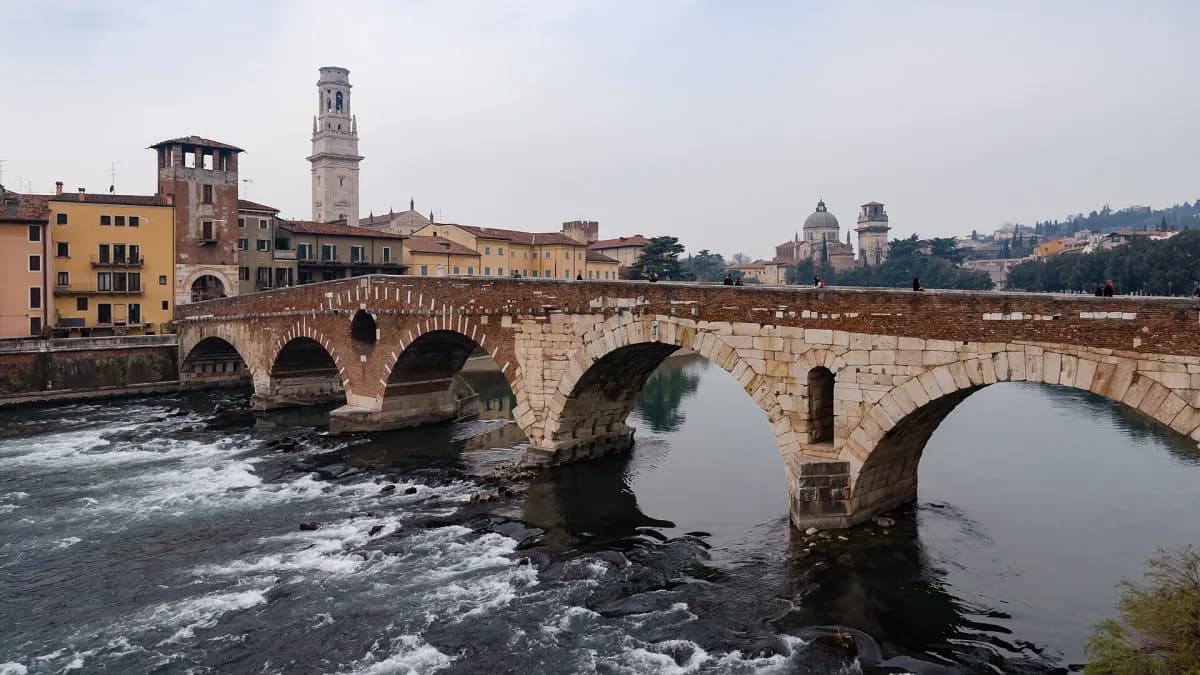
Ponte Pietra crosses the Adige River at the edge of Verona's historic centre, and the most useful thing to know before you go is also the simplest: there is no ticket to buy. The bridge is free to cross, has no gate or turnstile, and stays open 24 hours a day, every day of the year.
That single fact answers most of what people are really asking when they search "Ponte Pietra tickets" — there isn't one to book. What follows is the practical layer: how the bridge's five arches span five different centuries of Verona's history, when to go for the best light, how to walk there from the old town, and which nearby paid sites are worth combining it with in 2026.
What Is Ponte Pietra?
Ponte Pietra — Italian for "stone bridge" — is the oldest bridge standing in Verona and one of the oldest Roman structures still carrying daily foot traffic anywhere in Italy. The first crossing on this site dates to around 100 BC, when it carried the Via Postumia, the Roman road linking Genoa to Aquileia, over the Adige River.
What stands today is a patchwork of eras stitched into one structure. The bridge has five arches, and no two were built in the same century. The far-left arch, closest to the old town, is the only one still standing from the original Roman construction. A section on the opposite bank was rebuilt in 1298 under Alberto I della Scala, the ruler whose dynasty shaped much of medieval Verona. The central arches date to a reconstruction in the early 16th century.
The bridge's most recent rebuild is also its most dramatic. Retreating German forces destroyed four of the five spans in April 1945. Verona recovered the original stone from the riverbed and rebuilt the bridge to its historic profile by 1957 — meaning the brick and travertine underfoot in places really is close to two thousand years old.
Ponte Pietra Tickets & Prices 2026
There is no admission fee for Ponte Pietra and no ticket to buy, book, or print. It's a public pedestrian bridge, not a monument with managed entry, so the "ticket" listings that show up in search results for this bridge are almost always selling something else — a guided walking tour of Verona's old town that happens to cross the bridge, or a combined ticket to a paid attraction nearby.
The one paid site worth knowing about is the Roman Theatre (Teatro Romano) and its archaeological museum, a short walk east along the river. It charges its own separate admission and is not bundled with Ponte Pietra in any official ticket. If a third-party site quotes you a price specifically for "Ponte Pietra tickets," treat it as a tour package rather than an entry fee to the bridge itself.
Because it costs nothing, Ponte Pietra is a fixture on most free things to do in Verona lists, and it pairs naturally with a walk to Piazza delle Erbe or a climb up Castel San Pietro on the opposite bank, both also free.
Opening Hours & Best Time to Go
Ponte Pietra has no posted opening or closing time. As a public street, it's accessible 24 hours a day, seven days a week, including holidays. The only exceptions are rare and temporary — occasional maintenance work or a city event that closes the bridge to traffic for a few hours, announced locally rather than on a fixed seasonal schedule.
For the best experience, timing is about light and crowds rather than access. Sunset is the standout window: the low western sun catches the terracotta rooftops of the old town and turns the Adige gold, and the bridge itself gets busy with people stopping for photos. Early morning, before the tour groups arrive from the Arena and Piazza delle Erbe, is the quieter alternative — the light is softer and you can walk the bridge without dodging other visitors.
After dark, Ponte Pietra is lit and the arches reflect in the river, which makes it a reasonable stop even late in the evening if sunset doesn't fit your schedule. Because there's no gate, there's no risk of arriving to a locked bridge — the only real planning question is what time gives you the view you want.
How Long to Plan for Your Visit
Walking across Ponte Pietra and back takes about 10 to 15 minutes at an unhurried pace. Most visitors spend closer to 20 to 30 minutes total, stopping partway across for photos of the river and the hillside of Castel San Pietro on the far bank.
Treat it as a stop within a longer walk rather than a standalone destination. Combined with the adjacent Roman Theatre, budget an hour to 90 minutes. Folded into a full one-day Verona itinerary alongside the old town's main sights, the bridge itself barely dents your schedule — it's the kind of stop you cross on your way somewhere else and remember more than the destination you were headed to.
How to Get to Ponte Pietra
Ponte Pietra sits at the northern edge of Verona's old town, a flat and short walk from almost anywhere in the historic centre. From Piazza delle Erbe, it's about a 5 to 7 minute walk north along Via Sottoriva or Via Ponte Pietra to the bridge's western end. From the Verona Arena, plan on 15 to 20 minutes on foot through the pedestrianised centre.
If you're arriving by train, Verona Porta Nuova station is roughly a 25 to 30 minute walk, or a short bus or taxi ride, into the old town, from which the bridge is walkable. There's no dedicated parking at the bridge itself — the old town's ZTL (limited traffic zone) restricts private cars, so drivers should park in one of the paid lots ringing the historic centre and walk in.
No ticket or reservation is needed to cross, and there's no queue system — the only "line" you'll encounter is other visitors also stopping to take photos partway across.
Visit Tips: Queues, Booking & Mistakes to Avoid
Ponte Pietra doesn't have opening-hour queues, but it does get crowded at predictable times — golden hour and weekend afternoons, when it's a popular spot for both tourists and local photographers. If you want an uncrowded bridge for photos, go before 9 a.m. or well after dark.
A common mistake is booking a paid "skip the line" ticket for the bridge itself before realising it's free and has no line to skip — save that money for the Roman Theatre or the Arena, where timed entry can genuinely matter in high season. Another is treating it as a standalone half-day outing; it's a 15-minute stop, so plan it into a longer walk through the old town rather than a dedicated trip.
The bridge surface is smooth stone and can be slippery when wet, so watch your footing after rain. It's pedestrian- and bicycle-only, fully step-free, and wheelchair accessible, but it does get narrow when both foot traffic and cyclists are crossing at once — keep to the side if you're stopping to take a photo.
Nearby Attractions Near Ponte Pietra
Ponte Pietra sits within easy walking distance of most of Verona's headline sights, which is why it works best as a stop rather than a destination. The Roman Theatre and its archaeological museum are directly across the river, a two-minute walk from the bridge's eastern end, with views back over the arches.
Heading into the old town, Piazza delle Erbe, Verona's ancient forum and now its liveliest market square, is about five minutes on foot, and Torre dei Lamberti — the city's tallest tower, with a view over the rooftops you just photographed from the bridge — sits right beside it. The Verona Arena, the Roman amphitheatre that anchors the old town's south end, is a flatter 15 to 20 minute walk away and worth a half-day on its own.
Combine two or three of these into a single loop and Ponte Pietra becomes the free, scenic hinge connecting them — cross it once heading to the Roman Theatre, and again on the way back into town toward the Arena.
Frequently Asked Questions
Do you need a ticket to visit Ponte Pietra?
No. Ponte Pietra is a free, public pedestrian bridge with no gate, ticket booth, or admission fee. Anything sold online as a "Ponte Pietra ticket" is a guided tour or a combined pass to a different paid attraction nearby, not entry to the bridge itself.
What are Ponte Pietra's opening hours?
Ponte Pietra has no fixed opening hours — it's accessible 24 hours a day as a public street. The only exceptions are rare, temporary closures for maintenance or city events, which aren't on a set schedule.
How long should you spend at Ponte Pietra?
Plan for 15 to 30 minutes to walk across, take photos, and enjoy the river view. If you're pairing it with the adjacent Roman Theatre, budget closer to an hour to 90 minutes total.
Is Ponte Pietra worth visiting?
Yes. It's the oldest bridge in Verona, with one arch still standing from its original Roman construction around 100 BC, and it offers one of the best river views of the old town — all for free.
Is Ponte Pietra wheelchair accessible?
Yes. The bridge is step-free and open to pedestrians and cyclists only, with no vehicle traffic. The surface is smooth stone, though it can be slippery when wet.
Ponte Pietra rewards the kind of traveller who treats Verona as a place to walk rather than a checklist to clear. There's no ticket to buy and no line to plan around — just a two-thousand-year-old crossing that's free at any hour you choose to show up.
Time it for sunset if you can, or early morning if you'd rather have the bridge closer to yourself. Either way, fold it into a longer walk through the old town — toward the Roman Theatre on one side, or back to Piazza delle Erbe and the Arena on the other — and Ponte Pietra earns its place as one of the simplest, best free stops in Verona in 2026.
For official details, see Ponte Pietra on the official Verona tourism site and the Ponte Pietra entry on Wikipedia.


