

Standard adult admission to Castelvecchio is €9, with a reduced rate of €6 for Touring Club, FAI and Arte Terme Card holders and €2 for visitors aged 18–25 — under-18s enter free. The museum opens Tuesday through Sunday, 10 a.m. to 6 p.m., with last entry at 5:15 p.m., and stays closed on Mondays, 25 December, and 1 January. Those numbers are the planning basics; what actually draws most visitors is what's inside the walls: a red-brick medieval fortress built by the Della Scala family, now holding one of northern Italy's strongest regional art collections across 29 rooms.
This guide covers 2026 ticket prices and hours, how long to realistically plan, how to get there, and the visit mistakes worth avoiding — plus what's actually worth seeing once you're inside, as part of a wider day exploring Verona's historic centre.
What Is Castelvecchio?
Castelvecchio ("old castle") was built between 1354 and 1356 under Cangrande II della Scala, the Della Scala (Scaliger) family that ruled Verona for over a century. It was raised as a defensive stronghold against rival powers pressing in from Venice, Mantua's Gonzaga family, and Milan's Sforza — and, as its layout still shows, it was also built with an escape route in mind. The fortress is a square red-brick compound with seven towers and a reinforced central keep, its walls topped with the distinctive swallow-tail (M-shaped) merlons typical of Ghibelline architecture in the region.
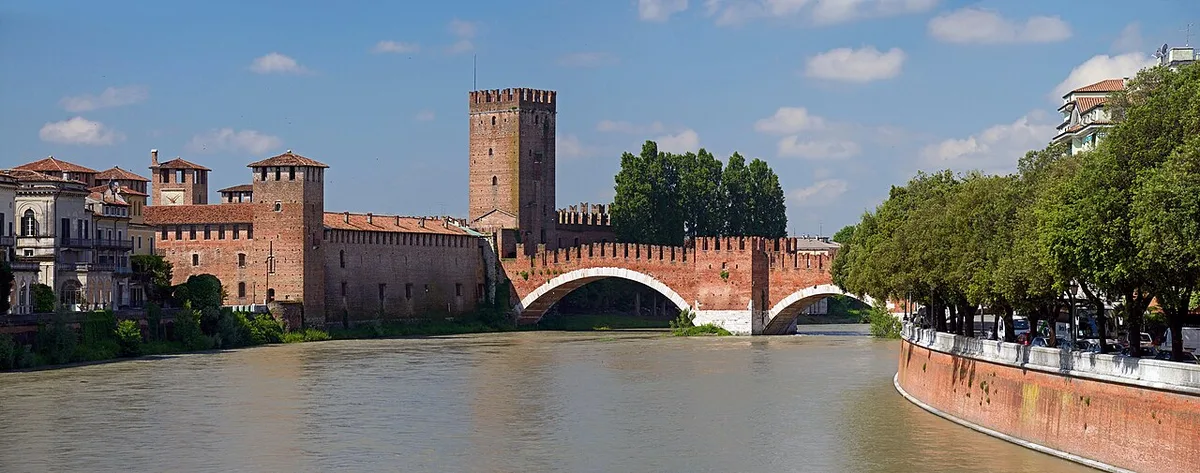
Attached to the castle is the Ponte Scaligero, a fortified bridge the Della Scala built across the Adige River so the family could flee north toward the Tyrol if Verona ever turned against them. German forces destroyed the bridge in 1945 during their retreat; using recovered original stones, it was rebuilt and reopened by 1949 — a rare case of a medieval structure returning almost exactly to its pre-war form.
The castle stopped being a fortress long before it became a museum — Napoleonic troops damaged it in the 1790s, and Austrian rulers later used it as a barracks. Restoration in 1923 began turning it toward public use, and a landmark redesign by architect Carlo Scarpa, carried out across the late 1950s into the mid-1960s, shaped the museum experience you walk through today — deliberately leaving old scars and construction seams visible rather than smoothing them away.
Castelvecchio Tickets & Prices 2026
Castelvecchio's standard entry ticket is €9 for full-price adult admission. Reduced tickets are €6 for Touring Club, FAI and Arte Terme Card holders, and €2 for visitors aged 18 to 25. Visitors under 18 enter free, as do visitors with disabilities and one accompanying companion. These are municipal museum rates — Castelvecchio is run by the Comune di Verona rather than Italy's state museum system. Tickets are sold at the museum's ticket office and online through CoopCulture, the civic museums' ticketing operator; each ticket is issued in the visitor's name and checked against an original identity document at the entrance.

If you're planning to see more than one Verona sight, the Verona Card is worth pricing out before buying single tickets. It gives free entry to Castelvecchio, the Arena and the city's other civic museums and monuments, plus ATV city buses, for €33 (24 hours) or €38 (48 hours). With civic museum tickets at €6–€9 and the Arena at €12, the 24-hour card pays off from about the fourth paid entry in a day.
Opening Hours & Best Time to Visit
Castelvecchio is open Tuesday through Sunday, 10 a.m. to 6 p.m., with the ticket office and last entry at 5:15 p.m. It's closed every Monday, plus 25 December and 1 January, with an extra opening on Monday 7 December 2026.
For the calmest visit, arrive right at 10 a.m. opening or after 4 p.m. — Castelvecchio doesn't pull the same volume of coach-tour traffic as the Arena or Piazza delle Erbe, so even a mid-morning visit is rarely crowded, but early or late still gives you the courtyard and sculpture gallery closer to yourself. Spring (April–May) and autumn (September–October) offer the mildest weather for walking the ramparts and the covered walkway along Ponte Scaligero without summer heat. Winter visits are the quietest overall, though the exterior views from the bridge are less atmospheric under grey skies than they are at golden hour in warmer months.
How Long to Plan for Your Visit
Budget 1.5 to 2 hours for a focused visit covering the sculpture gallery, the picture gallery, and a walk out onto Ponte Scaligero. Art and history enthusiasts working through most of the 29 rooms — arms and armour, ceramics, miniatures, and the full chronological run of Veronese and Venetian painting — should plan closer to 2.5 to 3 hours.
At minimum, don't rush past the Cangrande I della Scala statue, the museum's single most famous piece: an equestrian sculpture of the Scaliger lord that originally topped his tomb monument, shown with an unusual half-smile that's become the collection's signature image. It sits on a raised platform partway through the gallery route, and most visitors budget at least 10 minutes just for that room.
How to Get to Castelvecchio
Castelvecchio sits at Corso Castelvecchio, 2, on the western edge of Verona's historic centre, right on the Adige River. From Verona Porta Nuova, the main train station, it's about a 15–20 minute walk north through Corso Porta Nuova and along the river, or a short hop on the city bus lines that run that corridor.
If you're flying in, from Verona airport the Verona Airlink bus (line 199, €7) connects to Porta Nuova station in about 15 minutes. Driving isn't practical — the historic centre carries heavy traffic restrictions (Zona a Traffico Limitato), and there's no dedicated visitor parking at the castle itself; arrive on foot, by bus, or by train instead.
Visit Tips: Queues, Booking & Mistakes to Avoid
Castelvecchio rarely sees the queues that build at the Arena or Juliet's House, so advance booking is less essential; tickets are also sold online and through the CoopCulture call centre if you'd rather arrive with one.
The most common mistake is treating Castelvecchio as a quick photo stop at the bridge and skipping the museum itself — the collection inside, especially the Cangrande statue and the picture gallery's Veronese-school paintings, is the actual reason the site ranks among Verona's top sights, not just the exterior. And because the museum sits directly on the river with limited shade in the courtyard, summer visitors should expect real heat in the open-air sections at midday — plan the ramparts and bridge walk for morning or early evening instead.
Nearby Attractions
Castelvecchio sits close enough to Verona's pedestrian core to combine easily with the rest of a day's sightseeing. Piazza delle Erbe, the city's old Roman forum turned market square, is about a 15–20 minute walk east along Corso Cavour, and Torre dei Lamberti's bell tower — free with the Verona Card — sits just off the same square. In the other direction, the Verona Arena is roughly a 15-minute walk south, making the two easy to pair in one morning.
If you'd rather see the castle without paying museum entry, our free things to do in Verona guide covers the exterior and the Ponte Scaligero walk, both viewable without a ticket, and our hidden gems in Verona guide covers less-visited spots nearby.
Frequently Asked Questions
How much are Castelvecchio tickets in 2026?
Standard adult admission is €9, with a reduced rate of €6 for Touring Club, FAI and Arte Terme Card holders and €2 for visitors aged 18–25. Visitors under 18, and visitors with disabilities plus one companion, enter free. These are municipal rates set by the Comune di Verona; tickets are issued in the visitor's name, so bring an identity document.
What are Castelvecchio's opening hours?
Castelvecchio is open Tuesday through Sunday, 10 a.m. to 6 p.m., with last entry at 5:15 p.m. It's closed every Monday, plus 25 December and 1 January, with an extra opening on Monday 7 December 2026.
Is Castelvecchio covered by the Verona Card?
Yes. The Verona Card gives free entry to Castelvecchio and the city's other civic museums and monuments, plus ATV city buses, for €33 (24 hours) or €38 (48 hours). Against a €9 Castelvecchio ticket, it pays off from about the fourth paid entry in a day.
How long do you need to visit Castelvecchio?
Budget 1.5 to 2 hours for a focused visit covering the sculpture gallery, the picture gallery, and a walk out onto Ponte Scaligero. History and art enthusiasts working through most of the museum's 29 rooms should plan closer to 2.5 to 3 hours.
Is Castelvecchio worth visiting?
Yes. It combines a rare, largely intact medieval fortress with one of northern Italy's strongest regional art collections, including the museum's signature piece — the equestrian statue of Cangrande I della Scala. It's also less crowded than the Arena or Juliet's House, making it one of the more relaxed major sights in central Verona.
Castelvecchio rewards the visitors who go beyond the bridge photo and actually walk the museum — the Cangrande statue alone is worth the ticket price, and the 29 rooms behind it hold one of the strongest regional art collections in northern Italy, without the crowds that build at Verona's more famous sights.
Aim for a morning or late-afternoon visit to avoid the modest midday traffic, and budget close to two hours if you want to see the collection properly rather than rush the bridge and leave.
For the latest official information, see the Museo di Castelvecchio official site and the Castelvecchio overview on Wikipedia.


