As of mid-2026, admission to Basilica San Zeno costs €4 for a single-church ticket, or €8 (€7 reduced) as part of the Chiese Vive four-church pass that also covers Verona's Duomo, Sant'Anastasia, and San Fermo. The basilica runs a seasonal schedule — roughly 9 a.m. to 6:30 p.m. on weekdays from March through October, shorter hours in winter, and afternoon-only opening on Sundays and religious holidays. Those numbers are only part of the draw: inside is one of northern Italy's most complete Romanesque interiors, anchored by a 73-panel bronze door dating to the 11th and 12th centuries and an altarpiece triptych by Andrea Mantegna behind the main altar.
This guide covers 2026 ticket prices and hours, how long to plan, how to get there, and the mistakes worth avoiding — plus what's genuinely worth seeing once you're inside, as part of a wider day out west of Verona's historic centre.
What Is Basilica San Zeno?
Basilica San Zeno, formally San Zeno Maggiore, stands on the site of a Roman-era burial ground where Verona's patron saint, Zeno, an early bishop of the city, was buried. His relics were moved into a purpose-built church during a solemn consecration in 807, but the building visitors see today is largely a 12th-century Romanesque reconstruction — widely regarded as one of the best-preserved examples of Romanesque architecture in northern Italy.
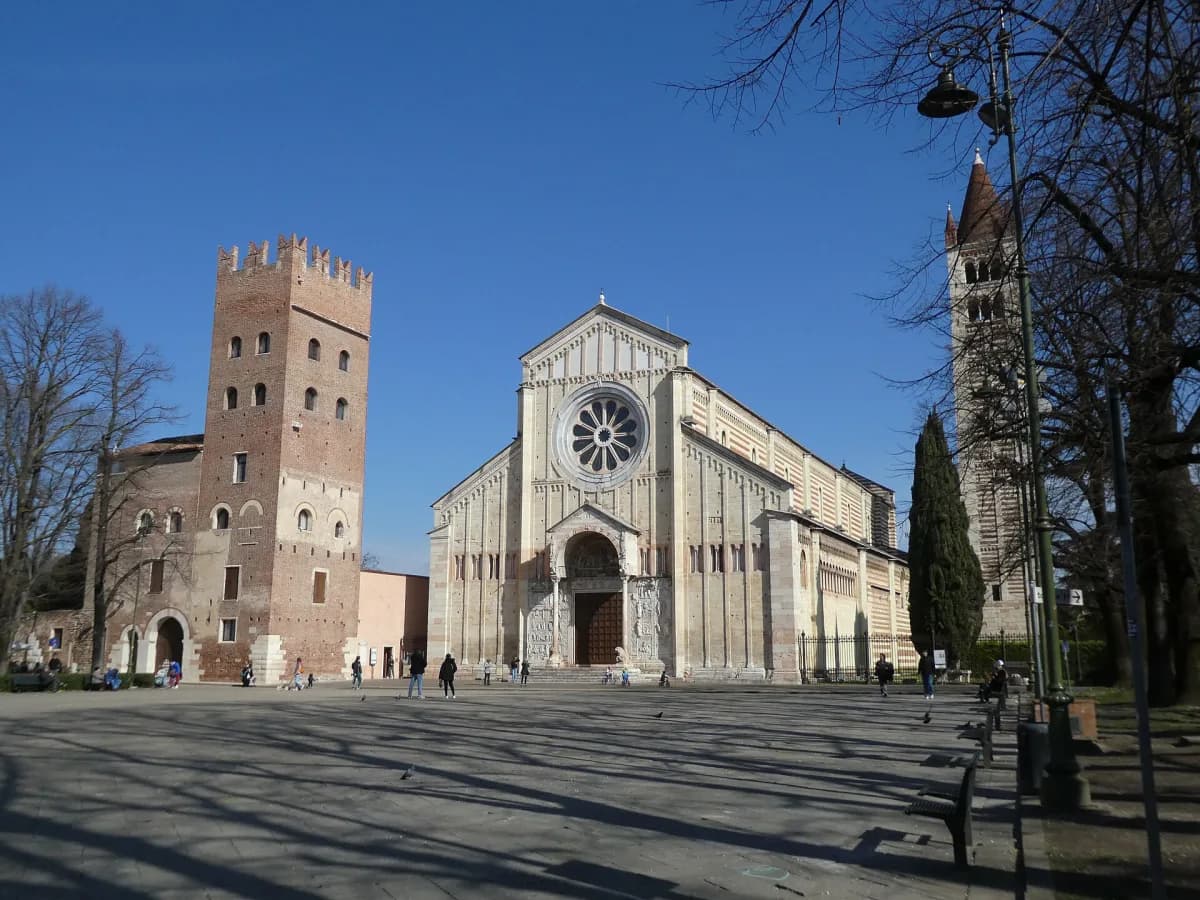
The façade alternates warm tufa stone and brick and is dominated by the basilica's best-known feature: bronze doors made up of 73 panels in total, the 48 largest depicting Old and New Testament scenes and four more showing miracles attributed to Saint Zeno. Above the doors, a large rose window known as the Wheel of Fortune, carved by the stonecutter Brioloto de Balneo, shows six figures representing the rising and falling stages of a human life. A slender bell tower, built between 1045 and 1178, stands to the right of the façade; an earlier, stockier 13th-century monastery tower balances it on the left.
Inside, the church is arranged across three levels — the main parish church, a raised presbytery behind the altar, and a crypt below holding Saint Zeno's remains, recomposed into a glass-sided gilded urn after their rediscovery in 1838. Behind the main altar hangs Andrea Mantegna's altarpiece triptych, one of the defining works of the early Renaissance in the Veneto, and the reason many art-history visitors make the trip out to San Zeno specifically.
Basilica San Zeno Tickets & Prices 2026
Basilica San Zeno is one of four churches ticketed together under Verona's Chiese Vive circuit, alongside the Duomo (Cathedral), Sant'Anastasia, and San Fermo. As of mid-2026, a single-church ticket covering San Zeno alone costs €4. If you plan to visit more than one of the four churches, the combined pass is better value at €8 standard or €7 reduced — the reduced rate applies to visitors 65 and over, students, and groups of 20 or more.
Group rates apply at €3 per person for parties of 20 or more, dropping to €2 per person when travelling with an authorised tour guide. Secondary-school groups pay €2 per student, while kindergarten and primary pupils from Verona, its province, or diocese enter free. Families get a break too: for every two paying adults, up to three minors under 18 enter free on either the single-church or four-church ticket.
Basilica San Zeno is also covered by the Verona Card, the city's combined sightseeing pass — worth pricing out if you're visiting three or more paid attractions in Verona. Tickets are sold at the entrance of the first church you visit rather than online, and reservations aren't required. Confirm current 2026 rates on the official Chiese Vive site before you go, since municipal church tariffs are revised periodically.
Opening Hours & Best Time to Visit
Basilica San Zeno runs on a seasonal schedule. From 1 March to 31 October 2026, it's open Monday to Friday 9 a.m.–6:30 p.m., Saturday 9 a.m.–6 p.m., and Sunday and religious holidays 1–6:30 p.m. From 1 November 2026 to 28 February 2027, hours shorten to Monday to Friday 10 a.m.–5 p.m., Saturday 9:30 a.m.–5:30 p.m., and Sunday and holidays 1–5:30 p.m.
For the calmest visit, arrive at opening on a weekday morning — San Zeno sits further from the coach-tour circuit that clusters around the Arena and Juliet's House, so it rarely gets genuinely crowded, but early morning still gives you the nave and cloister with the fewest other visitors. Because Sunday mornings are reserved for services, plan any Sunday visit for after 1 p.m. Spring and early autumn offer the most comfortable weather for the walk out from the centre; the piazza in front of the basilica has limited shade, so a midsummer midday visit outside is warmer than the shaded interior itself.
How Long to Plan for Your Visit
Budget 45 minutes to an hour for a focused visit — enough time to take in the bronze doors and rose window from the piazza, walk the nave, see the Mantegna altarpiece, and descend into the crypt. Visitors with a deeper interest in Romanesque architecture or Renaissance painting should allow closer to 90 minutes, particularly if the adjoining cloister is open, which adds a quieter, arcaded space worth a slow walk-through.
Don't rush past the crypt. It's a distinct, lower-ceilinged space set apart from the rest of the church, and it's where Saint Zeno's relics are kept — most visitors budget at least ten minutes there on top of time in the main nave.
How to Get to Basilica San Zeno
Basilica San Zeno sits on Piazza San Zeno, on the western edge of Verona, roughly 1.5 kilometres from Verona Porta Nuova station — about a 20-minute walk along Via Barbarani and Via San Zeno, or a short ride on one of the ATV city bus lines that run from the station toward the piazza. From Verona's historic centre and the Arena, it's closer to a 25–30 minute walk west along the Adige, or the same bus connection from a stop near Castelvecchio.
If you're arriving by car, note that much of central Verona, including the streets near San Zeno, falls inside the city's restricted traffic zone (Zona a Traffico Limitato), and street parking near the piazza itself is limited — walking, cycling, or the bus from Porta Nuova is the more reliable option. Verona Villafranca Airport connects to Porta Nuova station by shuttle bus in around 20 minutes.
Visit Tips: Queues, Booking & Mistakes to Avoid
San Zeno rarely produces the queues that build at the Arena or Juliet's House, so advance booking isn't necessary — tickets are bought on-site at the door of the first church you visit. The main mistake visitors make is treating the basilica as a five-minute photo stop at the bronze doors and skipping the interior, where the Mantegna altarpiece and the crypt are the actual reason the church ranks among Verona's most significant sights.
A second common mistake is visiting on a Sunday morning expecting general sightseeing access — the church is reserved for services until 1 p.m. on Sundays and religious holidays. And because San Zeno sits apart from Verona's densest sightseeing cluster, visitors sometimes underestimate the walk (or skip the bus) and arrive without enough time left before closing; check the seasonal hours above before setting out, especially outside the March–October window, when the basilica closes earlier.
Nearby Attractions
San Zeno's location west of the centre makes it a natural first or last stop on a day that also covers Verona's core sights. Castelvecchio, the Della Scala family's riverside fortress-turned-museum, is the closest major sight, roughly a 15–20 minute walk east along the Adige. Continuing into the historic centre, Piazza delle Erbe and Torre dei Lamberti's bell tower are about 30 minutes on foot from San Zeno, or a shorter hop combined with the same bus route from Porta Nuova.
For a fuller day that ties San Zeno into the rest of Verona's sights, our one-day Verona itinerary and hidden gems in Verona guide both cover routes that put the basilica alongside the city's more central landmarks without doubling back.
Frequently Asked Questions
How much are Basilica San Zeno tickets in 2026?
As of mid-2026, a single-church ticket covering just Basilica San Zeno costs €4. If you're visiting more than one of Verona's four Chiese Vive churches, the combined pass is €8 standard or €7 reduced (65+, students, groups of 20+). Confirm current rates on the official site before you go, as municipal tariffs are revised periodically.
What are Basilica San Zeno's opening hours?
From 1 March to 31 October 2026, the basilica is open Monday–Friday 9 a.m.–6:30 p.m., Saturday 9 a.m.–6 p.m., and Sunday/holidays 1–6:30 p.m. From 1 November 2026 to 28 February 2027, hours shorten to Monday–Friday 10 a.m.–5 p.m., Saturday 9:30 a.m.–5:30 p.m., and Sunday/holidays 1–5:30 p.m.
Is Basilica San Zeno covered by the Verona Card?
Yes. The Verona Card includes or discounts admission to Basilica San Zeno alongside the city's other major museums, monuments, and public transport — worth pricing out if you're visiting three or more paid attractions in a day or two.
How long do you need to visit Basilica San Zeno?
Budget 45 minutes to an hour for a focused visit covering the bronze doors, nave, Mantegna altarpiece, and crypt. Visitors with a deeper interest in Romanesque architecture or the cloister, when it's open, should allow closer to 90 minutes.
Is Basilica San Zeno worth visiting?
Yes. It combines one of northern Italy's best-preserved Romanesque façades with a genuinely important Renaissance altarpiece by Andrea Mantegna and the crypt holding Verona's patron saint — and it draws far fewer crowds than the Arena or Juliet's House.
Basilica San Zeno rewards visitors willing to go slightly further from Verona's tourist core — the bronze doors and rose window are only the introduction; the Mantegna altarpiece and the crypt below are the real reasons the church ranks among the city's most significant sights, without the queues that build at the Arena or Juliet's House.
Confirm current 2026 prices and seasonal hours on the official site before you go, plan around the Sunday-morning service restriction, and budget close to an hour if you want to see the interior properly rather than just photograph the façade.
For the latest official information, see the Chiese Vive official visitor-info page and the Basilica of San Zeno overview on Wikipedia.