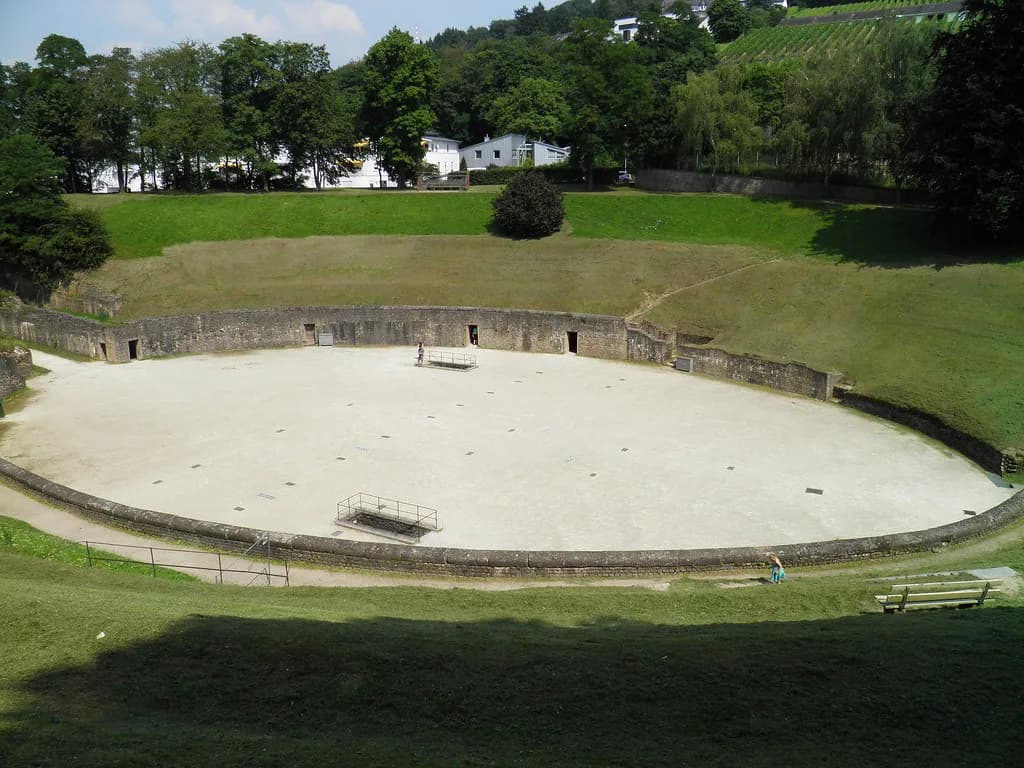
Trier's amphitheater is one of the Roman monuments that earned the city its UNESCO World Heritage listing, and it sits in a green slope rather than a built-up arena district. Because the seating was quarried away centuries ago, the site reads as an elliptical hollow in the hillside, which surprises visitors expecting a reconstructed arena. The operator publishes an adult admission of 6.00 euros and a clearly seasonal opening pattern, with last admission 30 minutes before closing, so the practical planning revolves around those two facts.
The official tourist information page is the reference point for current prices and hours, and anything quoted here should be rechecked there before you travel because operators revise both seasonally. For comparison, a TripAdvisor listing also summarises the adult rate and the family ticket, but user-generated pages are a starting point rather than the authority. Where the operator has not published a detail, such as underground access rules, this guide says so instead of guessing.
What Trier's Amphitheater Actually Is
The arena measures roughly 120 by 145 metres and was built around 100 AD for an audience in the region of 20,000 spectators, according to the tourist information page. That footprint places it among the largest preserved Roman amphitheaters, and the UNESCO listing it shares with Trier's other Roman monuments dates to 1986. Its scale is easiest to grasp from above, because the tiers themselves no longer exist.
What makes this site distinctive is its setting: it was cut into the natural slope of the Petrisberg rather than constructed as a free-standing building. The operator describes the exposed greenery as the very thing that reveals why the location is special, and the echo in the bowl still carries sound. If you want a sense of what the monument looked like in use, the Toga Tour and the city's other Roman structures fill in the context.
Two of the most useful sibling Roman sites to weigh alongside it are the Porta Nigra tickets and visitor guide and the Barbara Baths Trier visitor guide, both of which approach Roman Trier from a different angle. Reading one of them first helps you decide how many monuments justify a combined ticket rather than a single admission. The whole city's Roman layer is best understood as a set of separate sites, each ticketed on its own terms.
Opening Hours and Seasonal Variations
The operator publishes a clearly seasonal pattern rather than a single year-round schedule. In the extracted information, April through September runs daily from 09:00 to 18:00, October closes an hour earlier at 17:00, November through February ends at 16:00, and March sits at 17:00. The key constant is the last-admission rule: you must be inside 30 minutes before closing, which effectively shortens winter afternoons further.
That means a late-October visit has under an hour of usable time if you arrive near the end of the day, so aim for the middle of the afternoon. The compressed winter window is also the main argument for treating the amphitheater as a shorter stop and pairing it with something indoors if the weather turns. Because public-holiday and special-event hours are not part of the published pattern, confirm the day you intend to travel directly with the operator before setting out.
Admission Prices and Ticket Categories
The published adult rate on the tourist information page is 6.00 euros, with a reduced rate of 5.00 euros for categories that include pupils over 18, students, trainees, people doing community service, seniors, the unemployed and visitors with a disability, on presentation of evidence. Children and pupils aged 6 to 18 pay 3.00 euros, and children up to age 6 enter free. These figures come from the operator page and should be rechecked before you buy.
Family pricing comes in two tiers that differ by the number of accompanying adults. Family ticket 1 covers one adult and up to four children up to age 18, while family ticket 2 covers two adults and up to four children up to age 18. Because the tiers are structured that way, a larger group should compare the family rate against individual child tickets before deciding, since the cheaper option depends on how many adults are paying.
Groups of ten or more also receive a reduced rate, with one rate for adults and another for children and teenagers up to 18, and the operator requires that the group ticket be bought by a single person such as a guide or supervisor. If you are organising a school or club trip, that purchasing rule matters more than the headline price, because it determines who pays. Travel-industry and city sources describe the rate as 5.00 euros for adults and 3.00 euros for children in groups, which is a useful cross-check rather than the authority.
The 2026 Under-18 Summer Window
During the Rhineland-Palatinate summer vacation, the operator ran a dated free-admission window for young visitors from June 26 to August 9, 2026, covering under-18s at the Rheinisches Landesmuseum and the Roman ruins including the amphitheater. That promotion has now closed, so families travelling later in 2026 or in 2027 should not budget around it. Treat it as a fixed-window offer that may or may not be repeated, and check the operator page for any successor scheme.
Even without the promotion, the standard child rate of 3.00 euros and the two family tiers keep the cost low relative to many European Roman sites. The planning implication is straightforward: if a future under-18 offer returns, it changes the maths for families with several children, but the ordinary child and family tickets remain the reliable baseline. Confirm which scheme is active on the date you travel rather than assuming the summer terms apply.
What You Actually See Inside
The tourist information page is direct about the state of the monument: the stone animal cages are empty, the rows of seating have been removed, and the arena sand is gone. What remains is the elliptical structure itself, whose shape and depth still communicate the original scale. Visitors who arrive expecting a reconstructed arena with tiered benches are the ones most likely to be disappointed.
The exposed greenery and the bowl cut into the slope give the site its character, and the operator explicitly presents the natural setting as part of why the monument is worth seeing. After the Roman period the arena served as a quarry, which is why so much of the dressed stone is missing today. Knowing that history in advance reframes the visit from a hunt for ruins to a reading of the landscape.
The city's wider Roman layer rewards the same mindset, and the Trier landmark guides place the amphitheater in that context. If you want a second data point on how Trier presents its Roman heritage, the Porta Nigra is the obvious companion. Plan on looking, listening and imagining rather than on inspecting intact architecture.
Underground Passages and the Arena Level
The operator page describes the empty animal cages and the vanished seating, and its own framing mentions a netherworld factor of around 50 percent, which suggests there is something below the arena floor to see. It does not, however, publish a route, an access rule, or a condition report for the underground passages, so anyone promising you a particular underground experience is going beyond the available information. The honest position is that the below-ground element is part of the site's identity but its current access terms are unconfirmed.
If underground access matters to your visit, ask the operator directly before you travel rather than relying on third-party summaries. The contact details published for the monument are Olewiger Straße 25, 54295 Trier, telephone +49 651 73010, with the Zentrum der Antike as the associated site. A short call or email settles the question in a way that no guidebook can.
How Long to Allow
There is no official recommended duration for the amphitheater, so the following is editorial advice rather than an operator figure. For most visitors, 45 to 60 minutes is enough to walk the bowl, read the on-site interpretation, take in the Petrisberg setting, and sit for a few minutes in the acoustically lively arena floor. Anyone combining the site with a wider Roman-Trier itinerary will naturally spend longer on the surrounding walk than on the monument itself.
That estimate assumes you are not queuing and that you arrive with at least an hour before the last-admission cutoff. In the November to February window, when the site closes at 16:00, the practical visit is shorter and the light goes early, so a morning slot works better. Because the arena is outdoors, weather and daylight shape the experience more than the ticket does.
Combined Tickets and the AntikenCard Trier
The operator states that the AntikenCard Trier offers admission to the Roman monument sites in Trier plus additional discounts around the ancient city, and that it is available in four different versions. It does not publish, on the extracted page, the card's exact price or the number of individually named sites included beyond that description of four versions. Verify both points with the operator before deciding, because the value of the card depends entirely on how many monuments you actually plan to enter.
The card's worth is situational: it makes sense if you intend to visit several Roman monuments over a day or two, and it is wasteful if the amphitheater is your only ticketed stop. The individual amphitheater admission is low enough that you would need additional sites to justify the card. Run the comparison with real current prices from the operator rather than with secondhand figures.
Booking mechanics for the card, including whether it can be bought on arrival or must be ordered ahead, are not stated on the page, so treat that as a question to put to the tourist information office. The city's wider Trier itineraries and city travel guides can help you decide how many monuments fit realistically into your trip. Without that plan, a combined ticket is a guess rather than a saving.
Pairing the Amphitheater with the Roman Baths
The Roman baths are the natural companion to the amphitheater on a Roman-Trier day, and the combined-ticket structure is designed for exactly that pairing. The operator's AntikenCard description covers the Roman monument sites generally, without publishing individual bath admission on the extracted page, so confirm the bath's own ticket terms separately. Do not assume every Roman site in the city is covered by the same ticket.
In practice you can split the two across a single day or across two visits, depending on how much walking you want and how the seasonal hours line up. The amphitheater is a largely outdoor experience, while the baths are more of a structural and interpretive visit, so they suit different times of day and different weather. Building in a break between them usually produces a better day than rushing from one to the next.
Practical Planning and Contact
The monument's published address is Olewiger Straße 25, 54295 Trier, and the telephone contact is +49 651 73010. Trier Tourismus und Marketing's tourist information office sits at Simeonstraße 60, near the Porta Nigra, and is the place to resolve card pricing, holiday hours and any current promotion questions. For onward travel planning, the Deutsche Bahn network and the Trier Hauptbahnhof guide are useful for shaping arrival times.
Before you go, verify the day's opening hours, the current admission categories, whether any under-18 promotion is active during your travel dates, and what exactly the AntikenCard covers. Those four checks cover nearly every volatile detail, and each is answerable through the operator or the tourist information office. If you want a broader sense of the city's other sights for the same trip, the Hauptmarkt and Marktkreuz Trier visitor guide is a sensible next read.
Plan Your Visit
Trier's amphitheater is a modest ticket with an outsized story: a 120 by 145 metre arena, a UNESCO-listed Roman monument, and a green, hollowed shell where the seating and cages no longer survive. Set against the published adult rate and the low child and family categories, it is one of the more affordable Roman sites in the city.
The two decisions that matter are when you go and what ticket you hold. Check the seasonal closing time and the last-admission rule for your date, then decide whether a single admission or the AntikenCard fits your itinerary. Confirm both with the operator before you travel, because the figures here reflect the published information at the time of writing.
Frequently Asked Questions
How much does it cost to visit the Trier Amphitheater?
The operator publishes an adult rate, a reduced rate, a child rate, two family tiers and group rates, with children up to age 6 entering free. Because these figures are revised seasonally, check the current admission table on the tourist information page before you buy. Do not rely on older summaries, which may quote rates that no longer apply.
Is the Trier Amphitheater free to enter?
Entry to the arena is ticketed, and only children up to age 6 enter free under the standard published categories. A dated summer promotion once allowed under-18s in free during a fixed window, but that offer has closed and should not be assumed to apply to your travel dates. Confirm current terms with the operator.
What are the opening hours in October and winter?
The published pattern gives October a 17:00 close and the November to February period a 16:00 close, both shorter than the summer months, with last admission 30 minutes before closing. Public-holiday and special-event hours are not part of the published pattern, so confirm your specific date. Arriving with an hour to spare is the safest approach outside summer.
Do I need to book amphitheater tickets in advance?
The operator page does not state a booking or timed-entry requirement for the monument, so there is no published rule to rely on either way. If you are travelling with a group, or want the AntikenCard, ask the operator or the tourist information office in advance. That avoids assumptions about availability on the day.
Is the AntikenCard Trier worth it for the amphitheater and Roman baths?
The card covers the Roman monument sites and comes in four versions, so its value depends on how many of those sites you plan to enter. If the amphitheater is your only ticketed stop, a single ticket is likely to be the simpler choice. Verify the card's current price and coverage with the operator before deciding.
Can you go inside the underground passages at the amphitheater?
The operator describes the site's below-ground character but does not publish access rules, routes or a condition report for the passages. Anyone claiming to know the current access terms is going beyond the available information. Ask the operator directly before you travel if this part of the site matters to you.
How long do you need at the Trier Amphitheater?
There is no official recommended duration, so treat 45 to 60 minutes as editorial advice for a normal visit that includes the bowl, the interpretation and the Petrisberg setting. In the shorter winter opening window, plan for less time and aim for the morning. Allow longer if you are combining the site with other Roman monuments.