
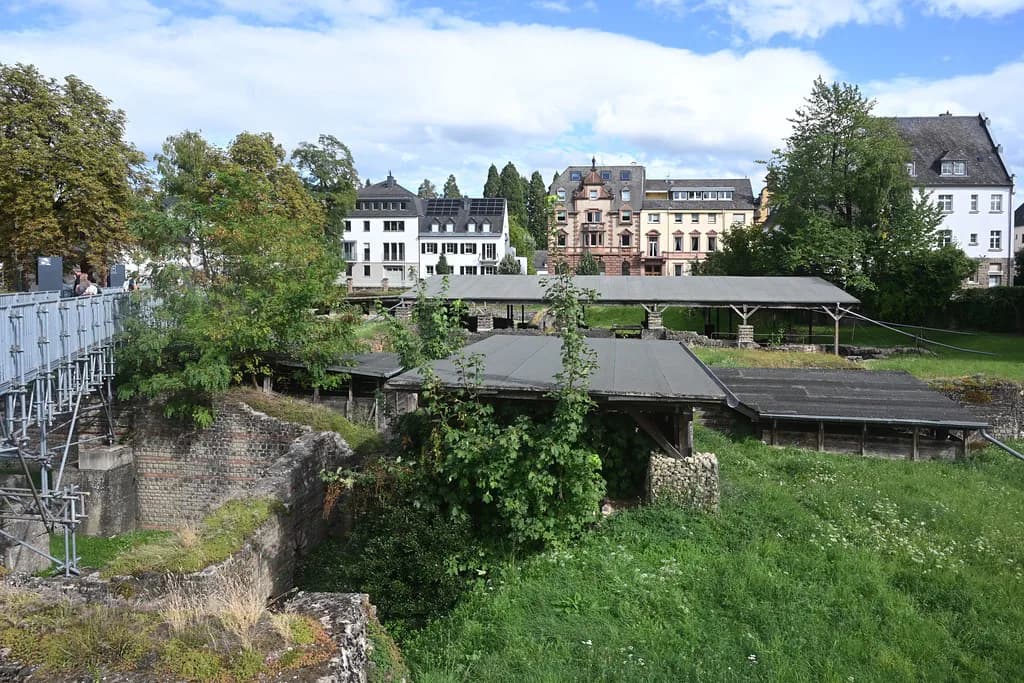
The Barbara Baths, known locally as the Barbarathermen, occupy the site of what the Tourist-Information Trier describes as the largest bath complex in the entire Roman Empire outside of Rome, spread over some 42,000 square metres and built during the second half of the second century. What stands along Südallee today is not a reconstructed bathing hall but an open excavation viewed from a visitor walkway. The same tourism page states that only a third of the original bathing temple has been excavated, so much of the visit depends on reconstructions and imagination rather than standing masonry. That gap between historical scale and present-day appearance is exactly what this guide addresses.
The most useful thing to know before you go is that the Barbara Baths are freely accessible during the opening hours and no entrance fee is charged, as the Tourist-Information Trier listing states directly. That makes the site a low-risk stop rather than a ticketed commitment, and it changes how you should slot it into a day. You will be looking at foundations, service remains and reconstruction panels rather than soaring walls. The site is a UNESCO World Heritage component of Roman Trier, yet it receives far less attention than the Porta Nigra.
Scale Check: What 42,000 Square Metres Actually Means
The scale figures for the Barbara Baths are the reason the site matters, so it helps to translate them into something you can see. The Tourist-Information Trier page states that the largest bath complex in the entire Roman Empire outside of Rome sprawled over an area of some 42,000 square metres here. That footprint is the point: you are walking through a district-sized facility, not a single building. The remains stretch across both sides of a modern street, which is why the walkway invites you to look across Südallee and Kaiserstrasse rather than at one concentrated ruin.
Because the complex was so large, the visible ruins are spread out and the interpretive walkway runs longer than you might expect from a single monument. Your eye has to bridge gaps that were once filled with halls, pools and porticoes. The scale also explains why later generations found the site so useful as a quarry, a theme the walkway reconstructions address. If you only look at the largest remaining masonry blocks, you will underestimate how much of the footprint is buried beneath surrounding streets.
What Remains Above Ground Versus What Survives Below
Above ground, the Barbara Baths present low foundation walls, column fragments and open trenches rather than standing architecture. History Hit notes that a little of the original complex can be seen above ground today, partly because the site was quarried for materials in the 17th century. The comparison that matters is with the Imperial Baths of Trier, which retain much more visible structure and are the better choice if you want walls and windows. At the Barbara Baths, the interesting material is largely below the modern surface: the same page describes foundations and service tunnels that ran underground, including sewer systems, pools, furnaces and a heating system.
The underground emphasis means the viewing angles matter more than the objects themselves. From the walkway you look up at treetops where buildings once rose, and across the street to visualise how far the complex stretched, as the tourism page describes. If you arrive expecting dramatic vertical shafts, note that History Hit describes the underground remains as service tunnels and foundations rather than deep chasms, so avoid imagining a cave system. Patience with the panels matters more than any equipment.
The Excavation Reality: A Third Excavated, Most Imagined
The Tourist-Information Trier page states that only a third of the original bathing temple has been excavated, which means much of what you are standing on is unexamined ground. The same page frames the experience with its own summary: UNESCO World Heritage Site 100 percent, Excavation 20 percent, Imagination 80 percent, an assessment that explains why the visible ruins feel fragmentary. Excavation enthusiasts will find the archaeology-in-progress descriptions along the walkway genuinely interesting, because they show how the site is still being read. Casual visitors who want a complete monument should adjust their plan accordingly.
The operator is unusually direct about the experience, describing it as a place where you will have to be a bit imaginative as you stand on the visitor walkway. Treat that as an honest brief rather than a warning. The excavation story also gives you a reason to linger at specific panels instead of walking the length in one pass. If you photograph only the largest ruined walls, you will miss the point that the most informative content is interpretive.
Opening Hours and Free Admission
The Barbara Baths are freely accessible during the opening hours and no entrance fee is charged, and the last admission is 30 minutes before closing; the Tourist-Information Trier page lists both details. That page gives the seasonal pattern as March daily 10:00 to 17:00, April through September daily 10:00 to 18:00, October daily 10:00 to 17:00, and November through February daily 10:00 to 16:00. Those windows are the operator's published pattern, not a guarantee for your specific date, so confirm the current listing before you travel. For wider planning, see Trier city travel guides.
Because entry to the walkway is free, there is no ticket to book at the bath site and the operator page mentions no combined ticket covering other Roman monuments, so you should not plan around purchasing anything at the gate. That also means the Barbara Baths are a good stop for a tight schedule or a low-energy afternoon when a paid interior might feel wasteful. The contact details on the operator page list the site under Barbara Baths, Südallee, 54290 Trier, with a telephone number and a link to the Zentrum der Antike. Note that the free access applies to the walkway and visible remains, not to museum collections elsewhere in the city, and each museum's ticket is separate.
How Long to Allow: A Suggested Duration
A suggested 20 to 30 minutes on the walkway is enough to read the reconstruction panels, look across the street and grasp the footprint; this is our suggestion, not an official recommended visit time. If you are an excavation enthusiast or you read every panel, allow closer to 45 minutes. The stop is short because there is no interior circuit to complete and no ticketed exhibition to work through. Add time only if you plan to double back along Südallee and Kaiserstrasse for the walk-across viewpoints.
The walkway itself is the visit, and its length is modest, so the main variable is how long you spend interpreting what you see. A brisk pass takes about ten minutes; a considered one takes half an hour. Because admission is free and hours are seasonal, a short stop costs you little even if it turns out not to hold your interest. Check your route on the city's transport information rather than assuming a specific bus line, since the published service details you find online may be out of date. For wider planning, see Trier Hauptbahnhof Guide.
Why the Reconstructions Are the Real Interpretive Tool
The Tourist-Information Trier page states that reconstructions reveal the architecture and the typical daily routine at the baths, and that the baths' post-antiquity fate as a quarry is also touched on. This last point reframes the disappointment many visitors feel: much of the stone was removed and recycled over centuries, which is why so little stands today. The same page notes that archaeologists describe their current restoration work on the site, turning it into a live archaeological project rather than a static ruin. Read the panels in order along the walkway and the fragments start to cohere.
The baths' later life as a quarry connects directly to the low walls you see, so the interpretation is not decorative background but the explanation for the site's condition. The operator page notes that Greek-inspired marmoreal Amazons, column ruins and sculptures from the complex are today housed at the Rheinisches Landesmuseum Trier, which is where you go if you want the artifacts rather than the setting. Planning the baths and the museum as a pair makes sense, but keep the two visits separate in your mind because they offer different things. The museum gives you objects; the walkway gives you scale and context.
Fitting the Barbara Baths Into a Roman Trier Itinerary
Trier has several Roman bath sites, and the sensible approach is to treat them as alternatives rather than a checklist. The Imperial Baths retain the most visible structure and are the best choice if you want architecture; History Hit notes that the Barbara Baths' above-ground remains pale in comparison to the Imperial Baths of Trier. The Barbara Baths are the better choice if you want scale, excavation context and a free stop. If your time is limited, choose one bath site and spend the saved time at the Rheinisches Landesmuseum for the artifacts. For wider planning, see Trier Amphitheater.
The site is accessible from Südallee, within walking distance of the centre, so it combines naturally with a Hauptmarkt stop or a walk from the main station. A practical sequence is Porta Nigra, Hauptmarkt, then the baths as an open-air pause before the museum. For a street-level orientation first, the Trier old town walking route is a useful companion, and one-day itineraries in Trier can absorb the baths if you keep the stop short. For wider planning, see Hauptmarkt and Marktkreuz in Trier.
UNESCO Status, the Name, and the Location
The Barbara Baths are part of Trier's UNESCO World Heritage listing; History Hit lists them as a UNESCO World Heritage site. The name does not come from a Roman figure: the same page explains that a chapel was built inside one of the Roman buildings and others were repurposed as a monastery to Saint Barbara, giving the baths their name. The site is entered from Südallee, and the address published by the operator is Barbara Baths, Südallee, 54290 Trier. Knowing the street name is more useful than any landmark, because the walkway entrance is easy to miss.
The tourism office's own summary places the baths among the city's Roman structures, which is the correct mental category: a component of a wider Roman city, not a standalone attraction. If you are tracing Trier's Roman past beyond the walls, day trips such as the Igeler Säule from Trier extend the theme outside the city. Within Trier, the baths work best as one piece of a walking day, and the wider landmark guides for Trier collect the other Roman pieces.
Who Should Skip or Shorten This Stop
Skip or shorten the Barbara Baths if you have limited time, want reconstructed interiors, or are travelling with children who need interactive exhibits to stay engaged. The site offers no covered rooms and no ticketed exhibition, so there is nothing to hold attention beyond the panels. Visitors with mobility concerns should check current conditions with the operator rather than relying on secondhand descriptions, because the walkway surface and access details are not documented in the sources reviewed here. If you only have one bath site in your schedule, the Imperial Baths will usually serve you better.
You will get the most from a short pause if you enjoy reading excavation interpretation or want a free, quiet contrast to Trier's busier monuments. Photographers looking for dramatic masonry should not expect it; the strongest images here are wide views across the street that convey footprint. Historians and archaeology enthusiasts will find the restoration descriptions more rewarding than the ruins themselves. Anyone combining the baths with the Rheinisches Landesmuseum should allow separate time for each and check the museum's own opening arrangements rather than assuming they match the walkway hours.
Plan Your Visit
Treat the Barbara Baths as a viewpoint and an imagination exercise rather than a reconstructed museum interior. The site is free, the walkway is short, and the value lies in understanding the scale of what stood here and why so little survives. Confirm the seasonal opening pattern and last-admission timing on the operator's page before you go, since published windows can change. Pair the stop with the Rheinisches Landesmuseum if you want the artifacts, and choose one bath site rather than collecting all of them.
For a broader Roman Trier plan, use the city's landmark guides and itineraries alongside this page and keep the baths as a low-cost, low-time stop. Above all, arrive with the right expectation: you are reading a site, not touring a building.
Frequently Asked Questions
Is there an entrance fee for the Barbara Baths in Trier?
No. The Tourist-Information Trier page states that the Barbara Baths are freely accessible during the opening hours and that no entrance fee is charged. Because entry is free, there is no ticket to book and no combined ticket with other Roman monuments mentioned on the operator page. Check the operator page before travelling, since access arrangements can change.
How long should I spend at the Barbara Baths?
A suggested 20 to 30 minutes is enough to walk the visitor walkway, read the reconstruction panels and look across Südallee and Kaiserstrasse to gauge the original footprint. This is a suggestion rather than an official recommended duration. If you read every panel or follow the archaeology descriptions closely, allow closer to 45 minutes.
What can you see from the Barbara Baths visitor walkway?
From the walkway you see low foundation walls and underground service remains, plus reconstruction panels that explain the architecture and daily routine at the baths. History Hit describes the underground workings as including sewer systems, pools, furnaces and a heating system. The operator page notes that only about a third of the complex has been excavated, so much of the experience is interpretive rather than structural.
Are the Barbara Baths worth visiting compared with the Imperial Baths?
Choose the Imperial Baths if you want visible standing architecture; choose the Barbara Baths if you want scale, excavation context and a free stop. History Hit notes that little of the Barbara Baths remains above ground today and that this pales in comparison to the Imperial Baths of Trier, partly because the site was quarried for materials. If your time is limited, visiting one bath site and spending the saved time at the Rheinisches Landesmuseum is a reasonable trade-off.
How much of the Barbara Baths has been excavated?
The Tourist-Information Trier page states that only a third of the original bathing temple has been excavated. That figure explains why the visible ruins are fragmentary and why the walkway relies heavily on reconstructions and descriptions of ongoing restoration work. Do not expect a fully revealed bathhouse.
Why are the Barbara Baths called the Barbara Baths?
The name derives from a monastery dedicated to Saint Barbara that was later built into the Roman ruins, rather than from a Roman figure. History Hit explains that a chapel was built inside one of the Roman buildings and others were repurposed as a monastery to Saint Barbara. The later religious use is part of why the site's history extends well beyond antiquity.


