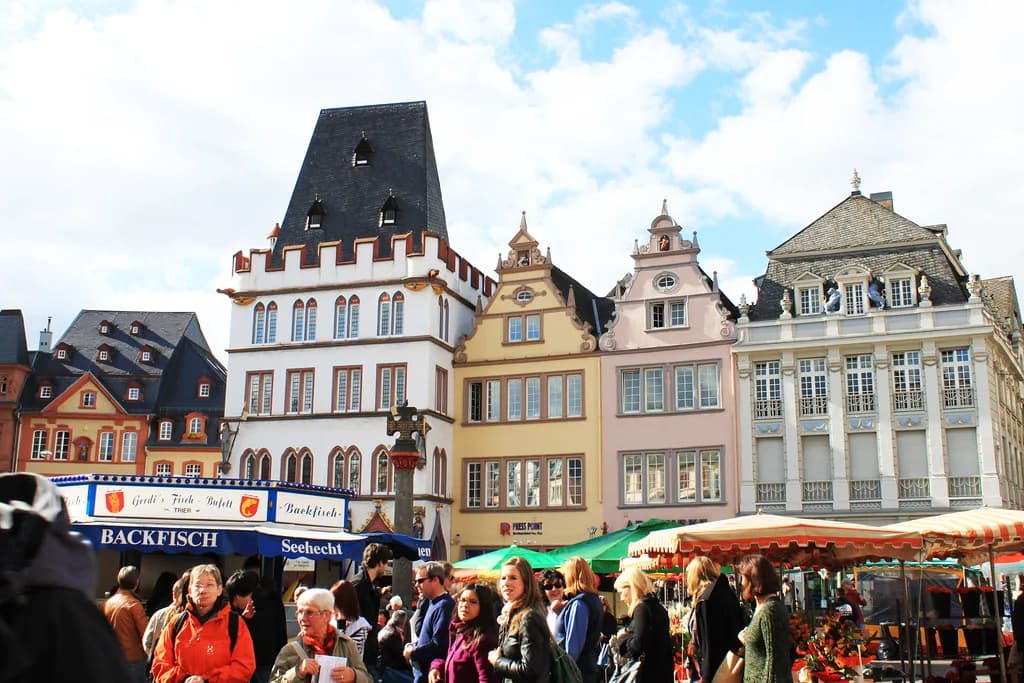
The Hauptmarkt is Trier's main market square and the natural midpoint of an old-town walk between the Porta Nigra and the cathedral. According to the city's tourist information, Trier received its market right in 958 and the Hauptmarkt became the centre of medieval Trier, which it says it remains today. The same page describes a square filled with colourful flower stalls six days a week, along with fruit and vegetable displays, and pedestrian malls that open out from it on all sides.
The most useful planning point is that this is an outdoor public square, not a ticketed attraction, so you can walk in, sit on the steps of the Marktkreuz and circle the fountain at no cost. That makes it easy to fold into a walk rather than a fixed appointment. For the classic old-town route that links the square to the Porta Nigra and the cathedral, see the old town walking route, and if you are looking for free things to do in Trier more broadly, the square belongs on that list as well.
What the Hauptmarkt Is and Where It Sits
The Hauptmarkt is the central market square of Trier's old town. Its identity comes from the market right the city was granted in 958, a date the tourist board uses to explain why the square became the heart of medieval Trier and why it still works as the city's everyday centre. The English-language name used on the tourist board page is Main Market, which is the wording you are most likely to see on English maps and signage. That single fact — a market site in continuous use for more than a thousand years — is the right frame for everything you see around you.
The square also functions as a junction. The tourist board states that pedestrian malls open out into it or radiate out from it on all sides, which is why the Hauptmarkt is a sensible place to turn an old-town stroll into two shorter legs. Walking in from the direction of the Porta Nigra puts you on the Roman side of the city, while heading east takes you to the cathedral. If you are structuring a day around Trier's landmarks, the square is the natural hinge point rather than a separate excursion.
On the everyday side, the tourist board describes flower stalls filling the square six days a week, with fruit and vegetable displays and general market bustle alongside them. That six-days-a-week wording is the best available summary from the sources that describe the square, but it is not a published timetable. The city's own portal covers markets and shopping elsewhere in Trier but does not set out Hauptmarkt trading days or hours on the pages a visitor would naturally land on, so check current days with the tourist information before you plan a morning around them. In practice, flowers and produce are the reliable elements, and they are better seen earlier in the day than late.
The Marktkreuz and What It Marks
The Marktkreuz, or Market Cross, stands at the centre of the square. The tourist board states it was erected in 958 and calls it the oldest market cross in all of Germany. The date ties directly to the market right that created the square, so the cross is not decoration but the legal marker of the market itself. It is built on steps, which is why people sit on it, and that also makes it the most practical meeting point on the square, since it is central and visible from the streets leading in.
There is a second, more practical use for the cross. The tourist board notes that from its steps you only need to turn slightly northwards to see the Porta Nigra, or eastwards to see the cathedral. Doing that once at the start of your visit orients you for the rest of the day and saves repeated map checks. It also explains the geography of the old town in a single movement: the Roman gateway on one side and the cathedral precinct on the other, with the market square as the place where the two eras meet.
The Petrusbrunnen and Its Figures
The fountain on the square is the Petrusbrunnen, and it rewards a full circuit rather than a glance. The tourist board describes watchful female figures around it as allegories of the four cardinal virtues — justice, fortitude, temperance and prudence — with St Peter, the city's patron saint, at the top. The page notes he had roughly 400 years to grow used to what surrounds him, which is a fair way of describing a fountain that is both civic monument and joke. Read clockwise and the fountain turns into a small iconographic puzzle.
The mischievous monkeys are usually the photographed detail, but the interesting part is their many paw positions, which the tourist board treats as the fountain's running prank at the patron saint's expense. Walk the basin slowly and look at the hands rather than only the faces. Children tend to find the joke first, so it is worth giving them the job of spotting the individual gestures as you go round.
The Steipe and the Surrounding Facades
The building most visitors single out is the Steipe, and the tourist board credits it with winning the square's unspoken contest for the most unusual facade decoration. Its distinguishing features are watchful knight figures and arcades of pointed arches, both of which are visible from the square at ground level and from a few steps back. The tourist board presents it as part of the square's architecture rather than as a place you enter, so plan on viewing it from outside. If interior access matters to your visit, confirm it with the tourist information rather than assuming the building is open.
The reason the square rewards looking up is that the surrounding buildings compete with the Steipe on their own terms. The tourist board lists Madonnas, gold stars, water features and oxen among the details used by different facades, all of them effectively auditioning for the title of most unusual exterior decoration. None of that is signposted, so the honest approach is a slow perimeter walk with your eyes raised, picking out what you can find. Several of the details sit well above head height, which is where a phone camera's zoom starts to earn its keep.
It is worth being explicit about scope here. The Hauptmarkt is one place with one character, and the buildings around it are viewed as streetscape rather than as a set of interiors sharing a single ticket. The churches and museums in the surrounding old town are separate entities with their own arrangements. If you want the wider context for those, the Trier city guides are the better starting point than the square itself.
The Seasonal Wine Stall
The square's best-known seasonal feature is its wine stall. The tourist board describes it as running from the end of March to early November, with a different winery from Trier and the surrounding region showcasing its wines each week, split between Monday to Thursday and Friday to Sunday. So the producer can change within a week as well as between weeks, which is a detail worth knowing if you are planning to return. Because this is a seasonal stall rather than a permanent venue, treat those months as a general window and confirm what is currently pouring when you arrive.
The tourist board also frames the stall's purpose as conversation: it describes it as the place to talk with winemakers and wine-lovers both in front of and behind the bar. That is useful for setting expectations. This is not a formal tasting room with a fixed flight; it is a standing place on a market square, which is precisely why it works as a pause in an old-town walk rather than a destination in itself.
How Long to Spend
A suggested allowance for the square itself is 20 to 30 minutes, which is enough for a full lap of the Marktkreuz, the Petrusbrunnen and the surrounding facades with some attention to the detail. This is a suggestion rather than official guidance, and it assumes you are not stopping for a drink or browsing the stalls. Add time if the wine stall is running or if the flower and produce displays are worth working through, because both slow the visit down considerably.
For a wider walk, a suggested half day covers the square plus the cathedral and the Church of Our Lady, with an hour or so of that spent in the streets between them rather than on the square. Building in the Porta Nigra as well turns it into a fuller half day, and the walking is the point rather than an overhead. If Roman Trier is your priority, the Barbara Baths and the other Roman sites sit on a different axis of the city and are better treated as a separate stop rather than squeezed into the same loop. For a broader plan, the one day in Trier itinerary sets out how these pieces fit together.
Pairing the Square With Nearby Sights
The cathedral and the Church of Our Lady are a short walk east of the Hauptmarkt, which makes them the most natural pairing with the square. Trier Cathedral is a working church, so it asks for a different kind of attention than an open square, and it is the reason the city's religious architecture deserves a slot in the day. The Church of Our Lady next door is often skipped in favour of the cathedral, which is a loss if Gothic detail interests you. Both are separate buildings with their own visiting arrangements, not extensions of the market square.
The Porta Nigra anchors the other end of the walk and is the obvious Roman counterweight to a medieval square. The Karl Marx House also sits in the old town and is close enough to fold into the same loop, which means one afternoon can span two thousand years of the city without needing a bus. Use the old town walking route as the spine of a day like that and drop into the square when you reach it, rather than treating the square as a separate trip.
Practical Notes and What to Verify
The square is free and open, but several details visitors ask about are not published in the sources that describe it. The tourist board's page on the Hauptmarkt says flower stalls appear six days a week, but it does not give trading days or hours, so confirm those before planning around the market. The Steipe interior is not presented anywhere in that material as a visitor attraction, so do not plan on going in. Accessibility, parking and public transport specifics for the square are also not covered there, so use the city's own mobility and parking information instead of guessing.
The tourist information office is the right first stop for anything volatile, from market days to events occupying the square. It sits on Simeonstraße 60 by the Porta Nigra, which puts it on the way into the old town rather than out of it. Ask about the wine stall's current producer if that is part of your plan, and ask whether any event is taking over the square during your dates, since a market square with a busy events calendar can be fully occupied. Christmas market arrangements are seasonal and change, so treat an undated schedule as a starting point rather than an answer.
Plan Your Visit
The Hauptmarkt repays attention in two directions: down at the Marktkreuz and the Petrusbrunnen, and up at the facades competing above them, led by the Steipe. Start at the cross, use it to orient yourself towards the Porta Nigra or the cathedral, then work a slow perimeter and let the market decide how long you linger. Because it is free public space, the only thing lingering costs you is time you had earmarked for the next stop.
Before you go, check current market days, the opening arrangements for anything you intend to enter, and whether the wine stall is running during your dates, since none of those should be assumed from a general description. Pair the square with the cathedral and the Porta Nigra on one walk, and keep a separate slot for the Roman sights further out. That way the square does the job it has done for centuries: the centre you keep returning to during a day in Trier.
Frequently Asked Questions
Is the Hauptmarkt in Trier free to visit?
Yes. The Hauptmarkt is an open public square with no gate and no ticket, so walking through it, sitting on the steps of the Marktkreuz and circling the Petrusbrunnen all cost nothing. There is no paid attraction inside the square itself, and the surrounding buildings, including the Steipe, are viewed from outside. If you later enter a church or museum nearby, that is a separate site with its own arrangements.
What is the Marktkreuz in Trier?
The Marktkreuz, or Market Cross, is the monument at the centre of the Hauptmarkt. The city's tourist information describes it as erected in 958 and calls it the oldest market cross in Germany, which links it to the market right Trier received that year. It stands on steps, so people sit on it, and it works as a meeting point because it is central and visible from the streets leading into the square.
How long should you spend at the Hauptmarkt?
A suggested 20 to 30 minutes is enough to circle the Marktkreuz, the Petrusbrunnen and the surrounding facades with some care. Add time if the flower and produce stalls are trading or the wine stall is running, since both slow a visit down. This is a recommendation rather than official guidance. If you are combining the square with the cathedral, the Church of Our Lady and the Porta Nigra, a half day is a reasonable suggested frame.
What figures are on the Petrusbrunnen?
The tourist information describes female figures around the fountain as allegories of the four cardinal virtues: justice, fortitude, temperance and prudence. Below and around them are monkeys in various paw positions, described as mischievous, while St Peter, the city's patron saint, stands at the top. Walking a full circuit is the best way to see the individual figures rather than only the fountain's outline.
When is the wine stall at the Hauptmarkt open?
The tourist information describes a wine stall at the Hauptmarkt running from the end of March to early November, with a different winery from Trier and the surrounding region presenting its wines each week and the rotation split between Monday to Thursday and Friday to Sunday. Because it is a seasonal operation rather than a permanent venue, confirm current arrangements through the tourist information before planning around it.
What is the Steipe and can you go inside?
The Steipe is one of the buildings framing the Hauptmarkt, distinguished by knight figures and arcades of pointed arches on its exterior. The tourist information presents it as part of the square's architecture and as the standout among competing facade decorations, rather than as a place to visit inside. If interior access matters to you, ask at the tourist information rather than assuming the building is open.