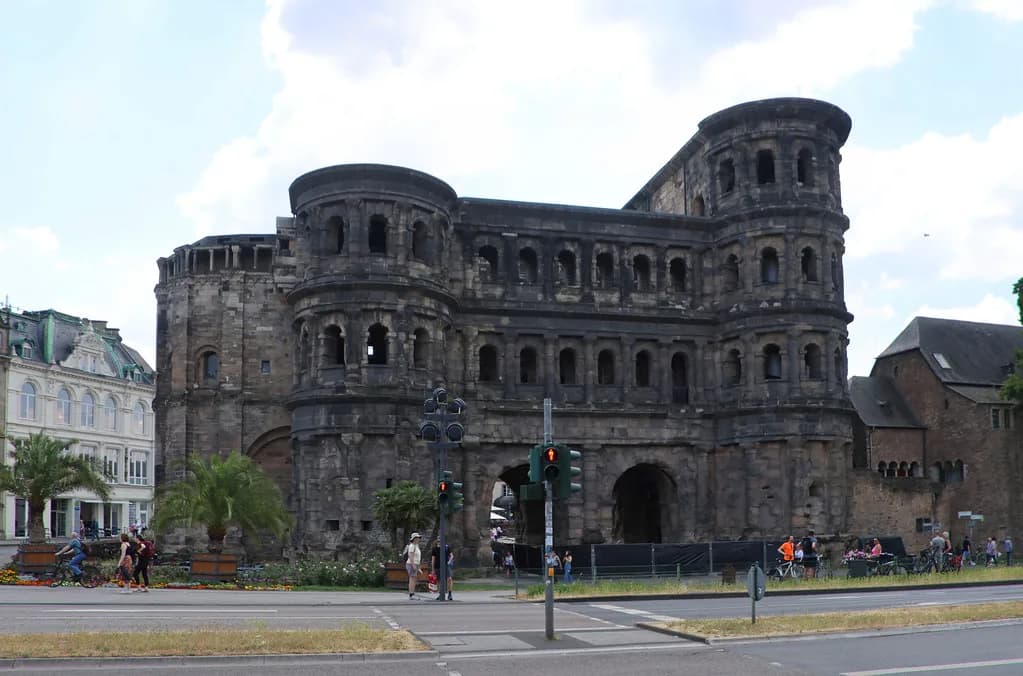
The Porta Nigra is the great blackened Roman city gate that has dominated Trier's northern approach for roughly eighteen and a half centuries, and it is the single structure most visitors associate with the city. The Roman builders laid its foundation stone around AD 170, according to the city's visitor information, and it has formed part of Trier's UNESCO World Heritage listing since 1986. This guide deals with one question: what you actually pay for, and what you can see for nothing.
The short answer is that the exterior is free. Anyone can walk around the gate, stand beneath its bulk and photograph it without buying anything. The gate passage, the interior courtyard and the upper galleries sit behind an admission ticket, so the decision is not whether to see the Porta Nigra but whether to go inside it. If you plan to enter, allow roughly 45 to 60 minutes as an unofficial suggestion; no official duration is published.
What the Porta Nigra Is and Why It Defines Trier
Roman builders laid the foundation stone around AD 170, when the gate was one of four in the city and one of many across the empire. Most of those gates are gone; this one survived because it was later absorbed into a church complex, which preserved the masonry that elsewhere was quarried away. That accident of history is why it is now described as the best preserved Roman city gate north of the Alps.
The name means simply 'Black Gate', a reference to the dark patina the sandstone has acquired, and it has been in use for at least nine hundred years. Locals call it the 'Pochta'. Its UNESCO status dates from 1986, and it anchors the wider Roman ensemble that makes Trier worth a dedicated stop rather than a quick detour.
Two architectural layers are visible once you are close: the monumental Roman blocks of the ancient gate, and the filigree Baroque reliefs added during its later life as a church. The contrast between the light-filled halls above and the dark rooms at ground level is part of what the monument is known for. You do not need to be a Roman history enthusiast to find that contrast striking, although it rewards anyone who lingers.
Free Exterior Versus Ticketed Interior
Everything visible from Simeonstraße and the surrounding streets is free. You can circle the gate, examine the stonework, and take the classic photograph from the pedestrian approach without spending anything. If your time in Trier is short or your budget is tight, this alone justifies the walk to the northern edge of the old town.
A ticket buys entry into a different experience: passing through the gate, standing in the interior courtyard and looking up at the scale of the structure, and climbing the upper galleries. The courtyard is the moment most visitors remember, because the height of the walls only registers when you are inside them. The paid interior is therefore about the physical experience of the building, not about seeing the facade.
It is worth being precise about what a standard ticket does not include. It does not cover the separate 'Secret of the Porta Nigra' guided tour, which has its own pricing and its own dates. Nor should you assume that a single ticket unlocks every museum in Trier; the monuments are managed and ticketed separately.
What a Ticket Includes: Gate, Courtyard and Upper Galleries
Admission covers the gate passage, the interior courtyard and the upper galleries, which are arranged over three levels. The sources describe the views by relative quality rather than promising a specific panorama: level 1 is rated around 60 percent for views of the old town, level 2 around 90 percent and level 3 around 100 percent. Treat those as the monument's own comparative guide rather than a guarantee of what you will see on a cloudy day.
Physical activity is rated at around 40 percent, which is a useful signal that the climb is real but not extreme. The galleries are reached by steps, and the ticket does not include lift access or step-free access to the upper levels. If stairs are a problem, plan on the courtyard and ground-level rooms rather than the upper galleries.
Whether climbing is worth it depends on what you want from the visit. If you are there for the building itself, the upper levels are the payoff, because they let you read the construction and look back over the old town. If you mainly want the photograph and the sense of scale, the courtyard may be enough.
Opening Hours by Season and Last Admission
Opening hours shift with the seasons, so check the day you plan to visit rather than relying on a general rule. The published pattern is daily opening, with March at 09:00 to 17:00, April to September at 09:00 to 18:00, October at 09:00 to 17:00, and November to February at 09:00 to 16:00. The last admission is 30 minutes before closing, which matters most in the short winter afternoons.
In practice, the 30-minute cut-off means you should aim to arrive well before the final half hour if you want to climb all three gallery levels. Turning up at 17:30 in October, for example, would already be too late. The official visitor information for Trier maintains the current listing, so confirm there before you travel.
2026 Admission Prices and Who Qualifies for Concessions
For 2026 the published admission is 6 EUR for adults and 5 EUR for concessions, with children and pupils aged 6 to 18 at 3 EUR and children up to age 6 free. Two family tickets are offered: one adult with up to four children at 6 EUR, and two adults with up to four children at 12 EUR. Groups of ten or more adults pay 5 EUR each, and groups of ten or more children or adolescents up to 18 pay 3 EUR each, with the group ticket purchased by one person such as a guide or supervisor.
Concession pricing is not automatic. It depends on presenting a certificate of entitlement, and the eligible categories include pupils over 18, students, trainees, people doing community service, seniors, the unemployed and people with disabilities. Bring the paperwork with you, because without it the full adult rate applies.
There is also a date-limited free window rather than a permanent rule. During the Rhineland-Palatinate summer vacation, from June 26 to August 9, 2026, children and teenagers under 18 have free admission, and the same window applies to the Rheinisches Landesmuseum and the Roman ruins. Outside those dates the normal child and youth rates apply.
The Zentrum der Antike is the body that coordinates the Roman monuments, including the Porta Nigra, and its pages carry the same admission information. If you are planning around a specific date, confirm the current figures there or at the Tourist-Information before you rely on them.
Scaffolding, Restoration and What Stays Open
Parts of the Porta Nigra are scaffolded while restoration work is underway. This affects the look of the exterior and can restrict some areas, but it does not close the monument: the gate remains open to visitors and can still be experienced up close during the work.
Do not assume that scaffolding means full access either. Restoration can change which sections are reachable on a given day, and the published pages do not promise step-free access to the upper galleries in any case. Check the current notice on the official visitor site shortly before your visit if access matters to you.
An Unofficial Suggestion for How Long to Allow
No official duration is published for a standard visit, so any figure here is a suggestion rather than a stated fact. As a rough planning guide, allow around 45 to 60 minutes if you intend to go through the gate, spend time in the courtyard and climb to the upper galleries. Add more if you like to read panels or photograph the stonework in detail.
If you are only viewing the exterior, the stop can be as brief as fifteen to twenty minutes, which makes it easy to fold into a wider walk through the old town. That flexibility is useful, because the gate sits at the northern end of the pedestrian centre and pairs naturally with other stops rather than demanding a half day of its own.
The Separate 'Secret of the Porta Nigra' Guided Tour
The 'Secret of the Porta Nigra' is an adventure tour led by a professional actor playing a Roman centurion, and it is not included in standard admission. It runs for about 60 minutes and is staged in German. The published dates are Saturdays at 13:00, with additional Tuesdays and Sundays at 13:00 from April to October, additional Saturdays at 15:00 from July to September, and additional Thursdays at 13:00 during Rhineland-Palatinate school holidays.
Pricing is separate: adults 19 EUR, concessions 17 EUR, children aged 6 to 14 at 10 EUR and a family rate of 48 EUR for two adults and up to four children aged 6 to 14. Holders of a Solidarkarte or Trier Card receive a further discount when buying at the Tourist Information office. Group size is capped at 45 people.
Access is limited. The tour is recommended for ages 10 and over, it covers areas that are difficult or impossible for people with limited mobility, and it takes place in cool rooms, so warm clothing is advisable. The meeting point is the Tourist Information next to the Porta Nigra, and tickets should be booked through the operator rather than assumed to be available on the day.
Combined Tickets: What the AntikenCard Trier Covers
The AntikenCard Trier is the combined option for visitors planning to see several Roman sites. It comes in four versions and offers admission to the Roman monument sites in Trier along with additional discounts around the city's ancient heritage. It does not cover every museum in Trier, so if your list includes non-Roman collections you will still need separate tickets for those.
Whether it pays off depends on how many Roman sites you intend to enter and how long you are staying. Compare the card's price for your party against the individual admissions you would otherwise buy, and check the versions carefully, because they differ in scope. The Zentrum der Antike is the place to confirm current inclusions and prices.
Getting There and Pairing the Gate With Roman Trier
The Porta Nigra stands on Simeonstraße at the northern edge of the pedestrian old town, close to the Tourist Information office. The official pages include a route planner and parking information, but you should check those directly for current arrangements rather than relying on secondhand descriptions of where to leave a car.
Arriving by train puts you within a manageable walk of the gate, so it is worth understanding the station layout before you set off. Pairing the gate with the cathedral and the Hauptmarkt makes a coherent half day on foot, since all three sit within the same compact centre.
For those following the Roman thread, the Barbara Baths and the Hauptmarkt area both sit naturally alongside the gate in a single day's walking route. Building the day around the monument rather than around transport keeps the distances short and the choices simple.
Plan Your Visit
The Porta Nigra is unusual among major landmarks in that its most famous view costs nothing. Decide first whether you want the interior and the climb, then buy accordingly, and treat the standard admission and the centurion tour as two separate purchases with separate prices and dates.
Before you go, confirm the current opening hours, admission and scaffolding status on the official Trier visitor pages, since these change with the season and with the restoration programme. Bring entitlement certificates if you intend to claim a concession, and book the guided tour in advance if you want it, because it does not run daily year-round. For related planning, see Kaiserthermen & Konstantinbasilika Trier: Tickets Explained.
Frequently Asked Questions
Can you go inside the Porta Nigra?
Yes. The gate passage, interior courtyard and upper galleries are open to visitors during published opening hours, with last admission 30 minutes before closing. Parts of the monument are scaffolded during restoration work, but it remains open, and the ticket does not include lift or step-free access to the upper galleries.
Do you need a ticket to see the Porta Nigra?
No ticket is needed to see the exterior from the surrounding streets, which is free. A ticket is required to enter the gate passage, stand in the interior courtyard and climb the upper galleries. If you only want the classic view of the facade, you can visit without paying.
Are children free at the Porta Nigra?
Not always. Children up to age 6 are free, and children and pupils aged 6 to 18 pay a reduced rate. There is also a date-limited free window for under-18s during the Rhineland-Palatinate summer vacation, from June 26 to August 9, 2026. Outside that window, the normal child rate applies.
How long do you need at the Porta Nigra?
No official duration is published, so treat any figure as a suggestion. Around 45 to 60 minutes is a reasonable allowance if you intend to enter the gate, spend time in the courtyard and climb to the upper galleries. Viewing the exterior alone takes considerably less, roughly fifteen to twenty minutes.
Is climbing the Porta Nigra worth it?
It depends on your interest in the building. The upper galleries are where the construction and the scale of the monument become legible, and the view quality improves from level 1 to level 3. If you mainly want the photograph and the sense of scale, the courtyard may be sufficient, especially if stairs are difficult for you.
Does the AntikenCard Trier include the Porta Nigra?
The AntikenCard Trier offers admission to the Roman monument sites in Trier in addition to discounts around the city, and it comes in four versions. It does not cover every museum in the city, so check the current inclusions for your party before buying. The Zentrum der Antike publishes the details.