

The Elisenbrunnen is one of those Aachen sights that rewards the right expectations and disappoints the wrong ones. It is a neoclassical pavilion on Friedrich-Wilhelm-Platz built around the city's thermal springs, not a spa complex and not a museum with galleries to work through. The regional tourism portal is blunt about why it still matters: people continue to fill thermal mineral water there daily for personal use.
That single fact should shape your visit. You are going to a working spring that happens to be dressed in nineteenth-century architecture, so the interesting part is watching an ordinary local habit happen in a handsome setting. Treat it as a short, free stop folded into a walk through the old town rather than a destination that eats an afternoon.
What the Elisenbrunnen Actually Is
The structure is a neoclassical pavilion rather than a bathhouse or exhibition venue, and it sits at Friedrich-Wilhelm-Platz in the historic centre. It was built to frame and shelter Aachen's thermal springs, which is why the architecture has that formal, colonnaded look instead of anything industrial. The city's own official site is the safest place to confirm the current framing of the site before you travel.
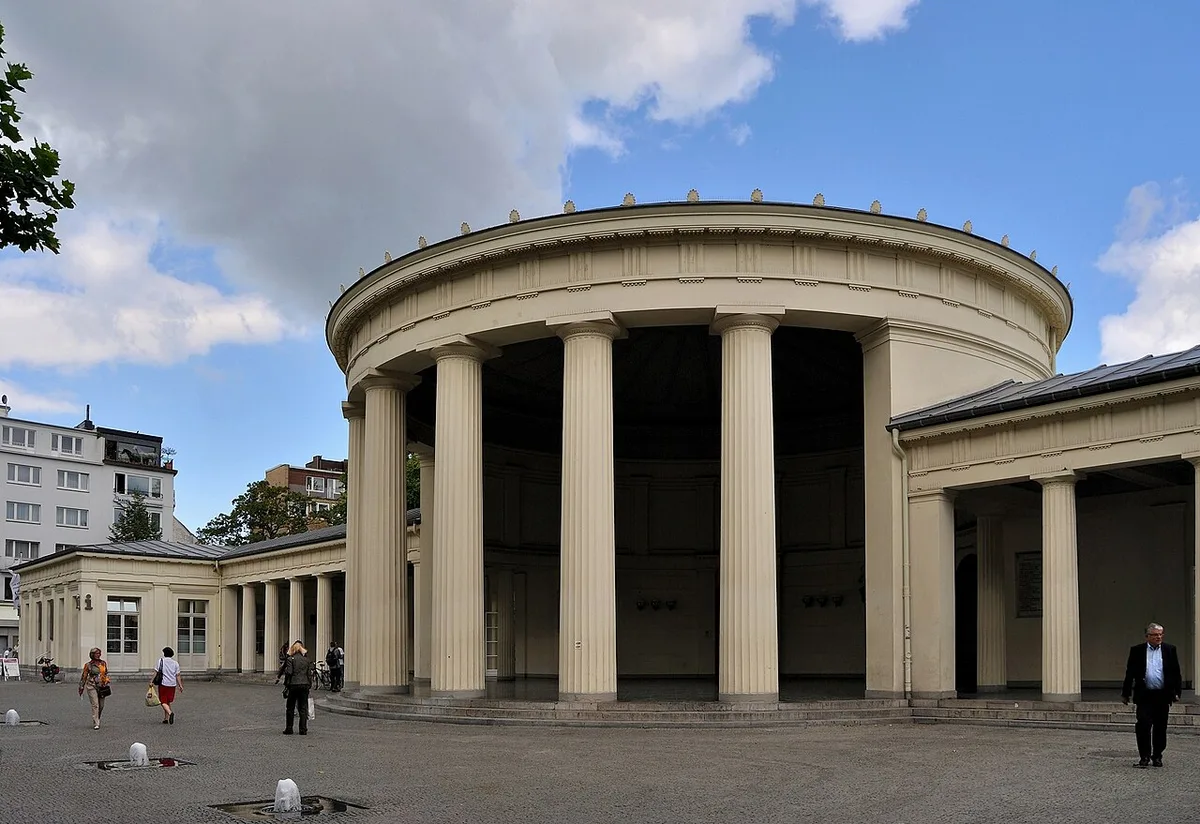
Nothing here operates as a ticketed attraction, so there is no box office, no queue for entry and no tour to book. The regional listing describes the tourist information office as sitting directly beside the historic Elisenbrunnen, in representative rooms appropriate to the setting. That adjacency is the practical heart of a visit: one half is a monument, the other half is a service point with staff and published hours.
It helps to place the pavilion in Aachen's wider story. The city's reputation rests on its hot springs, and the thermal tradition is the reason the site exists at all. If you want the broader context of the city before you arrive, the Aachen: Landmark Visitor Guides collection is a sensible starting point for orientation.
Free to Approach, Nothing to Book
There is no admission to pay at the Elisenbrunnen and no ticket, tour or reservation associated with it, so any page selling you an Elisenbrunnen ticket is selling you something else. The pavilion works as a public structure you walk up to, look at and move past. If you want a free-heavy day in the city, free things to do in Aachen is the useful companion list.
The trap in Aachen is mental bundling. Aachen Cathedral is free to enter as a place of worship, but the treasury charges separately, and attractions such as the Couven Museum and the Suermondt-Ludwig-Museum each run their own admission. A free stop at the pavilion should never be folded into an imagined single sights ticket. Check each operator's own site for current prices and hours rather than assuming one pass covers the city.
The Thermal Water in Practice
The one behaviour worth knowing before you arrive is that the spring is in active use. The StädteRegion Aachen tourism portal states plainly that many people still fill their thermal mineral water there each day for personal use. You are not visiting a dry relic; you are visiting infrastructure that residents treat as part of daily life.
What that water is composed of, how warm it is, what it contains and whether it is intended for drinking are not things this guide will guess at. Those are health-adjacent questions with real consequences, and the answers belong to the city, the spring operator or a medical professional rather than a travel page. If you need certainty on water quality or consumption, ask at the tourist information desk and treat anything you read elsewhere as unverified.
Practical etiquette follows from all of this. Keep the fill points clear while someone is drawing water, do not treat a working spring as a prop for a long photo session, and step aside rather than standing in the flow of foot traffic. The respectful move is the same one you would make at any local utility that happens to be beautiful.
How Long to Allow
Our suggestion, and explicitly not an official figure, is to budget roughly fifteen to thirty minutes at the pavilion itself. That is enough time to see the structure from a few angles, watch the fill points in use if anything is happening, and read whatever interpretation is posted on site. There is no published recommended visiting time for the Elisenbrunnen because there is no operator running a timed experience.
If you add the tourist information office next door, allow a further fifteen to twenty minutes for maps, questions and a look at the souvenirs. That turns the stop into a comfortable forty-five minutes without any sense of hurry. Anyone planning a full Aachen itinerary can calibrate the rest of the day against Aachen: Itineraries and City Travel Guides rather than guessing at timings.
The honest answer to how long you need is that it depends entirely on whether the fountain area is busy and whether you have questions for the staff. A quiet weekday morning is a ten-minute look; a busy Saturday with a full tourist office can stretch past half an hour. Neither version justifies building a day around the pavilion alone.
The Tourist Info Elisenbrunnen Next Door
The tourist information office occupies the left wing of the Elisenbrunnen and reopened in a redesigned form in June 2021, with a modern café alongside it. It is the part of the site with a real service function: information on the city, souvenirs, and staff who can answer questions about sights and walking routes.
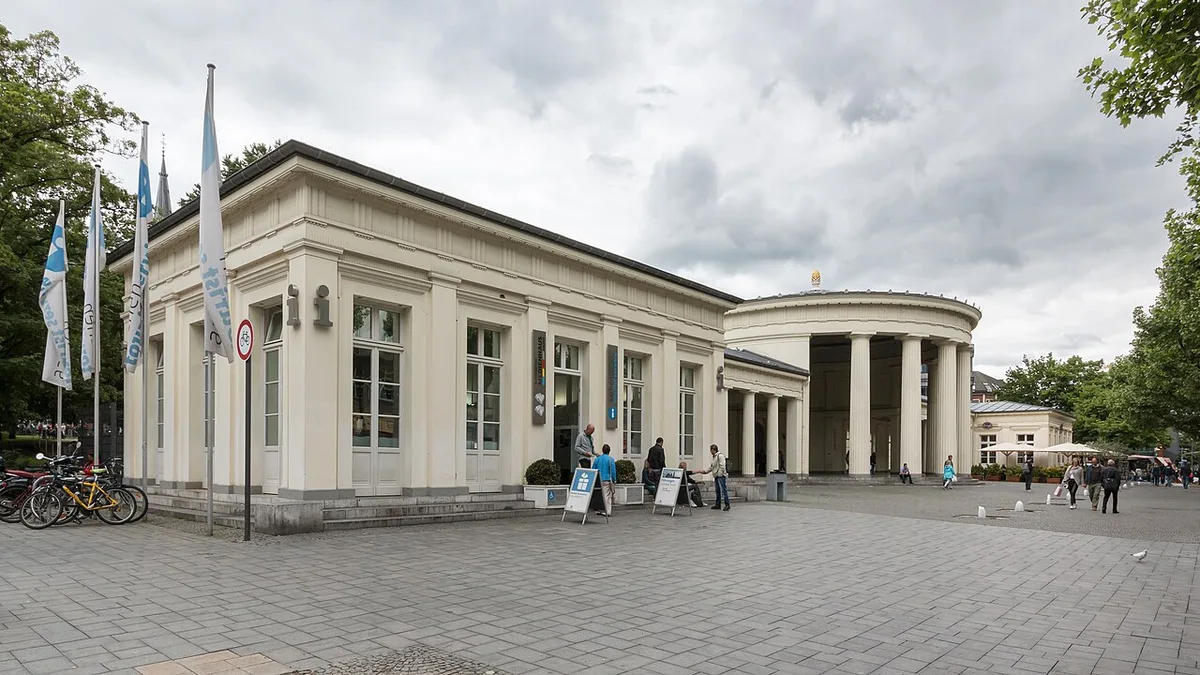
Its opening hours are the only hours worth quoting for the site, and they are a published schedule rather than a live check. The StädteRegion listing shows the office open Monday to Friday from 10:00 to 18:00 and Saturday from 10:00 to 14:00, under a stated validity window running from 1 January 2024 to 1 January 2039. Read that as an operator-published timetable that can change, not as a guarantee for the day you arrive.
Confirmation is worth thirty seconds of effort because published timetables drift. The destination listing for the same office carries its own set of hours, including holiday variations and closures on 25 and 26 December and on New Year's Day. If your visit falls near a public holiday, call ahead or check the operator's own site rather than relying on any single page.
Getting Your Bearings on Friedrich-Wilhelm-Platz
Friedrich-Wilhelm-Platz works best as a waypoint rather than a terminus. The tourist office sits at Friedrich-Wilhelm-Platz 13b in the 52062 postcode, and the square links naturally toward the old town, the cathedral quarter and the adjoining Elisengarten. Walking between these points is the normal way to see central Aachen; treat the square as the hinge of that walk.
Because the pavilion is on a public square, there is no gate to pass through and no arrival window to plan around. That flexibility is genuinely useful on a day when a church visit runs long or a museum closes early. Build the Elisenbrunnen into the route between other stops and it costs you almost nothing in time.
If your priority is the city's green and outdoor side, keep the pavilion on the short-stop list and put the heavier walking elsewhere. Aachen rewards that split, and the broader Aachen guide collection helps you decide which outdoor pieces earn a slot in a short trip.
Pairing It With the Rest of the City
The most natural pairing is the cathedral quarter a few minutes away. The cathedral is free to enter, but the royal throne and the choir are only accessible on a guided tour, and the treasury is a separate paid visit with its own opening hours. Treat the cathedral and treasury as two decisions, not one, and confirm both on the operator's site before you go.
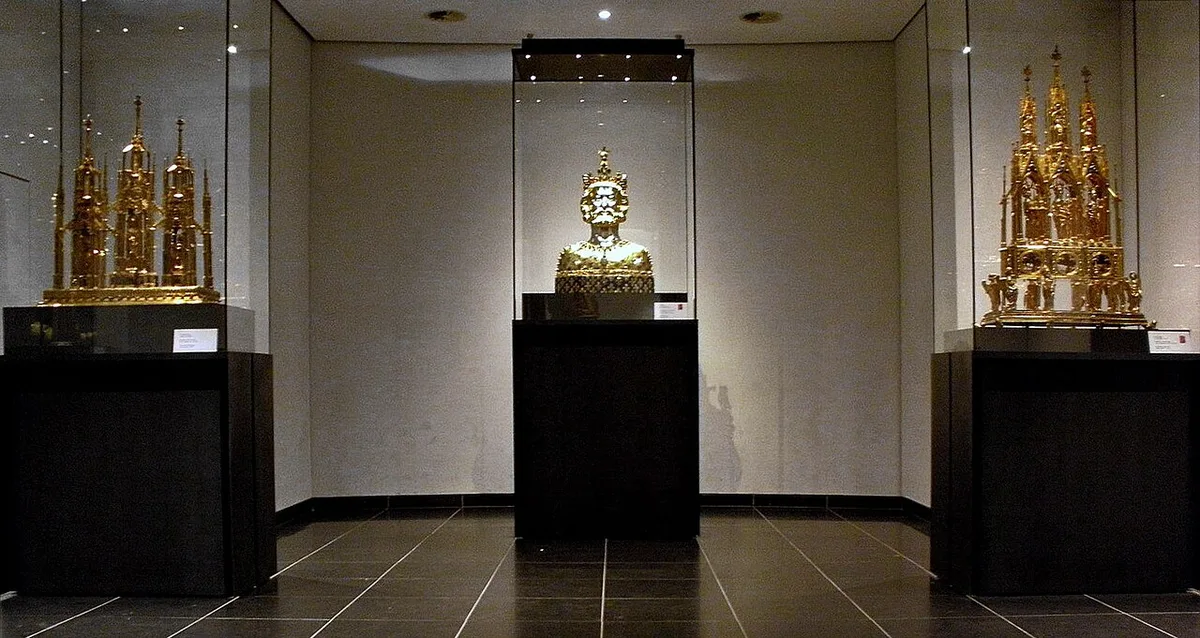
Because the treasury holds its own ticket and its own schedule, it is worth deciding in advance whether you want it. The Aachen Cathedral Treasury visitor guide helps you weigh that against the rest of your day so you do not arrive at the desk undecided.
For a different register entirely, the Couven Museum presents eighteenth and nineteenth century domestic interiors in a house at Hühnermarkt, with its own admission and its own opening pattern. The Suermondt-Ludwig-Museum takes the other end of the timeline, with collections reaching from the medieval to the contemporary in a nineteenth-century city palace on Wilhelmstrasse. Both are separate visits with separate tickets, so check each museum's own site for current hours and prices.
Thermal Bathing Today Is Somewhere Else
One confusion is worth clearing up before you pack a towel. The Elisenbrunnen is not a place to bathe, and Aachen's contemporary bathing tradition continues at a separate facility, the Carolus Thermen, on the other side of the centre. These are two distinct experiences with two distinct price structures, and neither substitutes for the other.
That distinction matters for planning. If you came for wellness, book and budget for the thermal baths rather than expecting the pavilion to deliver it. If you came for the city's history, the pavilion is the correct stop and the baths are optional, so decide which trip you are actually taking before you allocate time.
A Short Walk, Not a Half Day
The most common planning mistake is treating the Elisenbrunnen as a headline attraction that consumes a morning. It is a small structure on a city square, and its value comes from context rather than scale. Slot it between two larger stops and it improves the day; make it the day's centrepiece and you will be standing on a square wondering what to do next.
A sensible shape is to arrive in the old town, walk the cathedral quarter, pass through Friedrich-Wilhelm-Platz for the pavilion, and use the tourist office as your information stop before continuing. That sequence uses the square exactly as it functions best, as a hinge between the monumental and the everyday. Anyone who wants a longer urban route can compare the city's itinerary options before committing to a shape.
Etiquette at a Working Spring
Because the water is drawn for personal use, the people at the fill points are not part of the exhibit. Give them room, wait your turn if you are curious, and avoid positioning yourself between someone and their container. This is the difference between watching a city work and getting in its way.
Photography in the open square raises no particular issue, but scale your session to the setting. A few frames of the pavilion and the square is proportionate; a twenty-minute styling exercise in front of someone waiting with a bottle is not. The same courtesy applies to the café and the tourist office interior, where other people are trying to get help.
Plan Your Visit
The Elisenbrunnen is worth a deliberate fifteen to thirty minutes on your way through central Aachen, and it is worth far less if you approach it expecting a spa or a museum. Go for the architecture, stay for the working spring, and use the tourist information office next door for anything you need to confirm on the day.
If it turns out to be the only reason you came to Aachen, extend the trip rather than the stop. The cathedral and treasury, the city's museums and the thermal baths each offer a full half day, and the pavilion is the perfect introduction to those rather than a replacement for them. Check each operator's own site before you travel, because that is where current hours, prices and closures actually live.
Frequently Asked Questions
Is the Elisenbrunnen free to visit?
Yes. The pavilion stands on a public square and there is no admission charge, no ticket and no tour to book. Any page selling an Elisenbrunnen ticket is selling something else entirely. You can walk up to it at any time, look around and continue into the old town.
Can you drink the thermal water at the Elisenbrunnen?
The regional tourism listing notes that many people still fill thermal mineral water there daily for personal use, which describes a local habit rather than an official instruction. This guide does not assess water composition, temperature, safety or suitability for drinking. If you want to know whether the water is intended for consumption and whether containers are permitted, ask at the tourist information office beside the pavilion and follow what the city publishes.
Are there opening hours for the Elisenbrunnen fountain?
No opening or closing times are published for the spring or the pavilion itself, because it is a public structure rather than a ticketed attraction with a gate. What does have published hours is the tourist information office in the wing beside it, and those hours appear on the operator's own listings with a stated validity period. Treat that timetable as a published schedule rather than a live confirmation and check before travelling.
How long do you need at the Elisenbrunnen?
Our suggestion, and not an official figure, is roughly fifteen to thirty minutes for the pavilion itself, plus another fifteen to twenty minutes if you also use the tourist information office. There is no published recommended visiting time and no timed entry, so the real variable is how busy the square is and whether you have questions for staff. A quiet weekday look can be over in ten minutes.
Is the Elisenbrunnen the same as the Aachen thermal baths?
No. The Elisenbrunnen is a neoclassical pavilion around the city's springs and is not a bathing facility. Contemporary thermal bathing in Aachen happens at a separate paid venue, the Carolus Thermen, which has its own admission and its own opening arrangements. Visiting one does not give you access to the other.
What is near the Elisenbrunnen in Aachen?
The pavilion sits on Friedrich-Wilhelm-Platz, a short walk from the cathedral quarter and the old town, with the Elisengarten adjoining the square. The tourist information office occupies the building's wing, which makes the square a practical information stop. Aachen Cathedral, the cathedral treasury, the Couven Museum and the Suermondt-Ludwig-Museum are all separate visits with their own tickets and hours worth checking with each operator.


