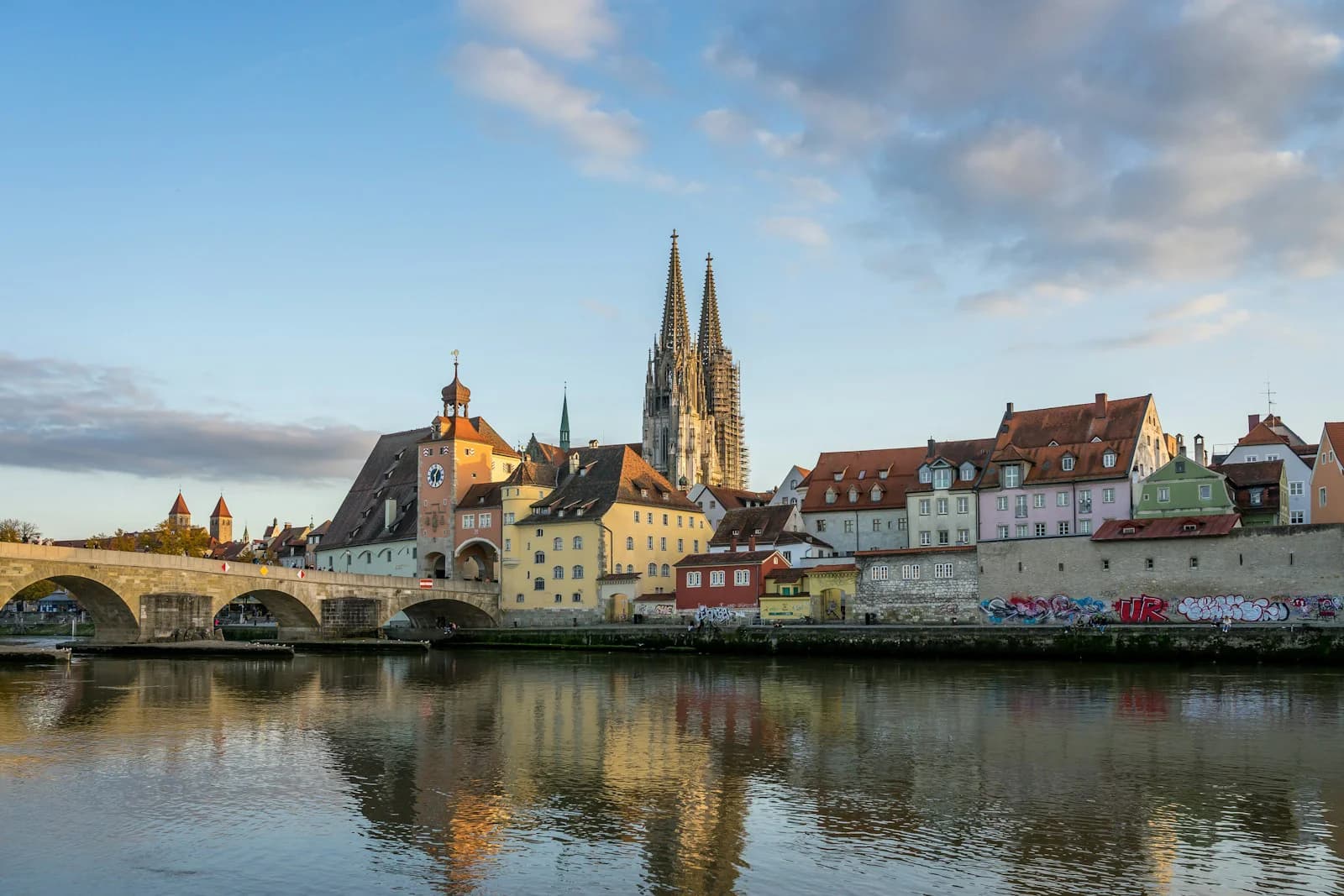
Regensburg rewards a walker who plans around one meal rather than a full itinerary. The city's tourist board states that Regensburg holds two World Heritage titles: the Old Town and Stadtamhof, inscribed in 2006, and the Danube Limes, added in 2021. The medieval street fabric, the Stone Bridge and the Danube make the setting itself part of the lunch. A food-focused walk here works best when one address anchors the day and the rest is left loose.
The anchor address most travellers look for is the Historic Sausage Kitchen, known locally as the Historische Wurstkuchl, at Thundorferstraße 3 near the Stone Bridge. One detailed visitor account describes a modest building with a takeaway kitchen, riverside picnic tables and a separate indoor space, so the experience changes depending on where you sit. Exact hours and current menu prices are not fixed in any reliable public snapshot, so they belong on a checklist to verify with the tourist board before you walk.
This guide is a decision aid, not an official tour: it separates the counter from the indoor tables, explains payment habits and bread-basket charges, and offers an editorially suggested duration for a leisurely route. It also flags what to sort out in advance and what to leave to luck.
Why Regensburg's food story suits a walk
Regensburg is described by the city's own tourist board as Germany's best-preserved medieval city, and the combination of a double World Heritage listing, the Danube and the Stone Bridge creates a setting where wandering between stops is the point. The official tourism site lists the Old Town and Stadtamhof, the Stone Bridge, the Altes Rathaus and the lanes of Wahlenstraße and Bachgasse among its highlights. That density is what makes a food walk practical: distances between the mood of one street and the next are short enough to taste your way through rather than tick off a list.
A food walk here works differently from a monument trail. The Old Town and Stadtamhof were inscribed as UNESCO World Heritage, with the Danube Limes added as a second title, so the streetscape itself is a draw. Set a loose route and let a bakery or a market stall interrupt it rather than scheduling every bite.
The Historic Sausage Kitchen explained
The Historische Wurstkuchl on Thundorferstraße is the address most travellers mean when they talk about Regensburg sausages. One detailed visitor account describes the building as having been constructed in 1135 as the construction office for the Stone Bridge, then serving dockworkers and sailors with boiled meat after the bridge was completed in 1146, before the current family took over in 1806 and began grilling sausages. Those dates and origins come from a single blog account rather than a formal history, so treat them as commonly told rather than independently confirmed.
You will also see the claim that it is the world's oldest continuously operating restaurant. The blog presents it as regarded rather than proven, and the phrasing matters when you repeat it to the person next to you. The building is small, low and close to the river, which is why the riverside benches exist in the first place.
Counter, benches or indoor Schenke
The original building houses only the takeaway kitchen, which offers a basic menu of grilled sausages with mustard and sauerkraut, according to the visitor account. Between the building and the river are a few picnic tables, which the same account describes as ideal on a warm day. That is your first real choice: eat standing or on a bench by the water, or move to a table indoors.
Over the years the operators have taken over two nearby buildings, each with a few tables and a slightly larger menu of regional dishes, so the indoor space called the Schenke is a different proposition from the counter. Indoor seating is limited, and the same visitor account notes that recent reviews frequently mention a hurried pace and diners being encouraged to leave to free up tables. If a slow, unhurried meal matters more to you than standing where the locals queue, choose your seating accordingly and plan to arrive outside peak moments.
If the counter is packed, that is not a reason to abandon the walk. The Regensburg Old Town walking tour shows how much of the surrounding fabric you can cover while you wait for a bench to free up.
What to order, and what to check first
The signatures are the six-piece grilled pork sausages with sauerkraut, described by the same visitor account as having a good snap, and a sweet mustard served from the counter and placed on the tables. That mustard is a matter of taste; it is designed to go with the sausage and a pretzel rather than with everything else. Sauerkraut, sausages and mustard are produced in-house according to that account.
The Weisswurst is the decision most people get wrong. The visitor account notes it is a pork-and-veal blend, which mattered to two of the diners who avoid veal on principle. If that applies to you, ask before ordering rather than after, and check the current menu at the venue because recipes and line-ups are not fixed forever.
Money, manners and the bread basket
Two practical rules do most of the damage to unprepared visitors. The venue is cash only according to the visitor account, and a basket of bread placed on the table is charged by the piece rather than being free. The same account states that the writers did not record prices, and that recent reviews they had seen mentioned significant increases, so a current figure is not something to rely on from any blog snapshot.
The safe planning move is to carry cash in small notes for the whole walk rather than assuming every Old Town stop takes a card; payment habits across Regensburg's food venues are not uniformly documented, and it is unreasonable to assume they are. Confirm the bread-basket charge and payment method when you order rather than at the end.
Building the walk around the Old Town
A sensible shape is to start in the heart of the Old Town, work towards the river through the lanes around Wahlenstraße and Bachgasse that the tourism site names as highlights, cross to the Stone Bridge area for the sausage stop, and finish either back at a market square or along the river. The official Regensburg tourism site can be used to confirm the current state of the sights you plan to pass, including the cathedral and the Altes Rathaus. Keep the sausage stop in the middle rather than at the end, so the walk does not become one long wait.
This kind of route also leaves room for the details that do not appear on a highlights list. Marking a few hidden gems in Regensburg before you leave gives you somewhere to drift if a venue is closed or too busy.
Specialties to look for beyond the sausage
The sausage kitchen is a starting point, not the whole cuisine. The city tourism board maintains a dedicated gastronomy section covering Regensburg's restaurants and food culture, which is the better source than a blog post for what is currently open nearby. Use it to identify a bakery, a brewery or a market stall for a second, smaller stop.
Portion discipline is the difference between a food walk and a single long lunch. Ordering a pretzel or a small plate at one stop rather than a full main at each leaves room to try something at the Christmas Market or a second venue. The walk is more enjoyable when the sausage course is one chapter instead of the whole book.
Timing, season and crowd behaviour
Weekday and weekend visits feel different, and the Christmas Market overlap is the biggest seasonal swing, since the sausage kitchen has appeared at the market with sausages and jars of mustard according to the visitor account. The same account describes the indoor space as the choice for staying warm and dry. If your visit falls in cold or wet weather, decide in advance whether you are willing to queue for an indoor table.
Rain, cold and limited indoor seating push people towards the same tables at the same time, so plan the sausage stop for the shoulder of the lunch period rather than the peak. Winter also shortens the daylight available for the walking sections, which matters more than the food timing.
How long to allow, and how to prepare
As a suggestion rather than an official figure, allow roughly two to three hours for a leisurely version including one seated stop, or about ninety minutes if you take the counter option and walk briskly. No official distance or duration exists for this route; the numbers here are editorial framing for planning. Compare that with a full one day in Regensburg itinerary and you can see how a food walk slots into a broader visit.
Before you go, check current opening hours and menu details with the Tourist Information at Rathausplatz, which publishes contact details and service times on the city tourism site, and treat those as details to re-verify rather than guarantees. Build a fallback into the plan: if the counter queue is long, walk the bridge and the riverbank first and return later.
Fitting the walk into a longer Regensburg stay
If you have more than a single day, the food walk becomes one thread in a larger plan rather than the whole visit. The 2 days in Regensburg itinerary treats the Old Town as a two-day proposition, which makes it easier to separate eating from sightseeing instead of doing both badly in one afternoon.
Treat the walk as flexible. The city's own list of highlights is long enough that a food stop can sit between the cathedral, the Rathaus and the river without a rigid timetable. The Regensburg city guide is the place to cross-check the surrounding itinerary.
Plan Your Visit
Regensburg's historic sausage stop works best as one planned moment inside a loose Old Town walk, not as the entire reason for the day. Decide between the takeaway counter, the riverside benches and the indoor Schenke before you arrive, carry cash, and ask about the bread basket and the Weisswurst blend when you order. Everything else can be improvised.
Verify current hours, menu and payment details with the Tourist Information at Rathausplatz shortly before you travel, since published details can change and no fixed opening times or prices can be assumed. If the counter is busy, walk first and eat later. The Regensburg city guide is the place to cross-check the surrounding itinerary.
Frequently Asked Questions
Is the Historic Sausage Kitchen in Regensburg the oldest restaurant in the world?
It is often described that way, and one visitor account presents it as regarded as the world's oldest continuously operating restaurant rather than stating it as proven. The same account traces the building to 1135 and a handover to the current family line in 1806, but those dates come from a single blog rather than an official history. Repeat the claim with qualification, and treat the founding details as commonly told rather than confirmed.
What should I order at the Regensburg sausage kitchen?
The six-piece grilled pork sausages with sauerkraut are the classic order, served with a sweet mustard that appears both at the counter and on the tables. A pretzel works well alongside. The Weisswurst is a pork-and-veal blend, so anyone avoiding veal should ask before ordering rather than discovering it at the table.
Can I pay by card at the Historic Sausage Kitchen?
The venue is described as cash only, so bring small notes rather than relying on a card. Do not assume the same applies at every other food stop in the Old Town, since payment habits vary between venues and no citywide rule is documented. Confirm with each place as you go.
Is there seating inside the sausage kitchen?
The original building houses only the takeaway kitchen, with a few picnic tables between it and the river. The operators later took over two nearby buildings with a small number of tables and a larger regional menu, which is the indoor option. Indoor seating is limited and recent reviews have mentioned a hurried pace, so decide whether you want speed or comfort before you arrive.
How long does a self-guided Old Town food walk in Regensburg take?
Allow roughly two to three hours for a leisurely version with one seated stop, or about ninety minutes for a brisk counter-based walk. These are editorial suggestions, not an official route duration or distance, since no such figure is published. Build in extra time if you plan to eat indoors at a busy period.
What else is Regensburg known for besides sausages?
The city holds two UNESCO World Heritage titles, covering the Old Town and Stadtamhof as well as the Danube Limes, and its tourism board highlights the cathedral, the Stone Bridge, the Altes Rathaus and the medieval lanes of Wahlenstraße and Bachgasse. The food walk sits easily alongside those sights because they are close together. Check the city tourism site for current visitor details before you plan the day.
Do I need to book the sausage kitchen in advance?
There is no reliable published information about reservations or booking availability, so do not plan around being able to reserve. The practical approach is to arrive outside peak lunch times and accept that indoor tables are limited. If the queue is long, walk the bridge and riverbank first and return later.