Regensburg rewards a slower trip than its size suggests. The city's tourism board describes it as Germany's best-preserved medieval big city, with two World Heritage titles: the Old Town and Stadtamhof listed in 2006, and the Danube Limes added in 2021. Those designations are history, not current events, but they explain why the centre is dense with original buildings rather than rebuilt set pieces.
For a two-day visit, treat each half-day as one anchor sight with room around it. A suggested shape is day one in the Old Town and along the river, and day two either for a single museum explored in depth or for a half-day out toward the Danube. That is a planning suggestion, not an official schedule, and it is deliberately lighter than a checklist.
Before committing to indoor visits or an excursion, stop at the Tourist Information point at Rathausplatz 4, which the city lists as its main walk-in office. Staff there can confirm what is currently open and how any single ticket is scoped. Opening hours and admission prices change, so verify them directly rather than relying on older guides.
Why Two Days Fits Regensburg
The historic core is compact enough that you can cover the headline sights on foot without needing public transport for the centre itself. Distances between the cathedral, the Stone Bridge and the old town squares are short, though the cobbles and crowds make progress slower than a map suggests; treat any walking time you read elsewhere as a rough guide only.
Travellers consistently describe Regensburg as walkable and slow-paced, which is exactly why two days works better than one. The Adventure Therapist's account of a day here notes cobbled streets, riverside beer gardens and the ease of wandering without a fixed plan. Use that as one visitor's impression rather than an official rating.
If you only have a single day, you can still see the cathedral, the bridge and the riverbank, and a one day in Regensburg itinerary covers that ground well. Two days simply buys you the museum half-day or the river excursion that a rushed visit forces you to drop. Three days, by contrast, opens up a proper excursion plus unhurried time in Stadtamhof.
Day 1 Morning: Cathedral and the Lanes
Start at St. Peter's Cathedral, which the city tourism board lists among its sixteen highlights as the cathedral of light. Its stained glass and the scale of the interior are the draw, and the surrounding lanes of Wahlenstrasse and Bachgasse are themselves listed as a highlight worth strolling. Allow more time than you think for these streets; they reward turning off the main route.
A Regensburg Old Town walking tour route is useful here because the lanes are not laid out on a grid and signage is understated. If you prefer to self-guide, pick two or three landmarks as fixed points and let the streets between them happen. Either way, check current opening arrangements for the cathedral before you build your morning around it.
Before you commit to any indoor visit, drop into the Tourist Information office at Rathausplatz 4. The city publishes its opening days and hours there, but these are seasonal and shift around public holidays, so confirm the day you plan to visit. It is also the sensible place to ask whether a single admission covers one collection or an entire complex.
Day 1 Afternoon: Stone Bridge and the Riverfront
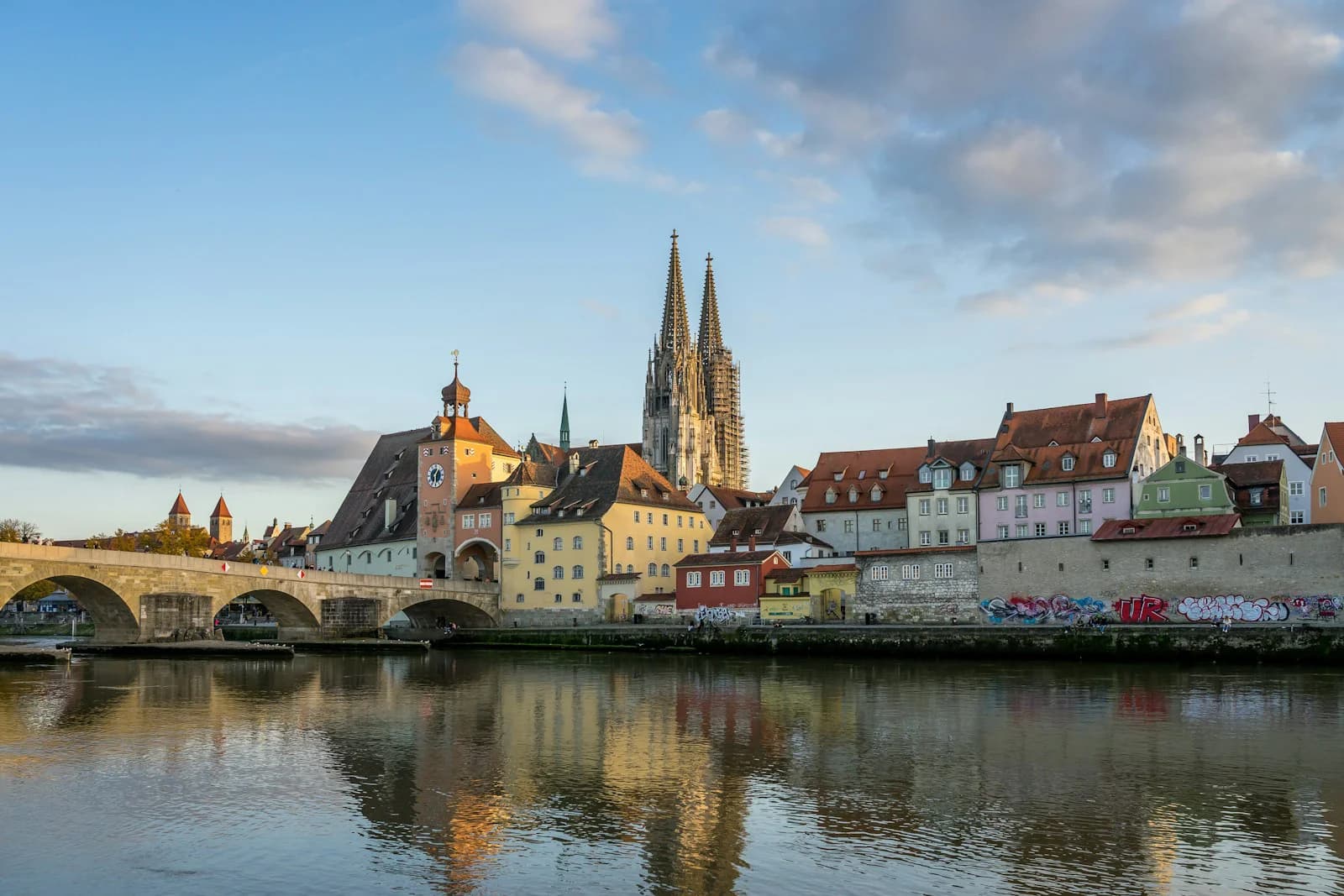
The Stone Bridge, called a wonder of the Middle Ages by the city's own tourism listing, is the natural pivot from the Old Town to the water. Cross it on foot to reach the Stadtamhof side, which the tourism board describes as a small microcosm of its own. From the bridge you get the classic view back across the riverfront facades.
The riverbank here is the northernmost point of the Danube, another entry on the city's own highlights list. Sitting on the wall or wandering the path costs nothing; only the interiors and the vessels require spending. Photographers should walk both banks, because the light changes completely between morning and late afternoon.
Self-service beer gardens along the water are the standard afternoon stop. One traveller's etiquette notes are worth heeding: a table signed Stammtisch belongs to regulars, and in self-service areas you are expected to return your own glasses and dishes to the collection stations. These are courtesies, not enforced rules, but they are what locals notice.
Day 1 Evening: Altes Rathaus and the Squares
The Altes Rathaus, home to the perpetual imperial diet, anchors the eastern old town and is best appreciated on an unhurried evening walk. Nearby squares such as Haidplatz and Neupfarrplatz are listed among the city's highlights, and they change character after the day trippers leave. This is the point in the trip to stop adding sights.
Adding a second museum on day one usually costs you the evening, which is a poor trade in a city built for strolling. The lanes around Wahlenstrasse and Bachgasse are quieter at night and the riverfront glows. Save your interior visits for day two when you have the energy to do one properly.
Day 2 Option A: One Museum, Done Properly
Regensburg's museum landscape splits roughly into city history, religious art and heritage interpretation. The Haus der Bayerischen Geschichte addresses Bavarian history on a large scale, while the Besucherzentrum Welterbe covers two thousand years of city history and the World Heritage story. Both appear on the city's own highlight list, so neither is a filler option.
The critical caution is scope: do not assume a complex shares one admission across all its collections. Some sites combine several displays under separate ticketing, and the only reliable answer comes from the ticket desk or the operator's current information. Confirm what a ticket actually includes before you pay for it.
If a second day of interiors feels heavy, swap this block for outdoor time. The city's landmark guides cover the major sites individually, which makes it easier to pick one and skip the rest without guilt. A slower morning often beats a packed one in a town this dense.
Day 2 Option B: A Danube-Side Half-Day
Instead of more interiors, give day two to the river. Walk the Stadtamhof bank, find a bench or a beer garden, and let the half-day pass without a fixed route. The Danube and its northernmost point are the reason the city exists, and the riverside needs no ticket.
River cruises and boat services do run from Regensburg, and the city is a noted stop for them, but schedules change by season and operator. Check the current timetable and departure point directly rather than assuming a daily service. Do not build a tight itinerary around a boat you have not confirmed.
Day 2 Option C: An Excursion Outside the City
An excursion day works if you treat it as a block of time rather than a to-do list. Regensburg's rail position makes it a practical base for day trips, and third-party tour listings for Germany departures from the city exist for planning context. Verify any operator's current programme and departure details yourself before booking.
The Walhalla memorial is the excursion most often associated with Regensburg, but transport arrangements, opening times and access details should be confirmed with the operator or the site itself. Do not rely on old posts or memory. If you cannot confirm the logistics, keep the day in the city instead; Regensburg has enough for two full days on its own.
Museums in Regensburg: How to Choose
Pick by interest rather than by proximity. City history suits travellers who want the imperial diet and the trading-city story; religious art suits those drawn to the cathedral and the medieval churches; the heritage centre suits anyone who wants the World Heritage designation explained. One museum per day is a reasonable pace.
Treat each admission as its own transaction. The city's own listings treat the Haus der Bayerischen Geschichte and the Besucherzentrum Welterbe as separate highlights, and combined or shared ticketing cannot be assumed. Ask at the desk whether your ticket covers one building, one exhibition or a group of sites.
Museum opening days vary, and one traveller's planning notes warn specifically that Sundays close many places in Germany. Check each venue's current published days before you plan around it, because a closed museum can reshuffle an entire half-day. A quick check the evening before saves a wasted morning.
Free Versus Paid in Regensburg
The riverfront, the Stone Bridge, the lanes, the squares and the exterior of the cathedral cost nothing to enjoy. Stadtamhof, the Ostentor gate and the Schottenportal are listed among the city's highlights and can be seen from the street. A generous two days is possible with very little spent on admissions.
Interiors, tower climbs and exhibitions require tickets, and the Dreieinigkeitskirche tower climb is explicitly one of the city's listed highlights rather than a free viewpoint. Confirm current access and any charge at the site, since arrangements for towers and churches change. Budget for two or three paid entries across the trip and you will not be short.
Practical Notes: Sundays, Quiet Hours and Courtesy
Sunday is the single biggest planning constraint. One traveller's account makes the point bluntly: expect many restaurants, bars and museums to be closed, and check ahead rather than discovering it on the day. Saturday arrivals therefore make a safer two-day shape than Sunday arrivals.
This is a lived-in Old Town, not a museum set. The same account asks visitors to keep noise down late at night, avoid leaning bikes on old walls and not to climb on monuments. A few words of German, such as Hallo, Bitte and Danke, go a long way and are genuinely appreciated.
Rail infrastructure works affect the Nuremberg to Regensburg to Passau corridor, and the city tourism site carries a notice about the general renovation programme. Rather than guessing at impacts, check your specific connection with the rail operator shortly before travel. Allow buffer time on any day with a fixed onward train.
How to Pace Two Days
One anchor sight per half-day is the pacing rule that makes this itinerary work. That gives you four anchors across two days: cathedral, bridge and river, one museum, and one river or excursion block. Everything else is optional texture around those fixed points.
Fewer stops and longer sits is the counterintuitive advice that most first-time visitors ignore. Regensburg's charm is in lingering at a beer garden or watching the river rather than ticking off buildings. If you leave with two memorable hours rather than twenty photos, the trip has gone well.
Where Two Days Fits in a Longer Bavaria Trip
Regensburg works well as a two-night stop between Munich and Nuremberg, or as a counterweight to a larger city. If you are comparing city breaks, a 2 days in Berlin itinerary is a very different proposition: Berlin demands transport and planning, Regensburg rewards walking and improvisation.
Dresden is a closer comparison for a compact two-day break, with a comparable concentration of historic architecture. A 2 days in Dresden itinerary shows how another German city fills the same duration. Choose Regensburg for medieval streets on a river and Dresden for Baroque scale and a rebuilt skyline.
If you have a third day, use it rather than cramming. A 3 days in Regensburg itinerary opens up the excursion, the remaining museums and unhurried time in Stadtamhof. That is usually a better use of a spare day than adding a second city.
What to Skip on a Two-Day Trip
Skip the second museum if the first absorbed your morning. Skip any excursion you have not confirmed, because an unverified boat or bus can eat a whole day. Skip trying to see every listed highlight; the city publishes sixteen and two days will not do them justice.
Skip rushing the bridge at midday in high season and come back in the evening instead. Skip assuming a whole complex shares one ticket. And skip treating Regensburg as a half-day stop between trains; the Old Town deserves at least an overnight.
Plan Your Visit
Two days in Regensburg works because the city is compact, walkable and best enjoyed slowly. Give day one to the cathedral, the Stone Bridge, the Altes Rathaus and the riverfront, and day two to one museum or a half-day on the water. Confirm opening days, ticket scope and any excursion logistics directly before you travel.
Start planning with the city's official tourism pages for current practical information, and use the city guide hub for itinerary variations by trip length. Build in a Sunday check and a rail check, and leave room in the schedule for an unhurried beer garden afternoon. That is the trip Regensburg is actually good at.
Frequently Asked Questions
Is two days enough for Regensburg?
Two days covers the Old Town, the cathedral, the Stone Bridge, the Altes Rathaus and the riverfront at a comfortable pace, with room for one museum or a river half-day. One day is enough for the headline sights but forces you to skip interiors and slow time by the water. Three days lets you add an excursion and still keep the trip unhurried.
What should I do on day one in Regensburg?
Start with St. Peter's Cathedral and the surrounding lanes, then cross the Stone Bridge for the Stadtamhof side and the Danube riverfront. Spend the late afternoon at a self-service beer garden, and finish with an evening walk past the Altes Rathaus and the old town squares. Check current opening arrangements before building the morning around any interior.
Is Regensburg walkable enough to skip public transport?
The historic centre and the riverfront are compact and can be covered on foot, with the bridge linking the Old Town to Stadtamhof. Cobbles and crowds slow you down, so allow more time than the distance suggests rather than planning a tight sequence. For anything beyond the centre, confirm current connections locally, since rail works on the Nuremberg to Passau corridor are ongoing.
Should I book a Danube boat trip or a Walhalla excursion in advance?
Confirm current departure points, timetables and booking arrangements directly with the operator or the city's tourist information before you commit a day to either. Seasonal services and excursion logistics change, and the city tourism pages do not publish schedules you should rely on. If you cannot verify the details, keep that day in Regensburg instead.
Do Regensburg museums close on Mondays or Sundays?
Opening days vary by venue, and one traveller's planning advice warns that many places in Germany close on Sundays. Check each museum's own current published days rather than assuming a shared pattern. If a closure affects your plan, swap in riverfront time, the bridge or the lanes, which need no ticket.
What is free to see in Regensburg?
The Danube riverfront, the Stone Bridge, the old town lanes and squares, the Ostentor gate and the cathedral exterior all cost nothing to enjoy from the street. Stadtamhof and the Schottenportal are also viewable without a ticket. Interiors, tower climbs and exhibitions generally require admission, so confirm each site's current terms.