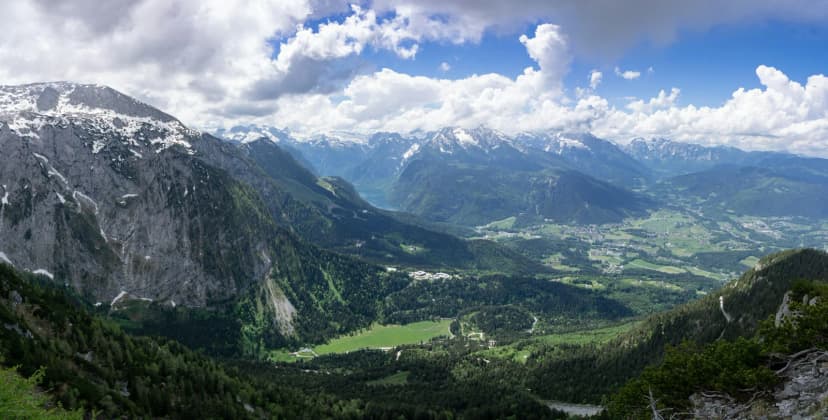
Berchtesgaden is not a compact old town you can wander end to end in an afternoon. The historic centre, the Königssee in Schönau, the Obersalzberg museums and the Rossfeld Panorama Road sit in different places, so a one-day plan is mostly about choosing one anchor and protecting the time around it. That is also why this guide starts with the lake rather than with a checklist. For wider planning, see Berchtesgaden landmark visitor guides.
The order below treats the Königssee as the fixed point, layers a documented mountain alternative on top for history-minded visitors, and gives driving visitors a late-afternoon loop. Every duration is an approximate suggestion, not an official schedule. Boat departure times, road tolls, museum entry and bus connections are all volatile, so confirm them on the operator's own pages before you travel. For wider planning, see Two Days in Berchtesgaden.
Why One Day Here Is a Logistics Problem, Not a Sightseeing Problem
The district spreads from the town of Berchtesgaden out to Schönau am Königssee, the Obersalzberg and Ramsau, and no single centre puts all of it within walking reach. Local buses exist but are not dense enough to let you leap between the lake, the museums and a panorama road on a whim, which caps how much one day can hold. Public transport timetables and regional mobility options are worth checking before you lock an order.
Distances are short on paper and slow in practice: a car helps enormously for the Obersalzberg and Rossfeld, while the lake is the one big sight where you park once and move by boat. Without a car, plan around a single hub and accept that two headline attractions is a full day. If you want to see how a second day absorbs the leftovers, the longer tour outlines on this site list the practical stops. For wider planning, see Three Days in Berchtesgaden.
The Default Order: Königssee First, Town Later
Start at the Seelände at Königssee, buy or validate your boat ticket, and take the crossing to St. Bartholomä before the day gets busy. The operator says you should plan at least 2 hours in total for a St. Bartholomä excursion; the one-way crossing takes about 35 minutes.
The boat itself is the anchor experience: an electric vessel glides over deep, green water while the crew demonstrates the lake's famous echo with a trumpet. From the paid car park you walk roughly five minutes through the pedestrian zone to the boatside. That walk, the ticket window and the boarding queue are the three places where a tight plan quietly loses an hour.
If you continue to Salet, the operator states the one-way crossing is about 1 hour and you should plan at least 3 hours in total for a Salet excursion. Those figures include the boat time, not your lunch, photography or the church visit.
Waiting times are concentrated rather than constant: they build from July to mid-September and on weekends, public holidays and bridge days in fine weather, and the first bright day after a rainy spell draws a crowd. The operator's own advice is to make the outward crossing before 10 am and to leave St. Bartholomä again by about 2:30 pm on those busy days. Buying online in advance lets you walk past the ticket queue to the pier, though online tickets cover departures from the Seelände only.
How Long Each Leg Actually Takes
Treat the operator's figures as floors, not schedules. A St. Bartholomä round trip is at least 2 hours; a Salet round trip is at least 3 hours; everything you add on shore is extra. Build a buffer of 30 minutes at the pier in high season and your day stops being a race against the last boat.
Once you are on the peninsula, the church is the free part of the day: the pilgrimage church at St. Bartholomä can be visited at no charge, and the boat ticket covers the boat and nothing else. The National Park information point at the same stop is a separate indoor space worth ten minutes if weather turns. There are no toilets and no drinks service on board, so use the shore before you commit to a long crossing.
The boats are not step-free: boarding runs over three downward steps through a narrow gangway, though crew assist and there is limited mid-ship space for wheelchairs. Power wheelchairs cannot be carried over the stairs, and only a small number of manual chairs can be borrowed at the ticket desk. Anyone with mobility needs should read the operator's own access notes rather than relying on a summary.
Going Further: Salet, Obersee and the Fischunkelalm
If you take the long run to Salet, you gain the section that most visitors remember: the Obersee. A mostly flat path leads from the Saletalm to the shore of the smaller lake. Budget roughly an hour to walk down and back before you count any time on the far shore.
Continuing along the western shore to the Fischunkelalm and the Röthbachfall is the step up in commitment. The official description calls that stretch largely flat but at times narrow and exposed, and community route notes for the Fischunkelalm loop flag it as demanding and needing sturdy shoes and sure footing. That contradiction between "flat" and "exposed" is exactly why you should judge it on the day rather than from a distance figure alone.
The Fischunkelalm at the rear of the Obersee is a centuries-old alpine pasture that has traditionally been farmed for roughly the warm half of the year, which is why it appears in some trip reports and not others. Because that season is a genuine planning variable, check its current status locally instead of assuming a drink stop at the far end.
Winter Reality: No Salet, Shorter Lake, Add a Museum
In winter operations the boat does not call at Salet, and since the Obersee is reached only from that pier, the upper lake is simply off the table. The crossing then effectively becomes a St. Bartholomä trip, which suits a shorter, colder day. This one closure changes the whole shape of a winter itinerary, so confirm it on the operator's page before you set out.
With the lake day trimmed, a winter or wet-weather plan works well as a lake morning plus one indoor stop. History-focused visitors can shift the balance entirely and give the afternoon to the Obersalzberg documentation centre. Rainy-day options around town and in the valley are collected in one place if you would rather not decide on the spot.
Two lakeside alternatives are genuinely free of charge: the Hintersee near Ramsau and the boulder-strewn Zauberwald beside it. The operator describes both as freely accessible at any time, with the forest path cleared in winter. Around the Hintersee the near-level Prinzregent-Luitpold-Weg makes an easy loop; parking is by fee and the area fills early on fine mornings, so arriving before mid-morning is the practical move.
The History Swap: Dokumentation Obersalzberg Instead of the Upper Lake
Dokumentation Obersalzberg is a learning and remembrance site covering the Nazi dictatorship and the history of the Obersalzberg, and it is a half-day proposition rather than a quick add-on. The operator recommends roughly 1.5 to 2 hours for the exhibition including the bunker complex, and about 40 minutes for the short self-guided multimedia tour. That scale is why it competes with the lake for your one day rather than sitting neatly after it.
Opening hours are daily from 9 am to 5 pm with the last entrance at 4 pm, and the site is closed on 1 November, 24, 25 and 31 December and 1 January. Maintenance closures are announced for 16 to 24 November 2026 and 1 to 8 March 2027, so a late-autumn or early-spring visit needs a calendar check first. Admission is modest for adults, free under 18 and discounted with a guest card; check the current fees before you go rather than carrying an old figure in your head.
On site, plan for practical friction: backpacks, large bags and strollers of any kind cannot go into the exhibition and go into lockers instead. Photography without flash is allowed for private use only, and food and drink are confined to the basement area. Arriving by bus 838 from Berchtesgaden main station drops you at the documentation centre stop, which is the simpler option on days when the car parks fill.
Only With Wheels: The Rossfeld Panorama Road
Rossfeld Panorama Road climbs to around 1,600 metres and for roughly 1.5 kilometres of its summit stretch actually runs on Austrian territory, which is a neat detail to know when you are planning navigation. It is open year-round in normal conditions, and the summit section connects the northern and southern approaches across a high plateau. This is a drive, a motorcycle ride or a serious bike climb, not a walking itinerary for a single day on foot.
The toll is charged per vehicle at either toll booth and works out at 9.50 euros for a car with its passengers and 6 euros for a motorbike with rider and passenger, with a bus charged 60 euros. A ten-trip pass is sold only at the northern booth in Oberau. Because the tariff is a policy figure rather than a fixed fact, treat it as the current published rate and confirm it on the road's own information page.
One rule catches visitors out: overnight stays in vehicles and camping along the route and its car parks are not permitted, so the road cannot double as a campervan pitch. There are around 400 parking spaces at the viewpoints, and the summit is also a trailhead for hikes toward the Kehlstein area. Allow roughly two hours for the drive with photo stops, and more if you walk any of the ridge paths.
What to Drop, and Why Stacking Everything Fails
The single most common planning error is assuming that a full lake day, an Obersalzberg museum visit and a panorama-road loop can share one afternoon. Each of those is a half-day in its own right once you count travel, parking and queues, and the three sit in different parts of the district. Pick one anchor and let the rest become the reason to come back.
Also drop the idea that the town centre needs a dedicated block of time. It is small, walkable and mostly cafés, shops and painted facades, so it fits into an hour either before you drive to the lake or after you return. If you want a named building rather than a stroll, the castle runs guided tours, but many are offered only in German, so verify the language before booking.
Sequencing Tips That Save an Hour
Buy the boat ticket online and go straight to the pier, because the queue you skip is the one at the ticket window rather than the one at the gangway. Board before 10 am in the July to mid-September window and on fine weekends and holidays, which is when the operator expects the heaviest demand. Keep the return leg loose enough to absorb a full boat.
Remember what the boat ticket does not cover: the church at St. Bartholomä is a free, separate stop rather than an included attraction, and nothing on board is sold. Take water, and use the shore facilities before boarding because there are none afloat. The same logic applies to the Obersalzberg site, where food and drink are restricted to one area.
Where a One-Day Plan Still Leaves Room
A town walk is the flexible filler: the Marktplatz, the Schlossplatz and the small Kurgarten sit within a few minutes of each other, and the walk up Weinfeldweg gives a quick skyline view over the rooftops. That is a 60-to-90-minute add-on, not a competing itinerary. It slots in before an early lake departure or after a late return.
If your day is built around a lake crossing and one town stroll, you have used the shape of the destination well. If you find yourself with a spare afternoon, Hintersee and the Zauberwald absorb it without any booking. Rail connections from Salzburg and Munich and the local bus network make the region reachable without a car, though a car widens your options considerably.
Plan Your Visit
The workable version of one day in Berchtesgaden is a Königssee crossing first, St. Bartholomä in the middle, and a deliberate decision at the pier about whether Salet is worth the extra hour each way. Add the town walk if the light and your legs allow, and leave the Obersalzberg or Rossfeld for a day that starts earlier and ends later.
Before you travel, confirm three things on the operators' own pages: whether Salet is being served on your dates, the current museum hours and any maintenance closures, and the current toll and boat arrangements. Everything else in this plan is a suggestion you can bend around weather and crowds.
Frequently Asked Questions
Can you visit the Eagle's Nest and Königssee in one day?
Not comfortably, and not as a plan to rely on. Both sit in different parts of the district, the lake crossing alone consumes at least a two-hour excursion for St. Bartholomä or three hours for Salet, and the Kehlsteinhaus has its own access arrangements that change with the season. Treat them as two separate days and check the operator's pages for current access before you commit.
Can you do the Obersee walk in winter?
No, because the boat does not call at Salet in winter operations, and Salet is the only pier from which the Obersee is reached. In that period the lake trip effectively ends at St. Bartholomä, which shortens the day considerably. Confirm the winter timetable on the operator's page, and use the freed time for a museum or one of the freely accessible valley lakes instead.
How much time should you budget for Dokumentation Obersalzberg?
The operator recommends roughly 1.5 to 2 hours for the permanent exhibition including the bunker complex, and around 40 minutes for the short multimedia-guided tour. Add time for lockers, a coat and the cloakroom process, since large bags and strollers are not allowed in the exhibition. Check the current opening hours and any announced maintenance closures before you go.