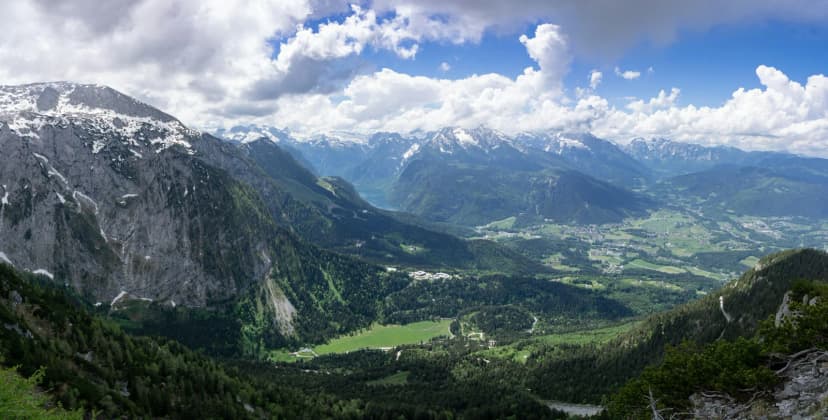
Berchtesgaden sits in the far southeastern corner of Germany, surrounded by the Austrian border and home to the only Alpine national park in the country. The region's signature experiences are a boat trip on the Königssee, a cable car and walk around the Jenner upper station, and a day trip across the border to Salzburg. A common suggestion from independent guides is three nights, which gives two to three full days on the ground.
This is a suggested plan, not an official itinerary. Treat the day-by-day sequence as a flexible template and swap days once you see the forecast. The region's own website publishes current information on attractions, mountain railways, and guest-card benefits, so check it before locking anything in.
Why Three Days Fits Berchtesgaden
Berchtesgaden itself is a small alpine town, but the surrounding area is spread across several valleys and municipalities. The Königssee lies south of town near Schönau am Königssee, the Jennerbahn valley station is a short distance away, and Ramsau bei Berchtesgaden sits east toward the Austrian border. Trying to see all of it in one day means spending most of your time in transit rather than on the water or the mountain.
Three nights gives you two to three full days, which is the shape one detailed Berchtesgaden guide recommends. That source suggests three nights is enough for the Königssee, the Jenner hike, Ramsau, the Rossfeld Panoramastraße, and a Salzburg day without rushing. That is a fair working assumption for a first visit, not an official minimum.
What three days does not cover is the wider Bavarian Alps. Munich, Garmisch-Partenkirchen, and Neuschwanstein are separate trips, not add-ons you can bolt onto a Berchtesgaden long weekend. If you want those too, plan a longer Bavaria itinerary and treat Berchtesgaden as one dedicated stop within it.
The Shape of the Plan: One Lake Day, One Mountain Day, One Salzburg or Culture Day
The plan this guide suggests is simple: one full day at the Königssee and Obersee, one full day around the Jenner with optional Rossfeld or Kehlsteinhaus add-ons, and one day in Salzburg or exploring Berchtesgaden's own cultural sights. That covers the region's three main visitor experiences without turning the trip into a checklist.
If you only have time for a shorter visit, the two days in Berchtesgaden itinerary drops the Salzburg day and pairs the lake with the mountain. That works well for travellers arriving by train from Munich or Salzburg who want the essentials without the border crossing.
The sequence matters: put the lake day first so you can catch an early boat before peak-season queues build, then hold the mountain day for the clearest forecast. A cable car up the Jenner in cloud gives you little beyond a cold ride, while a boat trip on the Königssee is dramatic even in grey weather.
Before You Go: Guest Card, Early Starts, Weather Layers, and Car Versus Bus
Accommodation in the region typically provides a free guest card, which one travel guide states covers most local buses to the Königssee, the Jennerbahn, and Ramsau. The card's exact scope and partner network are set by the destination and can change, so ask your host on arrival and confirm the current inclusions in the region's own materials before relying on it.
Getting there without a car is feasible: Berchtesgaden has a main station, and regional services connect through Freilassing. A car mainly buys flexibility for the Rossfeld Panoramastraße, the scenic toll loop above town, and for reaching trailheads at your own pace. If you do drive through Austria en route, note that Austrian motorway vignette rules apply on some routes.
Pack a waterproof shell and a warm mid-layer even in midsummer. Mountain weather changes quickly, and the Jenner summit can be noticeably colder than the valley floor. On the Königssee, morning departures are the most reliable way to avoid long ticket queues in July and August, when the dock gets busy.
Day 1, Lake Day: Königssee Boat to St. Bartholomä, Continuing to Salet and Obersee
Start at the Königssee dock south of town. The lake is fjord-like, with the Watzmann massif and Hagengebirge rising almost vertically from the water, and the only practical way to see it is the electric boat service operated by Bayerische Seenschifffahrt. Buy tickets at the terminal or online in advance; they are not timed, so an early arrival is your best defence against peak-season queues.
A round-trip ticket to St. Bartholomä was around 22.50 euros for adults in 2026 according to one travel guide, while the full route to Salet, the stop for Obersee, was around 29.80 euros. Treat those figures as that source's date-stamped reference rather than an official fare, and confirm current prices with the boat operator before you travel.
All boats stop at St. Bartholomä, where the red-domed pilgrimage chapel sits beside the water and a small beer garden serves smoked trout. If you continue to Salet, a flat walk of roughly fifteen minutes brings you to Obersee, the smaller lake behind the Königssee. From Obersee, another walk of about forty minutes reaches the Röthbachfall, often described as Germany's tallest waterfall.
Mid-journey, the boat pauses for the famous trumpet echo demonstration against the cliff walls, one of the few places where an echo repeats multiple times. It is short, quirky, and worth keeping your camera down for. The Obersee extension only operates in the warmer half of the year, so check the boat schedule if you are visiting in shoulder season.
Lake Day Pacing: Queues, the Echo, and a Ramsau Evening Stop
Budget most of the day for the lake. The boat ride to St. Bartholomä takes about thirty-five minutes one way, and continuing to Salet adds roughly another half hour, so a Salet round trip with an Obersee walk comfortably fills five to six hours including stops. Do not schedule a tight afternoon commitment on this day.
On the way back toward town, detour to Ramsau bei Berchtesgaden to see the church by the river that appears on countless postcards. It is a short stop, best in late-afternoon or sunset light, and pairs naturally with the lake day rather than standing alone as a separate outing. Allow perhaps half an hour on site plus travel time.
Day 2, Mountain Day: Jennerbahn Cable Car and the Loop Toward Carl von Stahl Haus
Take the Jennerbahn cable car up from the valley station near Königssee. A return ticket to the top station was around 47 euros in 2026 according to one travel guide, with a combined Königssee and Jenner ticket around 56 euros. Confirm current fares and operating hours with the operator, since these are third-party figures rather than official published prices.
From the upper station, a well-marked loop heads toward the Carl von Stahl Haus and back, with repeated views down over the Königssee. It is a moderate walk rather than a serious climb, which makes the Jenner a good mountain day for mixed-ability groups. Start in the morning so you have the option to extend if the weather holds.
The views over the lake from the Jenner are arguably better than those from the water itself, because you can see the full curve of the shoreline against the Watzmann wall. If clouds are sitting low on the summit, consider swapping this day with the Salzburg day and returning when the forecast clears.
Mountain Day Add-Ons: Rossfeld Panoramastraße and When the Kehlsteinhaus Fits
If you have a car, the Rossfeld Panoramastraße is a scenic toll loop above town and one of the highest paved roads in Germany. It is an excellent sunrise or sunset drive with multiple viewpoints, and it is frequently described as underrated compared to the bigger-name attractions. The toll is charged per vehicle and the amount should be checked locally rather than assumed.
The Kehlsteinhaus, known in English as the Eagle's Nest, is a weather-dependent half-day at best. Access is by a mandatory shuttle bus from the Obersalzberg area; you cannot drive up yourself. The official region site currently lists the Kehlsteinhaus as open until 8 November 2026, though the season is weather-dependent, so verify before planning around it.
One traveller's verdict is that the Eagle's Nest is skippable unless you are specifically interested in the history and the skies are clear, because it is crowded and the summit is often in cloud. Others treat it as a highlight and pair it with the Dokumentation Obersalzberg near the bus departure point. Either way, budget at least half a day including transport, and do not try to combine it with a full lake day.
Day 3, Salzburg or Culture Day: Crossing the Border and What to Weigh
Salzburg is only about thirty minutes from Berchtesgaden by road, which makes it one of the easiest cross-border day trips in the Alps. Trains run from Berchtesgaden's main station, and one travel guide states that since March 2023 the guest card has also covered the train to Salzburg. Because that benefit is set by the destination and can change, confirm the current scope with your accommodation before counting on it.
In the city, the old town is compact and walkable: Getreidegasse for shopping and Mozart's birthplace, the cathedral, St Peter's Abbey, and the funicular up to Hohensalzburg. Mirabellgarten and the Sound of Music locations are popular, and the beer hall Augustiner Bräu Mülln is a common recommendation for an unfussy meal. You can fill a full day here easily.
Whether Salzburg is worth a full day is a matter of taste. One traveller reported being slightly disappointed by how tourist-heavy it felt, while still recommending it as an easy trip. If you dislike crowds, consider a half day in Salzburg and use the rest for a Berchtesgaden old town wander or the salt mine heritage instead.
If You Skip Salzburg: Old Town, Salt Mine Heritage, and Dokumentation Obersalzberg
Staying on the German side for day three is a legitimate choice. Berchtesgaden's historic centre is small and pleasant, with colourful facades, a royal palace, and the salt mine heritage that made the town wealthy long before tourism. The region's own site lists the Salzbergwerk among its top sights and publishes current visitor information.
The Dokumentation Obersalzberg, near the Eagle's Nest bus departure point, covers the area's Nazi history and is often combined with a Kehlsteinhaus visit. One traveller notes that the ticket for the Eagle's Nest can include entry to the documentation centre, but confirm current arrangements on site. It is also a strong rainy-day substitute for a cancelled mountain day.
How to Adapt the Three Days for Rain, Snow, or Shoulder-Season Closures
Mountain weather in Berchtesgaden changes fast, and a single rainy day does not need to derail the trip. Swap the Jenner or Kehlsteinhaus for the salt mine, the Dokumentation Obersalzberg, or a spa afternoon, and save the mountain for the first clear window. The lake boat runs in most weather, so it can be moved earlier if the forecast turns.
In shoulder season, two things commonly close: the Obersee extension on the lake and the Kehlsteinhaus access road. Both are seasonal and weather-dependent, so a late-October or early-April visit can meaningfully change what is possible. Check the region's official pages and the relevant operator websites in the week before you arrive rather than relying on a guidebook.
Winter turns Berchtesgaden into a different destination, with skiing, sledding, and winter walking replacing the boat-and-cable-car rhythm. If your trip falls outside late spring to mid-autumn, expect a shorter list of open attractions and plan around the snow rather than against it. That trade-off is worth knowing before you book.
Where to Base Yourself and Why a Car Helps but Is Not Strictly Required
Staying in Berchtesgaden town puts restaurants and shops within walking distance, but parking can be awkward and traffic through the centre can be slow in peak season. Staying in a surrounding village such as Bischofswiesen or Schönau am Königssee often means better views, easier parking, and quicker access to the lake or the cable car. Both approaches work; the trade-off is convenience versus space.
A car is not essential for a basic three-day visit because the bus network and guest card cover the main attractions. It becomes genuinely useful for the Rossfeld Panoramastraße, for flexible pacing, and for reaching trailheads or smaller villages in the national park. If you are comfortable with buses and want to keep costs down, you can run this itinerary without one.
If you are combining Berchtesgaden with other Bavarian stops, the day trips from Berchtesgaden guide covers options like Salzburg and the wider Alpine road. For a shorter version of this same trip, the one day in Berchtesgaden itinerary distils the essentials into a single day.
Plan Your Visit
Three days in Berchtesgaden works because the region's highlights are close together but each deserves a full day. Put the Königssee first, hold the Jenner for the best forecast, and leave day three open between Salzburg and the German-side sights. That structure absorbs weather changes without forcing you to cancel anything.
Before you travel, confirm current boat and cable-car operating dates, guest-card inclusions, and Kehlsteinhaus access rules with the official sources rather than older trip reports. Prices, schedules, and seasonal closures shift from year to year, and the figures quoted here are for reference only. A short check the week before arrival saves a wasted morning.
Frequently Asked Questions
How many days do you need in Berchtesgaden?
Three nights gives you two to three full days, enough for the Königssee, the Jenner, Ramsau, and either a Salzburg day or a culture day in Berchtesgaden itself. Two nights is tight for the highlights unless you stay an extra night in Salzburg. Four or more nights lets you add Rossfeld, the Kehlsteinhaus, or a longer national park hike without rushing.
Is it better to stay in Berchtesgaden town or outside it?
In town you can walk to restaurants and shops, but parking is harder and summer traffic through the centre can be slow. Villages such as Bischofswiesen or Schönau am Königssee often offer better views, easier parking, and shorter drives to the lake and the cable car. Both work; base your choice on whether you value walkability or space and quiet.
Do you need a car for three days in Berchtesgaden?
Not strictly. The guest card provided by many accommodations covers most local buses to the Königssee, the Jennerbahn, and Ramsau, and the regional train network connects the main towns. A car helps mainly for the Rossfeld Panoramastraße, for flexible pacing, and for reaching trailheads, so it is a convenience rather than a requirement.
Is the Eagle's Nest worth visiting, and how long does it take?
It depends on your interest in the history and on the weather. Access is by a mandatory shuttle bus, you cannot drive yourself, and the summit is often in cloud even when the valley is clear. Budget half a day including transport, and consider pairing it with the Dokumentation Obersalzberg. If the forecast is poor, a Jenner hike or the Rossfeld drive may be a better use of the same hours.
Is Berchtesgaden in Germany or Austria?
Berchtesgaden is in Germany, in the far southeastern corner of Bavaria. It is largely surrounded by Austria, and Salzburg is closer than most German cities, which is why the two are often confused. This does not complicate a Salzburg day trip, but if you drive through Austria en route, check whether you need a motorway vignette for your route.