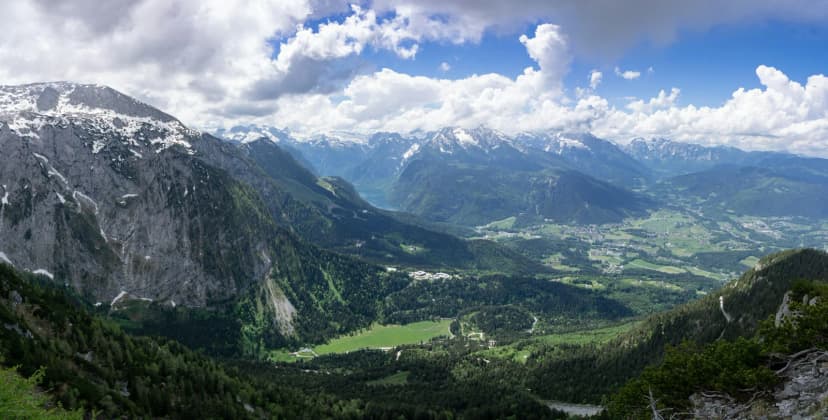
The Königssee has no road along its shore, so nearly every visit starts on the water. Electric launches leave the Seelände landing near Schönau am Königssee and glide south beneath the Watzmann east face. The decision that shapes the day is not whether to board, but how far to ride: the single sailing from the Seelände to St. Bartholomä takes roughly 35 minutes, while the full run to Salet takes about an hour.
The two main landings serve different days. St. Bartholomä is the halfway stop, suited to short outings built around the free pilgrimage church and a flat shore path. Salet sits at the southern end and is the gateway to the Obersee, with the Fischunkelalm and Röthbachfall further on for walkers with sturdy shoes.
What follows separates what the lake operator and the regional tourist board actually publish from what you must confirm yourself. Sailing times, fares and winter service change by season, so treat the details here as orientation and check the operator's own pages before you travel.
How the Königssee boat works and where it starts
Boats leave from the Seelände landing, reached in about five minutes on foot from the paid Königssee car park through a short pedestrian zone. Tickets are sold at the cash desk there, and online tickets exist only for departures starting at the Seelände. Hikers who walk down to St. Bartholomä, Salet or Kessel buy return tickets directly at the jetty, a rule the regional tourist board attributes to weak mobile signal at those landings.
The route functions as transport rather than a looping tour, with boats calling at fixed landings. The mid-lake trumpet echo demonstrated against the rock walls is the set piece, and because the fleet is electric and the lake sits inside a national park, the crossing stays quiet. A one-way sail to Salet runs about an hour, so a round trip to the far end consumes two hours before you set foot on a trail.
St. Bartholomä or Salet: matching the landing to your day
Choose St. Bartholomä if time is limited or you are travelling with a stroller or small children. The landing has a restaurant, a national park information point and a flat gravel shore path. The tourist board suggests allowing at least two hours in total for an excursion here, which covers the crossing, the church and a short walk.
Choose Salet if the point of the day is walking. The path from the jetty to the Obersee is short and stroller-friendly, but the shoreline path beyond it narrows and becomes exposed in places. The Obersee is reached only via the Salet landing, which the regional board notes is not served during winter operation, so this is a warm-season plan.
You are not forced to commit at the ticket desk. Passengers may leave the boat at St. Bartholomä on the outward or return leg and continue later with a different boat, so a round-trip ticket can cover both landings. The constraint is timing: you rejoin the queue at whichever jetty you left from.
What to see and do at St. Bartholomä
The palace and pilgrimage church were founded by the Prince-Provosts of Berchtesgaden in 1134, and the triple-concha design of the church dates to 1697, with stucco work by the Salzburg master Joseph Schmidt. After Berchtesgaden became part of Bavaria in 1810, the palace served the Bavarian kings as a hunting lodge. Admission to the church is free, but opening hours depend on the ferry timetable, which makes the sailing schedule your real visiting window.
The shore path rewards people who stay longer than planned. It is flat and gravel-surfaced, and from the jetty it takes about 15 minutes to reach the spot where the Eisbach flows into the lake, which makes it the reliable choice for buggies. The national park information point at the landing adds a short indoor stop if weather turns.
Food is available at the St. Bartholomä restaurant and at the Fischer vom Königssee, both at the landing, because there is no catering on the boats themselves. That matters more than it sounds: a two-hour outing can stretch longer if the light is good, and there is nothing to buy once you are aboard.
What to see and do at Salet and the Obersee
From the Salet jetty a flat path leads over the moraine ridge to the Obersee. No boats run on this smaller lake, and its sheltered position means the surface is usually calm, which is why the reflections of the rock walls are the reason photographers accept the extra hour of sailing. The Obersee has not been fished since the national park was established in 1978.
Continuing along the western shore brings you to the Fischunkelalm at the far end, a 500-year-old alpine hut staffed by two dairymaids and open from mid-May to mid-October. The path there is mostly flat but narrows and becomes exposed in sections, so it is a different proposition from the wide track to the lake. Above the alm, the Röthbachfall drops from the Röthwand onto the pasture floor.
Food is available at the Saletalm at the landing and at the Fischunkelalm further on. The board's guidance for families is blunt: the path beyond the Obersee suits older children with sturdy shoes rather than casual walkers, and a stroller should turn around at the lake.
How long to allow, and how to split the day
A suggested plan for St. Bartholomä alone is three to four hours door to door, allowing for the crossing, the church, the shoreline walk and a meal. The tourist board's own minimum for an excursion here is two hours in total, which works only if you keep moving and skip the longer path. This is editorial advice rather than an official duration.
For Salet and the Obersee, a suggested allowance is five to six hours including both crossings; the board's stated minimum is three hours. Add an hour if you intend to walk to the Fischunkelalm, and more if you want to sit there. Because the sail to Salet runs about an hour each way, the boat alone consumes two hours of that budget.
The stopover mechanic is what makes a combined day realistic, and it is also what catches people out. If you disembark at St. Bartholomä intending to continue south, you rejoin the queue at that landing rather than holding a reserved place. Build a buffer into the return leg, and check the day's last departures at the cash desk before setting off.
Boarding, queueing and online tickets
Queues build in good weather, particularly from July to mid-September, at weekends and on public holidays, and the first fine day after a wet spell is reliably busy. The board's practical advice for peak days is to start the outward trip to St. Bartholomä before 10am and to leave again by about 2.30pm. Buying online means walking straight to the jetty instead of the ticket queue, but it does not remove the queue for the boat.
Online tickets exist only for departures from the Seelände, not as one-way fares for hikers returning from the lake. The operator explains this as a coverage problem: signal at Salet and St. Bartholomä is too weak to rely on a digital ticket. If you are walking in over the mountains and only need the return crossing, plan to buy at the jetty.
Allow extra time for the car park and the short walk through the pedestrian zone to the landing, and check the operator's own pages for the current sailing schedule rather than relying on any summary, since first and last departures shift with the season.
On board: toilets, food, smoking and dogs
There are no toilets and no drinks or snack service on the boats, and smoking is not permitted on the electric launches. With a crossing of up to an hour in each direction, that combination argues for using the facilities at the Seelände before boarding and carrying water. Toilets are available on land at the landing points rather than at sea.
Dogs travel for a fee and must wear a muzzle, and dogs classed as fighting breeds are excluded from carriage altogether. Where a muzzle genuinely will not fit, as with very small or flat-nosed dogs, the operator requires a suitable carrier or box instead. Bathing from the shore is permitted, but the operator notes that water temperatures reach at most around 20 degrees Celsius even after long spells of fine weather, and asks swimmers to stay out of the shipping lane. Inflatables and rubber dinghies are prohibited inside the national park.
Families, strollers and step-free limits
Children up to five travel free with an adult, children aged six to 17 receive a 50 percent discount on the adult fare, and when accompanied by a full-paying adult the first child pays the child rate while each additional child aged six to 17 travels for a further one euro. Proof of age may be requested. Adult fares and any online-shop tiers should be checked directly with the operator.
Space for strollers on the electric boats is limited, and large ones can wait when the boat is full, so a foldable buggy is the sensible choice. Bike trailers converted into strollers cannot be brought aboard, and bicycles are not carried. Once ashore, the flat shore path at St. Bartholomä and the short track to the Obersee are both usable with a stroller; the path beyond the Obersee is not.
The boats are not designed for wheelchairs: boarding and leaving is narrow and steep and descends three steps, and the crew assists where they can. Each boat has room for roughly one or two wheelchairs amidships, but electrically powered wheelchairs cannot be carried because they cannot be rolled down those steps. A limited number of manual wheelchairs can be borrowed free of charge at the ticket desk, so ask there rather than assuming availability.
What the boat ticket does not cover
Boat fares are charged separately and are explicitly not included in the Bavarian Palace Administration's annual or 14-day season tickets. The palace administration states this directly on the St. Bartholomew's Church page, which also confirms that admission to the church itself is free. A palace season ticket for the region's royal buildings will not get you onto the water.
That separation matters when comparing passes for a Berchtesgaden itinerary. A day that combines the Königssee, the Kehlstein and the Obersalzberg mixes different operators and different tickets, so treat each on its own terms. The church is the only element here with free entry.
Pairing the lake with the rest of Berchtesgaden
If weather closes in on the lake, the Hintersee near Ramsau and the Zauberwald forest path make a lower, walkable alternative. The almost level path around the Hintersee can be walked year-round, and the forest footpath through the Zauberwald is cleared in winter. Boats can be rented on the lake in season, and a small electric boat also runs in summer.
For a second day, the Rossfeld Panorama Road climbs to around 1,600 metres on a toll road with two access points, north at Oberau and south via the Obersalzberg, and part of the summit stretch runs on Austrian territory. Toll rates are published by the road operator and subject to change, so check before you drive. Overnight stays in vehicles along the route and its car parks are not permitted.
History-minded travellers may prefer the Dokumentation Obersalzberg, which publishes its own opening hours, closure days and entrance fees on its visit page; under-18s enter free, and the exhibition is recommended for visitors over twelve. The bunker complex is part of the permanent exhibition, and strollers and large bags are not allowed inside.
The One Choice to Make Before Buying a Ticket
Decide first how far you want to ride. St. Bartholomä is the gentle option: a free pilgrimage church, a flat shore path, food at the landing and a generous two-hour minimum that most people fill without effort. Salet is the walking option, with the Obersee, the Fischunkelalm and the Röthbachfall, and it needs at least three hours and realistically half a day.
Then check the live details no guide can fix for you: current fares and sailing times with the boat operator, the day's first and last departures, and whether winter operation applies to the landings you want. If you plan to do both stops, buy a round-trip ticket, use the stopover at St. Bartholomä, and keep an eye on the clock for the return leg.
Frequently Asked Questions
Is the Königssee boat trip worth it?
For most visitors it is the whole point of the lake, because there is no road along the shore and no practical walking route around the steepest sections. The crossing is quiet and electric, includes the trumpet echo demonstrated against the rock walls, and delivers you to either a free pilgrimage church or the trailhead for the Obersee. If you have only a couple of hours, the shorter ride to St. Bartholomä still gives you the classic view of the church beneath the Watzmann.
Should I get off at St. Bartholomä or ride all the way to Salet?
Get off at St. Bartholomä if you want a short, low-effort visit built around the church, a flat shore path and a meal at the landing. Ride to Salet if you came to walk: the Obersee is a short flat stroll from the jetty, and the shoreline path beyond it leads toward the Fischunkelalm and the Röthbachfall for those with sturdy shoes. The tourist board suggests at least two hours in total for the first option and three hours for the second.
Can I get off at St. Bartholomä and continue to Salet later?
Yes. Passengers may leave the boat at St. Bartholomä on the outward or return leg and complete the journey later with a different boat, so a round-trip ticket can cover both landings. The catch is that you rejoin the queue at the jetty you left from, so build a buffer into the return leg and confirm the day's last departures at the ticket desk before setting out.
Are dogs allowed on the Königssee boats?
Dogs travel for a fee and must wear a muzzle, and dogs classed as fighting breeds cannot be carried at all. If a muzzle genuinely will not fit, as with some very small or flat-nosed breeds, the operator requires a suitable carrier or transport box instead. These are the boat operator's rules rather than national park rules, so check the current requirements before you travel.
Are there toilets or food on board the Königssee boats?
No. There are no toilets and no drinks or snack service on the boats, and smoking is not permitted on the electric launches. Use the facilities at the Seelände before boarding and carry water with you. Once ashore you will find restaurants at the St. Bartholomä landing and at Salet, plus alpine snacks further along the Obersee path at the Fischunkelalm in season.
Is the boat trip included in Bavarian palace tickets?
No. The boat fares are charged separately and are explicitly not included in the Bavarian Palace Administration's annual or 14-day season tickets, even though the church at St. Bartholomä is administered by that authority. Admission to the church interior itself is free. If you are putting together a multi-site itinerary, treat the boat, the palace sites and the Obersalzberg museum as separate tickets.
Can you swim in the Königssee?
Swimming from the shore is permitted, but the operator notes that water temperatures reach at most around 20 degrees Celsius even after extended fine weather and asks swimmers to stay clear of the shipping lane. Inflatables and rubber dinghies are prohibited because the lake lies inside Berchtesgaden National Park. Judge conditions on the day rather than treating any figure as a daily measurement.
Are the Königssee boats accessible for wheelchairs?
The boats are not built for wheelchair access. Boarding and disembarking is narrow and steep and involves three steps down, though the crew helps where they can, and there is space for roughly one or two wheelchairs amidships. Electrically powered wheelchairs cannot be carried because they cannot be rolled down those steps, but a limited number of manual wheelchairs can be borrowed free of charge at the ticket desk.
Sources
- Der Königssee | Berchtesgaden
- Bavarian Palace Administration | Palaces | St Bartholomew's Church
- Family trip to the lake Königssee
- Der Hintersee bei Ramsau | Berchtesgaden
- Your visit - Dokumentation Obersalzberg
- Rossfeld Panoramastraße: Usage & Info
- Der Obersee: Der kleine Bruder des Königssees | Berchtesgaden