

Konstanz suits a two-day visit because its historic core is compact and the lakefront does much of the work for you. The city sits at the western end of Lake Constance on the Swiss border, and its Old Town was largely spared wartime damage, so the lanes, painted facades and towers read as a genuine medieval townscape. The station itself dates from 1863 and its neo-Gothic tower was modelled on Florence's Palazzo Vecchio, which makes arrival part of the sightseeing.
The decision that shapes the whole plan is day two: Mainau, the heavily visited garden island, or Reichenau, the UNESCO-listed monastic island with its Romanesque churches. Mainau is a managed, ticketed garden experience with a baroque palace ensemble and a large butterfly house; Reichenau is a lived-in landscape of churches, museum buildings and walking paths. Choosing one rather than racing both is what protects day one's Old Town time. For wider planning, see Konstanz landmark visitor guides.
Everything below is a suggested structure, not an official schedule. Treat the timings as blocks you can stretch or cut, and check current opening hours, admission and boat, bus or train connections with the relevant operator before you travel.
Why Konstanz Works for Two Days
Konstanz is the largest city on Lake Constance and one of the easiest German cities to explore without a car. The Old Town, harbour and lakefront sit within walking distance of each other and of the main station, and the station connects to the Black Forest and Karlsruhe line as well as into the Swiss rail network toward Zurich and Lucerne. That combination makes the city a realistic base rather than a stopover.
Overnight guests are issued the Bodensee card at check-in, and one traveller account describes it as covering public transport around the Konstanz area, including Stein am Rhein and Überlingen, and as linked to reduced ferry, bicycle hire and museum rates. Because the exact list of partners and discounts has changed over time, treat the card as a transport convenience and confirm its current scope with your host or the tourist information office inside the station at Bahnhofplatz.
The practical consequence is that a two-day plan here involves almost no logistics: you walk in the city and take one train, bus or boat for the island day. If you want a shorter version, cut the island and keep the city, which is what a one day in Konstanz itinerary does well.
Day One Morning: Münster, Marktstätte and the Imperia
Start at the Münster Unserer Lieben Frau, the cathedral that gives the Old Town its spine. Construction ran across many centuries, so the building mixes Romanesque, Gothic, Baroque and Classical elements. Its crypt dates to the 9th and 10th centuries and contains four original gilded medallions, and the interior holds frescoes, statues and St. Maurice's Rotunda, a replica of the Church of the Holy Sepulchre in Jerusalem.
The cathedral tower rises about 76 metres and gives wide views over the rooftops and the lake, but tower access is on a separate schedule from the church and closes earlier; one traveller reports arriving to find the church open but the tower closed at 5 p.m. Check the parish's published hours on the day rather than assuming you can climb whenever the doors are open. If the tower is shut, the harbour and Stadtgarten give you a good free alternative.
Walk down to the harbour to meet the Imperia, Peter Lenk's nine-metre, eighteen-tonne sculpture of a woman holding two small crowned figures, a pope and an emperor. It commemorates the Council of Constance of 1414 to 1418, and the figure rotates on its pedestal roughly every four minutes. Behind it stands the Council building, where a papal election was once held; its first floor today has a restaurant terrace facing the water.
Then head to Marktstätte for the Kaiserbrunnen, created by Hans Baur in 1897 and later reworked by Gernot and Barbara Rumpf after the original figures were lost in the 1940s. Two of the original emperors returned as caricatures, Otto I was added, and a three-headed peacock alludes to the division in the Western church at the time of the Council. Use this square as your orientation point: the lanes north climb toward the cathedral, and those south lead back toward the station.
Day One Afternoon: Niederburg Lanes and the Medieval Towers
The Niederburg, literally "below the castle", is the quarter north of the cathedral on the site of an earlier fortress. Anyone entering medieval Konstanz over the Rhine bridge had to thread these narrow streets, which were home to craftsmen and fishermen; today the winding alleys, half-timbered houses, wine taverns and small shops are the most atmospheric walking in the city. Give this area an unhurried hour rather than treating it as a corridor.
Three surviving fragments of the city wall anchor the walk: the Rheintorturm, which guarded the Rhine bridge and stands around 35 metres tall; the Pulverturm, built by Konstanz's Jewish citizens and known for walls about two metres thick; and the Schnetztor on the southern edge of the Old Town, recognisable by its half-timbered upper storey and grey wooden-tiled roof. Their exteriors are part of the public street scene. Whether any individual viewing platform or gate is currently open to visitors is not something to assume, so check on arrival.
Roughly the same logic applies to the Old Town's decorated houses, such as the Tall House on Zollernstraße 29 with its Gothic structure and colourful frescoes, and the tower house known as the Golden Lion on Hohenhausgasse 3a with its painted facade from 1580. These are private and civic buildings you admire from the street; there is no ticket, and there is also no interior access. That distinction between free exteriors and ticketed interiors runs through the whole city.
Day One Evening: Lakefront, Stadtgarten and the Thermal Baths
Finish the day along the water. The lakefront promenade and the Stadtgarten give you the classic Konstanz evening: flower beds, benches, boats coming and going, and views across to the Swiss shore. In summer this is where the city socialises, and it needs no ticket at all.
If you want a structured end to the day, the Bodensee-Therme sits at Zur Therme 2 near the lake, with indoor and outdoor pools, a thermal pool, a sauna area and warm open-air bathing. It is a popular wet-weather and shoulder-season alternative to an evening stroll. Opening hours, sauna sessions and admission are set by the operator and change through the year, so check the current schedule before you go rather than turning up on a hunch.
Keep dinner flexible. Konstanz has a dense restaurant and café scene in the Altstadt and around the harbour, and there is no single address that justifies a detour on a two-day trip. Book only if you have a specific place in mind for a weekend evening.
Day Two Option A: Mainau Island
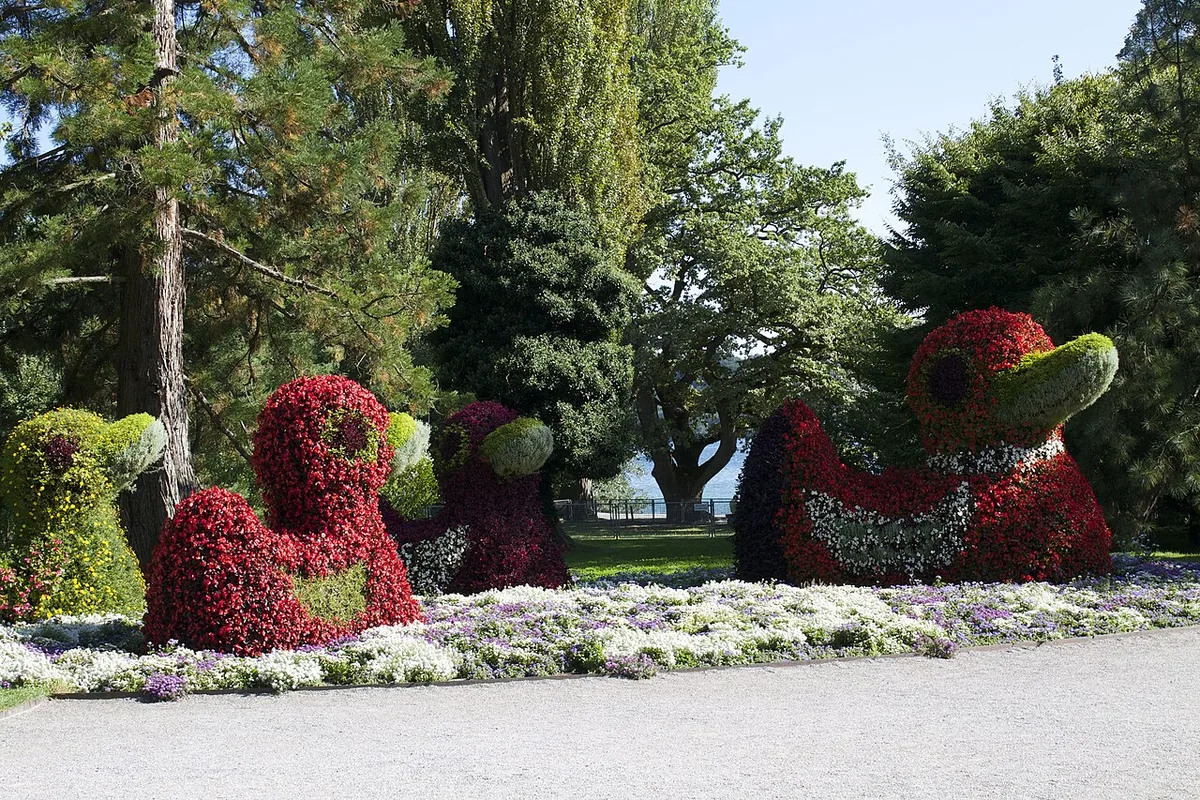
Mainau is the garden island, reached by bus from Konstanz and connected by a bridge, and it is the single most visited attraction in the area. Its 18th-century baroque palace ensemble, palm house and one of Germany's largest butterfly houses sit inside roughly 45 hectares of designed gardens, with themed areas such as a rhododendron slope, an Italian rose garden, a dahlia garden and a hydrangea path. Because it is a managed, ticketed site rather than open landscape, plan it as a half-day minimum.
The crowding is real: one account of the island notes that it draws over a million visitors a year, and the experience changes completely depending on when you arrive. Getting there for opening, rather than mid-morning, is the practical lever, and a conditional tip from that same account is to arrive by 9 a.m. if you want more solitude; it also cautions that the place can get very crowded. Ticket prices vary by season and by how you buy, so check Mainau's own published prices rather than relying on older figures.
Think about what you actually want from the island before committing. If you are going for the gardens and the butterfly house, Mainau justifies most of a day. If you mainly want lake scenery and a walk, Reichenau gives you more of that for far less queuing, and the trade-off is real rather than cosmetic.
Day Two Option B: Reichenau Island
Reichenau is the largest island on Lake Constance and a UNESCO World Heritage Site, and its appeal is monastic rather than ornamental. The island holds three significant Romanesque churches, including St. Mary and Mark, St. Peter and St. Paul, and St. George, together with four museum buildings that shed light on the monastery's manuscript illumination tradition. The main museum is housed in the Old Town Hall, which one visitor account describes as one of the oldest half-timbered houses in southern Germany.
Because the island is inhabited farmland and village rather than a fenced attraction, much of the pleasure is simply walking it: poplar avenues, vegetable plots, lake views and small church interiors that open to visitors on their own terms. Distinguish what is free from what is ticketed, and do not assume one admission covers several buildings. If you go by train and bus rather than car, you avoid the parking question entirely and the island rewards being explored on foot.
Reichenau pairs naturally with the western shore of the lake if you have a third day, which is what a 3 days in Konstanz itinerary can absorb, but for a two-day trip it should be the whole of day two. Squeezing both islands into one day leaves you with two rushed visits and no Old Town time.
Getting Around: Train, Bus and Boat
Three modes cover almost everything: walking in the city, the regional train and bus network for the islands and the western shore, and the lake boats for anything on the water. Konstanz Hauptbahnhof is central, connects to the Black Forest and Karlsruhe line, and links into the Swiss rail network toward Zurich and Lucerne, which makes it a realistic base rather than a stopover.
Exact bus numbers, sailing times and journey durations change with the season, so plan the island day against the timetables published for your travel date rather than against any fixed number you read in advance. The tourist information office inside the station at Bahnhofplatz advertises mobility advice and ticket sales for the city and region, and can confirm current connections and the scope of the guest card. Build in slack for the return trip, especially on a lake boat in shoulder season.
If your interest is mainly the wider region rather than Konstanz itself, it is more sensible to treat the city as a base and choose among day trips from Konstanz than to compress everything into this two-day frame.
Wet Weather and Shoulder Season Swaps
Lake Constance weather turns quickly, and the gardens that make Mainau special are the first thing to lose their appeal in heavy rain. The natural swap is to push the island day later in the trip and fill the wet hours with churches, museums and the thermal baths instead. St. Stephen's Church in the Old Town, described as a three-nave basilica with pews from around 1270 and later ceiling frescoes, is a good indoor stop.
Konstanz also has several ticketed museums, including the Rosgartenmuseum, which work well as indoor options without pretending they are the reason you came. If you have bought a guest card, confirm whether it changes anything for the museums you plan to visit, because coverage has varied over time and should not be assumed.
In cold months, the Münster and the Old Town lanes remain fully usable, and the harbour is still worth the walk with a hot drink. The island day becomes the flexible one: go if the forecast is clear, and swap to an indoor day if it is not.
Suggested Time Split per Day
The following split is a suggestion from this itinerary, not an official schedule. Day one: roughly two hours in the Münster and Marktstätte area, an hour at the harbour and Imperia, two hours in the Niederburg and along the tower remnants, and the evening on the lakefront or at the thermal baths. Day two on Mainau: most of a working day including travel, gardens, palace exterior and the butterfly house. Day two on Reichenau: a similar span, but weighted toward walking and church interiors rather than ticketed attractions.
The most useful adjustment is to front-load day one's cathedral visit. Church interiors are quieter and easier to appreciate early, and it leaves the afternoon free for the lanes without watching the clock. On day two, whatever you choose, leave the city immediately after breakfast.
Plan Your Visit
Two days in Konstanz works because the city does not demand more. Keep day one entirely within the Old Town and the waterfront, then commit day two to a single island: Mainau if you want designed gardens and the butterfly house, Reichenau if you want a UNESCO monastic landscape and the quietest walking on Lake Constance. Everything else is a bonus rather than a requirement.
Before you travel, verify the things that change: admission prices and opening hours for Mainau, the Münster tower and the thermal baths, current bus, train and boat connections for your dates, and the exact scope of the Bodensee card with your accommodation or the tourist information office. Confirm those with the operators rather than trusting any secondary summary, including this one.
Frequently Asked Questions
Is two days enough for Konstanz?
Yes, two days is enough for the city itself plus one island. Day one covers the Old Town, the Münster, the harbour and the lakefront comfortably on foot, and day two handles either Mainau or Reichenau. What does not fit is both islands and the Old Town at a relaxed pace, so treat the second island as a reason to come back rather than something to squeeze in.
Should I visit Mainau or Reichenau on day two?
Choose Mainau if you want a managed, ticketed garden experience with a baroque palace ensemble, themed plantings and a large butterfly house, and you are willing to arrive early to avoid the heaviest crowds. Choose Reichenau if you prefer walking through inhabited farmland, Romanesque churches and museum buildings tied to the island's monastic history, which is a UNESCO World Heritage Site. Mainau is more ornamental; Reichenau is quieter and more spread out.
Can you do a Konstanz itinerary without a car?
Yes. The Old Town, harbour, lakefront and station are all walkable, and the islands are reached by train, bus or boat from the city. Overnight guests are issued the Bodensee card at check-in, which is described as covering local public transport in the Konstanz area; confirm its current scope with your host or the tourist information office. Check current connections for your travel date, since timetables shift with the season.
Is the Konstanz Münster tower climb worth it?
The tower gives wide views over the Old Town and the lake, and at roughly 76 metres it is the best elevated vantage point in the city centre. The catch is that tower access runs on a separate schedule from the church and closes earlier, so check the parish's current hours before planning your day around it. If it is shut, the harbour and Stadtgarten give you a good free alternative.
What does the Bodensee guest card cover?
It is issued to overnight guests at check-in and is described as covering local public transport around Konstanz and the western lake region, which has been reported as including Stein am Rhein and Überlingen. It has also been linked to discounts on some ferries, boat and bicycle hire and museum admission, but the details have changed over time and should not be assumed. Ask your accommodation or the tourist information office inside the station at Bahnhofplatz for the current terms.


