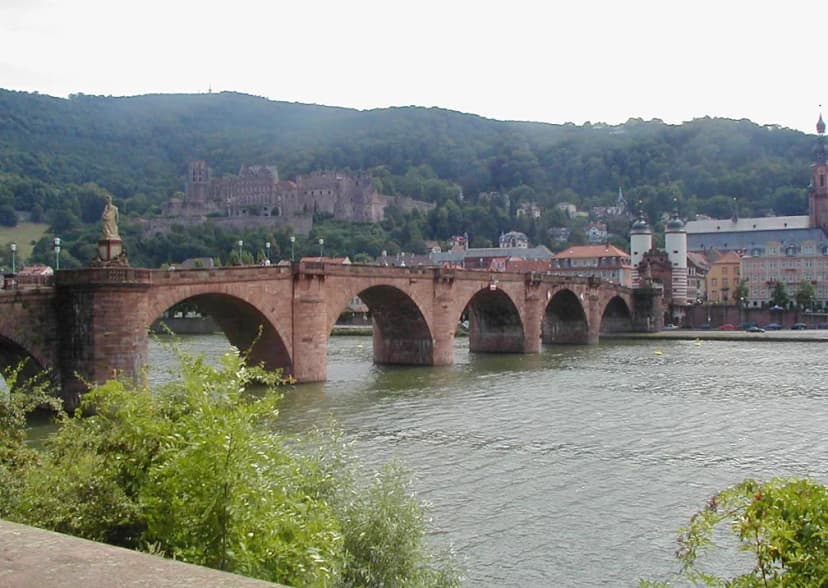
Heidelberg rewards photographers at dusk because the castle, the Old Town rooftops, and the Neckar sit inside a single view from the north bank. You do not need a paid platform or a timed ticket to get that composition. The Old Bridge, officially the Karl Theodor Bridge, is a public pedestrian site in the open air and is accessible 24 hours a day, year-round, with no tickets or advance booking required for a walk across, which makes it the dependable fallback when the light moves faster than you do.
The second position is a hillside path. Independent route notes recommend starting from the Alte Brücke and climbing the Schlangenweg steps if you only have time for one direction, because the arrival itself is the payoff. Those same notes suggest allowing roughly 30 to 60 minutes for the 1.9-mile (3 km) path at a leisurely pace, plus another 20 to 30 minutes each way if you are walking up from the Old Town; treat that as a planning aid rather than a rule.
Use this guide as a decision tool: pick a viewpoint, pick a frame, and keep an exposure routine you can repeat as the light drops. For broader city planning around the same trip, start with the Heidelberg: Itineraries and City Travel Guides hub.
Why Heidelberg Holds Together in One Frame
From the north side of the river, the three ingredients of a Heidelberg photograph line up rather than stack: the castle sits high on its hill, the Neckar occupies the lower third, and the Old Town's roofs and church tower fill the space between. That vertical order means you can make a strong picture without moving your feet, simply by changing how much river you include. The Neckar's width also gives you a bright band for reflections when the sky turns warm.
The city's own marketing describes Heidelberg as a place whose heart beats between the castle view, the banks of the Neckar and the old town streets, which is effectively a description of the sunset composition. For a photographer, that means the interesting subject is the relationship between the three, not any single landmark in isolation.
If you want to name the parts of that frame before you shoot them, the hub of Heidelberg: Landmark Visitor Guides breaks the city into individual sights so you can see what you are actually photographing.
Viewpoint One: the Philosophenweg Arrival via the Schlangenweg
The Philosophenweg runs along the northern slope of the Heiligenberg, opposite the castle, and offers a wide view of the Old Town, the river, and the castle together. Independent route notes recommend starting from the Alte Brücke and climbing the Schlangenweg steps if you only have time for one direction, because the arrival is the part you came to photograph: you crest the steps into the cypresses and the whole panorama is already in front of you.
The same source suggests allowing roughly 30 to 60 minutes for the 1.9-mile (3 km) path itself at a leisurely pace, plus another 20 to 30 minutes each way if you are walking up from the Old Town. Read those numbers as a planning aid rather than a rule, because your pace changes with gear, stops, and how often you put the bag down.
A separate hiking description notes the path is about two kilometres long on the sunny slope of the Heiligenberg, that the Schlangenweg winds up for almost 500 metres in a zigzag of paving and stairs, and that the last viewpoint before the top is particularly rewarding. Brick seating areas appear behind many of the bends, so treat them as breathing stops rather than photographic positions.
Another walker's account puts the path at about 1.5 miles, describes it as paved at the start and turning to dirt with stairs involved, and calls the paved section easy with a couple of moderate uphill parts. The variation between these figures is a useful reminder to budget time generously and to verify the route on the ground rather than trusting a single distance estimate.
What the Philosophenweg Costs You in Effort
The Philosophenweg is free to walk and can be visited at any time of day, with sunrise and sunset named as the best bets for good views and solitude. There are no published opening hours, tickets, or lighting arrangements for the path, so plan around daylight and carry your own light rather than expecting the route to be served by infrastructure.
One walking report explicitly warns to be careful at night because the route has tripping hazards and some drop-offs, which matters more if you are carrying a tripod and a bag in the dark. That is generic caution from a visitor account rather than an official safety statement, so weigh it against your own footing and the light you have. If you want the same panorama without a camera in hand first, the Heidelberg viewpoints and sunset overview puts this path alongside the city's other elevated options.
The path passes university buildings of the physics faculty and one of Heidelberg's more expensive residential areas, and the garden section is dotted with memorials and plaques. A sunset session here is therefore a walk through a lived-in neighbourhood, which shapes both how you move and how much noise you make.
Viewpoint Two: the Alte Brücke and Its River Foregrounds
The Old Bridge, officially the Karl Theodor Bridge, is built of red Neckar sandstone and spans the river between the Old Town and the Neuenheim district. Because it is fully pedestrianised, you can stand mid-span and frame the castle on the hill with the river running below and the Old Town roofs along the bank.
At the city-side entrance a medieval gate with twin towers marks what was once part of the fortifications, and the bridge carries monuments to Elector Karl Theodor and to Minerva. The popular bronze monkey with its mirror stands near the south entrance, which makes it a foreground subject in its own right when the light is low and flat.
Because the bridge is open around the clock with no ticket, it is the one Heidelberg sunset position you can use without any timing risk. Arrive, shoot, and leave whenever you like; the trade-off is that a bridge deck gives you less elevation than the hillside and a narrower slice of the valley.
Choosing Between the Hillside and the Bridge
Pick the Philosophenweg when you want the classic elevated panorama with the castle, river, and Old Town layered in one frame, and you are willing to spend time and effort getting there before the light goes. Pick the Old Bridge when you want certainty, close foreground interest like statues and the gate, and an easy exit after blue hour.
Doing both in one evening is realistic if you start high and finish low: climb first, shoot the wide frames while colour is still in the sky, then descend and cross to the bridge for the darker, more contrasty river shots. The uphill section is the part that dictates your start, so treat the climb as part of the session rather than a prelude to it.
If you would rather extend the same evening into a longer programme of city shooting, the Heidelberg photography guide covers composition and subject choices beyond the sunset window.
Framing Decisions That Change the Picture
At the crest of the Schlangenweg the cypresses and planted edges sit between you and the valley, so a wide composition includes foliage as a natural border rather than dead space. Moving a few steps along the path changes how much of the castle is screened, which is often the fastest way to improve a frame without changing any settings.
The path continues past the Merianausblick, where benches face the view, and on to the Philosophengärtchen, the small garden with busts and inscriptions to poets such as Eichendorff and Hölderlin. These features are options for foreground interest, but a memorial in the corner of your frame usually competes with the valley rather than supporting it.
From the bridge, the strongest decisions are horizontal: how much of the gate towers to include at one end, and how much empty water to leave in the lower frame. Reflections need calm surface, so watching for boats and swans before you release the shutter is more effective than trying to correct a smeared reflection afterwards.
Blue Hour Exposure in Plain Language
Treat these as sensible defaults rather than rules, because every camera and every evening differ. Set the lowest practical sensitivity for clean files, choose an aperture that keeps both the castle and the near river acceptably sharp, and let the camera meter for the sky rather than the dark rooftops; if the sky blows out, nothing later will recover the colour that drew you there. Local photography coverage in the Heidelberg photography guide follows the same principle of exposing for the brightest part of the scene.
Once the sun is gone, exposures lengthen quickly and hand-holding becomes unreliable, so brace the camera on a bridge parapet, a bench, or a wall if you have no support with you. Shooting a short bracket of three frames, one darker and one lighter than the meter suggests, gives you a choice later without slowing you down in the field.
Blue hour is also when the town lights come on and the contrast between warm windows and cool sky becomes the subject. That is the moment to keep shooting rather than packing up, and it is the main reason a hillside session is worth combining with a bridge session on the same evening.
Timing Your Session Without Guessing Clock Times
No source here publishes sunset or blue-hour clock times for Heidelberg, and those times shift through the year, so check a local almanac or a weather service for the date you are visiting rather than relying on a fixed hour. What you can plan is sequence: decide how long the climb takes you, then work backwards from the sky event so you are already in position when colour appears.
If your walk up takes 20 to 30 minutes from the Old Town, as one route report suggests, that is your buffer for the ascent alone, before any stopping. Add time for the step section of the Schlangenweg, which winds almost 500 metres up the slope, and you have a realistic departure time instead of an optimistic one.
Arriving by train puts you at Heidelberg Central Station, from where public transport reaches the city centre and the Old Bridge area; the bridge is also within walking distance of the Old Town, and the Philosophenweg climb starts on the far bank. Check current connections locally on the day rather than planning around a specific service.
Courtesy on a Path That Is Also a Neighbourhood
The Philosophenweg passes homes, university buildings, and gardens, so a sunset session there is a walk through a residential street as much as a viewpoint. Keep voices low, avoid blocking doorways and gates, and do not set up across the full width of a narrow path where residents and other walkers need to pass.
The route also carries benches and planted areas that invite lingering, and the sources describe the garden as a place of memorials to writers and thinkers rather than a viewing platform. Standing aside for a few seconds to let someone through costs you nothing and is the simplest way to keep access open for photographers generally.
On the bridge, the same logic applies at the popular spots: the gate, the statues, and the monkey sculpture attract steady foot traffic. Take the frame, step back, and let the next person through rather than holding a position through a long exposure sequence.
What to Skip and How to Build One Clean Loop
Skip the castle interiors, the funicular, and anything with a ticket on a photography-focused evening, because those add scheduling constraints without improving the sunset frame. The same applies to museum stops such as the Kurpfälzisches Museum, which publishes its own opening hours separately from anything outdoor and is a daytime decision rather than a dusk one.
One workable loop is to cross the Old Bridge, climb the Schlangenweg to the Philosophenweg, shoot the wide view as the sky colours, then walk back down and finish on the bridge deck for river and gate foregrounds. If you want to fold this into a wider visit, the Heidelberg two day itinerary shows how the same viewpoints fit around the rest of the city.
A camera, one spare battery, a cloth, and a small light are enough; heavy kit makes the stair section and the uneven stretches harder than they need to be. Leave behind anything you will not actually use in a two-hour window, and check the weather before committing to the climb.
Plan Your Sunset Session
Heidelberg's advantage at dusk is that its two best sunset positions require no ticket and no booking: the Philosophenweg above the Schlangenweg steps for the wide layered view, and the Old Bridge for foregrounds and a dependable late finish. Choose the hillside when you have time and energy before the light turns, and the bridge when you need certainty.
Check the sunset time for your actual date, allow more time than you think for the climb, and keep an exposure routine you can repeat as the light falls. Confirm current local details such as transport connections and any indoor opening hours with the operator before you travel, since those change independently of the viewpoints themselves.
Frequently Asked Questions
Where is the best place to photograph Heidelberg at sunset?
Two public viewpoints carry most sunset photography here. The Philosophenweg, reached by climbing the Schlangenweg steps from the Old Bridge, gives the elevated view with the castle, the Neckar, and the Old Town in one frame. The Old Bridge itself works for river foregrounds, statues, and the gate, and stays usable after the hillside has gone dark.
Do you need a ticket to watch the sunset from the Philosophenweg?
No. Independent route notes describe the path as free to walk and an option at any time of day, and no opening hours, tickets, or lighting are published for it. Because it is unlit and uneven in places, plan around daylight and bring your own light rather than expecting the route to be lit for you.
Is the Old Bridge in Heidelberg open at night?
Yes. The Old Bridge, officially the Karl Theodor Bridge, is a public pedestrian site in the open air and is accessible 24 hours a day, year-round, with no tickets or advance booking required for a walk across. That makes it the reliable option if you arrive late or want a second angle after blue hour.
Can you photograph Heidelberg Castle from the Old Bridge?
Yes, the castle is one of the main features of the view from the pedestrianised deck, along with the river and the Old Town roofs. The bridge sits lower than the hillside path, so the castle appears within the skyline rather than dominating it, and you will rely more on the river and the gate for foreground interest.
How long does the walk up the Schlangenweg take?
One route report suggests allowing 20 to 30 minutes each way when walking up from the Old Town, and you should budget additional time for the stepped section, which a separate hiking description says winds almost 500 metres up the slope in zigzags. Treat these figures as planning estimates from those sources and adjust for your own pace and gear.