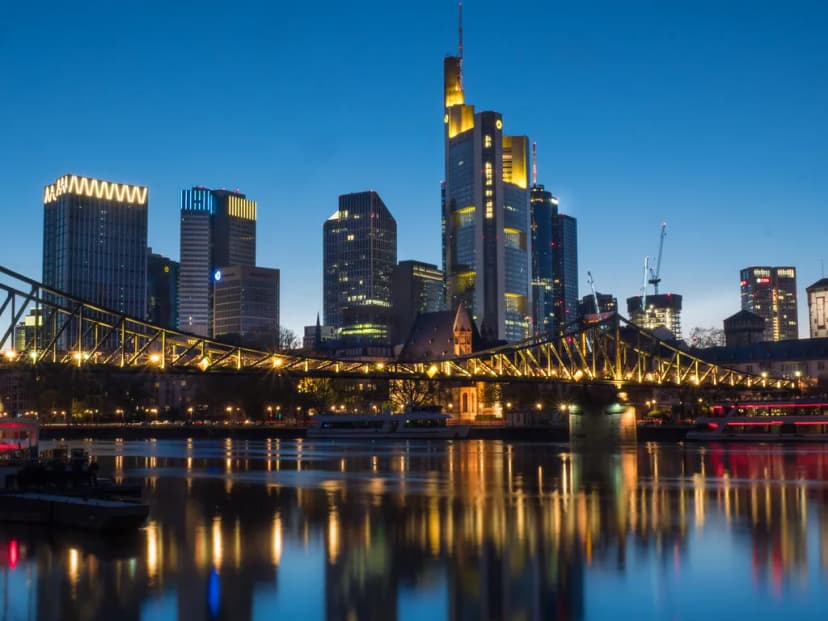
Few European cities let you move from a medieval-style square to a river promenade in one unhurried stroll, and Frankfurt's old town is compact enough to do exactly that. This route treats Römerberg as the starting anchor and the Main riverbank as the flexible finish, so the same spine works for a short orientation walk or a slow afternoon. The squares, lanes and riverside path are public space and free to wander.
Everything beyond the open-air walking is your call: church interiors, the cathedral tower and museum collections are optional and separately ticketed, and arrangements can change with the season. Use what follows as an orientation framework rather than a fixed checklist, then confirm any ticketed stop with the operator before you go. That way a closed door never derails the day.
How the Route Fits Together
Start on Römerberg, drift north through the reconstructed lanes of the Neue Altstadt toward the Kaiserdom, then continue down to the old quay edge at Haus Wertheym. From there the Eiserner Steg carries you over the Main, and the riverbank promenade on either side gives you a free, open-ended place to finish. The sequence is short enough to walk without rushing, and it reverses just as easily if you begin at the water.
Rather than fix a rigid schedule, decide what you want from the day: a quick orientation loop, a slow afternoon with one interior visit, or a longer outing that continues into Sachsenhausen. A published self-guided Frankfurt route suggests the old-town stretch can be covered in as little as three hours, but that is one writer's suggestion rather than an official duration, and your own pace plus any interior visit will change it. Because every stop sits close to the next, you can cut the walk short at any point and still see the old town's core.
Orientation is the one thing worth preparing. Download an offline map or carry a paper plan before you leave, since the Neue Altstadt's narrow passages and courtyards can be disorienting on a first visit. Mark your start, your river crossing point and one fallback cafe, and the route largely takes care of itself.
Römerberg and the Römer
Römerberg is the natural place to begin because it is a free public square that gathers several of the old town's signature sights into one view. The Römer, the ornate building on the west side, has served as Frankfurt's city hall for more than six centuries, and its stepped gable is the postcard image most visitors recognise. You can admire the facade at no cost and at any hour.
Facing the city hall across the square is the Ostzeile, the row of half-timbered houses that was fully restored in the 1980s, and the Fountain of Justice, which dates to the 16th century, stands at the centre. These are outdoor monuments rather than ticketed exhibits, so the square rewards slow looking instead of queuing. Photograph the ensemble from the middle of the square, where the gables and the fountain line up side by side.
Old St. Nicholas Church sits on the south side of the square and dates to the 15th century, having escaped the war with only minor damage. For a broader look at the surrounding lanes and buildings, it helps to have background before you arrive, which is what the Roemerberg and Old Town Frankfurt visitor guide provides. Related guide: Frankfurt Christmas Market Guide: Zones, Food & Crowd Timing.
Paulskirche and Paulsplatz
A short walk from Römerberg brings you to Paulsplatz, described as the largest square in Frankfurt's old town and the setting for St. Paul's Church. The church matters for German history: in 1849 the Frankfurt National Assembly, the first freely elected parliament for Germany, met here, and the constitution drafted in that period influenced later documents. You can walk the square freely and read the setting before deciding whether to step inside.
St. Paul's was nearly destroyed in the Second World War and was rebuilt as a memorial and ceremonial space rather than a parish church. When it is open, entry is free, making it an easy addition to a self-guided route, though you should check the current visitor arrangements on site rather than assume the doors are always unlocked. Paulsplatz itself is a good place to pause, sit and reset your bearings before heading into the Neue Altstadt.
Through the Neue Altstadt and Saalgasse
The district between the cathedral and the Römer, now known as the Neue Altstadt, was rebuilt in recent years after being left in ruins following the war. Reconstruction mixed salvaged original materials with recreated historic forms, so you are walking through a deliberate blend rather than a preserved medieval quarter. Following the traditional coronation route from the cathedral toward the town hall is a simple way to cross the district without getting lost.
Saalgasse is the street that shows the project's other side. Its historic houses were destroyed by fire during the 1944 bombing, and when the area was reconstructed in the 1980s several postmodern architects were invited to design individual buildings, so no two facades match. Walk it slowly and notice how older half-timbered reference points sit beside clearly contemporary forms.
Kaiserdom St. Bartholomäus
The Kaiserdom St. Bartholomäus, also called the Imperial Cathedral of St. Bartholomew, began as a collegiate church in the 14th century and served as the site of Holy Roman Empire coronations between 1562 and 1792. Ten kings were crowned here, which is why the building holds a civic as much as a religious role in Frankfurt's story. You can appreciate the exterior and the setting without buying anything.
Inside, the tower climb is the variable that most changes your day, because the viewing platform is separately ticketed and reached via a long stair. Many walkers find the ground-level church and the surrounding square satisfying on their own, while others consider the skyline view the highlight of the route. If the climb matters to you, treat ticket details, current access and any restrictions as things to confirm with the operator before you commit.
Haus Wertheym and the Old Quay Edge
Just past the cathedral, where the lanes open toward the water, Haus Wertheym gives the route its most tangible piece of surviving fabric. Dating to the early 1400s, it is the only half-timbered house on Römerberg that remained intact after the wartime bombing. Over its long life it has served as a public bathhouse, a customs house and guards' quarters.
The building is a useful landmark as well as a sight, because it marks the shift from the enclosed old town to the open riverfront. Its presence here hints at how the quay edge once functioned commercially, when goods and people moved between the city and the Main. Stand back and look at the timber framing and the low roofline before you continue toward the bridge.
Eiserner Steg: Cross Partway or All the Way
The Eiserner Steg is a pedestrian footbridge over the Main, and it is the clearest decision point on the walk. It connects the old town to Sachsenhausen on the south bank, and the first bridge on this site was built in 1868, while the current structure dates to the 1940s. Because it is a bridge for people rather than vehicles, walking it feels unhurried.
If your goal is the classic skyline view, walking partway across and turning back is a perfectly good choice, and it keeps the rest of the old town within easy reach. If you continue to the far side, you commit to the Sachsenhausen bank and a longer outing. Either way, the crossing is free and open, so the only cost is time.
The Main Riverbank
The riverbank promenade is the free, flexible endpoint that makes this route work for almost any schedule. Both banks offer long, flat paths with skyline views, and you can walk in whichever direction suits your return. Arrange your route so you finish near a bridge, which gives you an easy way back to the north bank and the old town.
This is also where the walk shifts from sightseeing to simply being in the city, so decide in advance how you will handle the return. If you want a fuller riverfront day with a district on the far side, the Frankfurt Mainufer and Sachsenhausen promenade walk is the natural next step.
Optional Extensions
Once you are on the south bank, Sachsenhausen and the Museumsufer stretch of museums along the water are the obvious extensions. Keep one caveat in mind: the riverbank is free, but each museum is separately ticketed, so do not assume one admission covers a whole cluster. Decide which single collection matters most and build the rest of the afternoon around that.
If you would rather stay on the north side, the Wallanlagen park ring follows the line of the old city fortifications and gives you a green, largely flat way to keep walking. A published Frankfurt walking route describes the old fortifications as having been dismantled in the early 1800s, with the land then designated as green space, so the park is a historic layer rather than a modern afterthought. These additions are best chosen by the time you have left rather than planned in detail.
Practical Decisions Before You Go
Time of day shapes this walk more than any other single choice. Mornings tend to be quieter around Römerberg and the Neue Altstadt, while late afternoon and early evening bring out strollers along the Main and make the riverbank the most pleasant part of the route. If you want the bridge and skyline at their best, plan to arrive at the water later in the day.
Before you set out, confirm the handful of details that actually determine your day: whether any church or museum interior you care about is open, whether the cathedral tower is admitting visitors, and whether any special event is taking over a square. The city's official tourism site is the right place to check, and it also covers transport and visitor services if you need them.
If you want to pair this old town spine with the city's other landmarks or spread the visit across more than one day, plan that layer separately. The Frankfurt am Main: Landmark Visitor Guides collection is a sensible place to choose which paid interiors are worth your time.
For a wider set of city-level ideas, including how to break the stay into days, the Frankfurt am Main itineraries and city guides hub gives you the broader framework. Use it once you have decided how much time you want to give the old town itself.
Plan Your Visit
This route works because it asks very little of you: start at Römerberg, thread the Neue Altstadt to the cathedral, pass Haus Wertheym, cross or partly cross the Eiserner Steg, and let the riverbank decide how the day ends. Keep the free public spaces as your backbone and treat every interior, tower and museum as an optional add-on with its own ticket.
If you want to build a longer Frankfurt stay around this walk, the Frankfurt two day itinerary: museums, old town and Mainufer gives you a structure for stretching the same geography across two days. Otherwise, pick one ticketed stop, confirm its current details, and leave the rest of the route open.
Frequently Asked Questions
How long does a self-guided walk from Römerberg to the Main riverbank take?
The old town, the cathedral and the riverfront sit close together, so a brisk orientation walk can be a short outing, while adding an interior visit, a tower climb or a longer stretch of riverbank easily turns it into a half day. A published self-guided Frankfurt route suggests the old-town stretch can be covered in as little as three hours, but that is one writer's suggestion rather than an official duration. Set your own pace.
Is the Frankfurt old town walk free, and which stops cost money?
Römerberg, Paulsplatz, the Neue Altstadt lanes, the Eiserner Steg and the Main riverbank promenade are public space and cost nothing to walk. The paid elements are optional extras: the cathedral tower viewing platform, museum interiors and any other separately ticketed attraction. Check current ticket details directly with each operator before you go, and never assume that one museum ticket covers a whole complex.
Can you walk across the Eiserner Steg into Sachsenhausen?
Yes. The Eiserner Steg is a pedestrian bridge connecting the old town to Sachsenhausen on the south bank, and crossing it on foot is free. You can also walk only partway for the skyline view and turn back, which keeps the rest of the old town within easy reach. If you cross fully, plan your return over a bridge so the riverbank walk becomes a loop.