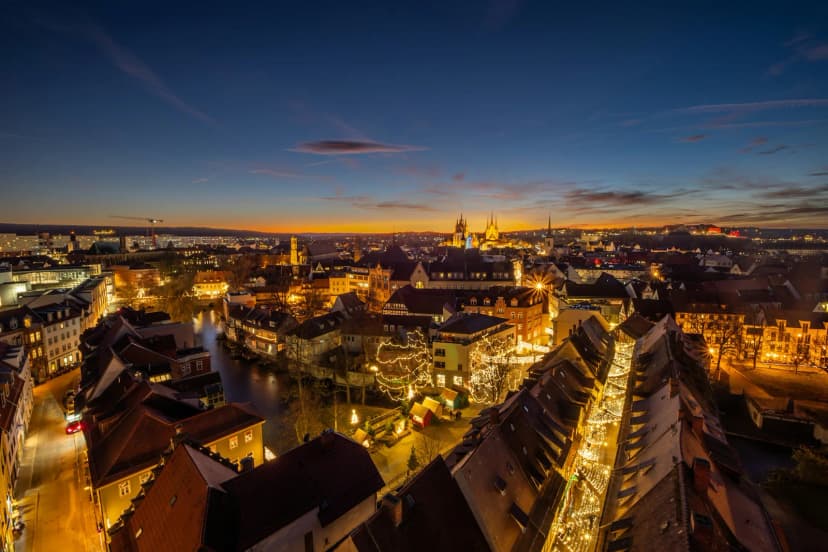
Erfurt's Old Town is compact enough that many visitors see the Merchants' Bridge, the cathedral and St. Severus in a single morning and call it done. What that route skips is a second layer: the medieval mikveh, the Stone House, courtyards behind archways, and churches that rarely make the top-ten lists. Treat those as detours you fold into a normal walk rather than separate excursions.
A useful concrete anchor before you start: the Campus Erfurt sights overview lists the Jewish medieval heritage and its associated sites of the Old Synagogue, Medieval Mikveh and Stone House among the city's must-sees, and records that Erfurt has been home to a UNESCO World Heritage Site for this heritage since 2023. That listing reframes those three places as one connected story spread across several addresses, close together in the Old Town.
As a rough suggestion rather than anything official, half a day is enough to combine the Jewish heritage quarter with one quiet church and a riverside stretch, and a full day lets you add courtyards and a look at the Petersberg ramparts without rushing. This guide to Erfurt, with itineraries and city travel guides, links the pieces together so you can judge what fits your own pace.
What 'Hidden Gem' Actually Means in Erfurt
In Erfurt the useful distinction is not famous versus secret but free public ground versus paid interior. Lanes, courtyards, bridges, churchyards and the riverside are open city space; the Old Synagogue museum, the citadel's casemates and tower climbs are interiors that are managed, ticketed or simply opened at set times. Deciding which category a place falls into changes both your budget and your route.
Practical resources such as a guide to free things to do in Erfurt help you build the free half of the day first, then slot in one or two paid interiors where they genuinely interest you. The trap is treating a free viewpoint as a museum, or skipping a courtyard because you assumed a gate meant an entrance fee. If a doorway is open and people are walking through, it is usually public passage.
Erfurt's relatively low international profile is exactly why these quieter corners still feel unhurried, a point a long-form account of Thuringia's highlights makes when it calls the city one of the cutest hidden gems it has visited. The same account notes the old town survived the Second World War largely intact, which is why the lanes read as a continuous historic fabric rather than a reconstruction.
The Jewish Heritage Layer: Old Synagogue, Mikveh and Stone House
The three sites work best understood as one narrative rather than three separate stops. Campus Erfurt lists them together under the UNESCO World Heritage designation for Jewish medieval heritage, which is the clearest sign that the city itself presents them as a set. The Old Synagogue holds the museum collection, the mikveh preserves the ritual bath, and the Stone House is a domestic building tied to the same quarter.
A broad round-up of Erfurt's things to do places the Old Synagogue in the context of a city with a deep Jewish medieval history and notes that the building itself is worth looking at even from outside. That is a genuinely useful fallback: if you only have time to stand in the lane and read the exterior, you still walk away with something. What you cannot assume is that the museum interior, the mikveh and the Stone House share a single admissions arrangement.
Before you build a day around these interiors, check the operator's own pages through Erfurt Tourismus for current opening arrangements and how each site is ticketed, since that information changes. Map the three addresses on foot first, because they sit close enough that walking between them takes minutes rather than a journey. Doing that also shows you how much ordinary street life still surrounds the heritage quarter.
The Mikveh and the Stone House: Easy to Walk Past
Both buildings are the kind of place you pass without registering unless you know what you are looking for. The mikveh is essentially a below-ground structure associated with a ritual bath, so its significance sits in the archaeology and function rather than a grand facade; the Stone House reads as a solid medieval domestic building rather than a monument. Slow down, look at ground level, and read whatever panel stands outside.
Reading them alongside the Old Synagogue is what makes each one legible: one is worship and community, one is ritual practice, one is everyday life. The UNESCO framing on Campus Erfurt's sights page explains why they are treated as an ensemble, which is more useful to you on the ground than any single building's superlatives. Claims about a building's age are best treated as attributed rather than settled fact.
The Stone House has its own visitor guide if you want to plan that interior properly before you commit to it. Anyone with a serious interest in the medieval Jewish quarter should otherwise plan on more time here than the map suggests, because the interest is in detail rather than scale. Confirm access specifics with Erfurt Tourismus before travelling rather than relying on older write-ups.
Quieter Churches: St. Aegidien and St. Severus
St. Aegidien sits at one end of the Merchants' Bridge and forms part of the bridge entrance, which makes it the easiest church in Erfurt to fold into a walk you were already doing. The Erfurt round-up notes the church dates back at least to 1325 and that its tower, the Red Tower, offers views over the bridge and Old Town. Treat the tower as the optional add-on rather than the main event, and check current access before you climb.
St. Severus stands directly beside the cathedral, which is precisely why people overlook it: they photograph the pair from the square and walk away. The same round-up describes its twin towers, carved portals, vaulted interior and historic organ, all of which reward a proper look once you are inside. If you only have time for one quieter church, pick St. Severus for architecture and St. Aegidien for convenience.
Do not assume the cathedral and St. Severus operate on a single shared ticket simply because they share the hill; they are separate institutions and each manages its own access. Walk up from the Fischmarkt and you will pass through the heart of the old town on the way, which is a better approach than arriving from above. An Erfurt Altstadt walk keeps you in that fabric instead of hopping between isolated monuments.
Courtyards and Lanes: Look Through the Archways
Erfurt's lanes reward a specific habit: when you pass an open archway, look in. Many lead to inner courtyards with timber galleries, workshops and small gardens that are simply part of the building's everyday life rather than attractions. The rule is easy to apply, and it is what turns a fifteen-minute walk into an hour of looking.
The same holds for the small architectural details around the old town: carved portals, painted facades, house signs, and the checkerboard and decorative flourishes that mark historic merchant houses. The Stadtmuseum's building is a good example of a facade that repays close reading, as the round-up of Erfurt sights points out, even if you never step inside. Walking without a checklist is the point here.
The Fischmarkt is the natural anchor for this kind of slow wandering, since it is both a square worth sitting in and the junction where several lanes meet. From there you can drift into side streets in any direction and still find your way back within minutes. It is also the least stressful place to decide your next move over a coffee.
A Slower Route Back: Gera River and the Small Island
The Gera runs through Erfurt and gives the city a quieter edge than the squares. A practical approach noted in the round-up of Erfurt things to do is to start at the Venedig park and follow the riverside path toward the Lehmannsbrücke, then continue near the old town where a small island sits mid-river. Treat the whole thing as a walk, not a sight.
The same source points out animal sculptures along the island path and flower boats near the Schlösserbrücke, which gives the walk a light treasure-hunt quality if you are with children. Those details make the river the best mood-break in a day otherwise heavy with churches and museums. Carry on to the bridge you have not yet crossed and you close the loop back into the centre.
Timing matters more than anything else here, because the appeal is daylight through the trees rather than a destination. Late afternoon works better than midday, when the old town is at its busiest. This fits naturally into a one day in Erfurt itinerary if you are working with a single day.
Bach Plaques, KiKa Statues and Other Small Details
The Bach family's connection to Erfurt predates Johann Sebastian, and the buildings at Junkersand carry plaques for the family and for Johann Pachelbel, as the Erfurt round-up notes. That makes it a stop for people who already know the music rather than a general sight, and five minutes is enough if the doors are shut. If you are not already interested, spend the time elsewhere.
The KiKa statues are the deliberate counterweight: a public art trail of children's television characters scattered across the centre, including the perpetually gloomy Bernd das Brot in the Fischmarkt. Families get an obvious quest out of it, and adults get a break from medieval history without leaving the old town. Combine the hunt with a square you were already visiting.
If your appetite for lesser-known city corners runs beyond Thuringia, comparisons with other German cities can be useful for calibrating how much walking you actually enjoy. Similar guides on hidden gems in Dresden and hidden gems in Berlin set a reasonable expectation that the best material is often domestic rather than monumental. Build the Erfurt day around texture and you will not be disappointed.
Building a Detour Route Without Overfilling It
The practical rule in Erfurt is to group by proximity rather than by theme. The Jewish heritage sites, St. Aegidien and the Fischmarkt sit close enough to combine into one unhurried loop; the cathedral hill and St. Severus are their own short block; the Gera walk and the island are an evening or late-afternoon add-on. That structure keeps you from crossing the city repeatedly.
If you are staying multiple days, spread the second layer across them and leave one or two things for another visit, since these are the places that suffer most from being rushed. A flexible 3 days in Erfurt itinerary gives you room to absorb the centre properly and still keep the riverside and the citadel separate. Fewer stops done well beat a full list.
All of the individual landmarks mentioned here, from the mikveh to St. Aegidien, are broken out in more detail in separate visitor guides. That is the right place to check one named site properly before you commit time to it. Erfurt: Landmark Visitor Guides collects them in one place so you can plan the interiors in advance.
Mistakes to Avoid
The most common error is assuming that sites grouped together in a complex share one ticket. The cathedral and St. Severus are the clearest case in Erfurt, and the UNESCO-listed Jewish heritage sites are three separate addresses rather than one building. Each has its own management, and each needs its own check before you go.
The second error is mistaking free grounds for paid attractions, or the reverse: the architecture in the old town and the lanes are open space with no entry requirement, while the citadel's interior areas and the tower climbs are managed visits. The third is skipping an interior because the exterior looked closed, when the entrance is simply round a corner. Walking the full perimeter usually resolves it.
The last mistake is treating the second layer as a checklist to be completed. These places are small, quiet and best absorbed slowly, and two of them in an afternoon is a good outcome. If you must cut something, cut a distant add-on rather than the courtyards you would have wandered through by accident.
Plan Your Visit Around the Quiet Places
Erfurt's lesser-known layer is not hidden in the sense of being difficult to reach; it is simply overshadowed by a bridge and a cathedral that dominate every photograph. The mikveh, the Stone House, the archways you look through, and the riverside path are all within the same compact old town, so the only real cost is a slower walking pace.
Check the Erfurt Tourismus website for current visitor information on the Jewish heritage sites and the museums before you travel, since access and ticketing arrangements are the details most likely to have changed. Everything else you can decide on the day. Keep the route loose and the detours will look after themselves.
Frequently Asked Questions
What are the hidden gems in Erfurt?
The strongest candidates are the medieval mikveh and the Stone House in the Jewish heritage quarter, the quieter St. Severus beside the cathedral, St. Aegidien at one end of the Merchants' Bridge, the courtyards you glimpse through archways, and the Gera riverside path with its small island. These work as detours within a normal old-town walk rather than as separate trips, and the surrounding lanes and public space are free to walk. Campus Erfurt groups the first three sites as the city's UNESCO-listed Jewish medieval heritage, so treat them as one connected story rather than three unrelated stops.
Is the medieval mikveh in Erfurt worth visiting?
It is worth it if you are interested in how the medieval Jewish community lived and practised rather than in grand architecture, because the structure is functional and easy to overlook. Read it alongside the Old Synagogue and the Stone House, since Campus Erfurt presents the three together as Erfurt's UNESCO-listed Jewish medieval heritage. Check the operator's current visitor information before planning your day around access to the interior, and do not assume one admission covers all three addresses.
Do the Old Synagogue, mikveh and Stone House share one ticket?
Do not assume they do. They are presented as one heritage group, but Campus Erfurt lists them as associated sites rather than stating that a single admission covers all three, and they sit at separate addresses. Check each site's own visitor information through Erfurt Tourismus before you go, and plan your time so that an interior which turns out to be inaccessible does not derail the rest of the walk.
Which quieter Erfurt church should I pick if I only have time for one?
Choose St. Severus if you want architecture, since it sits beside the cathedral with twin towers, carved portals, a vaulted interior and a historic organ, and it is routinely overlooked by people photographing the pair from the square. Choose St. Aegidien if you want convenience, because it forms part of the Merchants' Bridge entrance and folds into a walk you were already doing. They are separate institutions from the cathedral, so do not count on one shared ticket.
What can I see in Erfurt for free?
The lanes, squares, courtyards you can look into, the river paths and the bridge itself are open city space with no entry requirement. Both Happy to Wander and the Thuringia account note that the old town survived the Second World War largely intact, which is why wandering it is worthwhile in itself rather than a way of getting between paid sights. Some church interiors are open to visitors, but confirm current arrangements through Erfurt Tourismus rather than relying on older write-ups.