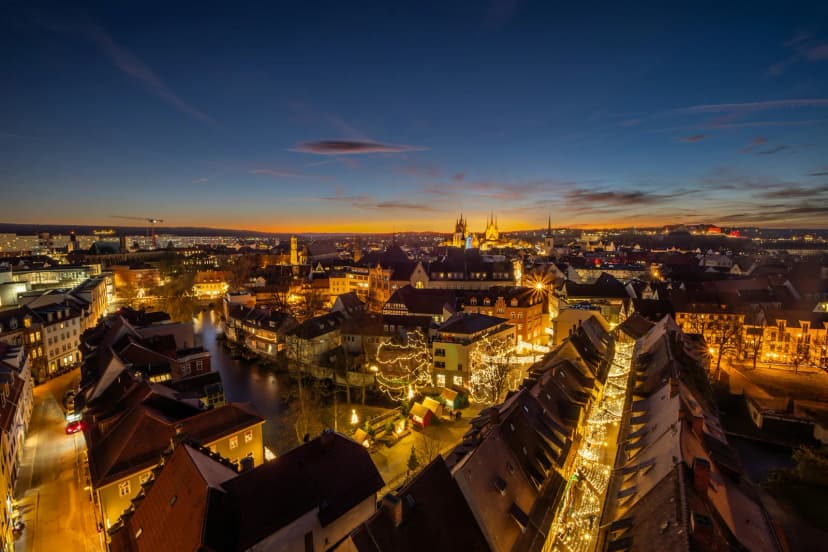
Erfurt rewards travellers who would rather walk than spend. The Thuringian capital holds one of Germany's largest intact old-town cores, and its headline sights sit within a few minutes of each other, so a free day here is mainly a matter of knowing which entrances cost nothing and which do not. This guide covers the genuinely free experiences and flags the paid interiors so you can budget honestly.
The single most useful distinction is between grounds and interiors. The free grounds of Petersberg Citadel are open to walk, while the tunnels, exhibitions and museum there are ticketed; the cathedral interior is free to enter, while a climb up the Ägidienkirche tower at the end of the Krämerbrücke involves a small fee. Once you separate those, Erfurt becomes a cheap city to explore on foot, and the Erfurt landmarks hub is the place to plan the individual stops.
Free Sights at a Glance
The free core of Erfurt fits inside a compact loop: the Krämerbrücke and its shops, the Fischmarkt with its neo-Gothic town hall, Domplatz with the cathedral and St. Severus, the free ramparts of Petersberg Citadel, and the Augustinian Monastery church and grounds. Erfurt Tourismus lists these among the city's principal places of interest and calls the old quarter Germany's largest single heritage site. Treat that list as your starting point rather than a checklist to complete.
Beyond those headline stops, wandering itself costs nothing. The lanes of the Andreasviertel, the Gera riverbanks near the so-called Little Venice, and the many church exteriors scattered through the centre are all open to anyone passing by. As an editorial suggestion rather than an official figure, budget roughly half a day for the free essentials and a full day if you add the citadel and the monastery properly. For wider planning, see Erfurt Altstadt Walk.
Start on the Krämerbrücke
The Krämerbrücke is the obvious first stop and the one sight nobody misses. It is a stone bridge lined with inhabited half-timbered houses, making it one of the longest sequences of inhabited buildings on any bridge in Europe, and crossing it feels like walking down any other narrow street until you notice the river passing beneath the gaps. Approach from the Fischmarkt end and you arrive with the bridge framed ahead of you.
The shops on the bridge are small, independent and deliberately not the usual souvenir trade, with artisans, galleries and food producers taking the units. Descriptions of the bridge note that the businesses are chosen for character rather than volume, which is why browsing takes longer than you expect. Allow time for the window displays alone, especially the puppet tableaux on the bridge and along the lane leading towards the cathedral.
At the far end of the bridge stands the Haus der Stiftungen, the house of the foundation that maintains the bridge. Accounts of visiting it describe a small exhibition about the bridge's history with no admission charge, plus a basement room built into a bridge pillar with a low window looking out over the water. It is a short stop that explains why the bridge looks the way it does, so make it your first free interior rather than your last.
Fischmarkt and Domplatz: The Two Main Squares
Fischmarkt is Erfurt's central square and the one you will cross without meaning to. Erfurt Tourismus describes the neo-Gothic town hall on its edge as built between 1870 and 1874, with murals inside depicting legends from the city's history, and the surrounding patrician houses carry decorated Renaissance facades worth a slow look. Trams pass directly across the square, so check behind you before stopping for photographs.
Domplatz is the grander of the two, a broad open space below the cathedral hill. From here you get the classic view of the cathedral and St. Severus side by side, and the citadel rises behind you on the other side of the square. Both squares are public space with no admission, and both are lined with cafe terraces where the only cost is whatever you order.
A useful free extra sits right on Fischmarkt: the Kunsthalle occupies the House of the Red Ox, and descriptions of the gallery note that its regularly changing contemporary art exhibitions usually carry an admission fee but open free on the first Tuesday of the month. If your dates are flexible, that Tuesday is worth knowing about. Always confirm the current arrangement with the gallery before planning around it.
Erfurt Cathedral and St. Severus
The cathedral interior is free to enter, which surprises visitors who assume a building this size charges admission. Erfurt Tourismus notes that the late Gothic cathedral with its high Gothic choir and Romanesque tower replaced a church built on the site for Bishop Boniface in 742, so the building you walk into carries more than twelve centuries of rebuilding. Enter from Domplatz and take the steps up between the cathedral and St. Severus.
Inside, the things worth lingering over are free to look at: a large medieval mural of St. Christopher, the bronze Wolfram candelabra, and the carved wooden choir stalls. The cathedral's fourteenth and fifteenth-century stained glass survived the war largely intact, and accounts of the windows treat that survival as the reason so much original glass remains in place. Photography conditions and any cordoned areas change, so follow whatever signage is in force on the day.
The Gloriosa bell is the detail most visitors ask about, and it is where expectations need adjusting. It is one of the largest free-swinging medieval bells anywhere, but it rings on special occasions and holidays rather than to a published daily schedule, so it is not something you can plan a visit around with certainty. If hearing it matters to you, check the cathedral's own ringing information close to your travel dates rather than relying on any fixed timetable.
Petersberg Citadel: Free Grounds, Paid Interiors
The free grounds of Petersberg Citadel offer the best free viewpoint in the city. The star-shaped baroque fortress sits on the hill above Domplatz, and walking its ramparts, courtyards and outer walls costs nothing; Erfurt Tourismus describes it as the only extensively preserved baroque town fortress in central Europe. The climb up from the cathedral square is short, and the reward is the whole old town laid out below you with the cathedral towers in the foreground.
What is not free is the interior layer: the listening tunnels where soldiers waited for enemy sappers, the citadel museum and the multimedia exhibition are ticketed. Accounts of the tunnels describe a guided walk that ends inside the fortress museum, which is why it cannot be done independently at no cost. Decide in advance whether you want the underground tour or just the panorama, because they are separate experiences.
One more free pleasure sits on the hill: the view from the fortress terrace over the city, particularly in late afternoon when the light hits the cathedral from the west. The glass-fronted Glashütte restaurant on the site is a paid stop, but nothing obliges you to buy anything to enjoy the outlook from the public areas. Wear shoes with grip if it has rained, since the ramparts and slopes are uneven.
The Augustinian Monastery and Luther's Erfurt
The Augustinian Monastery is a short walk northwest of the old town and a free stop for the essentials. Erfurt Tourismus dates the church and monastery to around 1300 and records that Martin Luther was admitted to the monastery on 17 July 1505, which is why the site draws Reformation-minded visitors. The church and the grounds are open to walk through at no charge; the atmosphere is quiet and cloister-like rather than museum-like.
Beyond the free church and grounds, the monastery operates as a study centre with extras: guided tours, library access and simple overnight accommodation are separate offers with their own terms. Guides are not always available in English on the spot, so if you want interpretation, ask at the visitor point on arrival rather than assuming. Check the monastery's own visitor information for current tour times, since these change with the season.
Jewish Heritage for Free: The Mikveh Viewing Window
Erfurt's medieval Jewish heritage is UNESCO-listed, and part of it can be seen without paying. The mikveh, a ritual bath of medieval origin in the old town, was among the sites selected for inclusion in the World Heritage List alongside the Old Synagogue and the Stone House, and a viewing window in the park lets you look down into it freely. That window is the free option; the interior is reached with a guide or on a scheduled tour.
The mikveh itself was unearthed in the cellar of a building in Erfurt and reported at the time as a two-storey-high structure in good condition dating to the thirteenth century, which makes the free glimpse into it genuinely unusual. The Old Synagogue nearby is the other half of the story, and it is described as one of the very few preserved medieval synagogues in Europe, now housing a museum on Jewish life in Erfurt and the medieval Erfurt Treasure. Entry to that museum is paid, so treat the exterior as the free stop and the interior as a deliberate purchase.
Wandering the Old Town, Riverbanks and Little Venice
The best free activity in Erfurt is simply walking, and the geography rewards it. The old town escaped the wartime destruction that flattened many German centres, which is why so much half-timbered and Renaissance fabric survives, and the streets between the cathedral and the river are where the city looks its best. Aim to get slightly lost between Michaelisstraße, the Andreasviertel and the lanes behind the Krämerbrücke.
Follow the Gera where it splits into small channels south of the old town and you reach the area nicknamed Little Venice, where the water runs between gardens and houses. A short riverside path from the Venedig park area onwards is a good free alternative to another museum, and the bridges give you views back to the Krämerbrücke from the side. This is also where you will find the flower boats and riverside sculptures that appear in most photo collections of the city.
Two free details are easy to miss. Look for the stone seats beside old doorways that locals once used to sit and watch the street, and for the small signs above lintels giving houses names like the House of the Sun. Both are scattered across the centre and cost nothing to find, and they turn an ordinary walk into a scavenger hunt.
What Is Not Free Nearby
Several Erfurt attractions that appear on free lists are not free at all. The Ägidienkirche tower at the end of the Krämerbrücke is a paid climb, the Old Synagogue museum and its Erfurt Treasure display charge admission, egapark Erfurt is a ticketed garden, and the municipal museums have their own entry terms. Plan for these as purchases rather than free add-ons so the day adds up the way you expect.
The free-entry museum day is a real thing but a scoped one. Erfurt's municipal museums open without charge on the first Tuesday of each month, and the Museum für Thüringer Volkskunde publishes that free Tuesday alongside its regular admission categories and opening days, so the rule is specific to those houses rather than a citywide giveaway. Check each museum's own visitor information for the current terms before you build a trip around that Tuesday, and note the Volkskundemuseum is closed on Mondays.
One caution about complex sites: do not assume a single ticket covers everything inside a fortress or monastery, because tunnels, exhibitions and museums are frequently run as separate offers with their own access arrangements. Confirm what a given ticket includes at the point of sale, then decide whether the interior is worth it to you or whether the free layer already gives you what you came for.
Suggested Free Routes by Duration
For a free half day, start at the Krämerbrücke, walk the bridge and look into the Haus der Stiftungen, then cross to Fischmarkt for the town hall facade and continue up to Domplatz for the cathedral interior and St. Severus. Finish on the Petersberg ramparts for the view. This route is continuous and mostly flat apart from the climb to the cathedral and the citadel, and it needs no transport at all. This timing is a suggestion, not an official figure.
For a full free day, add the Augustinian Monastery before or after the cathedral, detour to the mikveh viewing window, and spend the late afternoon on the Gera riverbanks and in the lanes around Little Venice. Break the walking with a stop in one of the squares rather than trying to see everything back to back. Because the centre is compact, you can reorder these freely without wasting time in transit.
Access and Practical Notes
Opening windows at Erfurt's churches vary, and some sights reduce their hours or close on winter weekdays, so the one thing worth doing before any free day is checking the current status of the specific buildings you care about. Church interiors in particular can be closed for services, restoration or simply because no one is on duty. Treat any timing suggestion here as a rough guide and verify with the operator on the day.
Surfaces matter as much as schedules. The old town is largely cobbled, the climb to the cathedral and citadel involves steps and slopes, and the tower staircases are narrow and steep where they exist at all. Comfortable shoes are not a cliche here, and if anyone in your group has mobility limitations, plan the free ground-level route through the squares and riverbank rather than the hilltop climbs.
Plan Your Free Day in Erfurt
Erfurt's free layer is generous and geographically tidy: the bridge, the two main squares, the cathedral interior, the citadel grounds and the monastery church can all be done on foot in a day without paying an entrance fee. Spend your money on the interiors you actually care about, whether that is the tunnels, the Old Synagogue museum or the tower climb. Verify current opening arrangements for churches and the mikveh before you travel, since those are the pieces most likely to shift. For related planning, see Theater Erfurt: A Visitor's Guide to an Evening of Culture.
Frequently Asked Questions
What can you see in Erfurt for free?
Walking the Krämerbrücke and browsing its independent shops costs nothing, as does the small exhibition in the Haus der Stiftungen at the end of the bridge. The Fischmarkt and Domplatz squares, the cathedral interior, the free grounds and ramparts of Petersberg Citadel, the Augustinian Monastery church and grounds, and the mikveh viewing window in the park are all free as well. Beyond those, the old-town lanes and the Gera riverbanks are free simply to wander.
Is the Erfurt Cathedral free to enter?
Yes, entering the cathedral itself is free, and that includes seeing the medieval mural, the candelabra and the stained glass windows. What is not free is anything organised around it, such as a guided tower visit to see the Gloriosa bell. The bell rings on special occasions and holidays rather than to a fixed daily schedule, so if hearing it matters to you, check the cathedral's own ringing information close to your travel dates.
Is Petersberg Citadel free to visit?
The citadel grounds, courtyards and ramparts are free, and the view over the old town from the hill is the best free panorama in Erfurt. The listening tunnels, the museum and the multimedia exhibition are ticketed and generally reached by guided tour. Decide whether you want the underground experience or just the walk and the view before you go up, since they are separate offers.
Can you visit the Old Synagogue in Erfurt without paying?
You can see the building from the outside at no cost, and the Old Synagogue is described among Erfurt's principal places of interest as one of the few preserved medieval synagogues in Europe. The museum inside, including the Erfurt Treasure, is a paid visit. If you want a free encounter with the city's Jewish heritage, the mikveh viewing window in the park close to the Krämerbrücke area lets you look into the medieval ritual bath without charge.
How long do you need for a free day in Erfurt?
A free half day covers the Krämerbrücke, Fischmarkt, Domplatz, the cathedral interior and the citadel ramparts at a comfortable pace. A full free day adds the Augustinian Monastery, the mikveh window and a slow walk along the Gera riverbanks towards Little Venice. These timings are suggestions, not official figures, and church opening windows can shorten any route.
Is Erfurt worth visiting for a budget traveller?
Yes, because the sightseeing core is compact and largely free, so transport costs are minimal once you are in the centre. The main expenses are food, any paid interiors you choose, and the tower climb or museum visits you decide to add. Check the municipal museums' free-entry day terms if you want to stretch the budget further, and confirm current conditions with each site rather than assuming.
Sources
- Places of interest - Erfurt Tourismus
- Startseite: Museum für Thüringer Volkskunde Erfurt | Volkskundemuseum Erfurt
- Erfurt, Germany. 16th Aug, 2023. Erfurt's mikvah, a Jewish ritual bath of medieval origin in the Old Town, is one of the three sites selected for inclusion in the Unesco World Heritage List at the city's request. The Old Synagogue and the Stone House are also among them. Credit: Jens Kalaene/dpa/Ala
- Medieval mikvah found in Germany - Jewish Telegraphic Agency
- egapark Erfurt - Erfurt Tourismus