Plaza de España is free to enter in 2026 — there's no admission ticket for the square itself, no gates to book a slot through, and most visitors budget one to two hours to walk the canal, cross all four bridges, and browse the tiled province alcoves. The plaza has no fixed closing time, though the practical visiting window most guides (and the on-site lighting and boat rental) run to is roughly 8am to 10pm.
Most of the "tickets" and "price" searches around this landmark trace back to a still-unresolved Seville city council proposal to charge non-resident visitors a small fee for part of the plaza — covered in detail below, including where that plan actually stands as of mid-2026. This guide also covers opening hours, how long to plan, how to get there, and the small paid extras — canal rowboats and the on-site military museum — worth knowing about. It's part of our full Seville attractions guide.
What Is Plaza de España?
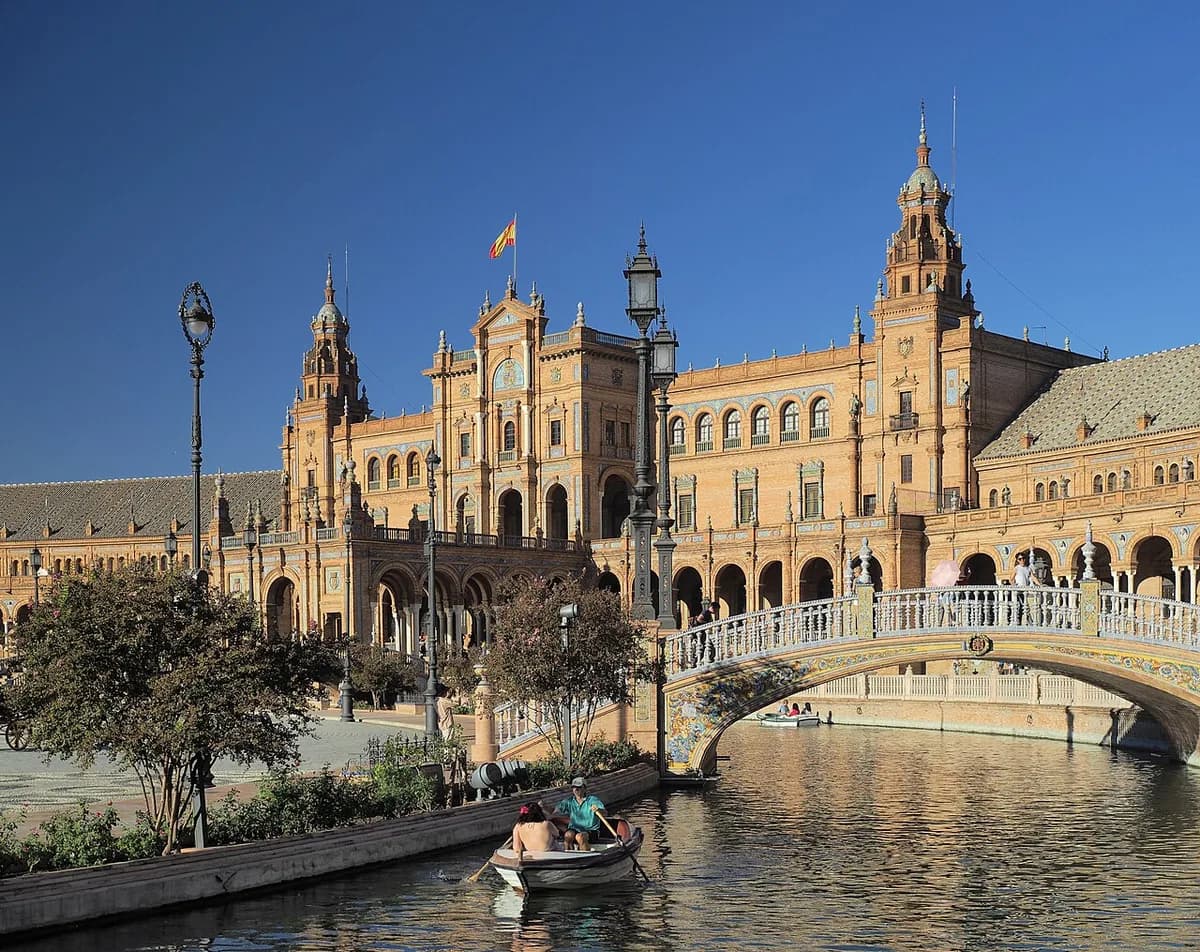
Plaza de España was built for the Ibero-American Exposition of 1929, designed by Sevillian architect Aníbal González and completed in 1928, a year ahead of the fair. It sits inside Maria Luisa Park, immediately south of Seville's historic center, and takes the form of a vast half-circle of brick and tile — roughly 50,000 square meters — wrapped around a 515-meter canal. Four bridges cross the canal, each representing one of the ancient kingdoms of Spain, and a continuous arcaded gallery lines the building's curve, its walls broken up by tiled alcoves — one for every Spanish province — each decorated with a map and a historical scene rendered in ceramic.
The plaza's scale and detail have made it one of the most filmed locations in Spain: it doubled as the capital of Naboo in Star Wars: Episode II — Attack of the Clones, and it also appears in Lawrence of Arabia, The Dictator, and Netflix's Kaos. That combination of architecture and film-location fame is a large part of why it draws heavy day-tripper crowds year-round — and part of why the city has floated new ways to manage and fund its upkeep, including the tourist-fee proposal covered next.
Tickets & Prices 2026
The plaza itself: free. There's no ticket to buy, no timed-entry booking, and no barrier to walk through — you can enter, cross the bridges, and browse the province alcoves at no cost. Two small paid extras exist on-site: canal rowboats rent for around €6 for 35 minutes (bring cash — several recent visitors have reported the rental kiosk not accepting cards), and the Military Historical Museum, tucked into the plaza's interior corridor between the Puerta de Aragón and the north tower, is also free to enter but keeps limited hours (Tuesday–Saturday, 10am–2pm).
The fee headlines come from a proposal Seville's mayor announced in February 2024: roping off the plaza's municipal section — the open area between the outer balustrade and the ceramic province benches — and charging non-resident visitors roughly €3–4 to access it, with revenue earmarked for maintenance and security, and residents of Seville and the province exempt. As of mid-2026, the plaza's own tourism board still lists entry as free and the fee as not yet in force, even though the plan remains politically active and a handful of recently published articles claim a specific rollout date that conflicts with on-the-ground reporting. Treat any "already charging" claim with caution and check the official visitasevilla.es page (linked below) immediately before you travel. If you're weighing whether a broader city pass makes sense regardless, our breakdown of whether the Seville Pass is worth it covers what it does and doesn't include — Plaza de España isn't a paid attraction the pass needs to unlock, but nearby sights often are.
Opening Hours & Best Time to Go
As an open public square, Plaza de España has no ticket booth and no fixed gates, so it's technically accessible at any hour. In practice, most visitor guides — and the plaza's own lighting and boat-rental schedule — treat roughly 8am to 10pm as the useful visiting window; overnight the square is quieter but still walkable and lit.
Early morning, before about 9am, and the hour before sunset are the two best windows: the light on the tiled facades is best then, and the large tour groups that arrive mid-morning and again after lunch haven't yet filled the arcade. Weather-wise, February–March and April–May are the most comfortable months to linger outdoors; July and August afternoons in Seville routinely pass 35°C (95°F), so if you're visiting in peak summer, plan around the heat rather than through it. The plaza also periodically hosts concerts and festivals — past events have included the Icónica Sevilla Fest — which can add crowds or partially restrict access on show nights, so it's worth checking local event listings for your travel dates.
How Long to Plan
Budget 1 to 2 hours for photos, a walk across all four bridges, and a pass along the tiled province alcoves. Add 30 to 45 minutes if you want a rowboat ride on the canal, and another 30 to 45 minutes for the free Military Historical Museum — arrive before 2pm, since it closes early and isn't a full-day operation. Pair the plaza with a walk through the surrounding park and the visit fills a relaxed half-day; combined with the Real Alcázar and the Cathedral, it's the natural third stop on a Seville sightseeing day, and there's room for all three on a proper first visit — see our 2-day Seville itinerary for how to sequence them.
How to Get There
The plaza sits inside Maria Luisa Park, about a 15 to 20 minute walk south of the historic center. The closest metro stop is Prado de San Sebastián on Line 1, a short walk from the plaza's northern edge. Several city bus routes run along Avenida de Isabel la Católica and Paseo de las Delicias, both bordering the park. On foot, it's roughly 15 minutes from Seville Cathedral through Murillo Gardens, and about the same from the Real Alcázar. Driving isn't worth it — on-street parking around the park is limited and metered, and walking or a short taxi from most central hotels is faster than finding a space.
Visit Tips: Queues, Booking & Common Mistakes
There's nothing to book. Entry is free and walk-up, so skip any third-party listing offering a "skip-the-line Plaza de España ticket" — it isn't needed, and what those listings usually sell is a bundled boat ride or guided walking tour, not admission to the square. The most common mistake is assuming the plaza works like the nearby Real Alcázar or Cathedral, both of which do require timed, pre-booked tickets — it doesn't, and that mix-up is a large part of why so many visitors search for "Plaza de España tickets" in the first place.
Bring cash if you want a rowboat, since card payments at the rental kiosk have been unreliable in recent reports. Arrive early or in the evening to avoid both the midday heat and the tour-group crush that peaks mid-morning. Keep an eye on your belongings in the crowded central area, as with any busy plaza. And if the tourist-fee proposal has gone into effect by the time you travel, confirm the exact price through the official signage on-site or the visitasevilla.es page rather than an older article — this one included.
Nearby Attractions
The Real Alcázar, Seville's Mudéjar royal palace, is about a 15-minute walk north through Murillo Gardens. Seville Cathedral and the Giralda, the world's largest Gothic cathedral, is a similar 15-minute walk through Maria Luisa Park. The park surrounding the plaza is Seville's largest green space and worth an hour on its own for its fountains, ceramic benches, and shaded paths — a natural place to cool off between the cathedral, the Alcázar, and the plaza on a hot afternoon.
Frequently Asked Questions
Frequently Asked Questions
Do you need a ticket to visit Plaza de España in 2026?
No. The plaza itself is a free public square in 2026 — there's no admission ticket, timed entry, or booking required to walk in, cross the bridges, or browse the tiled province alcoves. Optional paid extras, like the canal rowboats, are separate and don't require advance booking either.
Is there really a new entry fee for tourists at Plaza de España?
Seville's city council proposed charging non-resident visitors roughly €3–4 to access part of the plaza, first announced in February 2024, with the revenue earmarked for maintenance and security. As of mid-2026, the city's own tourism board still lists the plaza as free and doesn't confirm the fee is active, though the plan remains politically live — check visitasevilla.es for the current status before you travel.
What are the opening hours of Plaza de España?
There are no fixed gates, so the plaza is technically accessible around the clock. In practice, most visitors treat roughly 8am to 10pm as the useful window, since that's when the square is well-lit, staffed, and the rowboat kiosk is open.
How long should I spend at Plaza de España?
Plan on 1 to 2 hours for a walk around the canal, bridges, and tile alcoves. Add 30 to 45 minutes for a rowboat ride, and another 30 to 45 minutes if you visit the free Military Historical Museum inside the plaza (open Tuesday–Saturday, 10am–2pm).
Is Plaza de España worth visiting?
Yes — it's one of Seville's most photographed landmarks, and since it's free, there's little reason to skip it. Go early morning or near sunset for better light and thinner crowds, particularly if you're also fitting in the Real Alcázar and Cathedral the same day.
Plaza de España remains one of Seville's easiest "must-see" landmarks to actually see: free entry, no booking, and a location inside Maria Luisa Park that pairs naturally with a morning of sightseeing. The one thing worth tracking ahead of your trip is the city's on-again tourist-fee proposal — it hasn't changed the price of admission as of mid-2026, but Seville has moved on it before and could again.
Go early or near sunset, budget an hour or two, and treat the plaza as the natural third stop alongside the Real Alcázar and Cathedral on the same day. That's the version of the visit that matches what the square is actually known for.
For current official information, see Seville's official tourism board page for Plaza de España and its Wikipedia entry for full architectural and historical background.