

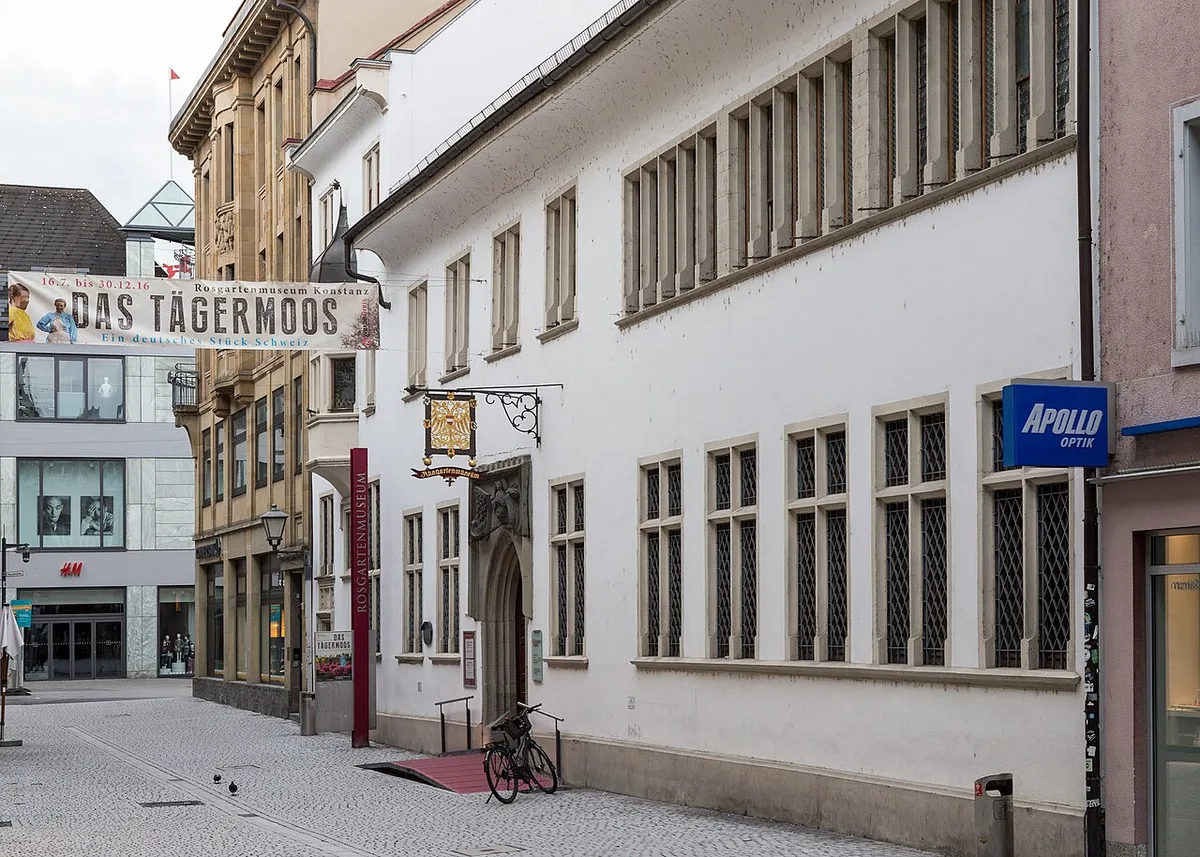
The Rosgartenmuseum sits at Rosgartenstrasse 3-5 in the middle of Konstanz's old town, inside a building that was the medieval guild house of butchers, grocers, apothecaries, stove makers and ropemakers. Founded in 1870 by the pharmacist and city councillor Ludwig Leiner, it is the art and cultural history museum of the city and the Lake Constance region, and the historic fabric of the house is as much the attraction as the objects on display. The museum's own education page lists admission at 3.00 euros per person, with a reduced rate of 1.50 euros and the same rate for groups of ten or more, and notes that guided-tour prices already include admission and the guide fee. It rewards travellers who want context on the region rather than a blockbuster art collection, so decide early whether regional history is your kind of stop.
What the Rosgartenmuseum Is and Who It Suits
This is a regional history museum, not a fine-art treasury. Its permanent exhibition draws on the museum's own collection to trace Konstanz and the Lake Constance area across a range of eras, and the operator also presents changing themed exhibitions that sit alongside the permanent rooms. If you have an hour and want one well-chosen introduction to the region, it works well; if you are chasing major old masters, other venues in the city will suit you better.
The museum describes itself as the art and cultural history museum of the city of Konstanz and the Bodensee region, which is the most honest way to set expectations. Plan it as a deliberate regional-history stop and it will over-deliver; treat it as filler between shopping streets and the mismatch is yours, not the museum's.
Why the Building Is Part of the Exhibit
The house Zum Rosgarten was the guild house of several trades, was first mentioned in 1324 and was merged with the neighbouring house Zum Schwarzen Widder in 1454, according to the museum's own history pages. The regional tourism board describes the result as unique, faithfully preserved halls and rooms from the late Middle Ages, and singles out the listed Leiner Hall on the ground floor as the home of the founder's collection. That combination of intact guild architecture and a working museum is the reason to come in the first place.

Because the historic halls are load-bearing and small, you will move through the building in a relatively compact sequence rather than a sprawling modern gallery. Give the Zunftsaal and the preserved guild rooms a few extra minutes even if the labels do not hold you long, since they are what you cannot see anywhere else in the city. The building is the exhibit, and the collection is the reason it survived.
Ludwig Leiner and the Founding Collection
Ludwig Leiner was a Konstanz pharmacist and city councillor who founded the museum in 1870, and the collection he assembled still shapes what visitors see today. The tourism board notes that objects relating to the history of the city and its landscape have been displayed here since that founding, and that the ground-floor Leiner Hall still houses his collection. A separate society of friends supports the museum, which is one reason a small municipal institution has kept a coherent collection rather than scattering it.
Look for the founder's name on the hall itself when you enter. It is the clearest single label explaining why this building became a museum rather than a shop or a civic office.
What Is Actually on Display
Three strands make up a typical visit: the permanent exhibition on the city and the Lake Constance region, the Leiner collection in the Leiner Hall, and an information point on the UNESCO World Heritage listing of Prehistoric Pile Dwellings around the Alps. The tourism board confirms that the museum informs visitors about the pile-dwelling World Heritage site, and that changing themed exhibitions rotate alongside the permanent displays. A specialist archaeological collection with broader prehistoric and Roman material is a separate museum in the city, so do not expect the Rosgartenmuseum to duplicate it.
Beyond the Leiner collection, the permanent city and regional history exhibition, the Leiner Hall, the Zunftsaal and the pile-dwelling information point, the operator's pages do not single out individual star objects. Treat that as a hint: the pleasure here is accumulation and context rather than a checklist of named treasures, and you should read the room labels rather than hunt for one famous piece.
The Mosbrugger Special Exhibition
The special exhibition Die Mosbruggers: Eine Künstlerfamilie am Bodensee ran from 21 May 2026 to 10 January 2027, according to the museum's own programme. It covered an artist family from Vorarlberg active around Lake Constance, in the neighbouring landscapes and in the Swiss hinterland from 1795 until the death of the last painter, Joseph, in 1869. The works ranged across psychologically intense portraits, representative family pictures, religious motifs, landscape painting and genre scenes.
Because special exhibitions come with their own run dates, check the museum calendar before you travel if a temporary show is your main reason for visiting. If your trip falls after the Mosbrugger run ended, plan around whatever the museum lists next rather than assuming that show will still be on.
Tickets and How the Costs Work
The operator's education and tours page states admission at 3.00 euros per person, 1.50 euros reduced, and 1.50 euros for groups of ten or more, and that guided-tour costs already include both admission and the guide fee. Those figures come from the museum's own page and may not reflect what is charged on the day, so confirm the current prices with the museum before relying on them for budgeting. The Lake Constance tourism listing separately publishes an adult price and a Bodensee Card PLUS arrangement, which shows how quickly third-party figures diverge from the operator's own.
The important structural point is that you pay once for a booked tour: the price bundles entry with the guide, so you should not be charged an admission ticket on top. Third-party resale listings add noise rather than clarity here, and no source states that a Rosgartenmuseum ticket unlocks entry to the other municipal museums in Konstanz. If a combined ticket matters to you, ask the museum directly rather than assuming.
Opening Hours and Planning Your Slot
The Lake Constance tourism board publishes a January-to-December pattern of Tuesday to Friday 10am to 6pm and Saturday and Sunday 10am to 5pm, and a third-party listing shows a similar opening time on the day it describes. Neither is the operator's own live calendar, so treat the pattern as a planning starting point and re-check the museum's site, particularly around public holidays and between seasons. A mid-morning arrival gives you the quietest rooms and leaves the afternoon free for the old town.
A free audioguide is available on demand in German, English and French, which the museum introduced for its 150th anniversary and describes as kostenfrei, meaning free of charge. That is a different product from a guided tour: the audioguide is self-directed and included with your visit, while a tour must be booked and paid for. If your German is limited, the audioguide is the cheapest way to get real interpretation, and it is worth collecting at the start rather than halfway round.
Sequencing matters in Konstanz because the museum sits in the pedestrian old town, which makes it easy to combine with a walk along the lakefront or a look at the harbour. Slot the museum as your indoor anchor and build the rest of the day around it on foot, rather than trying to reach it by car. Keep the ticket confirmation or receipt with you if you plan a same-day return.
How Much Time to Budget
The Lake Constance tourism listing suggests about 60 minutes as a recommended time, which is a useful floor rather than a target. As a suggestion of my own, allow 45 to 60 minutes if you skim the labels and concentrate on the guild rooms and the Leiner Hall, and 90 minutes to two hours if you read the permanent exhibition properly and a special exhibition is running. The audioguide lengthens any visit, so factor it in if you intend to use it in full.
Two separate time budgets are honest here because the building is compact but the content is dense. A quick orientation pass and a read-everything pass feel like different museums, and the second is only worth it if regional history interests you. Decide which one you are doing before you buy your ticket.
The Museum Café and Inner Courtyard
The tourism board describes an inner courtyard and a historic museum cafeteria that encourage visitors to relax in the building's historic atmosphere, and the museum lists the Museumscafé as part of the house. That is the operator's and the regional source's description, not a review of the food or drink on offer, so treat it as a reason to leave slack in your schedule rather than a dining destination. A coffee in the courtyard is the main way a 60-minute visit turns into something closer to two hours.
Because the courtyard and café are inside the building complex, you cannot easily judge their opening pattern from a street-level glance. If the café is a deciding factor for you, ask when you arrive or check the museum's own café page in advance.
Accessibility, Families and Group Visits
The museum publishes a dedicated accessibility page, and its education programme includes guided tours for blind and partially sighted visitors on request, covering the Leiner Hall and the Zunftsaal and using relief paintings and objects to make art tangible, with the tour lasting roughly an hour. It also runs special guided tours for parents with babies up to two years old, a monthly Museenioren afternoon for people aged 60 and over with coffee and cake after an hour-long tour, and themed monthly presentations. For families there are guided tours and workshops, a Kunstclub run with the Kunstschule Konstanz, and children's birthday workshops tailored to a chosen topic.
Several of these offerings require registration and some carry their own fee, so the practical step is to call or email the named contacts on the museum's education page rather than turning up and hoping. Dates for family programmes appear in the museum calendar and in the local press, which is how the operator says it announces them. If you need step-free access or specific assistance, confirm the details before your trip rather than assuming the historic building can be navigated in every configuration.
Booked Tours and City Walks
Guided tours must be booked in advance, according to the operator, and external guides are not permitted to lead tours in the museum. Groups are capped at 25 people for both pre-booked and public tours, and the minimum number of participants is three for public house tours and five for public city walks, which is the detail that decides whether a scheduled public tour actually runs. The operator also states that only English and Spanish guided tours are currently available in foreign languages, so do not assume French or Italian tour guidance. The museum adds a caveat that it cannot run two tours on the same topic simultaneously.
Timing carries money: the operator charges an additional 20 euros if a group starts 15 minutes or more late, which turns punctuality into a real cost. Tour lengths may vary slightly, and the museum offers thematic variants of the permanent and special exhibitions that can be adapted to a group's interests beforehand. If a drink afterwards appeals, the museum says it can arrange one on an individual quote.
Pairing the Museum With the Rest of Konstanz
Because the museum is indoors and in the middle of the old town, it works as the anchor of a wet or shoulder-season day and as a deliberate regional-history stop in a longer itinerary. If you want to compare it against the city's other museums on price, scale and subject matter before committing, work through the Konstanz museum comparison and pass first, then choose one or two rather than trying to do everything.
Two obvious pairings are a prehistory-and-Roman counterpart and a reform-era history stop: the Archäologisches Landesmuseum Konstanz visitor guide for the city's archaeology collections, or the Hus-Haus Konstanz visitor guide if your interest runs to the city's religious and reform-era history. Keep the museum visit to a single slot and leave the rest of the day to walking, since the old town rewards wandering rather than shuttling between ticketed interiors.
If rain is the deciding factor rather than history, a wider set of wet-weather options helps you avoid overloading one small museum. Take a look at Konstanz on a rainy day if you would rather build the day around the weather than around a single collection.
Practical Mistakes to Avoid
The most common error is assuming one ticket covers the other municipal museums in Konstanz. Nothing in the operator's or the regional source's pages states that, so treat each venue's admission separately unless the museum tells you otherwise. The second is arriving without a booked tour and expecting to join one, when tours require advance booking and depend on minimum participant numbers.
The third is trusting third-party reseller prices over the museum's own figures, especially where those pages bundle promotions or card offers that the operator does not describe. The fourth is treating published hours as fixed, when the sensible habit is to re-check before travelling, particularly around holidays. The fifth is expecting a large art collection: this is regional history with a strong historic building, and readers should decide in advance whether that is what they want.
Plan Your Rosgartenmuseum Visit
The Rosgartenmuseum is a compact, well-rooted regional history museum in a genuine medieval guild house, and it rewards a deliberate visit much more than a hurried one. Decide whether you want the 60-minute orientation pass or the longer read-everything version, check the operator's own pages for current prices and hours shortly before you travel, and book any tour in advance if you want interpretation rather than the included audioguide. Then build the rest of your Konstanz day around the old town on foot.
Frequently Asked Questions
What can you see at the Rosgartenmuseum in Konstanz?
The permanent exhibition covers the history of Konstanz and the Lake Constance region, drawn from the museum's own collection, and the ground-floor Leiner Hall still displays the founding collection assembled by Ludwig Leiner. There is also an information point about the UNESCO World Heritage listing of Prehistoric Pile Dwellings around the Alps, plus changing themed exhibitions. The building itself, a medieval guild house with preserved halls and rooms, is a large part of what you are seeing.
How much does admission to the Rosgartenmuseum cost?
The museum's own education and tours page carries the admission figures and states that guided-tour prices already include admission and the guide fee; check that page or ask the museum directly for the current rates before you travel, since published figures can change. Do not rely on third-party reseller listings, which may bundle promotions the operator does not describe. If you hold a regional discount card, ask the museum how it applies.
What are the Rosgartenmuseum's opening hours?
The Lake Constance tourism listing publishes a year-round pattern with longer weekday hours and shorter weekend hours, and third-party listings show similar opening times. Those are not the operator's live calendar, so check the museum's own website shortly before your visit, especially around public holidays and seasonal changes. If you are travelling for a specific exhibition, verify both the hours and the exhibition run dates together.
Is the audioguide at the Rosgartenmuseum free?
Yes. The museum says its audioguide is free of charge and available in German, English and French, introduced for the museum's 150th anniversary. It is a self-directed option included with your visit and is separate from a guided tour, which must be booked and paid for. If you want interpretation but not a fixed tour slot, the audioguide is the simpler choice.
How much time should you budget for the Rosgartenmuseum?
The regional tourism listing suggests around an hour, which works as a minimum. As a suggestion rather than official guidance, allow 45 to 60 minutes for a quick pass focused on the guild rooms and the Leiner Hall, or 90 minutes to two hours if you read the permanent exhibition properly and a special exhibition is running. Using the free audioguide adds time, and stopping in the museum café or courtyard can easily double a short visit.
Do you need to book a guided tour at the Rosgartenmuseum?
Yes, guided tours must be booked in advance, and the museum does not permit tours led by external guides. Groups are limited to 25 people, and public house tours need at least three participants while public city walks need at least five, so a scheduled tour only runs if enough people sign up. Only English and Spanish guided tours are currently offered in foreign languages, and arriving 15 minutes or more late triggers an additional charge.


