Reichenau rewards travellers who arrive knowing what they are looking at. The island has been a UNESCO World Heritage Site since 2000, and its monastery history reaches back to the founding of the abbey by Bishop Pirmin in 724. For a visitor based in Konstanz, the island works as a focused half day rather than a full resort-style outing, because the sights are village churches, fields and a few small museums rather than a single walled complex.
The island measures roughly 4.5 kilometres by 1.5 kilometres and has been linked to the mainland since the 19th century by a dam lined with poplars. The settlements of Mittelzell, Oberzell and Niederzell each hold one of the three surviving Romanesque churches, which together with the former Benedictine abbey form the World Heritage property. That geography is the key planning fact: a half day means choosing your stops and moving between villages rather than lingering in one place.
Practical details such as current opening hours, entrance fees and any seasonal access changes are not fixed in the sources consulted here, so treat every schedule claim you read elsewhere with caution. The reliable approach is to check the municipality's own pages before you travel, then build the day around what is confirmed. The sections below explain what each church contains, how the sites differ, and where free access ends and managed spaces begin.
Why Reichenau Is on the UNESCO List
Reichenau's inscription in 2000 recognises a monastic island that was an intellectual centre of early medieval Europe. Book illumination, scholarship and education flourished in the abbey, and the surviving churches preserve architecture and art from that period almost unchanged. The World Heritage value rests on the ensemble of the former Benedictine abbey and the three Romanesque churches rather than on any single building.
The island's monastery garden at Mittelzell was recreated following the plans described in the Hortulus, the ninth-century gardening poem by the monk Walahfrid Strabo. That garden is freely accessible and can be visited without paying admission. Knowing this matters for budgeting time and money: the outdoor heritage of the island is open to wander, while certain interiors are separate, managed spaces.
Because the island is working farmland as much as a heritage site, its character changes with the season. Vegetable fields, greenhouses and vineyards sit directly beside the church villages, and the poplar-lined dam frames the approach. Plan for a landscape of cultivated fields and quiet lanes, not a promenade of attractions.
Orientation: Three Villages, Three Churches
The three church stops sit in three separate villages, and that shapes every route decision. Mittelzell holds the Minster of St Mary and Mark, Oberzell holds the Church of St George, and Niederzell holds the Church of St Peter and Paul. If you have only a few hours, decide in advance whether you will cover all three or concentrate on one or two.
A useful way to think about the island is as a loop rather than a list. Cyclists commonly ride the island's well-signposted paths between the villages and the fields, and the terrain is essentially flat lake plain. Walking the whole island in one half day is possible but tight once you add time inside churches and museums.
The island's highest point, the Hochwart, offers the panorama that ties the whole circuit together. The Hochwarthaus building at the top was constructed in 1839 as a tea house and stands some 40 metres above the surrounding land. Treat the ceramics studio there as possibly open rather than guaranteed, and do not build your timetable around it.
Mittelzell: The Minster of St Mary and Mark
The minster is the historic centre of the monastery complex and the most complex building on the island. Its oldest section is the east transept with the crossing, consecrated in 816, while the west transept with its tower was added under Abbot Bern in the eleventh century. The result is an unusual arrangement of two crossings and two apses that can confuse first-time visitors looking for a single focal point.
The treasury holds the monastery's collected relics, including the shrine associated with St Mark the Evangelist and the so-called Pitcher of Kana. These objects reflect the medieval practice of collecting relics from across Europe, and they are the reason the treasury is a distinct space rather than part of the church nave. Budget it as its own stop with its own access conditions.
If the construction history feels tangled, the Museum Reichenau uses models and floor plans to explain how the building changed over the centuries. That context pays off before or after you walk the church itself, because the architectural sequence is otherwise hard to read from the interior alone. Check locally for the museum's current opening arrangements, since these are not fixed in the sources consulted here.
Oberzell: St George and the Ottonian Wall Paintings
St George's Church in Oberzell is the reason many visitors come to Reichenau at all, because its nave carries the most important surviving cycle of Ottonian wall paintings north of the Alps. The murals depict the miracles of Christ and are accompanied by Latin inscriptions that summarise each scene. They are also faint, so arriving without preparation often means seeing decoration rather than narrative.
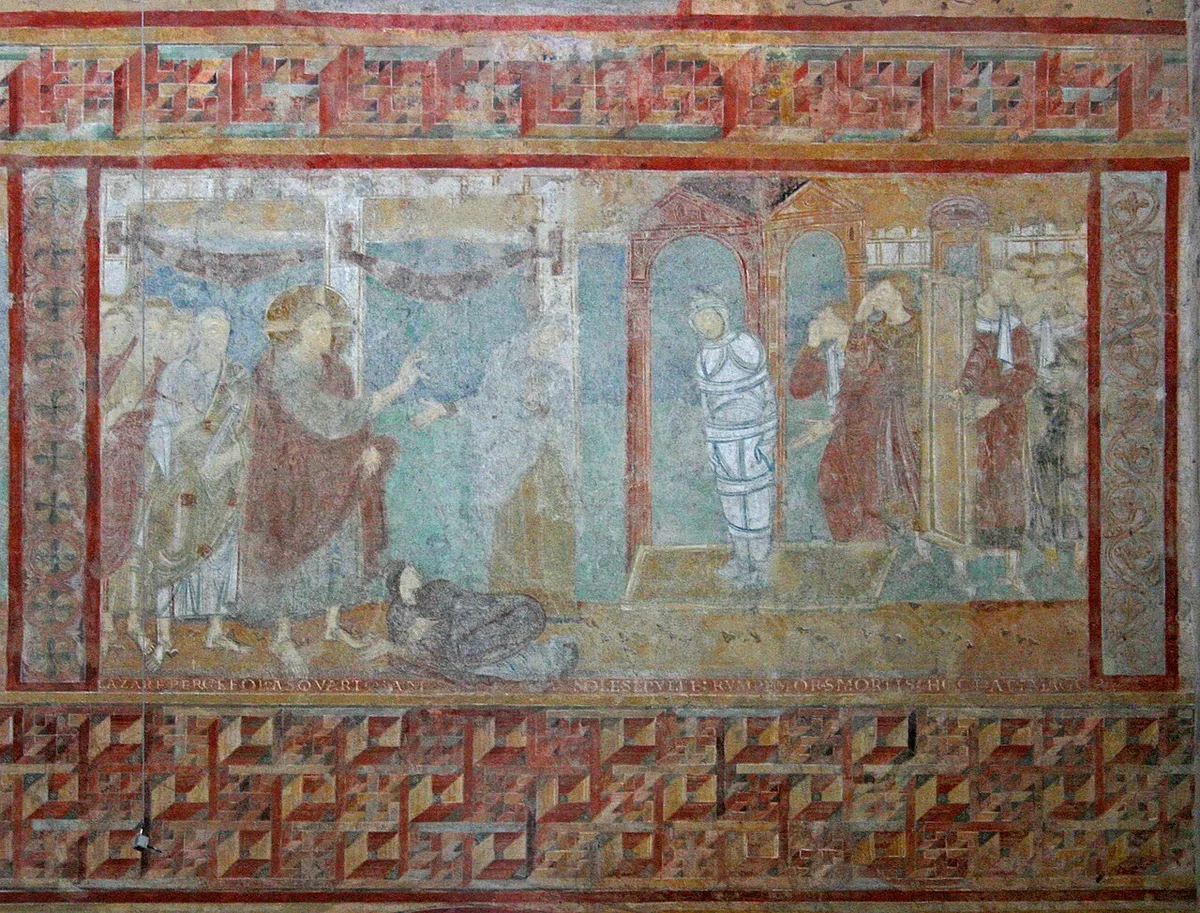
The paintings have a deliberate reading order that repays knowing in advance. Begin on the north wall, moving from west to east toward the altar, then continue on the south wall from east to west, finishing with the Last Judgement in the west apse. Each panel pairs a scene with a titulus, or title, and a meander frieze indicating the direction of reading.
The small museum near the church explains the arrangement, meaning and conservation history of the murals, and it is the practical way to decode what you are about to see. Opening hours are not fixed in the sources consulted here, so verify current arrangements locally before relying on it. If time is short, the trade-off is real: skipping the museum saves minutes but usually costs you the ability to read the paintings.
Visitor numbers and interior climate have historically been a conservation concern at St George's, and access restrictions such as replacing individual visits with guided tours have been documented in the past. Whether any such measure applies on the day of your visit is not something the available sources confirm, so check with the organiser rather than assuming either way. Treat limited entry as a conservation decision, not an arbitrary rule.
Niederzell: St Peter and Paul and the Apse Fresco
Niederzell is the quietest of the three stops and the site with the deepest founding story. Bishop Egino of Verona, who left Verona after local political resistance, was granted a small monastic cell at the edge of the island, and the Church of St Peter was consecrated there in 799. The present three-nave basilica was rebuilt on those foundations and completed in 1134.
The apse fresco of Christ in Majesty is one of the earliest surviving depictions of that theme north of the Alps, and it is the visual highlight of the church. A small museum a short walk away covers the building's history and the excavations that revealed earlier structures. As elsewhere on the island, confirm current opening arrangements before you go rather than assuming a fixed daily schedule.
Because Niederzell sits at the edge of the island, it can feel like a detour on a tight half day. The compensation is context: this is where the island's monastic story begins, and the site's remoteness reflects how Egino's hermitage was originally positioned. If you are cutting stops, cut this one knowing you are trading founding history for the wall paintings.
Free Grounds and Managed Interiors
One of the most useful distinctions on Reichenau is between spaces you can simply walk into and spaces that are managed and ticketed. The monastery garden at Mittelzell is freely accessible and can be visited without paying admission, which makes it a reliable low-cost stop regardless of how other plans shift. The surrounding fields, lanes and dam are similarly open.
Interiors are a different matter, and the treasury is described as a separate space holding the monastery's relics. Current entrance fees, whether a combined ticket covers several churches, and which interiors require payment are not confirmed by the sources consulted here, so do not budget from a fixed figure you find online. Verify fees and access conditions with the organiser before you travel.
The same caution applies to the small church museums in Oberzell and Niederzell. They are valuable for interpretation, but their opening hours and any charges should be checked locally rather than assumed. This is the practical trade-off of a Reichenau visit: the outdoor heritage is dependable, and the indoor experiences need verification.
Beyond the Churches: Fields, Vineyards and the Hochwart
Vegetable growing on the island began on a professional footing in the mid-nineteenth century, building on foundations laid by the monks. In 2024, 39 farms were reported to be growing around 70 different types of vegetables, including 2.1 million heads of lettuce. Those figures are a snapshot of that year rather than a current count, and the sector is changing as family farms give up growing.
Viticulture on the island is older still, with the first vines planted by Benedictine monks in 818. The mild lake climate, with Lake Constance acting as a large water reservoir, is what makes both the vegetables and the wine possible. Riding or walking between the fields is part of the experience rather than a way of getting somewhere.
The Hochwart, the island's high point, is the natural end to a circuit because it delivers the panorama that the flat fields withhold. From the Hochwarthaus the view sweeps across the Untersee, the vegetable fields and toward the Swiss side of the lake. Since the building's ceramics studio and any tea service are not guaranteed, treat the summit as a viewpoint first and a stop second.
A Suggested Half Day from Konstanz
The following sequence is a suggestion rather than a published itinerary, and it assumes you have confirmed current opening times before setting out. Start at Mittelzell with the minster and, if it is open, the treasury and the museum for context. Walk the free monastery garden while you are there, since it costs nothing and needs no booking.
Move next to Oberzell and St George's, ideally visiting the nearby museum before the church so the painting cycle makes sense. Follow the reading order through the nave and finish at the west apse. If time is already short, this is the stop to protect, because the murals are the island's single most distinctive sight.
Finish with Niederzell and the apse fresco, then climb to the Hochwart for the panorama if daylight and energy allow. If you have less time, drop Niederzell first and the Hochwart second, keeping Mittelzell and Oberzell as the core. Reichenau is one of several possible day trips from Konstanz, and pairing it with another lakeside stop rarely works well on a half day.
Travel between Konstanz and the island can be arranged by more than one mode, but exact connections, journey times and route numbers should be checked with the transport operator on the day. If you want the wider menu of options around the lake, compare what a Mainau Island visitor guide covers before committing your afternoon to a single destination.
Practical Checks Before You Go
Opening hours for the churches, the treasury and the small museums are not fixed in the sources consulted here, so confirm them with the organiser before you travel. The same applies to entrance fees and to whether any combined ticket exists across the sites. Plan around confirmed information rather than a schedule copied from an old page or a secondary listing.
Access arrangements can also shift for conservation reasons, particularly at St George's, where the interior climate has historically been monitored. If you are travelling specifically for the wall paintings, ask in advance whether individual visits are currently possible or whether another arrangement applies. That single question can save a wasted journey.
Finally, remember that Reichenau is quiet farmland and small villages rather than a resort strip, and that the island gets busy on fine weekends. Going early, or on a weekday, changes the experience more than any other single decision. If you are comparing indoor options in the base city, the Archäologisches Landesmuseum Konstanz visitor guide covers a museum stop that pairs well with a wet-weather day.
Plan Your Visit
Reichenau works best when you accept its scale and plan around three specific stops. The minster at Mittelzell gives you the monastery's centre and its treasury, St George's at Oberzell gives you the Ottonian paintings, and St Peter and Paul at Niederzell gives you the apse fresco and the founding story. Everything else on the island is landscape, which is precisely the point.
Treat the monastery garden as a dependable free stop and verify everything ticketed before you travel. Because hours, fees and seasonal access measures are not fixed here, a short check with the organiser is worth more than any assumption. The island's own visitor information and the municipality's pages are the right places to confirm the details closest to your date.
Frequently Asked Questions
How long do you need to visit Reichenau Island?
A half day is a reasonable suggestion for the three Romanesque churches, and it is a recommendation rather than an official visiting time. If you want to see Mittelzell, Oberzell and Niederzell with their nearby museums and still reach the Hochwart, you should plan on several hours of moving between villages. With less time, concentrate on Mittelzell and Oberzell, which carry the minster complex and the Ottonian wall paintings.
Which of the three Romanesque churches on Reichenau should you not miss?
St George's in Oberzell is the standout because its nave holds the most important surviving Ottonian wall painting cycle north of the Alps. The Minster of St Mary and Mark in Mittelzell is the historic centre of the monastery and the starting point for understanding the complex. St Peter and Paul in Niederzell is the quietest stop, but its apse fresco of Christ in Majesty is one of the earliest of its kind north of the Alps.
Can you visit Reichenau as a day trip from Konstanz?
Yes, Reichenau is well suited to a trip from Konstanz, and many visitors treat it as a half day rather than a full one. Exact transport connections, journey times and route details vary, so check current timetables with the relevant operator rather than relying on a fixed schedule from a secondary source. Keeping the island as your single destination makes for a calmer visit than combining it with another lakeside attraction.
Is the monastery garden on Reichenau free to enter?
The monastery garden beside the Minster of St Mary and Mark in Mittelzell is freely accessible and can be visited without paying admission. Other spaces, such as interiors and collections associated with the churches, may be managed separately, and current entrance arrangements are not fixed here. Confirm fees and access conditions with the organiser before you plan your time.
How do you read the Ottonian wall paintings in St George's Church?
The cycle has a deliberate reading order: start on the north wall moving from west to east toward the altar, then continue on the south wall from east to west, finishing with the Last Judgement in the west apse. Each panel carries a Latin title summarising the scene and a frieze marking the reading direction. Because the murals are faint, visiting the nearby museum first makes the sequence far easier to follow.
Where is the best viewpoint on Reichenau Island?
The Hochwart is the island's high point and the best viewpoint, with the Hochwarthaus standing about 40 metres above the surrounding land. From there the view reaches across the Untersee, the vegetable fields and toward the Swiss side of the lake. The building's ceramics studio and any refreshments are not guaranteed to be open, so plan the climb as a viewpoint visit.