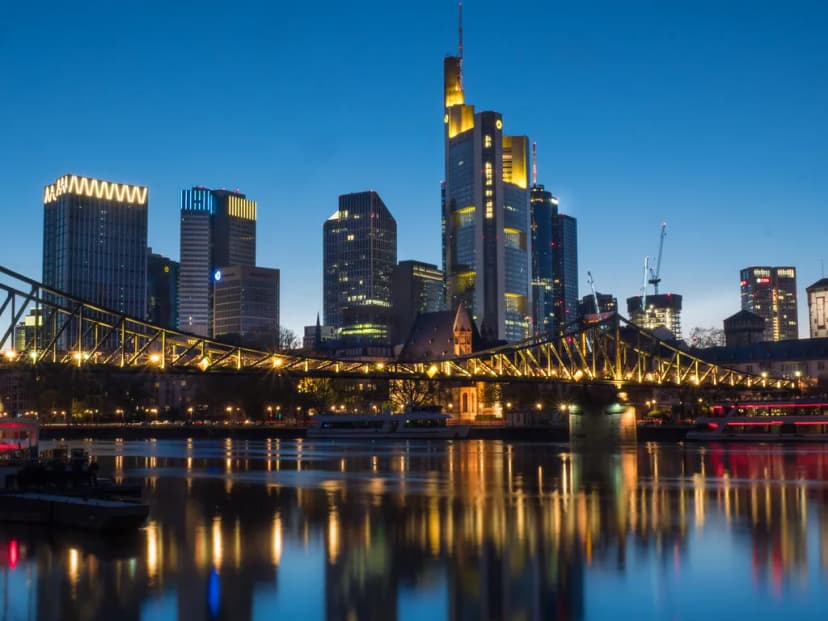
Frankfurt am Main stacks its banking quarter tightly between the Main riverbank, the old town and the trade fair grounds, which is why the whole district can be read on foot in a single loop rather than as a checklist of separate buildings. The nickname Mainhattan comes from exactly this pairing: the River Main on one side and a dense high-rise cluster on the other. This guide is an orientation exercise, so it explains what each tower is, which one lets the public up, and which viewpoints are simply street corners with a good angle.
One decision shapes the whole route: Main Tower is a roughly 200-metre-high structure with a public observation platform near the top, while Commerzbank Tower belongs to the same ensemble but is not presented as a viewing attraction. Booking platforms and operator pages change their conditions, so treat every price, opening time and closure as something to confirm on the day you plan to go. A labelled suggestion in this article is editorial guidance, not an official operator figure.
Why Frankfurt's Skyline Earns the Nickname Mainhattan
The name Mainhattan fuses the River Main with Manhattan, and the geography explains it better than any slogan. Banking institutions cluster in the streets just north of the river, so the towers read as a wall of glass when you look across the water from the southern bank. That riverside framing is the reason the skyline photograph so many visitors recognise is taken from the Main rather than from inside the district.
A 2019 view from Untermainbrücke towards the financial district shows exactly this composition, with the towers rising behind the street and the river in the foreground. The city's own visitor organisation presents Frankfurt as a place where historical timber-frame architecture and modern skyscrapers sit side by side, which is a useful frame for a walk here. You are not choosing between the old town and the financial district; they are neighbours, and the contrast is the point.
Read the city's official tourism pages before you travel to see which guided formats and neighbourhood suggestions are currently published. Commerzbank Tower and Main Tower both appear in the wider high-rise ensemble that defines the district's profile, and the ensemble is easier to appreciate once you know which addresses are offices and which are visitor venues.
What to See on a Financial District Walk
Treat the district as an ensemble rather than a list of individual addresses. Main Tower is formed by two interconnected glass towers, a circular one and a cuboid one, and it is the anchor most orientation routes are built around. Everything else in the cluster is best understood by how it sits relative to that one landmark and to the river.
Commerzbank Tower belongs to the same ensemble and is one of the addresses that defines the banking quarter's profile, but it is a working office building rather than a viewing attraction. The towers around it are part of the visual composition rather than visitor venues. Plan your street-level stops around facades, plazas and sightlines instead of interiors.
Skyscrapers here were designed to be looked at from outside, and the cladding changes character with the light, from flat grey in overcast weather to bright reflections in low sun. Walking the same street twice at different times of day is more rewarding than rushing between named buildings. If you want to photograph the towers rather than simply identify them, plan the loop around the light rather than around a fixed order of stops.
Main Tower: The Tower With a Public Viewing Platform
Main Tower's defining feature for visitors is its public observation platform near the top of the building, which distinguishes it from most other high-rises in the city. From up there the view covers the financial district itself, the historic old town, the Main River and the surrounding towers, and on clear days it stretches beyond the city limits. That combination of angles is why the platform is the one high-rise stop worth building a walk around.
Evening and sunset are the most requested times on the platform, which means the experience depends heavily on weather and on how many other people had the same idea. Rain, low cloud or haze can flatten the view entirely, so keep the stop flexible within your day rather than fixing it to a single hour. Because admission arrangements and accessibility rules can change, check the current ticket and opening information with the operator shortly before you go.
If you want the view without committing to a ticket, the same cluster can be read from the riverbank and from bridges, where the towers appear as a group rather than as individual buildings. Those vantage points are free and open, but they show the skyline from a distance, not the city from above. Decide in advance whether you want altitude or composition, because the two come from different places.
Commerzbank Tower: A Landmark, Not a Viewpoint
Commerzbank Tower is one of the most recognisable silhouettes in the district, and photographs of the cluster usually include it, but it is a working office building rather than a public attraction. There is no public viewing platform to plan around, and interior, lobby or rooftop visitor access is not something a casual visitor should expect. Admiring it from the street, from a bridge or from the riverbank is the realistic option.
Corporate buildings in financial districts occasionally open to the public during special events, art programmes or organised tours, and those arrangements are set by the companies themselves. Any such access is temporary and announced case by case, so it belongs in your planning only after you have seen it confirmed for a specific date. Do not build an itinerary around the assumption that an office tower will admit visitors.
Skyline Orientation: Reading the District Against the Main and the Old Town
The clearest way to orient yourself is to fix three reference points: the Main River to the south, the historic old town and cathedral to the east, and the dense high-rise cluster in between. Once you can place the river and the cathedral, you can tell which direction the banking quarter lies even with your back to it. That mental map matters more than memorising street names in a district of similar glass facades.
You do not need a specific bridge or tram stop to do this; walking the riverbank and crossing where a bridge presents itself keeps the orientation honest. Bridges give you the side-on view of the ensemble that explains why the towers look taller collectively than individually. Keep the river on one side of your loop and the old town on the other, and the district organises itself. If you would rather follow a fixed sequence of stops, our one-day city itinerary gives you a ready-made order to adapt.
Sequencing the Loop: High-Rises, Riverbank and Old Town Edges
A logical order is to start among the high-rises, work down to the Main, walk the bank until the old town edge appears, then finish inland. This puts the dense, shaded streets first and the open river light second, which suits both photography and tired legs. It also means the one paid viewpoint stop can be placed either at the start or the end depending on the weather forecast.
The Museumsufer stretches along the southern bank between the Friedensbrücke and the Eiserner Steg, with many museums clustered side by side in that corridor. That makes the riverbank a natural extension of the walk rather than a separate trip, especially if you want to end the day indoors. Check current exhibition programming and admissions through the Museumsufer listing before committing an afternoon to one collection.
If you are travelling with children and deciding between ticketed attractions rather than simply walking, the city operates several combined and discounted ticket products whose current scope and validity should be checked directly, since inclusions change. Families weighing a science-focused indoor stop against a skyline viewpoint can compare options on a dedicated family guide before committing. Keep the walk itself as the baseline and treat every interior as an optional add-on.
How Long to Allow, and What to Verify First
A suggested half-day, roughly three to four hours, is enough to walk the high-rise cluster, drop to the riverbank and edge into the old town without rushing; this is an editorial suggestion, not an official figure. Add time if you plan to go up Main Tower, because queues and weather delays are unpredictable. If you only want the skyline photograph, a much shorter walk along the river will do the job.
Before you set out, confirm the things that actually change: whether the observation platform is open, what the current ticket arrangement is, and whether any part of the district is affected by works or events. Opening hours, closures and admission rules are published by the operators and by the city, and only those sources should be trusted for your specific date. A generic guide, including this one, cannot guarantee conditions on the day.
Travel connections and accessibility provisions also deserve a direct check, because lift availability, security screening and entrance routing at high-rise buildings are controlled by the building rather than by any tourist board. Confirm details with the venue before relying on them. Treat any specific line or entrance mentioned elsewhere online as unverified until the operator confirms it.
Light, Weather and Timing Your Viewpoint Stop
Frankfurt's skyline photographs best in clear, crisp conditions, and a hazy or heavily overcast day will cost you the long-distance detail that makes a rooftop view worthwhile. Because the platform is exposed, wind and rain affect comfort as much as visibility. If your trip is short, build a backup indoor plan so a washed-out day does not waste a morning.
Season matters too: low winter sun can put the towers in silhouette, while summer evenings give long, warm light across the river. Note that some riverside and museum venues adjust their hours seasonally or close on particular days, so verify the specific venue you intend to enter. Free street-level viewing is always available regardless of opening hours, which makes it the safest fallback.
Extending the Walk: Museumsufer and Nearby Cultural Stops
If the walk leaves you wanting art rather than altitude, the Städel Museum holds more than 700 years of art under one roof, and its rooftop area offers a skyline view as an alternative to a tower ticket. The museum publishes its own opening hours and ticket categories, including a reduced-price Tuesday slot, so check its visitor page for the date you intend to go. The museum is a strong choice when the weather rules out an outdoor viewpoint.
Close by, the Liebieghaus sculpture collection occupies a villa on the same riverside strip and covers five thousand years of sculpture from ancient Egypt to Neoclassicism. Its own site states that it is closed for renovation and reopens on 18 November 2026 with the exhibition Athena, the Stage is Yours, so confirm the current status before crossing the river for it. Combining a sculpture collection with a financial district walk gives you the city's two contrasting faces in one day.
Away from the river, the Botanical Garden belongs to the Palmengarten and publishes a seasonal opening pattern, with free public guided walks listed in its programme. That makes it a good add-on for a second day rather than part of the banking quarter loop. Check the garden's own visitor information for the current season before travelling out to it.
Plan Your Walk
The financial district walk works best as an orientation exercise: identify the ensemble, learn where the river and the old town sit relative to it, and treat Main Tower as the single high-rise stop with a public viewing platform. Commerzbank Tower and its neighbours shape the skyline but are not visitor venues, so admire them from outside and from the bridges. For wider planning, see Frankfurt am Main city travel guides.
Before travelling, confirm current opening arrangements, ticket conditions and any building works directly with the operators and the city, since these are the details most likely to change between planning and arrival. Keep the free street-level route as your guaranteed plan and let any paid viewpoint be a bonus. That way a closed platform or a grey afternoon costs you an hour, not your whole trip.
Frequently Asked Questions
Does Commerzbank Tower have a public observation deck?
Commerzbank Tower is a working office building and is not a public viewing attraction. There is no public observation platform to plan around, and interior, lobby or rooftop visitor access should not be assumed. View it from the street, from the riverbank or from a bridge, where it reads as part of the skyline ensemble rather than as a destination you enter.
Which Frankfurt skyscraper has a publicly accessible rooftop platform?
Main Tower is the tower in the financial district known for a public observation platform near the top of the building. From there you can see the high-rise cluster, the old town, the Main River and the surrounding region on clear days. Because access arrangements and opening conditions change, confirm the current situation with the operator shortly before your visit rather than relying on older descriptions.
How long should a Frankfurt financial district walk take?
Allow roughly three to four hours for a relaxed loop covering the high-rise cluster, the riverbank and the edge of the old town; this is an editorial suggestion, not an official figure. Add extra time if you intend to visit the observation platform, since queues and weather can delay the stop. If you only want a skyline view from the water, a much shorter route along the Main suffices.
Why is Frankfurt's skyline called Mainhattan?
The nickname blends Main, the river that runs through the city, with Manhattan, referencing the concentration of high-rise banking towers in the district just north of the water. The comparison is about visual density and the riverside setting rather than about size. Photographs that show the towers rising behind the Main are the clearest illustration of why the name stuck.
Do I need a ticket to walk through Frankfurt's financial district?
Walking the streets, riverbank and bridges of the financial district is free, and that is what most of this route covers. Paid access applies only to specific interior experiences such as an observation platform, which has its own conditions set by the operator. Check current arrangements directly if you intend to include one of those stops.